1796’s Toi et Moi Ring: Meaning, History, and Stones First Design
“Toi et Moi” translates to “you and me,” and the ring earns that name honestly: two stones set together represent two people joining their lives in one piece of jewelry. It has stood in for the traditional solitaire since at least the 18th century, and today it shows up as often at anniversaries and push presents as it does at proposals.
TL;DR:
- Matching stones of similar visual weight and intentional shape pairings create a balanced and dynamic look that emphasizes the couple’s connection.
- The original Napoléon ring from 1796 demonstrates the long history of documented, symbolic two-stone jewelry symbolic of love and partnership.
- Contemporary rings often feature contrasting stones, personalized colors, and mixed cuts to reflect individual stories rather than traditional uniformity.
- Durability depends heavily on stone hardness; diamonds and sapphires are most suitable for everyday wear in protective settings like bezels or bypass mounts.
- The style serves not only for engagement but also as anniversary tokens, milestone gifts, or family and friendship rings, emphasizing its flexible personal significance.
Table of Contents
- What Is a Toi et Moi Ring? Defining Features and Common Variations
- History and Notable Examples: From Napoléon’s Ring to Modern Revivals
- What the Ring Symbolizes: Common Readings and Myth-Busting
- Design Choices: How to Choose the Two Stones and Setting
- Durability, Wearability, and Care: Practical Tips for Everyday Wear
- How a Trusted Maker Designs a Toi et Moi Ring
- Cultural Variations and Interpretations of Toi et Moi Rings
- Occasions Beyond Engagements: When Else People Choose Toi et Moi Rings
- Toi et Moi vs. Other Two-Stone Styles: How the Meaning Changes
- Why Two Stones Still Say More Than One
- Ready to Design Your Own Toi et Moi Ring?
- Sources
- FAQ
What Is a Toi et Moi Ring? Defining Features and Common Variations
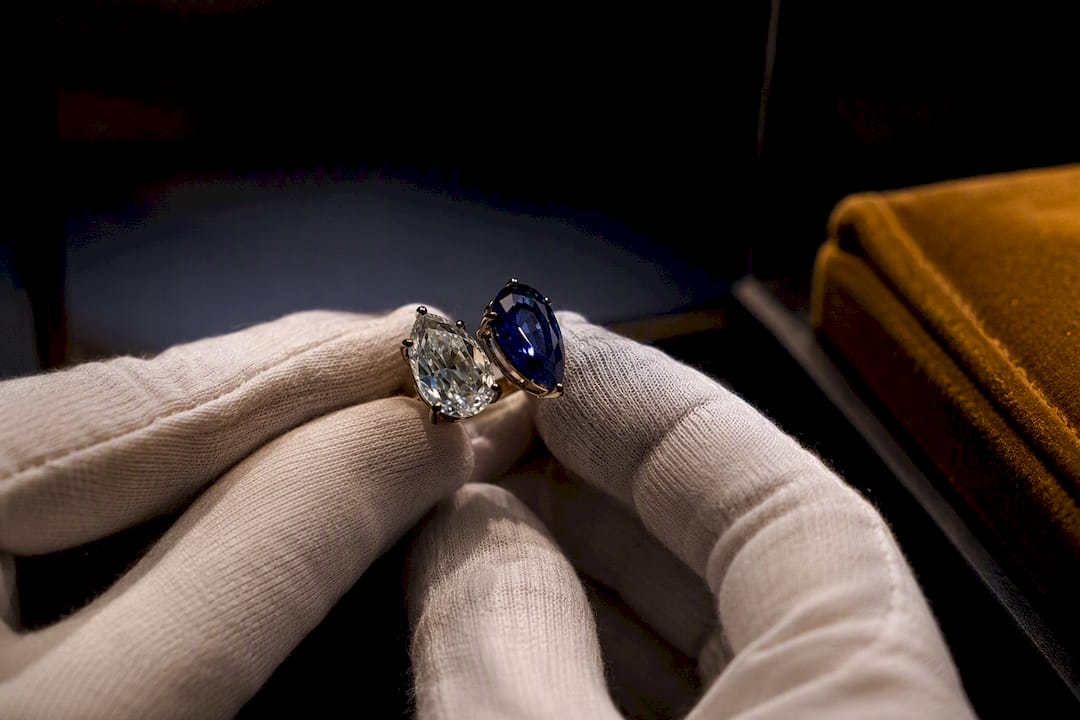
A Toi et Moi ring is built around two principal stones, set side by side or in a bypass band that lets each gem angle toward the other. That crossover geometry is what separates it from a simple two-stone cluster. The stones lean into each other rather than sitting in a flat row, which is part of why the style reads as a couple rather than a coincidence.
Within that basic structure, a few common variations show up again and again:
- Matching stones, usually two diamonds of similar size and cut, for a classic, unified look.
- Contrasting stones, pairing a diamond with a sapphire or other colored gem, which is where most of the personal storytelling happens.
- Touching vs. separated mounts, where the stones either meet at a point or sit with visible metal between them.
- Mixed cuts, such as a pear next to a round, or an emerald cut beside an oval, which creates visual movement across the hand.
Proportion matters more than people expect. Two stones of wildly different size can look unbalanced, while two stones of similar visual weight, even in different shapes, tend to read as a matched pair.
History and Notable Examples: From Napoléon’s Ring to Modern Revivals
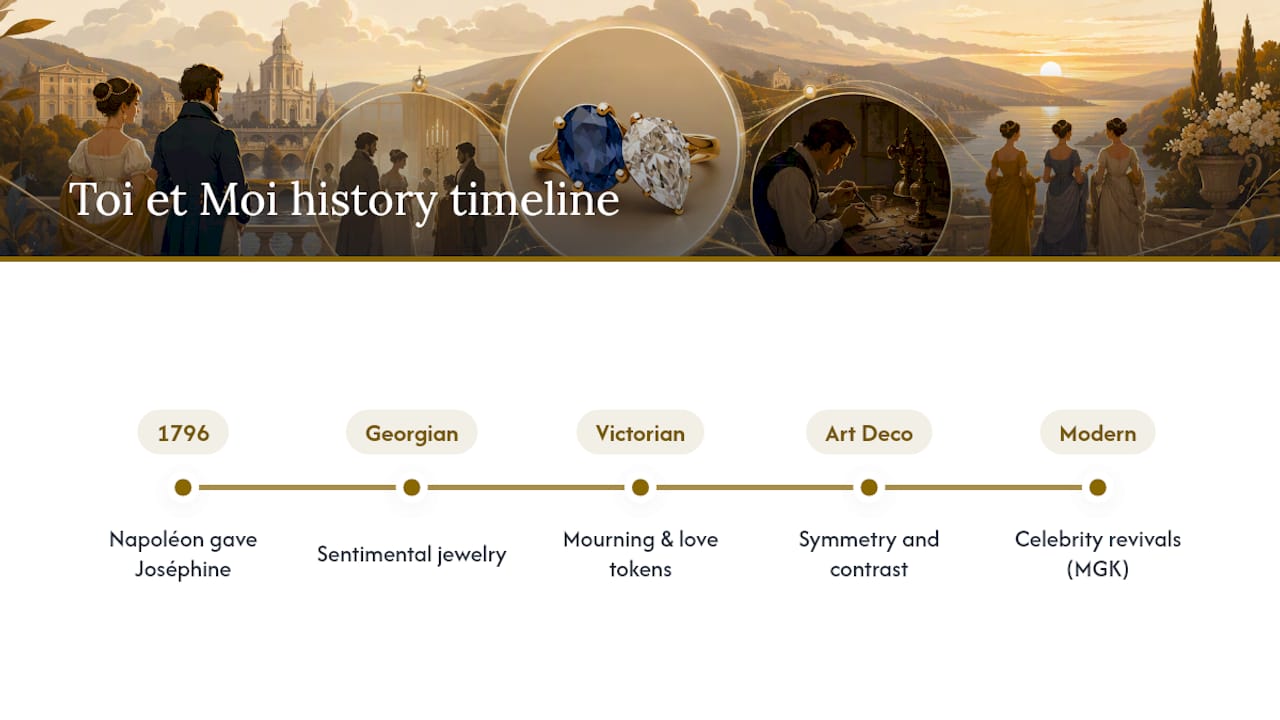
The most famous early Toi et Moi ring is not a legend. It is a documented gift: in 1796, Napoléon Bonaparte gave Joséphine a ring featuring a pear-shaped diamond paired with a pear-shaped sapphire, and its provenance is recorded through auction house archives at Sotheby’s. That kind of cataloging matters. It is the difference between a romantic rumor and a verified piece of jewelry history, complete with the kind of documentation collectors and historians can actually check.
The two-stone motif didn’t stay frozen in the 1790s. It moved through Georgian sentimental jewelry, resurfaced in Victorian mourning and love tokens, and got a sharper, more geometric treatment during the Art Deco period, when symmetry and contrast were already fashionable design language.
The modern revival is largely a celebrity story. Fashion coverage has tracked a wave of high-profile engagements built around Toi et Moi settings, with jewelers increasingly experimenting with mixed cuts and colors to make each ring feel specific to the couple wearing it, a trend British Vogue has covered in detail. One widely referenced example is Machine Gun Kelly’s proposal ring for Megan Fox, which used contrasting stones as a deliberate personalization choice rather than a matched set. The ring’s 18th-century pedigree is exactly why it feels substantial now instead of trendy for trendiness’s sake.
What the Ring Symbolizes: Common Readings and Myth-Busting
The core reading never really changes: two stones, two people, one band holding them together. That is the meaning most buyers walk in wanting, and it is the meaning the ring has carried since Napoléon’s era.
Beyond that baseline, couples layer in more personal interpretations:
- One stone represents each partner’s individuality within the shared piece.
- The pairing can symbolize past and future, or two families joining.
- Birthstone combinations turn the ring into a literal, wearable timeline of the relationship.
- Contrasting cuts can represent complementary personalities rather than sameness.
Pro Tip: If you want the ring to tell a specific story, pick stones that mean something individually first, then worry about whether they match. A sapphire for a birth month and a diamond for durability says more than two identical stones ever could.
One thing worth clearing up: there is no evidence that choosing a Toi et Moi over a solitaire has any bearing on how a relationship turns out. Superstitions about “unlucky” two-stone rings are just folklore. The Natural Diamonds guide to the style treats the contrasting-stone approach as a modern personalization tool, not a risk. Meaning here is assigned by the couple, not by the ring itself.
Design Choices: How to Choose the Two Stones and Setting
Choosing stones for a Toi et Moi ring is less about finding a perfect twin and more about building a composition that reads as intentional. A few priorities, in order:
- Start with proportion, not matching. Two stones of similar visual weight, even in different shapes, look more deliberate than two stones that merely share a color.
- Pick a shape pairing that has natural flow. A pear diamond next to a round, an emerald cut next to a cushion, or a marquise beside an oval all create a sense of motion instead of competition.
- Decide what each stone needs to do. A diamond earns its place through durability and everyday sparkle. A sapphire or ruby earns its place through color and personal meaning, since gemstones can carry symbolism a diamond simply can’t.
- Choose the setting to protect the pairing, not just show it off.
On that last point, a few practical options matter:
- Bypass settings let both stones angle toward each other while each sits in its own protective mount.
- Shared prongs at the center point save metal but put more pressure on that junction, so they need careful craftsmanship.
- Bezel settings wrap a stone in metal, which is the safer call for a softer gemstone worn daily.
- Two-tone metal can visually separate the stones even when they’re similar in color, echoing the two-tone engagement ring trend that’s picked up steam recently.
If you’re weighing a diamond against a colored stone, it helps to look at how two gems actually compare side by side, including things like hardness and how each holds up over decades of wear.
Durability, Wearability, and Care: Practical Tips for Everyday Wear
A Toi et Moi ring can absolutely handle daily wear, but the details decide whether it holds up. Stone hardness matters: diamonds and sapphires sit high on the Mohs scale and tolerate daily knocks far better than softer gems like opal or emerald.
- Clean the ring gently with mild soap and a soft brush rather than harsh ultrasonic cycles if a softer stone is involved.
- Have a jeweler check prongs and the bypass junction every six months, since that’s where two-stone settings see the most stress.
- Insure the ring, especially if it pairs a diamond with a rarer colored stone.
- If one stone is notably softer, consider a bezel setting or save the ring for occasional wear instead of daily use.
Pro Tip: If you love the two-stone look but worry about softer gems taking a hit, put the durable stone (diamond or sapphire) on the outside where it takes the impact, and let the more delicate stone sit protected on the inside of the bypass.
How a Trusted Maker Designs a Toi et Moi Ring
The strongest Toi et Moi rings start with the stones, not the mount. Choosing both gems first and building the setting around their exact proportions produces far better visual balance than forcing two stones into a generic template designed for one center stone. It’s a detail easy to overlook and hard to fix later.
At Usajewels, that stones-first philosophy runs through every custom commission. Because we manufacture in-house, we can adjust prong height, bypass angle, and metal weight around the specific pair of stones you’ve chosen, rather than working from a fixed mold. Our design-your-own process typically moves through stone selection, a wax or digital mock-up for approval, and a final fit check before the ring ships. Every stone we set is ethically sourced, and our lifetime diamond upgrade program means the ring can grow with your story long after the original commission.
Cultural Variations and Interpretations of Toi et Moi Rings
The two-stone motif doesn’t belong to one culture, and its meaning shifts depending on where you look. In French tradition, the “you and me” reading stays literal and romantic, tied directly to the language itself. In some Eastern European jewelry traditions, twin-stone rings have historically marked betrothal rather than marriage itself, a subtle but real distinction from Western engagement customs.
South Asian jewelry has its own long history of paired-gem pieces, though there the stones often carry astrological or protective meaning tied to specific birth charts rather than a purely romantic “two people” reading. Contemporary Western buyers tend to blend these traditions freely, choosing a sapphire for a birth month and a diamond for permanence without necessarily knowing the stone’s older symbolic baggage, and that’s fine. Part of what keeps the Toi et Moi relevant is that it absorbs whatever meaning a couple brings to it rather than demanding they follow one script.
Religious and regional customs sometimes dictate which hand or finger carries symbolic weight, so couples blending traditions may want to confirm local convention before assuming the ring goes on the standard left ring finger. The style flexes to fit the wearer, which is a big part of why it has survived more than two centuries of shifting jewelry trends without losing its core identity.
Occasions Beyond Engagements: When Else People Choose Toi et Moi Rings
Engagements get most of the attention, but the Toi et Moi has always worked for other milestones too. Anniversary gifts are a natural fit, since the two-stone format can mark a specific year: one stone for when the relationship began, a second added later to mark how far it’s come.
Push presents, the gift many partners give after the birth of a child, frequently lean on the same two-stone symbolism, with each gem representing a parent or, in some cases, a parent and child. Friendship and family rings borrow the format too, particularly among sisters or best friends marking a long relationship that isn’t romantic at all. Some buyers choose a Toi et Moi as a self-gift after a major life change, pairing a birthstone with a stone tied to a specific turning point.
The format’s flexibility is really the point. Because the meaning comes from the wearer’s story rather than a fixed tradition, a Toi et Moi ring can mark almost any relationship worth commemorating with two connected stones. If you’re shopping for a milestone gift and want it to feel specific rather than generic, general guidance on choosing meaningful milestone gifts can help frame what makes a gift land emotionally, whether or not you land on this particular style.
Toi et Moi vs. Other Two-Stone Styles: How the Meaning Changes
Not every ring with two stones is a Toi et Moi, and the distinctions matter for anyone trying to nail down the right symbolism. A three-stone ring, often called past-present-future, uses a trio instead of a pair, and its meaning is built around a timeline rather than a partnership. It’s a fundamentally different story: three chapters instead of two people.
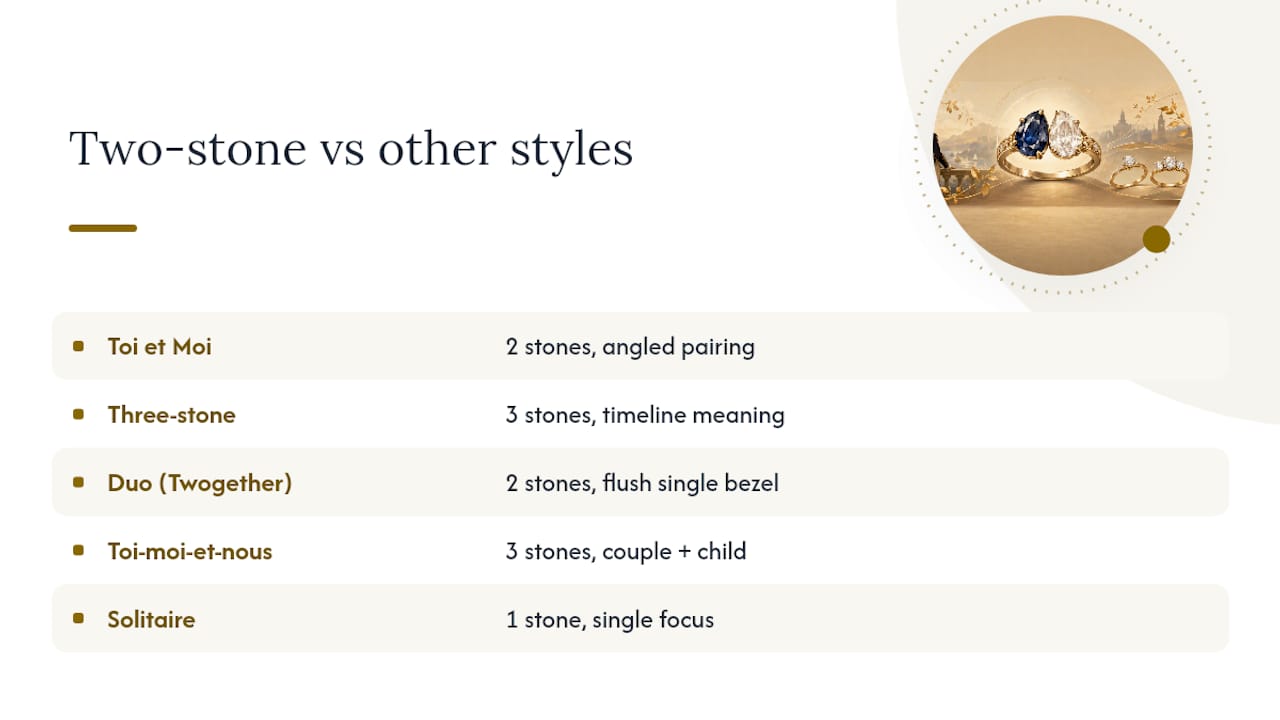
A duo or “twogether” ring is sometimes used interchangeably with Toi et Moi, but some jewelers reserve that term for stones set flush in a single shared bezel rather than the bypass or crossover structure that defines a true Toi et Moi. The visual difference is subtle but real: bypass rings let the stones angle toward each other, while flush-set duo rings keep them level and static.
A toi-moi-et-nous variation adds a small center stone between the two principals, explicitly symbolizing a couple plus a child. It’s a direct extension of the same “you and me” logic, just with a third party written into the design.
Compared to a classic solitaire, the meaning shift is the whole point. A solitaire says one commitment, one focus. A Toi et Moi says partnership, two individuals choosing to sit side by side rather than one stone standing alone. Neither is more romantic than the other. They’re just telling different stories, and picking between them really comes down to which story fits the couple.
Why Two Stones Still Say More Than One
The solitaire will always have its place, but there’s something the Toi et Moi does that a single stone simply can’t: it lets you tell a specific, two-person story at a glance. Anyone can look at it and read the shape of a relationship, not just its price tag.
That’s the real reason this style has outlasted two centuries of jewelry trends. Personalization beats symmetry. If you’re choosing stones for your own ring, resist the urge to match them just because it looks tidy. Pick the pairing that actually reflects your story, birthstones, contrasting cuts, mismatched colors and all, even if it isn’t the most conventional combination on the counter.
— Joseph
Ready to Design Your Own Toi et Moi Ring?
If the two-stone story speaks to you, the next step is choosing stones that actually reflect your relationship rather than a generic template. Usajewels builds every custom piece in-house, starting with your stones and designing the mount around them for the kind of fit and balance a stones-first approach makes possible. Browse our engagement ring collection to see current settings, or start from scratch with our design-your-own guide and work with our family team to build a Toi et Moi ring around the stones and story that are actually yours. With ethical sourcing and a lifetime diamond upgrade program built into every commission, it’s a piece meant to grow with you, not just mark one moment.
Sources
This article draws on Sotheby’s history of the Toi et Moi ring, Natural Diamonds’ style guide, British Vogue’s trend coverage, and Aquamarise’s design guide.
- Two stones symbolizing love since 1796: the Toi et Moi ring | Sotheby’s
- Toi et Moi ring | Natural Diamonds
- Toi et Moi ring trend | British Vogue
FAQ
What Are the Four Rings a Woman Should Receive?
There’s no official rule, but a popular tradition names four milestone rings: an engagement ring, a wedding band, an eternity ring for an anniversary, and a “right hand” or self-purchased ring marking personal achievement. A Toi et Moi ring often stands in for the engagement ring in this sequence, or serves as the eternity ring later on.
What Finger Should a Toi et Moi Ring Be Worn On?
In most Western traditions, a Toi et Moi engagement ring goes on the left ring finger, the same as a solitaire. Couples blending other cultural customs should check local convention, since some traditions assign symbolic meaning to a different hand or finger.
What Celebrity Has a Toi et Moi Ring?
Machine Gun Kelly’s proposal ring for Megan Fox is one of the most widely referenced modern examples, using contrasting stones as a personalization choice rather than a matched pair. The style has also appeared in several other high-profile engagements covered in recent fashion press.
Is Toi et Moi a Good Engagement Ring?
Yes, for couples who want the ring to tell a specific story rather than follow the standard solitaire format. Durability depends on the stones chosen and the setting’s security, so pairing hardier gems like diamond or sapphire with a protective bypass or bezel setting keeps it practical for daily wear.
Recommended
- Mother’s Ring Design: What It Means and How to Choose
- Why Two-Tone Engagement Rings Are So Popular
- Pick Ring Setting Style Guide for Every Buyer
- Promise Ring vs Engagement Ring: What’s the Real Difference?

Deep Mehta is the Co-Owner of USA Jewels, a family-owned jewelry business she has led since 2013 in Deerfield Beach, Florida. With over 13 years of hands-on experience in fine jewelry retail, manufacturing, and diamond importing, Deep specializes in engagement rings, wedding bands, and custom jewelry design. She also co-manages Kaash Group Talent Acquisition. Deep is a University of Florida graduate and oversees every aspect of USA Jewels’ operations, from product development to marketing.
Fine Jewelry Collection

You May Also Like
40–42 kHz Ultrasonic Jewelry Cleaners Jewelry Owners Can Trust
Pendant Bail Size: 6–8mm, 8–11mm, or 15mm+ for Buyers & DIYers