Buyers: Verify a GIA Laser Inscription in Two Minutes with a 10x Loupe
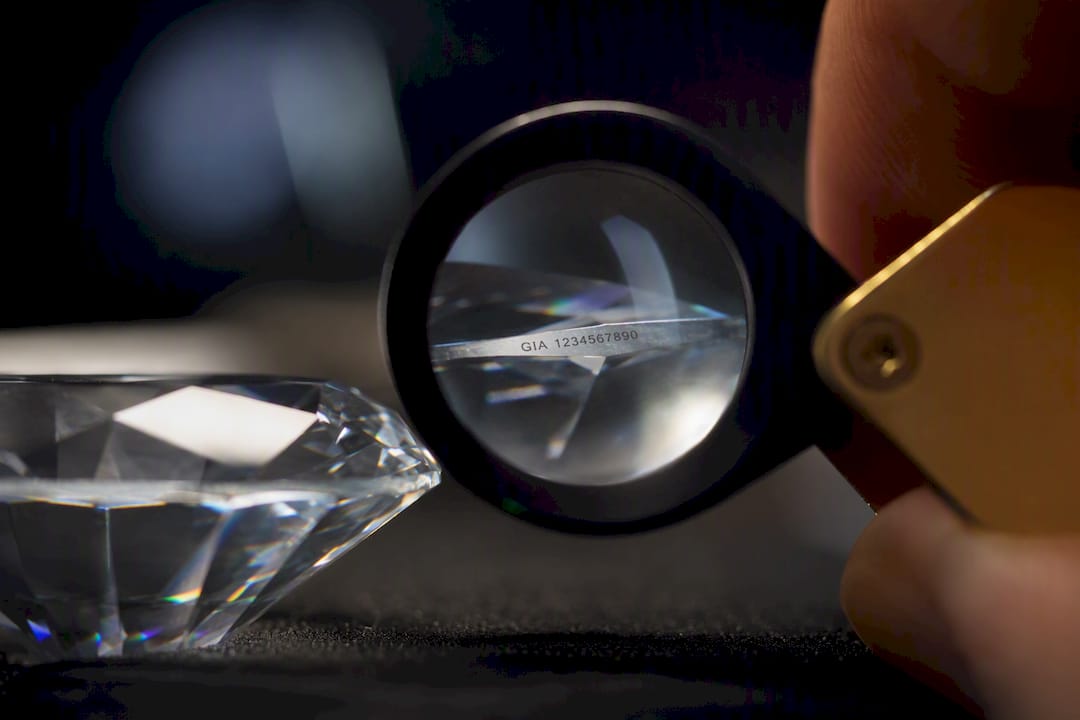
A GIA laser inscription is a microscopic ID etched into a diamond’s girdle that permanently links that exact stone to its GIA grading report. It exists for one reason: verification. Anyone can read the inscription under magnification, then confirm the report number is real through GIA Report Check or match it digitally with GIA Match iD™. Below, we walk through exactly how to read one, when it’s included automatically, and what to do if you can’t find it.
TL;DR:
- Most GIA diamonds under 1 carat automatically include a laser inscription that displays the report number and is invisible to the naked eye.
- Read the inscription under 10x magnification by cleaning the stone and slowly rotating it to confirm the report number before purchase or repair.
- Inscriptions are optional on larger stones and must be requested separately if not included in the initial report, with fees and turnaround times varying by service.
- A laser inscription primarily aids verification, insurance claims, and resale by confirming the stone matches its official report, not by increasing its value.
- External markings or inscriptions by other labs or jewelers are common, but only GIA laser inscriptions tied to their database serve as reliable proof of authenticity.
Table of Contents
- What Is a GIA Laser Inscription and Where Does It Appear?
- How to Check and Read a GIA Laser Inscription
- When Inscriptions Are Automatic and How to Request One
- Why Laser Inscriptions Matter for Verification, Insurance, and Resale
- Limitations and How to Avoid Fraud or Mismatches
- A Practical Checklist for Buyers and Owners
- How to Verify the Inscription Against GIA Report Check
- GIA Laser Inscriptions vs. Other Diamond Markings
- Does a Laser Inscription Affect Diamond Value or Resale?
- Caring for a Laser-Inscribed Diamond
- How Usa Jewels Approaches Inscriptions in Practice
- Sources
- FAQ
What Is a GIA Laser Inscription and Where Does It Appear?
The inscription lives on the girdle, the thin band running around the widest part of the diamond where the crown meets the pavilion. GIA etches it with a laser at a scale so fine that it’s invisible to the naked eye. You need magnification to see it at all, and that’s by design: the mark shouldn’t interfere with the stone’s face-up appearance or its grade in any way.
Most people encounter this feature for the first time on a smaller stone, because GIA automatically includes the laser inscription on every Diamond Dossier® report, which is typically issued for diamonds under 1 carat. For larger stones graded on a standard Diamond Grading Report, inscription is optional and has to be requested separately.
A few things worth knowing about how the mark actually works:
- It’s readable under magnification typical of a standard jeweler’s loupe.
- It usually shows the GIA report number, though a personal message or logo can sometimes be added alongside it.
- It does not touch or alter the facets, so it has zero effect on cut, clarity, color, or carat weight.
- It sits on the girdle specifically because that surface is typically left unpolished or only lightly finished, making it the most practical spot for a permanent mark.
How to Check and Read a GIA Laser Inscription
Reading the inscription yourself takes about two minutes once you know where to look, and it’s one habit every diamond owner should build. You don’t need a lab. You need patience and the right light.
Here’s the routine:
- Clean the stone first. Oil, lotion, or dust on the girdle will hide the inscription faster than anything else.
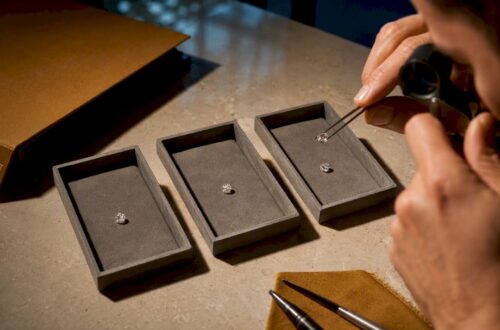
- Position the diamond under a 10x loupe or gem microscope, angling light so it grazes across the girdle rather than shining straight through it.
- Rotate slowly. The inscription can sit anywhere around the girdle’s circumference, so you’re scanning, not staring at one spot.
- Record the number once you spot it, then punch it into GIA Report Check to confirm it matches an active GIA record.
If the stone is mounted, a jeweler’s inscription viewer or a stable gem holder under a bench microscope makes the job far easier than trying to hand-hold a loupe over a ring. For loose diamonds, GIA Match iD™ can scan the inscription with the companion GIA App and digitally compare it against GIA’s database in seconds, which is faster than a manual lookup, but works only on the report types GIA has enabled for digital matching.
Pro Tip: Photograph the inscription the moment you find it. If a jeweler ever needs to confirm the same stone came back after resizing or repair, that photo is your baseline.
When Inscriptions Are Automatic and How to Request One
Whether your diamond already carries an inscription depends entirely on which report it holds. Diamond Dossier® reports come with the inscription built in as a standard feature. Standard Diamond Grading Reports do not, unless you ask.
Here’s how the request process actually works:
- Ask for inscription at the time of submission if you’re sending a diamond to GIA for grading. It’s added to the process rather than tacked on afterward.
- If the diamond already has a report without an inscription, GIA offers it as a follow-up service you can request separately.
- Service availability can carry weight or size cutoffs. GIA’s submission guidelines note thresholds for certain services, so check the current requirements for your stone’s carat weight before assuming inscription is available.
- Turnaround and fees vary by service tier and current submission volume, so confirm both directly with GIA rather than relying on a flat number from a third party.
Why Laser Inscriptions Matter for Verification, Insurance, and Resale
The inscription’s real job is proving your diamond is the diamond described on the report in front of you. That sounds simple, but it solves a surprising number of practical problems.
- Verification: the inscription is the fastest way to confirm a loose stone matches its paperwork before you buy it.
- Insurance: adjusters increasingly ask for the report number on file, and an inscribed stone lets you prove ownership of the exact diamond named in your policy.
- Resale: buyers and appraisers trust a listing more when the inscription checks out, which can shorten negotiation and reduce lowball offers based on authenticity doubt.
- Service and repairs: when a ring goes out for resizing or a prong repair, the inscription confirms the same stone comes back, not a substitute.
An inscribed diamond doesn’t automatically sell for more, but it removes friction from every transaction that depends on trust. That’s the value: fewer questions, faster closings, less risk of dispute.
Limitations and How to Avoid Fraud or Mismatches
No verification method is airtight, and laser inscriptions have real limits worth knowing before you rely on one.
- Older reports and some report types skip inscriptions entirely. A diamond graded before inscription was standard, or one on a report type where it was never requested, simply won’t have one.
- Mounted stones are harder to read. Prongs and settings can block the exact spot where the inscription sits, and dirt buildup around a mounting makes it worse.
- Faded or shallow inscriptions on older stones can be tough to read even under good magnification.
- Fraud typically happens through stone swapping or counterfeit paperwork, not through faking the laser mark itself, which is extremely difficult to replicate convincingly.
Digital matching through GIA Match iD™ speeds up verification for loose stones, but it doesn’t replace a physical inspection when a diamond is mounted or the inscription has degraded. Treat the inscription as one layer of proof, not the only one. Combine it with a GIA Report Check lookup, seller documentation, and your own photographic record, and you’ve built a verification trail that’s genuinely hard to fake.
A Practical Checklist for Buyers and Owners
Before you hand over money or hand over jewelry for service, run through this short list:
- Ask to see the inscription alongside the GIA report, whether the stone is loose or mounted.
- Run the report number through GIA Report Check before finalizing any purchase.
- Request photographic documentation from the jeweler at intake and again at handover if the piece is going in for repair or resizing.
- Record the GIA report number in your insurance file and on your receipt, not just in a drawer somewhere.
- Buying online? Ask the seller for close-up, well-lit photos of the girdle inscription and confirm they’ll stand behind a report-number match before you commit.
None of these steps take more than a few minutes, and together they close most of the gaps a laser inscription alone can’t cover.
How to Verify the Inscription Against GIA Report Check
Once you’ve read the number off the girdle, GIA Report Check is where you confirm it’s legitimate. Go to GIA’s report check page and enter the report number exactly as it appears on the stone and on the paperwork. GIA’s system pulls up the matching record, showing the shape, carat weight, color, and clarity GIA originally assigned to that stone.
Compare every field against what’s in front of you. If the report claims a 1.20 carat round brilliant and the ring in your hand is clearly a cushion cut, that’s a mismatch worth walking away from. Small discrepancies in carat weight can happen due to rounding conventions, but shape, cut style, and grade categories should line up cleanly.
Report Check confirms the report is real and describes a genuine GIA-graded stone somewhere. It does not, by itself, confirm the stone in your hand is that exact diamond. That’s what the physical inscription does. The two checks work together: the inscription tells you which report to look up, and Report Check confirms that report actually exists in GIA’s system and hasn’t been altered.
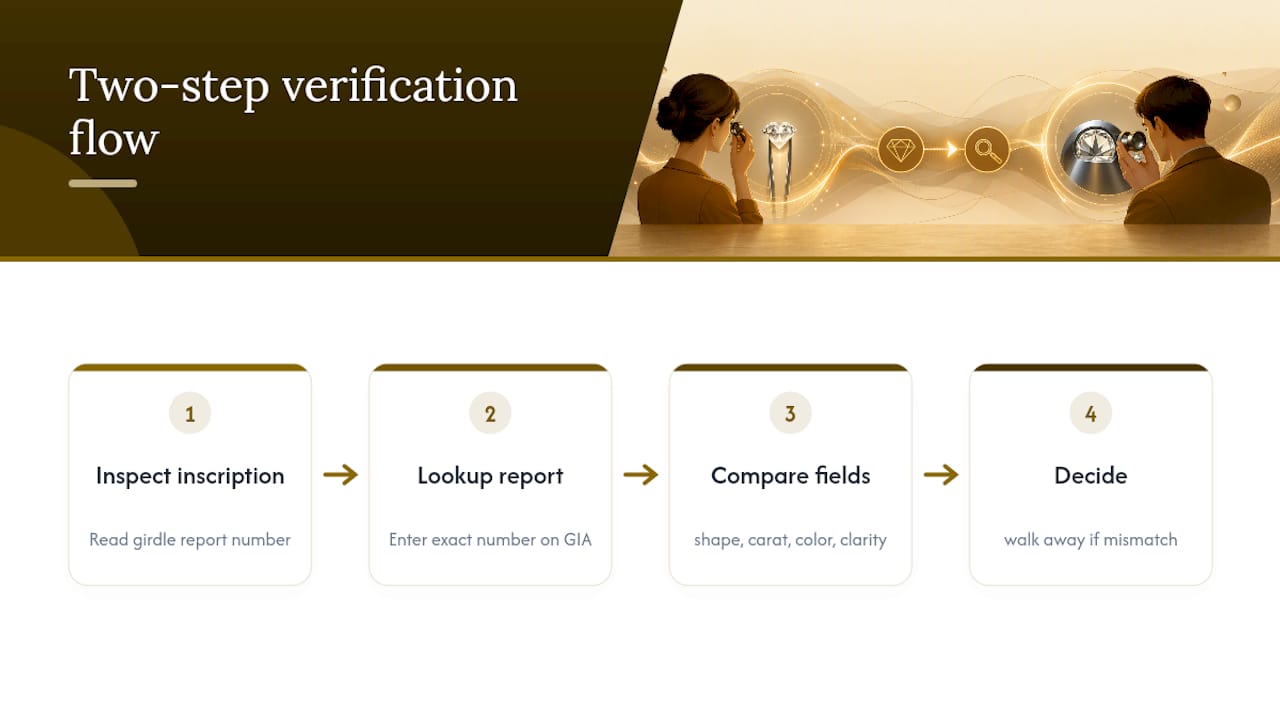
Run this check before wiring money for an online purchase, and ask any private seller to walk through it with you in real time rather than just sending a screenshot, since screenshots can be edited.
GIA Laser Inscriptions vs. Other Diamond Markings
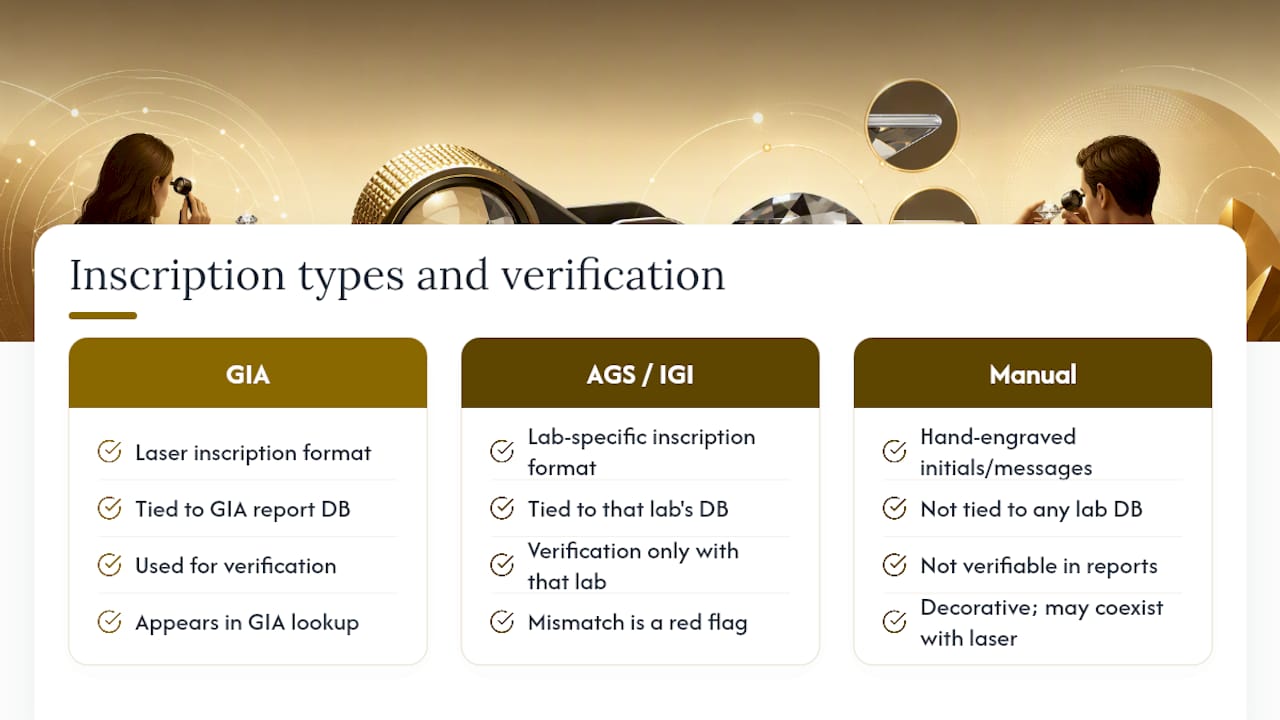
Not every mark on a diamond’s girdle came from GIA, and the differences matter more than most buyers realize. Other gem labs, including AGS and IGI, offer their own inscription services tied to their own report numbers. A stone inscribed by a different lab will carry that lab’s format and prefix, not GIA’s, so if you’re holding a GIA report but the girdle shows a different lab’s inscription style, that’s an immediate red flag worth investigating before you buy. Our comparison of GIA, AGS, and IGI reporting breaks down how these labs differ in grading standards, which matters just as much as the inscription itself.
Manual engravings are a separate category entirely. Jewelers sometimes hand-engrave initials, dates, or a private message on a band or even on a diamond’s girdle using mechanical tools rather than lasers. These are decorative and personal, not verification marks, and they carry no connection to any grading lab’s database. A manual engraving can coexist with a GIA laser inscription on the same stone, but it will never show up in a GIA Report Check lookup because it was never part of GIA’s system.
The practical takeaway: when you’re verifying a stone, you need to know which inscription you’re looking at. A GIA report number checks out against GIA’s database. A personal engraving or a competing lab’s mark does not, and treating one as proof of the other is how mismatches slip through unnoticed.
Does a Laser Inscription Affect Diamond Value or Resale?
An inscription doesn’t add carats, improve cut, or upgrade clarity, so it has no direct effect on the four Cs that drive a diamond’s baseline price. What it does affect is how quickly and confidently a buyer commits, which shows up in resale timelines more than sticker price.
A diamond that comes with a clean, verifiable inscription tends to move faster on the resale market because it removes the single biggest hesitation a buyer has: is this actually the stone described on the paperwork? Appraisers and private buyers alike treat an inscribed, verifiable stone as lower risk, and lower risk translates into fewer lowball offers built around authenticity doubt.
The inverse is worth noting too. A diamond with a report but no inscription, or one where the girdle shows signs of damage near where an inscription should be, invites more scrutiny and more negotiating leverage for the buyer. It’s not that the stone is worth less on paper. It’s that trust has to be rebuilt through other means, which slows the sale and often costs the seller more in the end than the inscription service would have.
For anyone buying with resale in mind, whether that’s an investment-grade stone or a piece you might trade in later through a lifetime upgrade program, requesting inscription up front is one of the cheaper decisions you’ll make relative to what it protects.
Caring for a Laser-Inscribed Diamond
The inscription is durable, but it’s not indestructible, and a few habits keep it legible for decades.
Routine cleaning is the biggest factor. Built-up lotion, soap residue, and skin oils settle into the girdle area faster than anywhere else on the stone, and that grime can make even a well-cut inscription impossible to read without a deep clean first. A regular soak in warm water with a mild dish soap, followed by a soft-bristle brush around the girdle, keeps the area clear enough to inspect anytime you want to check it.
Avoid ultrasonic cleaners if the stone has any fractures or has been clarity enhanced, since vibration can worsen existing inclusions near the surface. If you’re unsure whether your stone has been treated, our guide on clarity-enhanced diamonds explains what to ask before you use anything stronger than a gentle soak.
Physical impact is the other risk. A hard knock against the girdle, more likely on stones set without protective prongs at that edge, can chip the area and take part of the inscription with it. If you ever have a setting reworked, ask your jeweler to inspect and photograph the girdle before and after, so you have a record confirming the inscription survived the service intact.
How Usa Jewels Approaches Inscriptions in Practice
We treat the laser inscription as a working tool, not a formality. Every stone that comes through our shop for setting, resizing, or repair gets checked against its report before we touch it, and we document the girdle with macro photography at intake and again at handover. That record protects you and protects us, because it proves the stone that leaves our workshop is the same one that walked in.
We built our lifetime diamond upgrade program on that same principle: provenance has to be traceable, or an upgrade promise means nothing. When you buy from a jeweler rather than a faceless marketplace, you should expect documentation, not just a handshake. Ask any jeweler to show you the inscription, confirm it against GIA Report Check, and hand you photos before you sign off on a purchase or a repair. If you’re ready to shop with that confidence already built in, our certified diamond engagement rings come with full GIA documentation from the start.
— Joseph
FAQ
Do GIA Diamonds Have Laser Inscriptions?
Not automatically for every report type. Diamond Dossier® reports include the inscription as a standard feature, while standard Diamond Grading Reports require it to be requested separately.
How Do I Check a GIA Laser Inscription?
Use a 10x loupe or gem microscope to read the girdle, then confirm the report number through GIA Report Check. For loose stones, GIA Match iD™ can scan and digitally match the inscription using the GIA App.
Can a Jeweler Fake a GIA Report?
Fraud typically happens through fake paperwork or a swapped stone rather than a counterfeit laser mark, which is difficult to replicate convincingly. Always run the report number through GIA Report Check and physically verify the inscription yourself before trusting any document.
What Is a Laser Inscribed Diamond?
A laser inscribed diamond carries a microscopic, permanent mark on its girdle, usually the GIA report number, etched to link that specific stone to its official grading documentation. It’s invisible without magnification and has no effect on the diamond’s grade.
Does an Inscription Lower a Diamond’s Value?
No. The inscription doesn’t touch the facets or alter the four Cs, so it has no negative effect on grade or price, and it typically makes resale smoother by giving buyers a fast way to confirm authenticity.
Recommended
- Save 30–50% with Clarity Enhanced Diamonds: GIA Facts and What to Ask
- GIA Certification Diamonds: What Buyers Need to Know
- Eye Clean Diamonds: How to Get a Flawless Look
- Diamond Clarity Chart — FL to I3 Grades Explained

Deep Mehta is the Co-Owner of USA Jewels, a family-owned jewelry business she has led since 2013 in Deerfield Beach, Florida. With over 13 years of hands-on experience in fine jewelry retail, manufacturing, and diamond importing, Deep specializes in engagement rings, wedding bands, and custom jewelry design. She also co-manages Kaash Group Talent Acquisition. Deep is a University of Florida graduate and oversees every aspect of USA Jewels’ operations, from product development to marketing.
Fine Jewelry Collection

You May Also Like
What Is Coordinates Jewelry Design? A Buyer’s Guide
Pick One of 3 Paths to an Ethical Engagement Ring You Can Verify