Bow Tie Effect Oval Diamonds: What Causes It and How to Avoid It
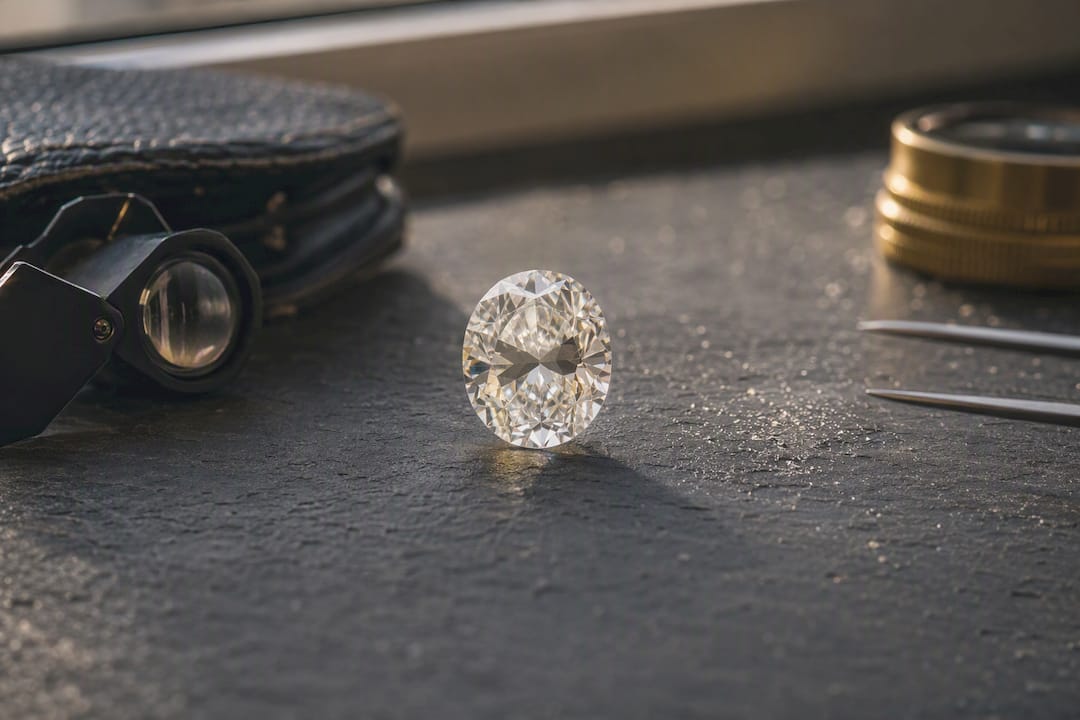
The bow tie effect in oval diamonds is a dark, butterfly-shaped shadow that crosses the stone’s center, caused by light leakage through the pavilion rather than any flaw in the diamond itself. Nearly every oval shows some trace of it, so the real question is severity, not existence. Before you buy, we always tell our customers the same thing: ask for video, not just photos, and compare several stones side by side so your eye has a reference point.
- A butterfly-shaped shadow across the center is normal in most ovals
- Video, not a static photo, is the only reliable way to judge it
- Severity varies widely, and mild bow tie is not a defect worth rejecting a stone over
Key Takeaways
The bow tie effect is a normal optical trait of elongated diamonds that certificates don’t measure, so video comparison and proportion filters, not grading reports, are what actually protect your purchase.
| Point | Details |
|---|---|
| Bow tie is nearly universal | Almost all oval diamonds show some shadow; the real variable is severity, not presence. |
| Certificates don’t cover it | GIA reports grade the four C’s and proportions but never quantify bow-tie severity. |
| Use proportions as filters | Depth 62 to 66%, table 54 to 62%, and L/W 1.35 to 1.50 are reasonable starting ranges, not guarantees. |
| Video beats photos every time | Movement reveals whether a bow tie is constant or angle-dependent; still photos can mislead. |
| Usajewels screens and shows proof | In-house inspection and on-request unedited video help you judge a stone before you commit. |
Table of Contents
- What Causes the Bow Tie Effect in Oval Diamonds?
- Do All Oval Diamonds Have a Bow Tie?
- How Do You Evaluate the Bow Tie Effect Before Buying?
- What Proportions Reduce the Bow Tie Effect?
- When Should You Accept or Reject a Bow Tie?
- Does the Bow Tie Effect Affect a Diamond’s Value?
- Oval vs. Marquise vs. Pear: Which Shape Bow-Ties the Most?
- Do Grading Reports Mention the Bow Tie Effect?
- Sources
- FAQ
What Causes the Bow Tie Effect in Oval Diamonds?
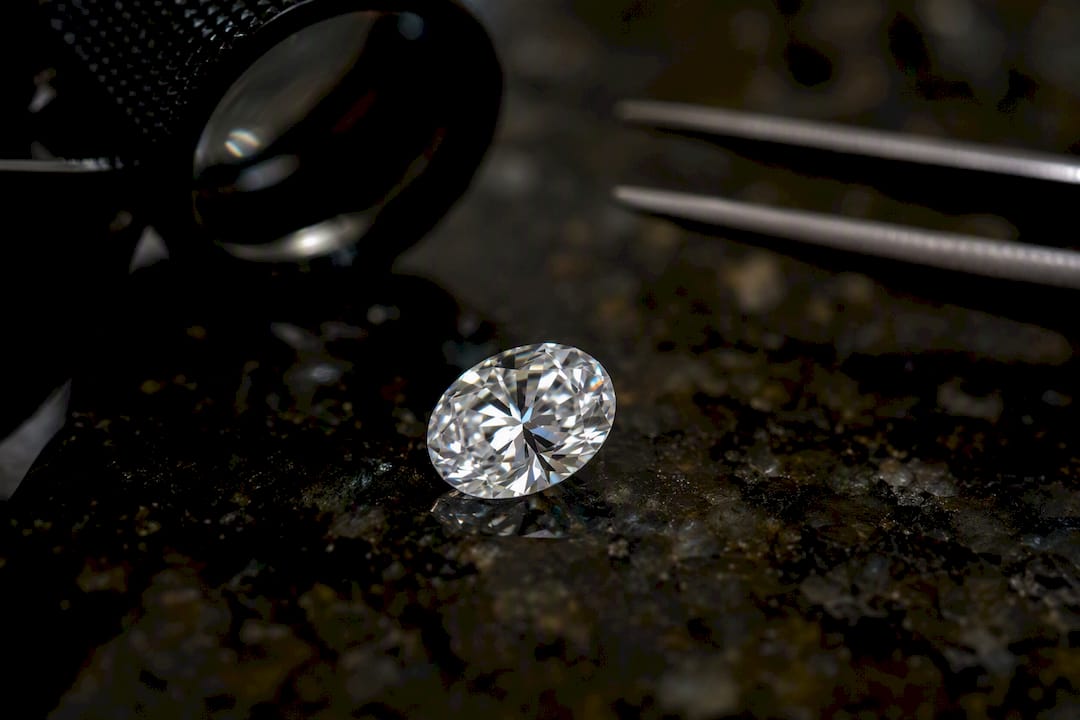
Look straight down at an oval diamond and you’ll notice two darker regions meeting near the middle, forming a shape that resembles a bow tie or a butterfly’s wings. That shadow is not dirt, not an inclusion, and not a cutting mistake in the way most people assume.
The cause is optical. In the center of an elongated shape, certain pavilion facets sit at angles that fail to reflect light straight back up to your eye. Instead, light leaks out the sides of the stone or scatters away from the viewer, leaving that area comparatively dark against the brighter, more reflective zones near the ends. Your own head and shoulders can make it worse, blocking ambient light and casting your own shadow into the exact spot where the geometry is already weak.
A few things worth knowing about how it shows up:
- The shadow tends to sit at the widest part of the oval, where the girdle curves outward
- Ambient lighting changes its visibility dramatically, a stone can look calm under soft light and dramatic under a single overhead spotlight
- Moving the diamond, or moving your head, shifts where the dark zone lands, which is why a still photo tells you so little
Do All Oval Diamonds Have a Bow Tie?
Practically, yes. Nearly all oval diamonds carry some degree of bow tie because the effect comes from the shape’s elongated geometry, not from a specific cutter’s error. The nuance buyers miss is that “having a bow tie” and “having a distracting bow tie” are two different situations entirely.
Bow tie severity typically falls into three tiers, and knowing which one you’re looking at changes everything about your decision.
- Minimal: A faint, soft shadow visible mainly at certain angles, often blending into the diamond’s overall sparkle rather than standing apart from it
- Moderate: A noticeable dark band that’s present in most lighting but doesn’t dominate the face of the stone
- Severe: A heavy, well-defined dark shape that’s visible from nearly every angle, even in bright light, and pulls the eye away from the diamond’s brilliance
A stone photographed under diffused studio light might look perfectly clean, then reveal a moderate bow tie the moment you see it move in a video. That gap between still photography and real movement is exactly why so many buyers feel blindsided after their ring arrives.
How Do You Evaluate the Bow Tie Effect Before Buying?
Judging bow tie severity is a visual exercise, and it rewards buyers who slow down and actually look rather than trust a single glamour shot. Here’s the sequence we recommend every time:
- Request unedited video first. Ask the vendor for raw footage of the diamond rotating under normal light, not a filtered or slow-motion clip designed to hide movement.
- Watch for consistency. A bow tie that fades in and out as the stone turns is far less concerning than one that stays dark through the entire rotation.
- Compare table-up and table-down angles. Both views reveal different things about pavilion performance and where the dark zone sits.
- See it in person when possible. Hold the stone at arm’s length the way you would wear it, then bring it closer, since bow tie visibility changes with viewing distance.
- Use a loupe or gemscope to check facet symmetry around the center, which often hints at whether the bow tie stems from proportion or from an off-center culet.
- Line up two or three ovals side by side. This is the fastest way to calibrate your eye, since severity is relative and hard to judge in isolation.
Pro Tip: Ask every online vendor for both a video and a same-day photo taken in natural daylight. A stone that looks identical in both is usually telling you the truth about its bow tie.
What Proportions Reduce the Bow Tie Effect?
Certain proportion ranges give you a practical starting filter, even though no combination of numbers guarantees a bow-tie-free stone. CutGrade’s recommended ranges put depth around 62 to 66 percent, table around 54 to 62 percent, and a length-to-width ratio near 1.35 to 1.50.
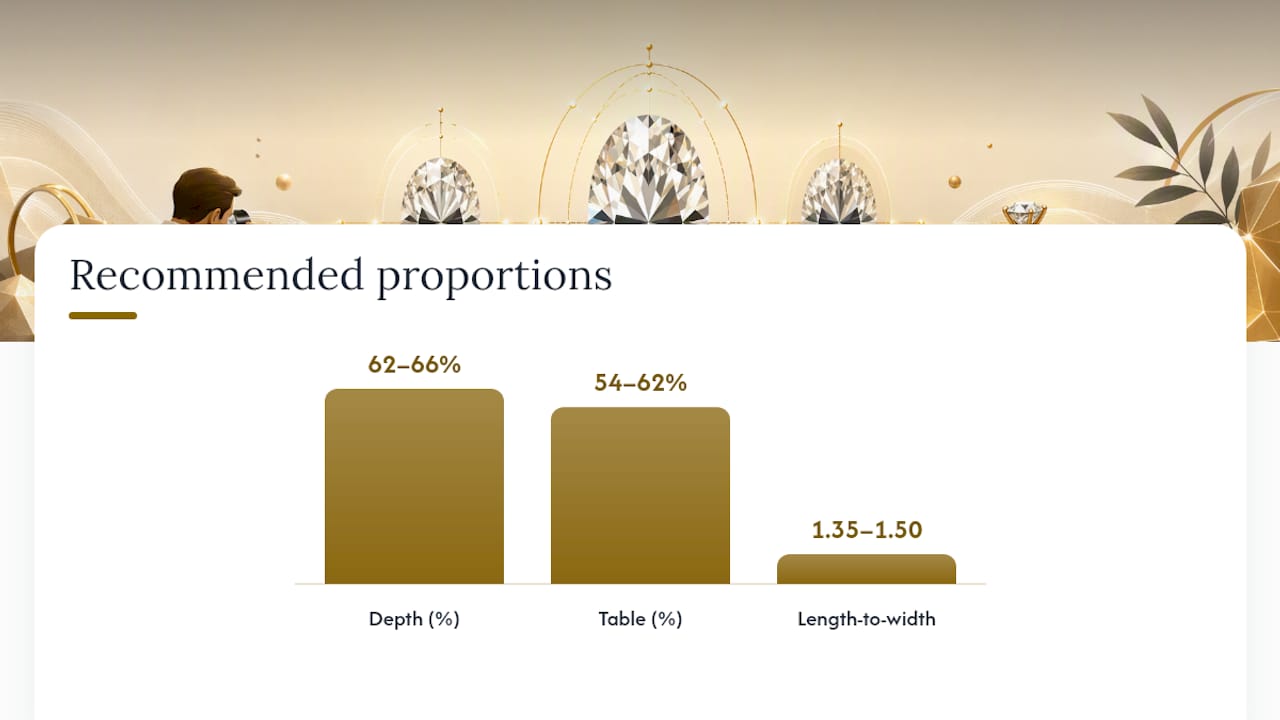
These numbers work because they influence how light travels through the pavilion and returns to your eye. A shallower depth tends to let more light escape out the sides near the center, deepening the shadow, while a table that’s too large or too small changes how much light even enters that zone in the first place. The length-to-width ratio matters too: a longer, narrower oval has more elongated pavilion geometry, which statistically correlates with a more pronounced bow tie.
Here’s the caveat that trips up a lot of buyers filtering diamonds online:
- Two stones with identical depth, table, and L/W numbers can show meaningfully different bow ties because of tiny variations in individual facet angles
- Filtering too aggressively (for example, only accepting depth of exactly 64% and nothing else) can eliminate plenty of beautiful, low-bow-tie stones for no real reason
- Proportions are a starting filter to narrow a search, not a substitute for actually watching the stone move
Treat these ranges as a way to shrink your search from hundreds of stones to a manageable shortlist, then let your eyes make the final call.
When Should You Accept or Reject a Bow Tie?
Not every bow tie deserves the same response, and having a simple decision framework saves you from either panicking over a nonissue or settling for a stone that will bother you every day.
- Accept it if the shadow is minimal, shifts with movement, and the diamond still shows strong overall brilliance. A soft bow tie often reads as character rather than flaw.
- Negotiate if the bow tie is moderate but everything else about the stone (color, clarity, price) is exceptional. Ask about a price adjustment, or consider a setting with more open sides that lets in additional light.
- Reject it if the bow tie is severe, constant across every angle, and visibly dulls the diamond’s sparkle in person.
The trade-off buyers underestimate: cutters can sometimes minimize a bow tie by altering pavilion angles or depth, but pushing too far in that direction often costs the stone brilliance and can make it face up smaller than its carat weight suggests.
Pro Tip: Don’t chase a “perfect,” bow-tie-free oval at the expense of fire and scintillation. A lively stone with a light, well-blended bow tie usually beats a flat, over-corrected one.
How USA Jewels Helps You Avoid a Severe Bow Tie
We built our screening process around the exact problem this article describes. Every oval that goes into our inventory gets checked in-house before it’s ever offered to a customer, and we back that with a straightforward video policy: if you’re shopping with us, you can request raw, unedited footage of the actual stone you’re considering.
- In-house inspection of fancy shapes before listing
- Unedited video available on request, not just staged photography
- Custom-cut alternatives if a specific stone’s bow tie doesn’t sit right with you
- Lifetime diamond upgrades if your taste or needs change down the road
Family-owned since 1999, we’ve built our reputation on transparency rather than pressure, and that shows up most clearly in how we handle a detail as easy to hide as this one.
Does the Bow Tie Effect Affect a Diamond’s Value?
The bow tie effect doesn’t move a diamond’s grading numbers, since color, clarity, cut grade, and carat weight stay exactly the same regardless of how visible the shadow is. What it does move is desirability, and desirability drives price in the real world of buying and selling.
A severe, constant bow tie can make an otherwise well-graded oval sit on the market longer or sell at a discount relative to a comparable stone with a clean face-up appearance. Buyers shopping visually, which is nearly everyone, will pass over a stone that photographs poorly even if its certificate looks identical to a better-performing one. That’s a real cost, even though no grading report ever mentions it by name.
On the flip side, a minimal or well-blended bow tie usually has little to no effect on resale or perceived value, because most buyers won’t notice it unless they’re specifically looking. This is part of why two ovals with the same carat weight, color, and clarity can carry noticeably different price tags. The one with better light performance and a quieter center commands the premium, even though nothing on paper explains the gap.
If you’re shopping with resale or long-term value in mind, treat visual light performance as an unofficial fifth factor alongside the four C’s. It won’t show up on your certificate, but it will show up every time someone looks at the ring.
Oval vs. Marquise vs. Pear: Which Shape Bow-Ties the Most?
Bow tie isn’t unique to ovals. It appears in every elongated fancy shape, but the intensity and pattern differ enough that comparing them helps explain why ovals get so much attention on this specific issue.
Marquise diamonds tend to show the most pronounced bow tie of the group, largely because their pointed ends and narrow profile push pavilion facets into steeper, less light-efficient angles across a longer stretch of the stone. A marquise with a high length-to-width ratio often shows a bow tie that spans a larger percentage of its total surface than an oval’s does.
Pear-shaped diamonds fall in the middle. The bow tie effect in pear diamonds tends to concentrate near the point where the rounded end meets the tapered tip, and it’s often less symmetrical than what you see in an oval or marquise. A pear shopper generally has an easier time finding a low-bow-tie stone than a marquise shopper, but a harder time than someone shopping rounder ovals with an L/W ratio closer to 1.35.
Ovals sit in a favorable middle ground. Their curves are gentler than a marquise’s points, which tends to soften the transition into the dark zone, and their proportions are more forgiving to adjust without dramatically changing the shape’s character. That relative flexibility is part of why ovals remain one of the most popular fancy shapes despite carrying the same underlying optical trait as their pointier cousins.
Do Grading Reports Mention the Bow Tie Effect?
No major grading lab includes a bow tie assessment on a diamond certificate, and that gap surprises a lot of first-time buyers who assume a report covers everything relevant to a stone’s appearance. GIA and other labs grade color, clarity, carat weight, and cut for round brilliants, along with proportions for fancy shapes, but there’s no standardized bow-tie metric anywhere on the document.
That absence isn’t an oversight. A lab can tell you a diamond’s pavilion angle and depth percentage, both of which correlate loosely with bow tie visibility, but it can’t tell you how dramatic that shadow will look on your finger under your kitchen lights.
This is exactly why video and in-person inspection matter more for fancy shapes than they do for round brilliants. When you’re reading a certificate for an oval, use it to confirm the four C’s and the stated proportions, then treat the actual bow-tie judgment as a separate step entirely, one that depends on your own eyes, not the report in your hand. Ask your jeweler directly whether they’ve reviewed the stone’s light performance beyond what’s printed on the paper. If they haven’t, that’s worth knowing before you commit.
A Jeweler’s Note on Judging Bow Ties by Eye
After years of watching customers fall in love with a photo and then feel unsure once the ring arrived, I’ve come to believe the certificate was never the problem. It’s the missing video. A stone’s proportions can look perfect on paper and still surprise you in daylight, which is exactly why we insist buyers see movement before they decide, not just numbers.
Get a Video-Verified Oval Before You Commit
Usajewels gives you something a certificate never will: a real look at how your specific stone behaves before you buy it, not just a lab’s numbers on paper. Every oval we offer can come with unedited video on request, so you’re judging the actual diamond, not a curated photo shoot.
If a particular stone’s bow tie doesn’t sit right after you’ve seen it move, we’ll walk you through custom-cut alternatives instead of pushing you toward a compromise. Our lifetime diamond upgrade program also means your decision today isn’t a permanent one. Browse our current oval and fancy-shape engagement rings and request video on any stone that catches your eye. It’s the single fastest way to know exactly what you’re getting before it’s on your hand.
Sources
- Oval Cut Diamond Buying Guide | Key Factors & Things to Consider | GIA 4Cs
- Oval Diamond Bow Tie Effect: How to Find Oval Cuts Without Dark Areas | CutGrade
- The Bow Tie Effect in Diamonds: Why It Shouldn’t Scare You
FAQ
Do all oval diamonds have the bow tie effect?
Nearly all do to some degree, since it comes from the shape’s elongated geometry rather than a cutting defect. Severity is what varies, ranging from barely noticeable to visually dominant.
How do you avoid the bow tie effect on an oval diamond?
Usajewels can provide in-house video on request so you’re judging the actual stone, not a filtered photo.
What causes the bow tie effect in diamonds?
It’s caused by light leaking through pavilion facets in the center of the stone instead of reflecting back to your eye, sometimes worsened by your own head blocking ambient light. The effect appears in every elongated shape, including oval, marquise, and pear diamonds.
Is it possible to get an oval diamond without any bow tie?
A completely bow-tie-free oval is extremely rare, and chasing one too aggressively can push a cutter toward proportions that reduce brilliance or make the stone look smaller. Aiming for minimal, well-blended bow tie rather than zero bow tie usually produces a livelier, better-performing diamond.
Which fancy shape has the worst bow tie, oval or marquise?
Marquise diamonds typically show a more pronounced bow tie than ovals because of their pointed ends and higher length-to-width ratios. Pear-shaped diamonds fall between the two, with the shadow usually concentrated near the point where the curve meets the tip.
Recommended
- Oval Diamond Guide: Elegant and Flattering | USA Jewels
- Pear Shaped Diamond Guide: Teardrop Elegance | USA Jewels
- Round vs Oval Diamond: Which Shape Is Right for You?
- Marquise Diamond Guide: Maximum Carat Presence | USA Jewels

Deep Mehta is the Co-Owner of USA Jewels, a family-owned jewelry business she has led since 2013 in Deerfield Beach, Florida. With over 13 years of hands-on experience in fine jewelry retail, manufacturing, and diamond importing, Deep specializes in engagement rings, wedding bands, and custom jewelry design. She also co-manages Kaash Group Talent Acquisition. Deep is a University of Florida graduate and oversees every aspect of USA Jewels’ operations, from product development to marketing.
Fine Jewelry Collection


You May Also Like
59–62.6% Depth: Verify Diamond Table and Depth Before You Buy
Are Lab-Grown Diamonds Worth It? A Practical 2026 Guide