Diamond Color Chart: D-to-Z Grades and How to Choose
A diamond color chart is a ladder of letters from D to Z that rates how much pale yellow or brown tint a white diamond has. D is the most colorless and Z has the most tint. For most engagement rings and gifts, the sweet spot is the near-colorless middle of the chart, where a diamond looks white to the eye and you are not paying for differences you cannot see. Below you will find the full scale, what each group looks like once the stone is set, and how to pick a grade for your ring, metal and budget. At USA Jewels, our certified loose diamonds start from $142, so you can put this chart to work on real stones.
TL;DR
- The scale runs D to Z across five GIA categories: Colorless, Near Colorless, Faint, Very Light and Light.
- D, E and F are colorless. G, H, I and J are near colorless, and most of them still look white in a finished ring.
- Cut, shape, size and metal change how much color you notice, so the letter alone does not tell the whole story.
- Prices step down noticeably as you move down the scale, which is why G to J is where many couples find the best balance of beauty and value.
- Fancy colors such as pink and blue are graded on a separate scale, not on this chart.
Table of Contents
- What the diamond color chart actually measures
- The D-to-Z color scale, grade by grade
- How a diamond’s color is graded
- D versus G: what you see and what you pay
- What changes how color looks in a finished ring
- Which color grade should you choose?
- Our view on color
- Put the chart to work with a certified diamond
- FAQ
- Sources
What the diamond color chart actually measures
When jewelers talk about diamond color, they mean how closely a white diamond approaches no color at all. According to GIA, the less color a diamond shows, the higher its value. The exception is fancy colored diamonds, like pink or blue, which are valued for strong color.
Most white diamonds carry a trace of nitrogen, which absorbs a little blue and violet light and leaves a faint yellow cast. The chart rates how visible that cast is. It has nothing to do with sparkle or flaws inside the stone. Those belong to cut and clarity, which are separate parts of the 4Cs.
The chart is a guide to a grading range. It is not a photograph that predicts exactly how your stone will look mounted. That is why the sections below cover what changes the look once a diamond is in a ring.
The D-to-Z color scale, grade by grade
GIA created the D-to-Z scale and it is the standard used across the industry. It starts at D, which stands for colorless, and moves toward Z, which is light yellow or brown. According to GIA’s own history of the scale, it begins at D rather than A to make a clean break from older, inconsistent systems that used A, B and C, numerals and vague terms like “blue white.”
| Category | Grades | What it means |
|---|---|---|
| Colorless | D, E, F | The least color. The rarest and most expensive range. |
| Near Colorless | G, H, I, J | A trace of color that is hard to see, especially once the diamond is set. |
| Faint | K, L, M | Tint becomes easier to notice, especially in a white metal setting. |
| Very Light | N to R | Visible light yellow or brown tint. |
| Light | S to Z | The most noticeable tint on the white diamond scale. |
The five groups follow GIA’s interactive color page. IGI, another major grading lab, also notes that D, E and F are the rarest and most expensive, and that stones with more color than Z, or in hues like orange, pink or blue, are called Fancy Colored Diamonds and graded on a separate report.
Each letter is a range, not a single point
A grade is a band of color. GIA researchers explain in a 2008 Gems & Gemology article that master stones sit at the least-colored edge of each grade. A diamond with less color than the E master stone receives a D, so no D master stone is needed.
In practice, two G diamonds can differ slightly, and a stone near the line between G and H could be graded either way by different labs. This is one more reason to buy a diamond with a grading report and to look at the stone itself, not only at its letter.
How a diamond’s color is graded
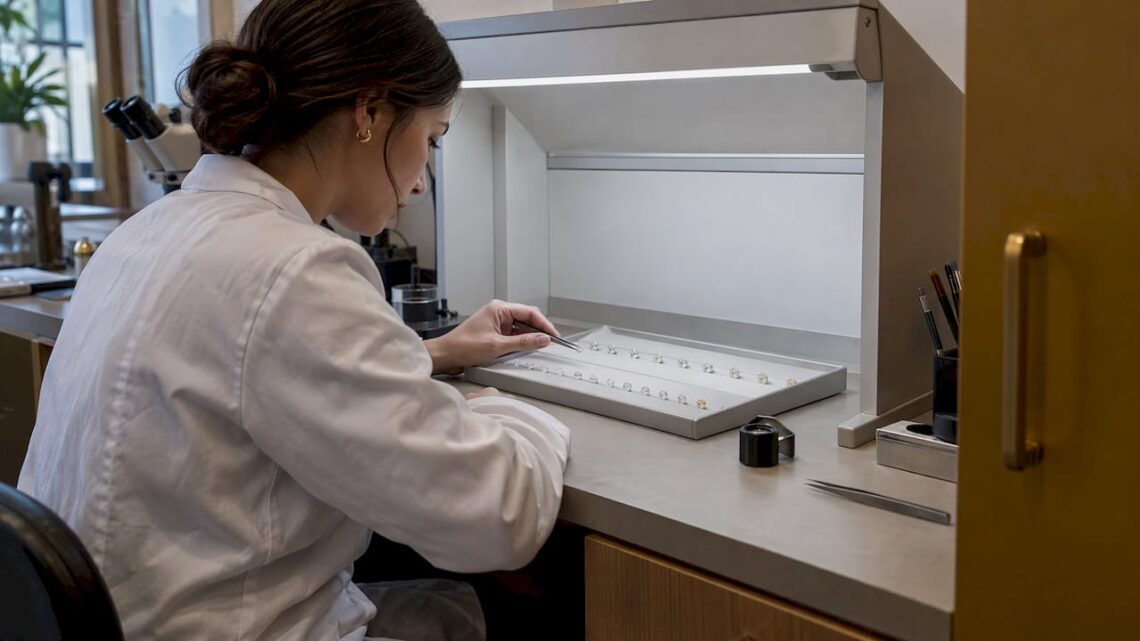
Graders do not judge color by eye in ordinary room light. GIA says that because light source and background strongly affect color, diamonds are graded in a standardized viewing environment, and the final grade is set when enough independent grader opinions agree. The 2008 article adds that graders bracket a stone between pairs of master stones, narrowing the range step by step, which keeps results repeatable.
IGI explains that diamonds are graded face-down, viewed through the pavilion (the pointed underside). Size, shape, cut quality and fluorescence can all influence how color shows face-up, and so can lighting, the mounting and even what the viewer is wearing.
That is also why a screen is a poor judge. Screens are not calibrated to one another, and photos lose the lighting that decides how a diamond looks. Use a chart to learn the scale, then rely on the grading report and the actual stone.
All of our loose diamonds are certified, so the color grade you read on the report is the grade the stone was graded at. If you want to know how the major labs compare, our diamond certification guide walks through GIA, AGS and IGI.
D versus G: what you see and what you pay
In a ring, the difference between D and G is far smaller than the difference in price. Fine jeweler Greg Kwiat told Brides that many people do not see noticeable differences between diamonds one to two color grades apart. That is why diamonds from D to J most often look white face-up in jewelry.
The price side is steeper. In the 2008 GIA article, a December 2008 Rapaport price report showed about a 32% price difference between D and E for a one-carat Internally Flawless round brilliant. For a one-carat VS1 round, the step from G to H was about 16%. Those figures are from that year and market prices have moved since, but the pattern holds: each step up toward D costs more, even when the eye can hardly tell the difference.
A worked example: say you are choosing between a D and a G of the same size, cut and clarity. Set in a ring, both will read as bright white to nearly everyone who looks at your hand. The extra money for the D buys rarity on paper. Put that money into a larger stone, a better cut or a more detailed setting, and you will see it every day.
What changes how color looks in a finished ring
The letter on the report is one input. These factors decide what you actually see.
Cut and brilliance
A well-cut diamond throws back so much light that it looks whiter than its grade. As jeweler Thelma West put it to Brides, diamonds are worn face-up but graded face-down, and well-cut stones appear whiter than their real color when set. Our guides to diamond cut grades and cut comparison for engagement rings show how to choose that sparkle.
Shape
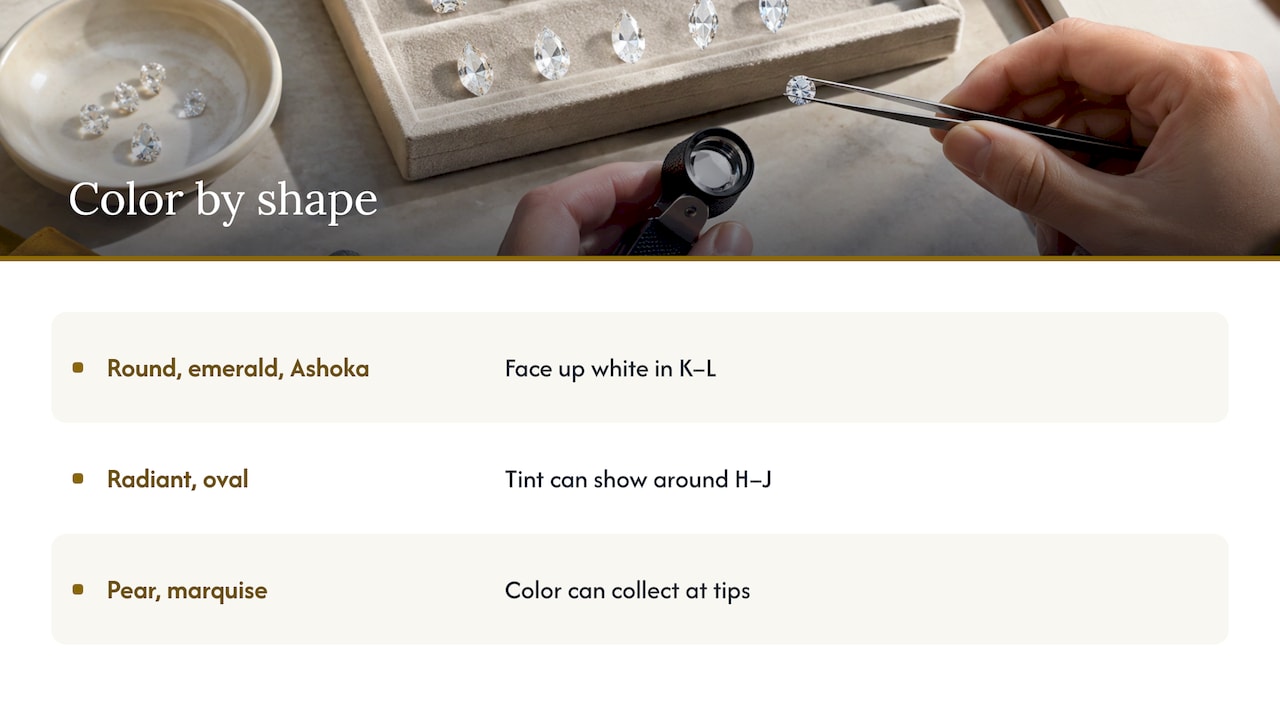
Round stones hide color well. Kwiat notes in the same Brides piece that rounds, emeralds and Ashoka cuts face up quite white even in the K-L range, while radiants and ovals show color more readily, sometimes looking tinted around H, I and J. According to DGI Academy, pointed shapes such as pear and marquise tend to collect color at the tips. Our diamond shapes guide compares every shape side by side.
Size
Larger diamonds show more color because there is more stone for light to pass through. If you are shopping for a bigger center stone, aim a step higher on the chart than you would for a smaller one.
Metal
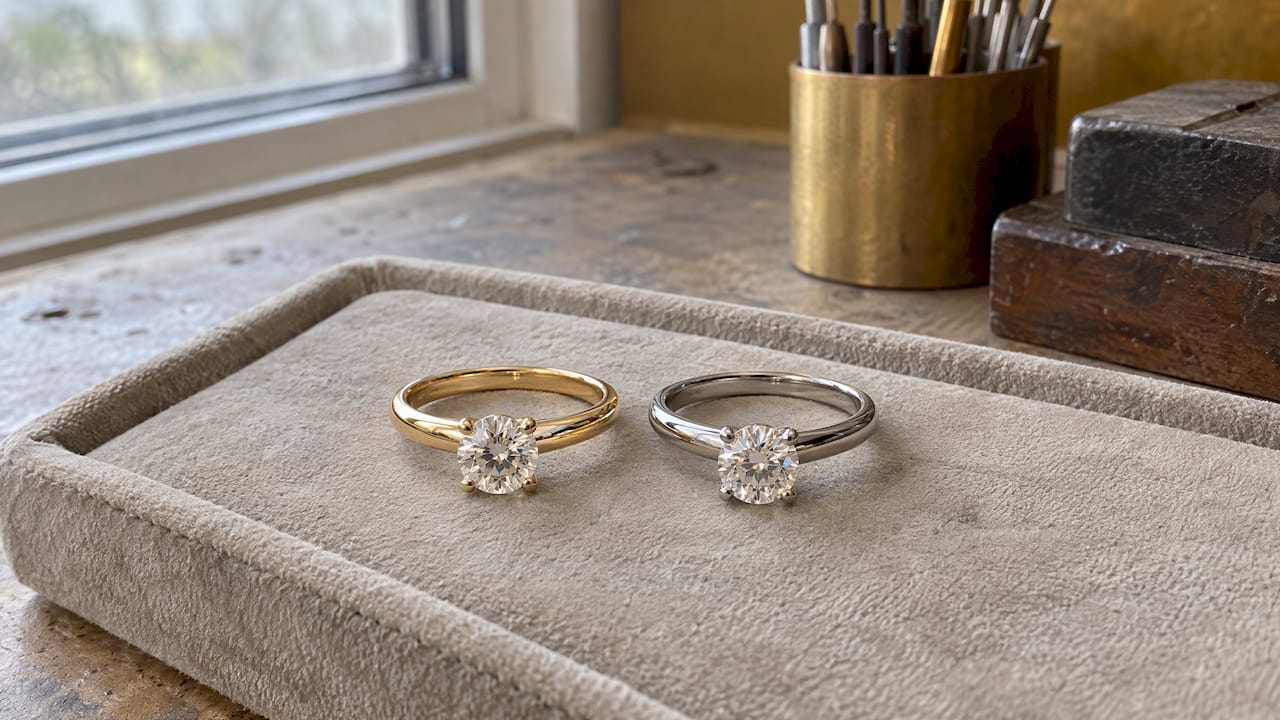
The metal frames the stone. DGI Academy says yellow gold can absorb a yellowish tint from a diamond, while platinum and white gold make tint stand out more. The International Gem Society’s buying guide agrees on the practical result: in yellow or rose gold you can drop into the faint range, but with white gold or platinum it advises I color or better. We cover the warm-metal side in best diamond color for yellow gold rings. If you prefer a white metal, our platinum jewelry starts from $327.
Fluorescence
Some diamonds glow under UV light. The grading report notes it, and medium to strong blue fluorescence can make a lower-grade stone look whiter in daylight, according to DGI Academy. Read it as one more detail of the whole diamond.
Which color grade should you choose?
Start with the metal and the shape, then set a grade range.
- White gold or platinum, round stone: G to I is a strong range. The International Gem Society recommends near-colorless G, H, I and J diamonds as a better buy than colorless stones, with G and H looking bright white.
- White gold or platinum, oval, radiant or pear: lean toward G or H, since these shapes show color more readily.
- Yellow or rose gold: I, J and sometimes lower can look lovely, because the warm metal blends with a trace of warmth in the stone.
- Large center stone (roughly over a carat): go one step higher on the chart.
- Budget first: Kwiat suggests the F to I range as a sweet spot for balancing budget, size, color and clarity, per Brides.
The International Gem Society also advises matching the color grade of the center stone and the accent diamonds, so the center does not look off-color next to them.
If you are weighing color against clarity, read why cut comes first, then color versus clarity. For an overview of both, see our diamond color and clarity guide.
Gifts, firsts and smaller budgets
If you are buying your first diamond piece, or a gift for a daughter or a loved one, you do not need the top of the chart. Earrings and pendants use smaller stones, which show less color, so a near-colorless grade reads white. Our diamond earrings and pendants start at $176 for earrings and $492 for pendants.
Lab-grown diamonds use the same scale
Lab-grown diamonds are graded with the same D-to-Z letters. We explain what the grades mean for them in lab diamond color, and our lab-created diamonds guide covers the rest.
Once the diamond is chosen
With the stone settled, the next decision is the ring around it. If you are exploring styles for the wearer’s other pieces, women’s designer rings can help you see how settings and metals look together.
Our view on color
We are a family business, and we have been making jewelry since 1999. People often arrive at our door convinced they need the highest color grade on the chart. Then they hold two stones side by side in a ring setting and the difference they expected is not there.
That is why we build rings around what you will see, not what is rarest on paper. Our in-house manufacturing means we sell directly, with no middlemen, so more of your budget goes into the diamond and the ring itself. Our pieces are solid, not hollow or plated.
We hand-select our diamonds, they are certified and ethically sourced, and you can choose the diamond quality and metal when you design your own ring. If you ever want to move up to a larger or finer stone, our lifetime diamond upgrade program is there for that day.
Choose a grade that looks beautiful on the hand you love, and let the story of the ring do the rest.
Joseph
Put the chart to work with a certified diamond
You can browse certified loose diamonds from $142 and filter by shape and quality. If you would rather build the whole ring, our Design Your Own Diamond Ring starts at $399, and ready-to-ship engagement rings start at $346. Orders come with free insured shipping and a 30-day money-back guarantee.

New to the process? Our step-by-step design guide walks you through it, and the engagement ring buying guide covers the rest.
FAQ
What is the best color for a diamond?
The most colorless grades, D to F, are the rarest and priciest. For most buyers the best color is the one that looks white in the chosen metal and shape at a price that leaves room for a good cut. For many rings that means G to I in white metal.
Which is better, D or G?
D is rarer and more colorless on the report. Once set, though, many people cannot tell a D from a G, and the G costs less. Choosing G lets you spend more on size or cut.
How do I tell what color my diamond is?
The reliable way is the grading report that came with the stone, which records the D-to-Z grade from a standardized grading process. Color is graded face-down in controlled light, so it cannot be judged accurately from a photo or by eye at home.
What is the difference between the diamond color scale and fancy colors?
The D-to-Z scale covers white diamonds, where less color is better. Fancy colored diamonds, such as pink, blue or yellow with strong saturation, are graded on a separate scale. You can read about them in our colored diamond guide.
Sources
- GIA 4Cs Color D-to-Z
- GIA interactive 4Cs color grading
- How GIA Grades Diamonds
- Color Grading D-to-Z Diamonds at the GIA Laboratory (Gems & Gemology, 2008)
- IGI: Diamond Color grading scale
- Brides: The Complete Guide to Diamond Color
- International Gem Society: Ultimate Diamond Buying Guide
- DGI Academy: The D to Z Scale Explained
Recommended
- Lab Diamond Color: What the D-to-Z Grades Mean
- Diamond Color & Clarity Explained: What to Buy
- Best Diamond Color for Yellow Gold Rings
- Diamond Quality 4Cs Breakdown: Your Buying Guide

Deep Mehta is the Co-Owner of USA Jewels, a family-owned jewelry business she has led since 2013 in Deerfield Beach, Florida. With over 13 years of hands-on experience in fine jewelry retail, manufacturing, and diamond importing, Deep specializes in engagement rings, wedding bands, and custom jewelry design. She also co-manages Kaash Group Talent Acquisition. Deep is a University of Florida graduate and oversees every aspect of USA Jewels’ operations, from product development to marketing.
Fine Jewelry Collection

You May Also Like
5 Checks Buyers Must Do for Diamond Girdle Thickness
Verify GIA Reports in 2 Minutes: How to Read a GIA Report