Strongest Gold Chain Type: What Makes a Chain Last
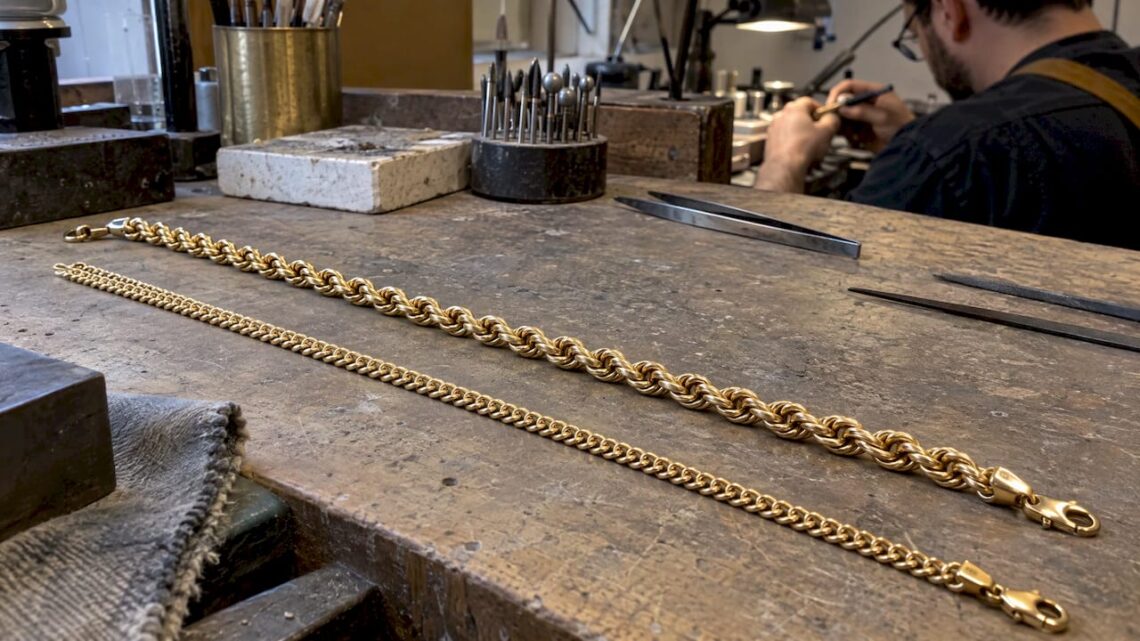
The strongest gold chain is a solid one, not a hollow one. It has thick links that share the load, in 14K or 18K gold, and a sturdy clasp. Style matters, but construction matters more. A solid Franco, Cuban, box or rope chain of good thickness will outlast a hollow chain of any style, and at our family’s bench we build our chains solid for exactly that reason. If you want to see what that looks like for your budget, you can design your own chain from $149.
Below, we walk through what actually breaks a chain, which styles hold up best, how karat changes things, and how to choose a chain you can wear every day without worrying about it.
TL;DR
- Solid beats hollow every time. In lab testing, an 18-gauge hollow chain broke at about 5 lb, while a same-size solid chain took 30 to 35 lb.
- Thickness is the biggest lever. Doubling a chain’s diameter gives roughly four times the strength.
- For daily wear, 14K solid gold is the sweet spot of strength, color and price. 18K is richer in color and a lovely choice for a special piece.
- Franco, Cuban, box, rope and wheat chains are the styles people most often choose when they want durability.
- The clasp and jump ring are where chains most often fail, so choose a lobster clasp and check it as carefully as the links.
Table of Contents
- What “strong” really means in a gold chain
- Solid versus hollow: the biggest difference you can buy
- Thickness: the strength you can measure
- Which chain styles are the strongest?
- Karat: which gold is the most durable?
- The part people forget: clasp and jump ring
- Choosing a chain for everyday wear
- Caring for a chain so it lasts
- Why we build chains the way we do
- Design a chain that fits how you live
- FAQ
- Sources
What “strong” really means in a gold chain
When people search for the strongest chain, they usually mean one thing: I don’t want it to snap. That can happen in three ways.
- A link opens at its solder joint. Every link is closed with a small join. Under a hard pull, a thin or poorly made join is the weak spot.
- A link bends out of shape. Links that hang loose can kink when snagged, and a kinked link stays kinked.
- The clasp or jump ring gives way. This is the most common failure, and it has nothing to do with the chain style.
So a strong chain has enough metal in every link, links that spread a pull across their neighbors, and hardware that matches the chain. Keep those three in mind as you compare styles.
Solid versus hollow: the biggest difference you can buy
A solid chain is made of gold all the way through each link. A hollow chain is formed from thin gold sheet into a tube, so the inside is empty. Hollow chains look big and weigh little, which is why they can look like a bargain.
The difference in strength is large. In published chain testing from the jewelry trade, an 18-gauge hollow chain broke at about 5 lb (2.27 kg), versus 30 to 35 lb (13.6 to 15.9 kg) for a same-size solid chain. That is six to seven times the strength for a chain of the same visible size.
There is a practical side too. Hollow walls are very thin, so they dent easily, and a dented link is hard to repair well. A solid chain can usually be worked on, resized and repaired for many years.
How to tell what you are looking at:
- Read the product description. It should say “solid” plainly, and it should list the weight in grams.
- Compare weight to size. A thick-looking chain that weighs very little is likely hollow.
- Ask about the clasp and the end rings, not just the links.
At USA Jewels our chains are solid, not hollow or plated. That is part of how we make our pieces, and it is why we are comfortable calling them everyday jewelry.
Thickness: the strength you can measure
Style gets the attention, but thickness does the heavy lifting. The same trade testing found that a 14-gauge (1.8 mm) solid rope chain broke at about 15 lb (6.8 kg), while a 25-gauge (3.4 mm) chain went past 60 lb (27.2 kg). Roughly doubling the diameter gave about four times the strength.
That has a simple lesson for a shopper. If you are choosing between two solid chains in the same style, the wider one is the more forgiving one. A delicate chain can still be a good choice for a light pendant or for a gift to a child, but treat it as a piece to enjoy gently, not one to tug on.
The same testing also gave a rough yardstick: a break load around 7 to 8 lb is the line between a strong chain and a weak one, though very small, lightweight chains can break below that without being faulty. In plain terms, a very fine chain is not a defective chain, but it is not the one to pick if toughness is your goal.
Which chain styles are the strongest?
Here is how the common styles compare when they are made solid. Treat this as a guide to construction, not a promise about any one chain, because thickness and quality of make always count.
| Style | How the links work | Why people choose it for durability |
|---|---|---|
| Franco | Interlocking V-shaped links that lock together tightly | Dense and flexible, with little room for links to shift or kink |
| Cuban (curb) | Flat, twisted links that lie smooth and overlap | Heavy, sturdy look, and the links lie flat while sharing the load |
| Box | Square links that stay square | Stays still on the neck, and holds a pendant steadily |
| Rope | Several strands twisted together | Twisted, multi-part build spreads stress along the chain |
| Wheat (Spiga) | Woven links in a tight braid | Compact, with a firm, steady drape |
| Figaro | Pattern of short and long curb links | Strong and classic, though thin versions are lighter |
| Cable | Simple oval links | Easy and affordable, best at medium thickness and above |
The common thread among the sturdiest styles is that the links either lock into each other or sit tightly together. When links hang loosely, a snag can bend a single link out of shape. Tight, dense patterns like Franco, box and wheat leave a snag much less to work with.
If you want to see each style side by side, our gold chain styles guide covers Cuban, rope, Figaro and more.
Karat: which gold is the most durable?
Pure gold is 24K, and it is very soft. For jewelry that is worn, gold is blended with other metals, and that blend adds strength. Fewer parts of gold generally means a harder metal.
- 14K is 14 parts gold out of 24, about 58.3% gold. It is hard enough to take daily wear and keeps a warm, rich color.
- 18K is 18 parts gold out of 24, or 75% gold. It has a deeper color and a luxurious feel, and it is a lovely choice for a chain you will cherish.
- 10K is the toughest of the three in raw hardness, but its lower gold content shows in the color and the feel.
The trade testing is a good reminder that the exact alloy matters too: chains made with hardenable alloys were found to be much stronger than those made with regular alloys. So karat tells you about gold content, while the makers’ alloy and process shape how strong the finished chain turns out.
For most people, our suggestion is 14K for everyday wear. It balances strength, color and price well. Browse our 14K yellow gold chains to see what that looks like, or step up to 18K yellow gold chains if you want the richer tone.
Can a chain be 100% gold?
Technically yes: 24K is pure gold. In practice it is too soft for a chain you wear every day, since it would stretch and scratch quickly. That is why fine jewelry is made in 14K and 18K. A 14K or 18K chain is still real gold, and “solid” tells you the links are not hollow, which is a separate point from the karat.
The part people forget: clasp and jump ring
The chain can be built like a tank and still be lost if the clasp lets go. Some things to look at before you buy:
- Lobster clasp. It closes with a spring-loaded gate and holds better than a basic spring ring, especially on thicker chains.
- Soldered ring. The small ring the clasp hooks onto should be closed, not left as an open loop.
- Proportion. A chunky chain needs a clasp that is sized to match it.
- Gold to match. The clasp should be gold too, in the same karat as the chain.
Check the clasp every few months by gently opening and closing it. It takes a few seconds and tells you whether it still snaps shut firmly.
Choosing a chain for everyday wear
Because “best for everyday” depends on how you wear it, here are a few simple matches.
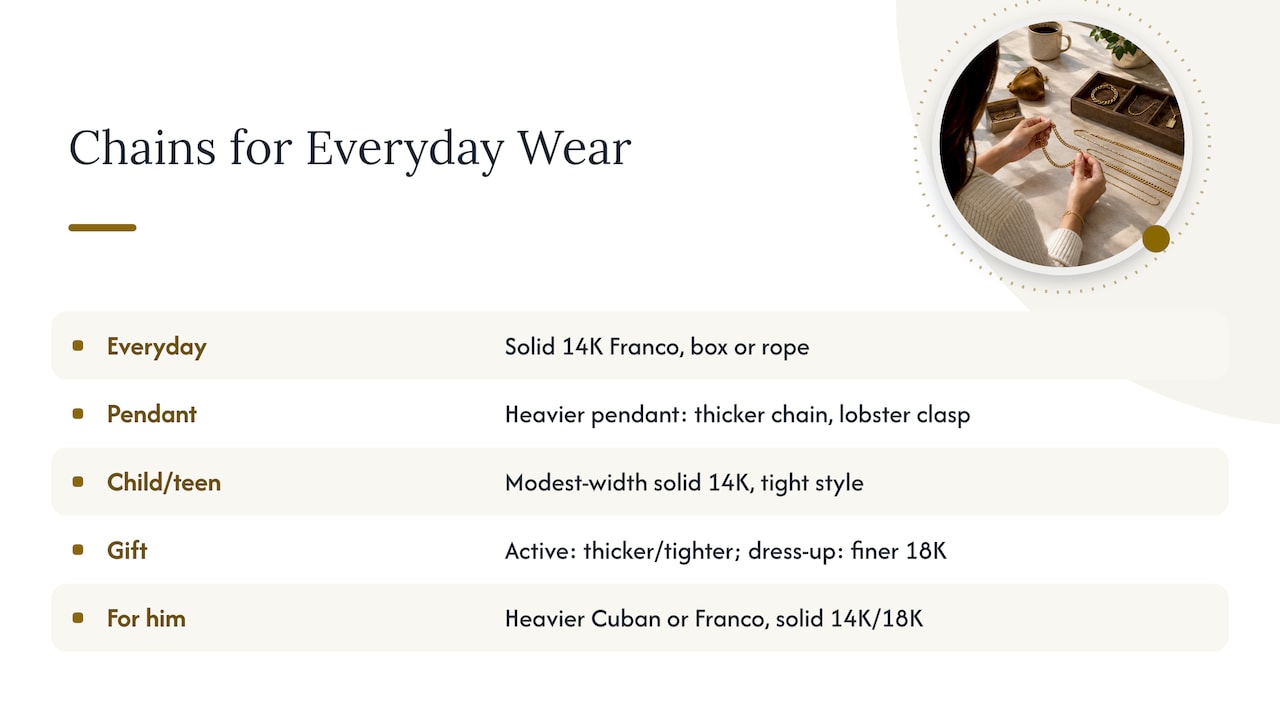
You want one chain for every day, with nothing on it. Choose a solid Franco, box or rope chain in 14K, in a width you like the look of. Go a little thicker than your first instinct, because strength rises quickly with thickness.
You wear a pendant. The pendant changes the job. A heavier pendant pulls on the chain all day, so pick a chain that is sturdy and in a style that stays still, such as box, Franco or wheat. As a general rule, the heavier the pendant, the thicker the chain should be, and a heavier pendant calls for a heavier chain with a lobster clasp. Browse our pendants and match one to a chain that suits it.
You are buying for a child or teenager. Parents often ask us for something that is real gold, affordable, and not fragile. A modest-width solid 14K chain in a tight style is a good answer. Hollow chains dent easily, which is a poor match for active kids.
You are buying a gift. Think about how the person lives. If they work with their hands or are on the move, choose a thicker, tighter style. If the chain is for dressing up, a finer one is fine, and you can go with 18K for the color.
You are shopping for him. Heavier Cuban and Franco styles are popular, and you can look at our men’s gold chains in 14K and 18K solid gold.
Caring for a chain so it lasts
Strong does not mean indestructible, and a few habits make a real difference.
- Take it off for heavy workouts, gardening and cleaning with strong chemicals.
- Keep it out of pool and hot tub water. Chlorine is hard on gold alloys over time.
- Store it flat or hanging, closed, so it does not tangle or kink.
- Clean it gently with mild soap, warm water and a soft brush, then dry it.
- Do not straighten a kinked link yourself. Bring it to a jeweler before it gets worse.
Why we build chains the way we do
We have been making jewelry as a family since 1999, and we get the same question again and again: “Which chain won’t let me down?”
Our answer is always about construction first. We make our pieces in-house, and we make them solid, not hollow or plated, because a chain should be something you stop thinking about once it’s on. Because we make our own jewelry and sell directly to you, there is no middleman adding to the price. That lets us put the money into the gold itself.
We would rather see you choose a slightly thicker 14K solid chain you can wear every day than a thinner showpiece that makes you nervous. And if you love the richness of 18K, we have that too. Every order ships free and insured, and our 30-day money-back guarantee means you can choose with confidence.
Strength is one of those things you only notice when it is missing. We build ours so you never have to.
Joseph
Design a chain that fits how you live
If you know what you want, you can choose the style, the metal and the thickness yourself. Our Design Your Own Chain option starts at $149 and lets you pick the details that matter for strength: a solid build, a karat you like, and a width that suits your neck and your pendant. If you would rather browse ready-to-ship pieces, our gold jewelry collection is a good place to begin, and the 14K and 18K selections are easy to compare.

Buying a chain as a gift? Pair it with a pendant or earrings from our fine jewelry collections, which start at $176. We hand-select our materials and stand behind them with lifetime diamond upgrades on diamond pieces, so a gift can grow with the person who wears it.
FAQ
What is the strongest type of gold chain?
A solid chain in a tight, interlocking style such as Franco, box, wheat or rope, at a good thickness, is the strongest choice. Solid construction and width matter more than the style name alone. Pair it with a lobster clasp and a closed ring so the hardware matches the chain.
What is the most durable gold chain for everyday wear?
A solid 14K chain of medium or heavier width is the usual answer. It resists scratching and bending better than pure gold, keeps its color, and sits well at a friendly price. Avoid hollow chains if you plan to wear it daily, since their thin walls dent easily.
Is 14K or 18K stronger for a chain?
In general, a lower karat means a harder alloy, so 14K is the more practical pick for daily wear. 18K has more gold, a richer color and a more luxurious feel. Both are real gold, and both are good in solid construction.
Can a gold chain be 100% gold?
Yes, 24K is pure gold, but it is too soft to hold up in a chain you wear every day. That is why fine chains are made in 14K or 18K, where other metals add strength. The karat and the build, solid or hollow, are two separate things to check.
Sources
Recommended
- Which Gold Chain Fits You: 1.5–3mm Rules, Purity, Custom Orders
- Gold Chain Styles Guide: Cuban, Rope, Figaro & More
- Chain Buyers Guide: How to Choose Gold Chains

Deep Mehta is the Co-Owner of USA Jewels, a family-owned jewelry business she has led since 2013 in Deerfield Beach, Florida. With over 13 years of hands-on experience in fine jewelry retail, manufacturing, and diamond importing, Deep specializes in engagement rings, wedding bands, and custom jewelry design. She also co-manages Kaash Group Talent Acquisition. Deep is a University of Florida graduate and oversees every aspect of USA Jewels’ operations, from product development to marketing.
Fine Jewelry Collection

You May Also Like

Gemstone Color Meaning: Choose Stones That Express You

Why Sterling Silver Is a Popular Gift Jewelry Choice