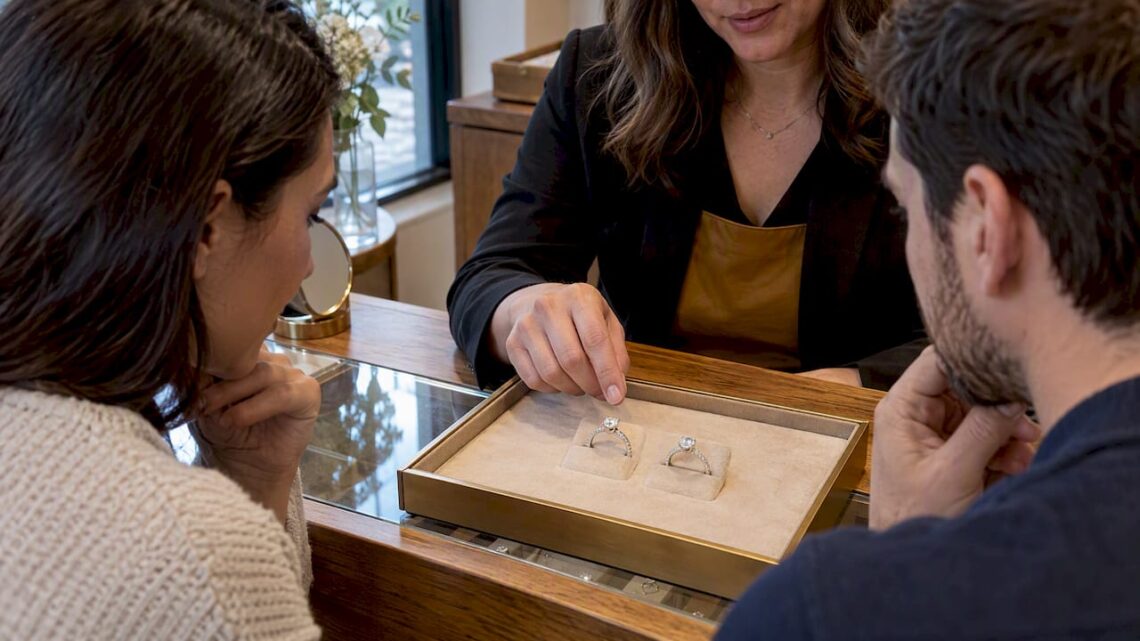
0.25 CTTW Example: Choose Pavé or Micro Pavé for Engagement Rings
Pavé uses larger melee stones set close together for individual, chunky sparkle, while micro pavé uses uniformly tiny stones, often under 0.01 carat, set under magnification for a seamless glittering surface. Choose pavé when you want visible, dimensional sparkle on a budget that allows for easier future repairs, and choose micro pavé when you want the most refined shimmer and are ready for more careful upkeep.
TL;DR:
- Micro pavé uses smaller stones under 0.01 carat, allowing for tighter, seamless glittering surfaces, but requires more precise and time-consuming craftsmanship.
- Durability concerns are higher with micro pavé due to fewer metal beads holding the tiny stones, making it more vulnerable to impacts and wear over time.
- Both styles generally cost similar amounts because micro pavé’s detailed, labor-intensive setting process offsets the lower price of smaller stones.
- Micro pavé pairs best with delicate, vintage-inspired designs and step-cut centers, while larger pavé melee offers more noticeable sparkle and easier repairs.
- Active lifestyles or heavy manual work warrant choosing standard pavé or protective settings, as micro pavé’s small beads are more prone to damage from impacts.
Table of Contents
- How pavé and micro pavé are made
- Diamond size, count, and total carat weight explained
- Appearance and sparkle: how each setting looks on the hand
- Durability and wearability: what can go wrong and when
- Cost and value: what drives the price difference
- How to choose between pavé and micro pavé for your ring
- Inspection, maintenance, and care you can actually follow
- Our experience designing pavé and micro pavé rings
- Which setting fits your lifestyle
- How USA Jewels can help you design your setting
- Sources
- FAQ
How pavé and micro pavé are made
Both styles rely on the same underlying technique: bead setting. A jeweler drills tiny holes into the metal, nestles a diamond into each one, and raises small beads of metal around the stone’s edge to hold it in place. GIA explains that pavé arranges these stones close together in a honeycomb-like pattern, so the metal nearly disappears beneath the diamonds and the surface reads as continuous sparkle rather than individual stones.
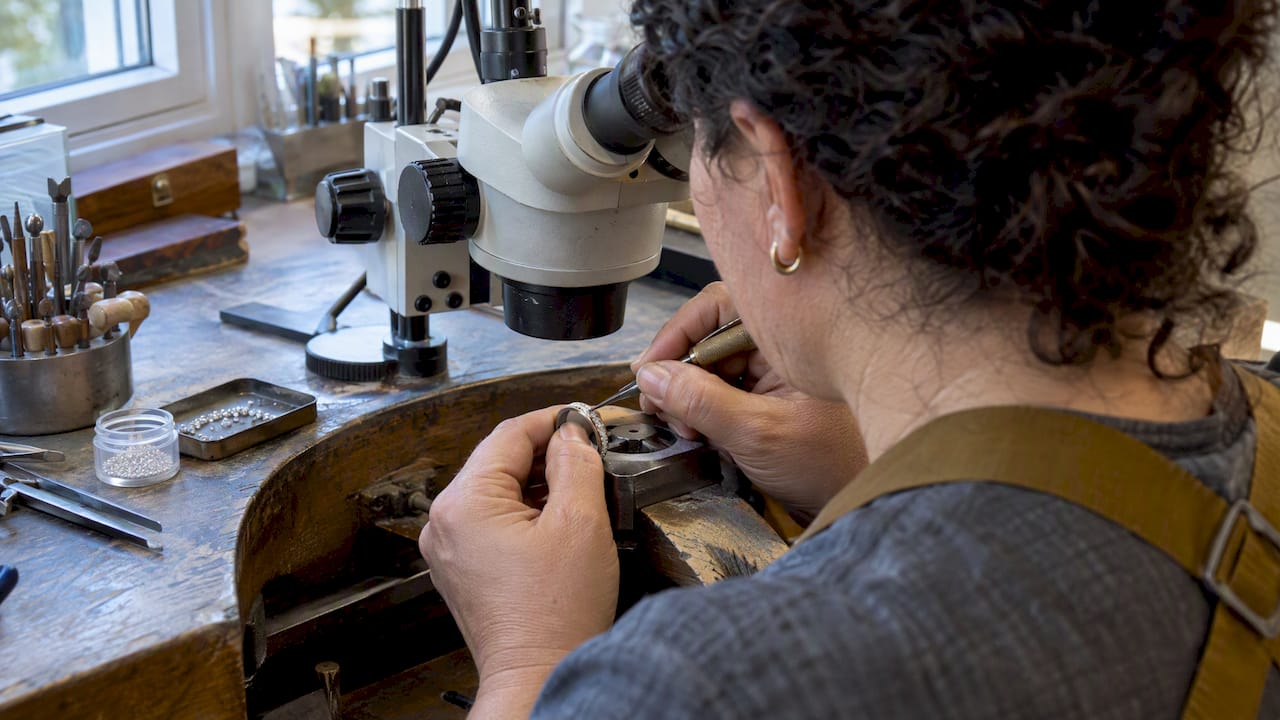
The difference between pavé and micro pavé comes down to scale and precision, not a different mounting method. Standard pavé uses melee diamonds large enough to set comfortably under normal lighting and a loupe. Micro pavé uses stones so small that a jeweler often works under a microscope, placing each diamond and shaping each bead with tools fine enough to avoid cracking a stone that weighs a fraction of what standard melee weighs.
Because the stones are smaller and packed tighter, micro pavé setting takes considerably more time and a steadier hand. The beads holding all stone are also smaller by necessity, which is part of why durability conversations differ between the two styles later in this guide.
You will also run into a few naming variations while shopping or designing:
- Micropavé is simply an alternate spelling of micro pavé, used interchangeably across the industry.
- French pavé refers to a cutting style where the metal between stones is carved into a V-shape, exposing more of each diamond and increasing brilliance.
- Shared-prong pavé uses small prongs shared between adjacent stones instead of individual beads, a method sometimes used on pavé bands to speed up setting.
- Bead-set pavé is the generic term GIA uses for the technique underlying all of these variations.
GIA notes that melee diamonds let designers create dramatic, sparkling effects as a cost-effective alternative to simply buying a larger center stone. That principle applies whether the melee is pavé-sized or micro pavé-sized: it is a way to add visual weight to a ring without paying for carat weight in a single stone.
Diamond size, count, and total carat weight explained
The numbers are where pavé and micro pavé diverge most clearly, and they matter because they show up directly on a jeweler’s quote. TeachJewelry summarizes that micro pavé typically uses stones under 0.01 carat each, while standard pavé melee generally runs larger, giving each stone more visible presence on its own.
Because micro pavé stones are so much smaller, a jeweler can fit far more of them into the same amount of space. That density is exactly what produces the seamless, glitter-like surface micro pavé is known for, compared to the more distinct, dotted sparkle of standard pavé.
A few practical numbers to keep in mind when comparing quotes:
- Standard pavé melee is large enough that each stone contributes noticeably to the ring’s overall sparkle and carat total on its own.
- Micro pavé stones are small enough that dozens can be set in the space a handful of standard pavé stones would occupy.
- TeachJewelry’s comparison of the two styles notes that design options expand with micro pavé, since finer stones allow curved rows, tapered lines, and detailed patterns that larger melee cannot follow as precisely.
- Total carat weight (CTTW) depends on both stone size and count, so two rings with similar CTTW can look very different depending on which setting style was used to get there.
Here is how that plays out in a design decision. Say a shank carries a target of 0.25 CTTW in side stones. A jeweler could reach that number with around a dozen standard pavé melee stones, each large enough to catch the eye individually, or with several dozen micro pavé stones that blend into one continuous shimmer. The carat weight on the appraisal is the same either way, but the visual result and the labor behind it are not.
This is also the point where buyers start weighing side stones against the center stone. Adding 0.25 CTTW in pavé side stones increases sparkle around the band, while putting that same budget toward a larger center diamond increases the size of the main event. Our engagement ring budget guide walks through that trade-off in more detail.
Appearance and sparkle: how each setting looks on the hand
Larger pavé melee stones catch light individually, so a pavé band tends to show distinct points of sparkle as the hand moves, almost like a string of tiny mirrors. TeachJewelry’s breakdown of the two styles notes that larger pavé melee can produce stronger single-stone brilliance than the smaller stones used in micro pavé.
Micro pavé trades that distinct sparkle for a different effect: a smooth, almost liquid shimmer where individual stones are nearly impossible to pick out. That uniform glitter tends to suit delicate, vintage-inspired designs and pairs especially well with step-cut center stones like emerald or Asscher cuts, where the clean lines of the center diamond benefit from a quieter, more textural frame rather than competing sparkle points.
A few design patterns worth knowing when you are picking between the two:
- Halo settings often use micro pavé to create a dense, continuous ring of light around the center stone without adding visible bulk.
- Pavé shanks tend to favor larger melee when the goal is a band that sparkles as a feature in its own right, not just a backdrop.
- Multi-row micro pavé bands pack several rows of tiny stones side by side, a look that would be visually heavy and structurally fragile if attempted with standard pavé-sized melee.
If you are still deciding on a center cut, our diamond shapes guide breaks down how different cuts interact with the kind of light play each pavé style produces.
Durability and wearability: what can go wrong and when
Every bead-set stone, pavé or micro pavé, is held by a small amount of metal, and that is the root of most durability concerns. Jewelers Mutual warns that pavé’s tiny metal beads create many microscopic points of failure, and a hard knock against a counter or car door can bend or chip a bead enough to loosen the stone it holds.
Micro pavé carries a similar risk with even less metal to work with per stone, since the beads have to stay proportionally small to suit the tiny diamonds they secure. That does not make micro pavé fragile in daily wear, but it does mean the margin for error during a hard impact is smaller.
A few failure patterns to watch for over time:
- A bead flattens or wears thin from years of friction against clothing, countertops, or other jewelry, gradually losing its grip on the stone.
- A single hard knock bends or chips a bead, which can loosen one stone without affecting its neighbors.
- Repeated small impacts compound over months, so a ring that looked fine at the last inspection can have multiple weak beads by the next one.
Jewelers Mutual recommends avoiding heavy manual activities while wearing pavé settings, a caution that applies just as much to micro pavé. Gardening, moving furniture, or regular gym sessions all put a bead-set ring at higher risk than a smooth bezel or channel setting would face in the same activities.
Pro Tip: Slide a ring off before any task that involves gripping, lifting, or scraping, since friction against a hard surface is what wears beads thin over time.
For anyone whose daily routine includes a lot of hands-on work, a protective setting is worth considering instead. Channel settings tuck stones between two metal walls, bezel settings wrap metal fully around the stone’s edge, and flush settings sink the diamond into the metal so nothing protrudes. Our settings guide compares these options directly if durability is your top priority.
Cost and value: what drives the price difference
Pavé and micro pavé often land in a similar price range, which surprises people who assume tiny stones cost less. TeachJewelry notes that micro pavé setting is more time-consuming and exacting, and that extra labor can offset the lower cost of smaller individual diamonds.
A jeweler setting micro pavé stones under a microscope spends more hours per carat than one setting standard pavé melee by hand, simply because there are more stones to place and less margin for error on each one. That labor cost shows up on the final price even though the raw material cost per stone is lower.
A few variables that move the price beyond setting style alone:
- Stone quality matters even at melee size: color, clarity, and cut consistency across dozens of tiny stones affect both appearance and price.
- Metal choice changes the base cost significantly, since platinum typically costs more than gold for the same design.
- Stone count scales with design complexity, so a multi-row micro pavé band will cost more to set than a single row, regardless of total carat weight.
When budget is the deciding factor, the real choice often is not pavé versus micro pavé but side stones versus center stone. Adding melee, in either style, increases a ring’s overall sparkle for a relatively modest cost increase, while upgrading the center diamond increases the size of the main stone itself. Diamonds by Daisy’s guide to affordable alternatives covers similar trade-offs for buyers weighing clarity against budget, a useful companion read when you are deciding where to put your money.
How to choose between pavé and micro pavé for your ring
Picking a setting style gets easier once you match it against three things: your center stone, how you actually use your hands day to day, and the finish you want the ring to have.
- Match the setting to your center cut. Step cuts like emerald or Asscher tend to pair well with the quiet shimmer of micro pavé, while round or cushion cuts can carry the bolder sparkle of standard pavé without looking busy.
- Be honest about your wear profile. If your hands are busy all day with physical work, lean toward larger pavé melee or a protective setting instead of micro pavé’s smaller, more delicate beads.
- Decide what finish you want. Pavé gives you visible, dotted sparkle; micro pavé gives you a continuous glitter effect that reads as one surface rather than many stones.
- Ask for exact melee size and CTTW in writing before you order, so you know precisely what you are paying for and can compare quotes apples to apples.
- Request mounting photos under magnification. A jeweler who is confident in their bead work will have no problem showing you close-up images of similar pieces.
- Ask about the repair policy before you buy, since re-beading or re-setting micro pavé is a more delicate job than servicing standard pavé and not every jeweler offers it.
- Think ahead to servicing. Standard pavé is generally easier and faster to repair than micro pavé, which matters if you expect to wear the ring daily for decades.
For evaluating the craftsmanship behind a specific piece, HerMJ’s guide to assessing handmade setting quality offers useful questions to bring to a consultation, particularly around bead consistency and finish.
Inspection, maintenance, and care you can actually follow
A pavé or micro pavé ring needs more attention than a solitaire, but the routine is simple once it becomes a habit. Jewelers Mutual recommends professional inspection at least twice a year to catch loose beads before a stone actually falls out, since a jeweler can often re-secure a weak bead in minutes if it is caught early.
Professional inspection at least twice a year is the baseline recommendation from Jewelers Mutual, and it is worth treating as non-negotiable for any bead-set ring. Between those visits, a quick at-home check once a month takes less than a minute: hold the ring up to a bright light and look for anything out of place.
Cleaning requires some caution too. Jewelers Mutual notes that ultrasonic and steam cleaning can be effective but are not suitable for every setting and stone, and using either method on a ring with an already-loose stone can shake it free. A soft brush, mild dish soap, and warm water handle most day-to-day cleaning safely.
During your monthly at-home check, look for:
- Any stone that wiggles slightly when you press on it gently with a fingernail.
- Gaps where metal looks uneven or a bead appears flattened compared to its neighbors.
- Dark or dull metal showing through where a bead used to sit flush with the stone.
- Rows that look uneven or where one section catches less light than the rest.
Catching any of these early is almost always cheaper and easier than replacing a stone that has already been lost.
Our experience designing pavé and micro pavé rings
This jeweler has been family-owned since 1999 and uses in-house manufacturing, allowing the same team that designs a piece to often set the stones, providing direct insight into how pavé and micro pavé hold up over years of real wear, not just on the day they leave the workshop.
Most clients who come to us deciding between the two are weighing the same two things: how much sparkle they want versus how much upkeep they are willing to commit to. For an active lifestyle, we often suggest standard pavé melee or a protective setting over micro pavé, simply because the beads are larger and more forgiving of daily bumps. For a bolder, more continuous shimmer, especially around a halo or a step-cut center stone, micro pavé tends to be the better fit.
We also adjust metal choice based on wear profile. Platinum holds beads more securely over time than softer gold alloys, which matters more for micro pavé’s smaller beads than for standard pavé’s larger ones. Our platinum jewelry collection and gold jewelry collection both support custom pavé and micro pavé work, so the decision usually comes down to budget and how the metal’s color suits the design.
When a client sits down for a custom order, we recommend asking a few direct questions: What is the exact melee size and total carat weight? Can I see the mounting under magnification before it ships? What does the repair policy cover if a stone loosens? Getting clear answers up front avoids surprises later, and it is exactly the kind of transparency we build into every custom quote.
Which setting fits your lifestyle
If you work with your hands all day or simply forget you are wearing jewelry when you reach for a heavy box, go with standard pavé or a protective setting like bezel or channel. The larger beads and thicker metal give you more room for error, and repairs are simpler when something does go wrong.
If sparkle is the priority and you are willing to commit to twice-yearly inspections, micro pavé delivers a shimmer that standard pavé genuinely cannot match. It suits a halo around a step-cut center stone especially well, where a quieter, continuous glitter lets the center diamond’s lines do the talking.
If budget is the main constraint, standard pavé usually offers more visible sparkle per dollar, since the labor cost per carat tends to run lower than micro pavé’s more exacting setting process.
Whichever you choose, get the ring appraised and insured, and keep to a regular inspection schedule. A beautiful setting is only as good as the beads holding it together.
— Joseph
How USA Jewels can help you design your setting
Deciding between pavé and micro pavé gets a lot easier when you can see both options built around your own center stone instead of guessing from photos online. Because we manufacture in-house, we can show you real mounting samples under magnification and adjust melee size, metal, and row count until the design matches what you actually want to wear every day.

If you already know roughly what you want, our Design Your Own Diamond Ring tool lets you choose your diamond shape, quality, and metal type and see pavé or micro pavé options applied directly to your design. For anyone who wants full control over the side stones themselves, our certified loose diamonds page lets you select melee by size and quality before it ever reaches a setting.
A few things that help when you reach out for a custom quote:
- A photo or sketch of the style you are drawn to, even a rough one.
- Your center stone’s shape and size, if you already have one chosen.
- Any wear considerations, like a physically active job or daily gym use, so we can recommend bead size and metal accordingly.
Custom pieces sometimes come with satisfaction guarantees and lifetime diamond upgrade options, providing flexibility beyond the initial purchase. Start a conversation through our engagement rings page, or reach out directly for a custom quote tailored to your design.
Sources
The technical claims in this guide draw on GIA’s explainer on melee diamonds and bead-setting technique, Jewelers Mutual’s guidance on pavé care and inspection schedules, and TeachJewelry’s practical comparison of pavé and micro pavé. These sources cover the setting mechanics, maintenance recommendations, and sizing distinctions referenced throughout.
- What to know about the pavé setting | Jewelers Mutual
- Melee diamonds: tiny diamonds, big impact | GIA 4Cs
- Pavé vs Micro Pavé Settings (3 Differences) | TeachJewelry
FAQ
Are micro pavé diamonds real?
Yes, micro pavé settings use genuine diamonds, just at a much smaller size than standard melee, often under 0.01 carat each according to TeachJewelry’s comparison of the two styles. Their small size does not make them synthetic or lower quality, it simply reflects the fine scale of the setting technique.
Which type of pavé setting is the most secure?
Security depends more on bead geometry and execution than on the pavé versus micro pavé label itself, since GIA notes that pavé is fundamentally a bead-setting technique where stone retention comes down to bead thickness and height. For active lifestyles, protective alternatives like channel or bezel settings generally hold up better than any bead-set pavé style.
Are pave diamonds worth anything?
Pavé diamonds carry real value based on their total carat weight, quality, and the labor involved in setting them, even though each individual stone is small. The combined value of dozens of melee stones in a pavé or micro pavé design can add up meaningfully to a ring’s total worth and insurance appraisal.
Are pave rings more expensive?
Pavé and micro pavé rings often land in a similar price range because labor costs balance out stone size, since TeachJewelry notes that micro pavé’s smaller stones require more time-consuming, exacting setting work even though the diamonds themselves cost less individually. The bigger price factors tend to be metal choice, stone quality, and overall design complexity rather than pavé versus micro pavé alone.
Recommended
- Engagement Ring Prong Style Selection: 2026 Guide
- Pick Ring Setting Style Guide for Every Buyer
- Design Your Own Engagement Ring: Step-by-Step Guide
- Diamond Cut Comparison Guide for Engagement Rings

Deep Mehta is the Co-Owner of USA Jewels, a family-owned jewelry business she has led since 2013 in Deerfield Beach, Florida. With over 13 years of hands-on experience in fine jewelry retail, manufacturing, and diamond importing, Deep specializes in engagement rings, wedding bands, and custom jewelry design. She also co-manages Kaash Group Talent Acquisition. Deep is a University of Florida graduate and oversees every aspect of USA Jewels’ operations, from product development to marketing.
Fine Jewelry Collection

You May Also Like
Finish Your Engagement Ring in 4–8 Weeks Without Retail Markup
Guide to Popular Wedding Ring Styles