Lab Diamond Certification: How to Read and Trust a Report
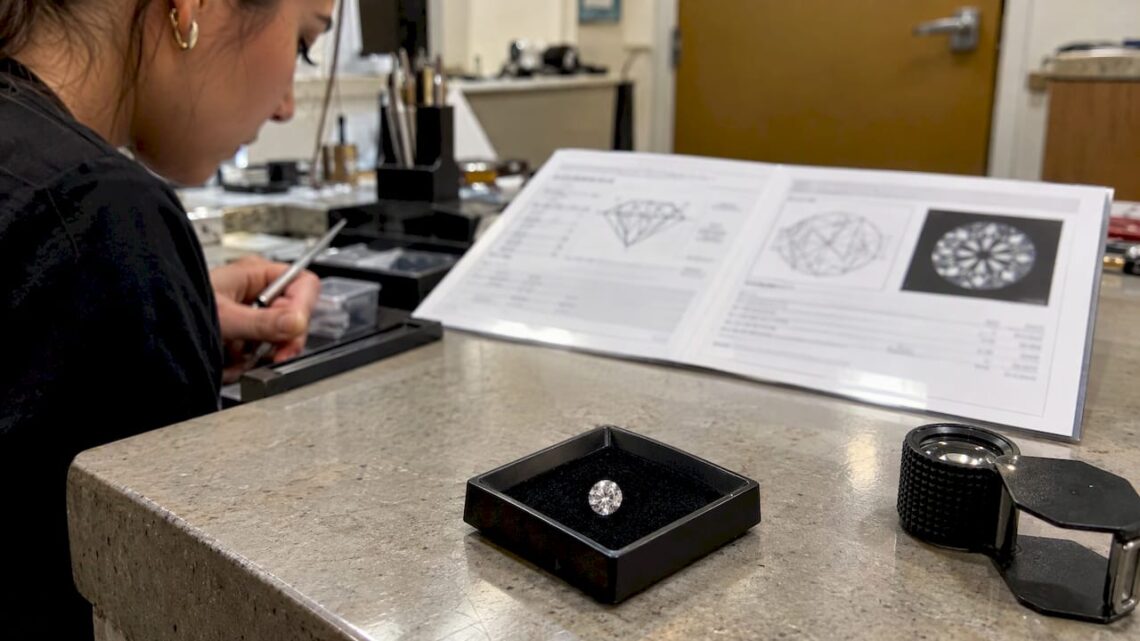
A lab-grown diamond should come with an independent grading report that says the stone is laboratory-grown and documents its color, clarity, cut and carat weight. That report is what lets you compare two stones fairly, confirm that the diamond in your hand is the one on paper, and know exactly what you are paying for. At USA Jewels, our lab-grown diamonds are IGI and GIA certified, and we built this guide so you can read any report with confidence, ours or anyone else’s.
TL;DR
- A lab diamond certificate is an independent lab’s grading report: it identifies the stone as laboratory-grown and records its 4Cs, measurements and any treatment.
- IGI and GIA are the two labs most buyers see on lab-grown stones. Compare stones graded by the same lab, because grading standards are not identical between labs.
- Check the report number against the lab’s own online database and against the laser inscription on the girdle (the thin outer edge of the stone).
- A grading report describes the stone. It does not set a price. An appraisal is a separate document that estimates value for insurance or sale.
- Look for “laboratory-grown” in the report heading, the growth method (CVD or HPHT), treatments, the report date and fluorescence.
Table of Contents
- What a lab diamond certificate actually is
- Which labs grade lab-grown diamonds
- What a lab-grown diamond report contains
- What the laser inscription tells you
- How to verify a report in a few minutes
- Can a stone be identified as lab-grown without the report?
- A report is not an appraisal
- What to check before you buy
- Our perspective
- Choosing a certified lab-grown diamond with us
- FAQ
- Sources
What a lab diamond certificate actually is
People use “certificate” and “grading report” interchangeably. Both mean a document from a gemological laboratory that has examined the stone and recorded what it found. The lab does not sell the diamond, and that independence is the point.
A lab-grown report answers two separate questions. IGI explains that it first screens each stone to determine whether it is laboratory-grown, natural or a simulant (a look-alike material such as cubic zirconia or moissanite), and then documents its gemological characteristics. Knowing a stone is lab-grown does not tell you its quality. Two lab-grown diamonds can differ widely in color, clarity, cut and craftsmanship, and the grading is what documents those differences in a standard way.
That matters if you are buying an engagement ring, a gift for a child or your first piece of fine jewelry. You usually cannot judge a diamond by eye, and a report gives you something objective to hold the price against.
Which labs grade lab-grown diamonds
Three names come up most often in the United States.
| Lab | What it issues for lab-grown stones | Good to know |
|---|---|---|
| GIA | Quality assessment and colored diamond reports, digital-only | Girdle laser inscription with “Laboratory-Grown” and the report number |
| IGI | Laboratory Grown Diamond Report | Screens identity first, then documents measurements and 4Cs grades |
| EGL USA | Lab-Grown Diamond Report | Published price schedule from its New York and Los Angeles labs (2021) |
GIA
The Gemological Institute of America has graded lab-grown diamonds since 2007. Its current reports are digital-only and designed to look different from its natural-diamond reports. According to GIA, its Laboratory-Grown Diamond Quality Assessment classifies loose colorless-to-near-colorless stones of 0.15 carat or more as Premium or Standard, and it issues separate digital reports for lab-grown colored diamonds. GIA announced in October 2020 that its lab-grown reports would use the 4Cs color and clarity specifications in place of earlier descriptive terms, and that they would state whether a stone was made by CVD or HPHT (two growth methods) and whether it may include post-growth treatments.
If you want the full walk-through of a GIA document, our guide on how to read a GIA report takes you through it line by line.
IGI
IGI’s report records measurements and 4Cs grades. The growth process and any detected treatments may appear in the report comments when requested or applicable. IGI is widely used for lab-grown stones, and its report is a common sight on engagement-ring diamonds.
EGL USA
EGL USA publishes a price schedule for lab-grown reports: $60 per stone up to 0.69 carat, $65 per stone for 0.70 to 0.99 carat, and $65 per carat from 1.00 carat up, per its 2021 schedule. You may see its name on some stones.
For a side-by-side view of how the major labs differ, see our diamond certification guide and our comparison of AGS and GIA.
Why the lab name matters when you compare
A D color, VS1 clarity stone from one lab is not guaranteed to match the same grades from another. Labs apply their own standards. So when you shop, compare stones graded by the same lab. Comparing an IGI report to a GIA report grade for grade can leave you thinking one stone is a bargain when you are really looking at two different yardsticks.
A store-issued “certificate” or in-house card is not an independent report. It is useful as a product description, but the grading should come from a separate laboratory.
What a lab-grown diamond report contains
Expect these items on a good report:
- Clear lab-grown identification. CIBJO’s 2024 guidelines, written by the international jewelry confederation, recommend that the heading state prominently that the stone is laboratory-grown, and that report colors and designs differ significantly from natural-diamond reports.
- The 4Cs. Carat weight, color (graded on the D to Z scale for colorless to light yellow), clarity and cut, plus precise measurements. GIA says it evaluates lab-grown stones as meticulously as natural ones.
- Growth method. CVD (chemical vapor deposition) or HPHT (high pressure, high temperature). CIBJO recommends spelling it out rather than only abbreviating it. If you are curious why it matters, our piece on HPHT vs CVD diamonds explains how each method can change what the 4Cs mean for you.
- Treatments. Some lab-grown stones receive post-growth treatment to improve color. A good report says so.
- Issue date and the lab’s name and address. Both are part of what CIBJO recommends a report disclose.
CIBJO also makes a consumer-friendly point: it is best when the specification and the report sit in a single document, and if they are separate, you should always see both before you decide.
What the laser inscription tells you
Most lab-grown stones are inscribed on the girdle with a microscopic laser engraving. GIA says each lab-grown stone it grades is inscribed with “Laboratory-Grown” and the GIA report number. Where a stone already carries a qualifying origin statement, GIA adds only the report number.
The inscription does two jobs. It tells anyone who examines the stone that it is lab-grown, and it ties the diamond to a specific report number. You can read it with a 10x jeweler’s loupe, and our guide on checking a GIA laser inscription shows how.
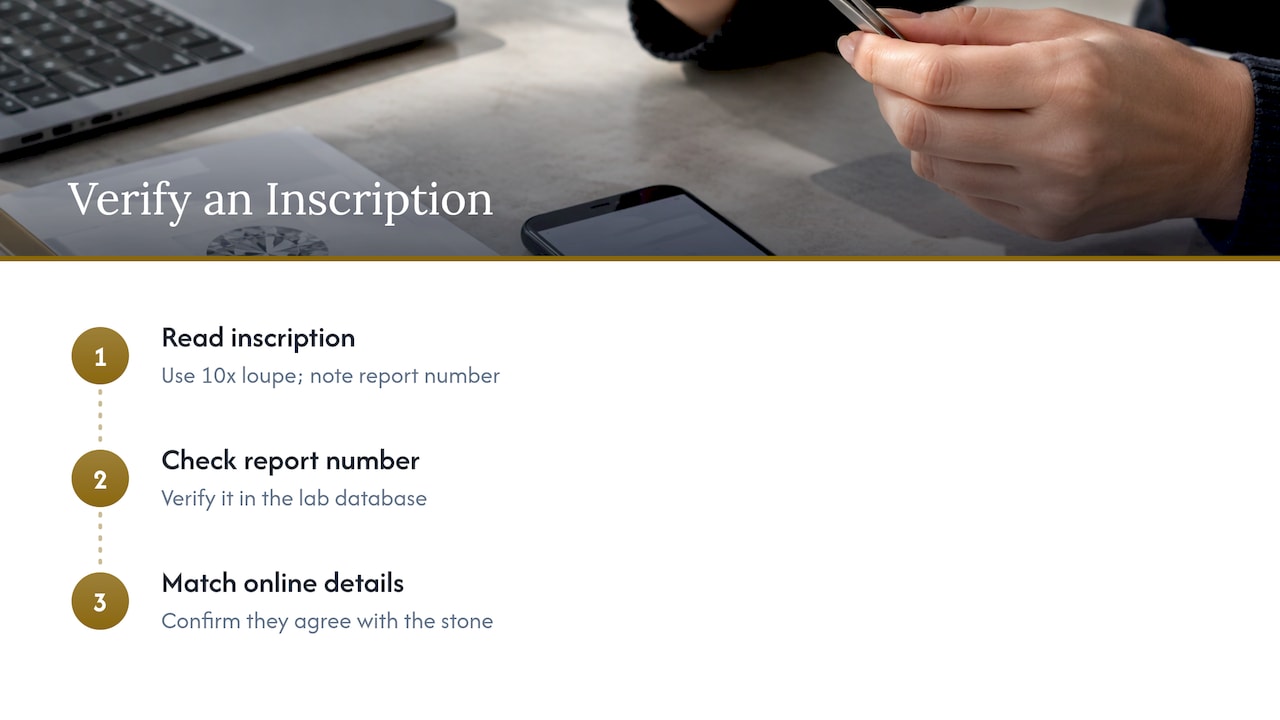
What it does not do is prove the report is genuine on its own. GIA’s 2024 update notes that a laboratory-grown girdle inscription supports identification but can be removed. So treat the inscription as one half of a match: the number on the stone must also check out in the lab’s database, and the details online must agree with the stone you are buying.
How to verify a report in a few minutes
- Find the report number on the paper or digital report.
- Look up the number on the lab’s own site. GIA states that its lab-grown reports are digital-only, and that a report found in Report Check is authentic. IGI offers a verification page on its site where you can search by report number.
- Read the girdle inscription with a 10x loupe and compare the number to the report.
- Compare the details. Carat weight, measurements, color, clarity and cut on the screen should match the listing.
- Check the date and the heading. The heading should say laboratory-grown, and the issue date should make sense for the stone.
Online lookups confirm data. They do not, by themselves, prove that the stone in your hand is the stone described. EGL USA, for example, says its online verify service confirms data only, and that for absolute certainty a professional gemologist should check the stone against the report. For a large purchase, that extra check is worth asking about. When you buy from us, you can ask our team about the report for any stone you are considering.
Can a stone be identified as lab-grown without the report?
Gemologists can, but it takes laboratory equipment. GIA’s guide to identification describes using refractive index, density and spectroscopy to establish that a stone is a diamond, then testing for natural, treated or laboratory-grown origin. HPHT stones often show metallic inclusions, while CVD stones can show layered growth under deep-UV light.
The authors of GIA’s 2024 Gems & Gemology update say that no cost-effective, rapid tool definitively identifies every lab-grown diamond, and that consumer screening devices give “pass” or “refer” results. They also note that no single observation settles origin: it is the combination of features that confirms it. In plain terms, you cannot tell by eye, and a pawn shop counter test is not a reliable way to know. That is exactly why the independent report exists.
A report is not an appraisal
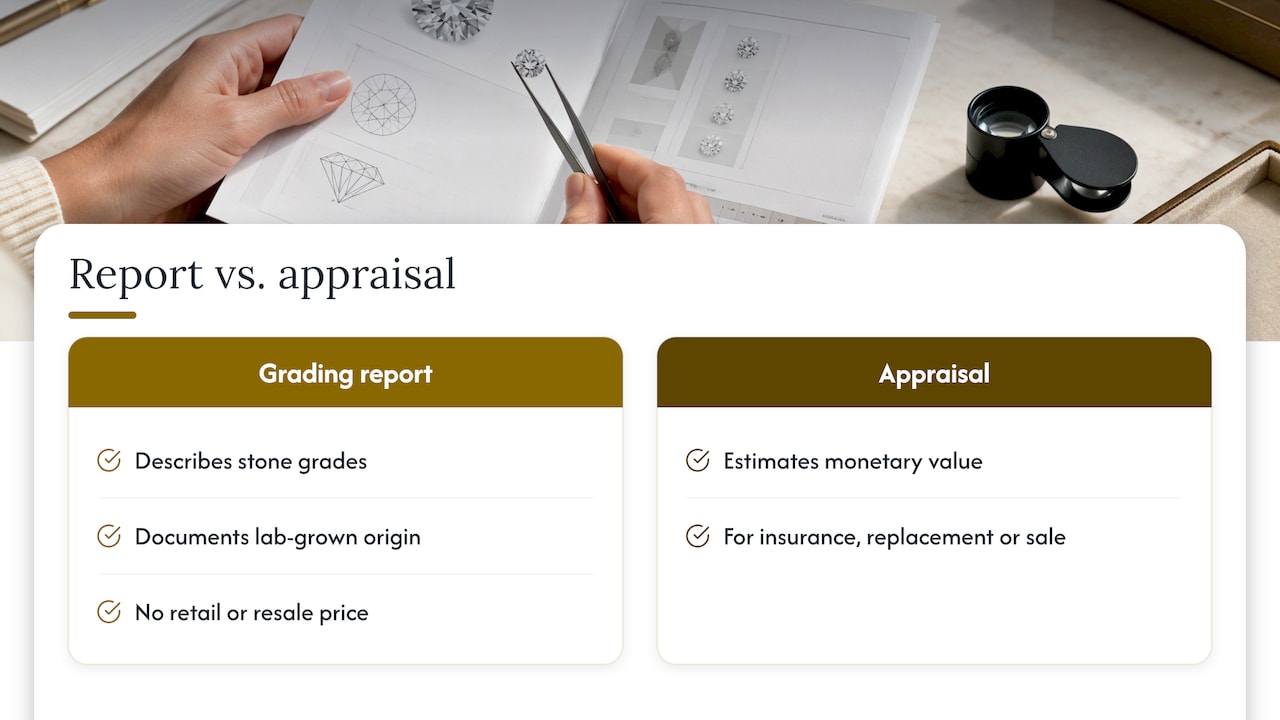
This is the most common confusion we hear from first-time buyers. A grading report describes the stone. IGI states that its report documents gemological characteristics and lab-grown origin but does not assign a retail or resale price. An appraisal is a separate document in which a gemologist estimates monetary value, typically for insurance, replacement or sale.
So if you are insuring a ring, you will want an appraisal in addition to the report. And if you ever plan to sell or trade a stone, the report is the document a buyer will ask for first, because it proves what the diamond is. Without it, you would have to have the stone graded again.
A worked example: you are choosing between two 1.00 carat round lab-grown diamonds. One has an IGI report and the other has only a seller’s card. The first lets you confirm its color, clarity and cut grades with the lab and compare it against other IGI-graded stones. The second asks you to take the seller’s word. Even at the same sticker price, you are only buying certainty with the first.
What to check before you buy
Keep this list handy when you compare lab-grown diamonds:
- The word “laboratory-grown” on the report and in the listing. Under U.S. Federal Trade Commission jewelry guidelines, a lab-grown stone should be described with a qualifier such as “laboratory-grown” or “laboratory-created” directly before the word diamond.
- An independent lab. Not a store card.
- A report number that checks out on the lab’s website and matches the girdle inscription.
- Growth method and treatments noted, so you know what you are paying for.
- Measurements and cut. Cut drives sparkle more than any other factor, so do not shop on color and clarity alone.
- Fluorescence and report date.
- The same lab across the stones you compare.
If you are comparing lab-grown and natural, our lab-grown vs natural diamonds guide lays out the differences in plain language, and our guide to GIA certified diamonds covers what a GIA report means for buyers.
Our perspective
We are a family business, and we have been making jewelry since 1999. In all that time, the questions we hear most are not about trends. They are about trust: is this stone what you say it is, and am I paying a fair price for it?
That is why we think a lab diamond certification should be the starting point of a purchase, not an afterthought. A report from an independent lab gives you the same facts we have, in the same words, so you never have to take anyone’s word for it, including ours.
It is also why we make our own jewelry in-house and sell direct. Without middlemen, more of what you pay goes into the diamond and the solid, not hollow or plated, gold or platinum around it. Our lab-grown diamonds are IGI and GIA certified, and our lifetime diamond upgrade program means a stone you choose today is not a decision you are locked into forever.
Whether you are designing an engagement ring with your partner or choosing a first piece of fine jewelry for a child, we want you to leave knowing how to read the paper that comes with your stone.
Joseph
Choosing a certified lab-grown diamond with us
If you are ready to look, our lab-grown diamonds are IGI and GIA certified, and our certified loose diamonds start from $142. You can pair a stone with a setting through Design Your Own Diamond Ring, where you choose the diamond shape, quality and metal. That feature starts from $399.

Our orders ship free and insured, and we offer a 30-day money-back guarantee, so you can look at the stone and its report in person with the confidence that you have time to decide.
FAQ
Do lab-grown diamonds come with certification?
Yes, reputable lab-grown diamonds are graded by independent laboratories. GIA and IGI both issue lab-grown diamond reports, and each report identifies the stone as laboratory-grown and records its 4Cs. Ask for the report number before you buy so you can check it yourself.
Is GIA or IGI better for lab-grown diamonds?
Both are established labs, and both identify lab-grown stones and document their grades. The practical rule is to compare stones graded by the same lab, since grading standards are not identical between labs. Our AGS vs GIA guide goes deeper on how labs differ.
Does a lab-grown diamond need a certificate to be resold?
A report is not legally required, but it makes selling far simpler. It proves what the stone is and documents its grades, which is what a buyer wants to see. Remember that the report does not state a price. Value is a separate question, and an appraisal is the document for that.
How do I know a lab-grown diamond report is real?
Search the report number on the issuing lab’s website and compare the listed details to the stone. Then read the laser inscription on the girdle with a 10x loupe and make sure the number matches. For a large purchase, a gemologist can confirm that the stone matches the report.
What is the difference between a grading report and an appraisal?
A grading report describes the diamond’s characteristics: measurements, color, clarity, cut and treatments. An appraisal estimates what the stone is worth in money, usually for insurance, replacement or sale. You may want both, but they do different jobs.
Sources
- Lab Grown Diamond Certification & Grading Report, IGI
- Laboratory-Grown Diamond Services, GIA
- GIA Gets Specific on Laboratory-Grown Diamonds
- Laboratory-Grown Diamond Report (LGDR) by GIA
- How can I be sure that my GIA Laboratory-Grown Diamond Report is authentic
- EGL USA price schedule
- The Laboratory-Grown Diamond Guidelines, CIBJO 2024
- Summer 2024 Gems & Gemology: Laboratory-Grown Diamonds update
Recommended
- Why Diamond Certifications Differ Globally: 2026 Guide
- Certified vs Non-Certified Diamonds: What Buyers Should Know
- Verify GIA Reports in 2 Minutes: How to Read a GIA Report
- Diamond Certification Guide: GIA vs AGS vs IGI Compared

Deep Mehta is the Co-Owner of USA Jewels, a family-owned jewelry business she has led since 2013 in Deerfield Beach, Florida. With over 13 years of hands-on experience in fine jewelry retail, manufacturing, and diamond importing, Deep specializes in engagement rings, wedding bands, and custom jewelry design. She also co-manages Kaash Group Talent Acquisition. Deep is a University of Florida graduate and oversees every aspect of USA Jewels’ operations, from product development to marketing.
Fine Jewelry Collection

You May Also Like
Fair Trade Gemstone Examples: What to Ask and Buy
VS1 vs VS2 Diamonds: Save the Upgrade for Cut, Carat, or Color