Swimming With Jewelry: What Is Safe and What to Take Off
The short answer: take it off. Solid gold and diamonds are tough, but the prongs, clasps and links that hold a piece together are not, and pool chemicals work on exactly those parts. If you have already gone in with your ring or chain on, you can usually fix it with a rinse and a gentle clean. Below, we explain what actually happens, how each metal and gemstone holds up, and how to decide what stays on.
TL;DR
- Chlorine and hot tub chemicals can wear down the metal alloys in settings, loosening prongs and risking a lost stone, according to GIA.
- Solid gold is the sturdiest everyday choice, but a quick dip is not a free pass. Gold-plated pieces are the most vulnerable.
- Pearls, turquoise and coral should never go near chlorinated water.
- Rinse with fresh water right away if you forget, then clean gently with mild dish soap and a soft brush.
- When in doubt, leave it in a safe place before you swim. A ring dish in your bag costs nothing.
Table of Contents
- Why jewelry and pool water don’t mix
- Metal by metal: how your jewelry holds up
- Diamonds and gemstones: tough, but not invincible
- What about salt water and the ocean?
- Can you wear a necklace or chain swimming?
- Our perspective: why we say “take it off”
- If you already swam in it: what to do
- Where to put your jewelry while you swim
- Choosing jewelry that fits an active life
- Build a piece made to last with us
- FAQ
- Sources
Why jewelry and pool water don’t mix
Most people think about the material: “it’s gold, so it’s fine” or “it’s a diamond, so nothing can hurt it.” Both are partly true and mostly beside the point.
GIA and the American Gem Society both advise removing jewelry before swimming in chlorinated pools or hot tubs. Chlorine is a harsh chemical that can erode the metal alloys in settings, which can lead to permanent damage or the loss of gemstones. The warning signs are discoloration, dullness and prongs that start to feel loose.
The key idea is that a piece of jewelry is an assembly. A diamond may be one of the hardest materials on earth, but it sits in a setting made of small prongs, a clasp, a jump ring, a box catch. Those small parts are the real points of failure. A ring can look perfect after a swim and still have a prong that has been quietly weakened.
There is also a practical risk that has nothing to do with chemistry. Cold water makes fingers shrink, and rings slip off. Pool drains, lake bottoms and ocean waves do not give things back.
Metal by metal: how your jewelry holds up
Not every piece carries the same risk. Here is how we think about it, from the sturdiest to the most delicate.
| Material | Swimming risk | Our take |
|---|---|---|
| Platinum | Lower risk for the metal itself | Still remove it. Settings and stones are the concern. |
| Solid 14K or 18K gold | Moderate | Better than most, but chlorine can still work on the alloy and the settings. |
| Gold-filled | Moderate to high | Thicker layer than plating, but not built for pools. |
| Gold-plated or gold-washed | High | The coating is extremely thin and wears away quickly. |
| Sterling silver | High | Tarnishes easily and chlorine speeds it up. |
| Pearls, turquoise, coral | Very high | Never wear in chlorinated water. |
This table is a general guide drawn from the sources below and from what we see as jewelers. It is not a promise that any one piece will or won’t be harmed.
Can you swim with gold jewelry?
This is the question we hear most. Solid gold does not rust and does not turn your skin green the way a thin coating can. But gold jewelry is almost always an alloy: pure gold is soft, so it is mixed with other metals for strength. Those other metals are what chlorine can attack. GIA’s guidance is about alloys in settings, which is why a plain gold band is a smaller worry than a gold ring holding a diamond on four slim prongs.
If you want to know the difference between karats and how they behave, our guide to yellow, white and rose gold explains how color and alloy go together.
Gold-plated, gold-filled and solid gold
These three terms get mixed up constantly, and the difference matters in the water.
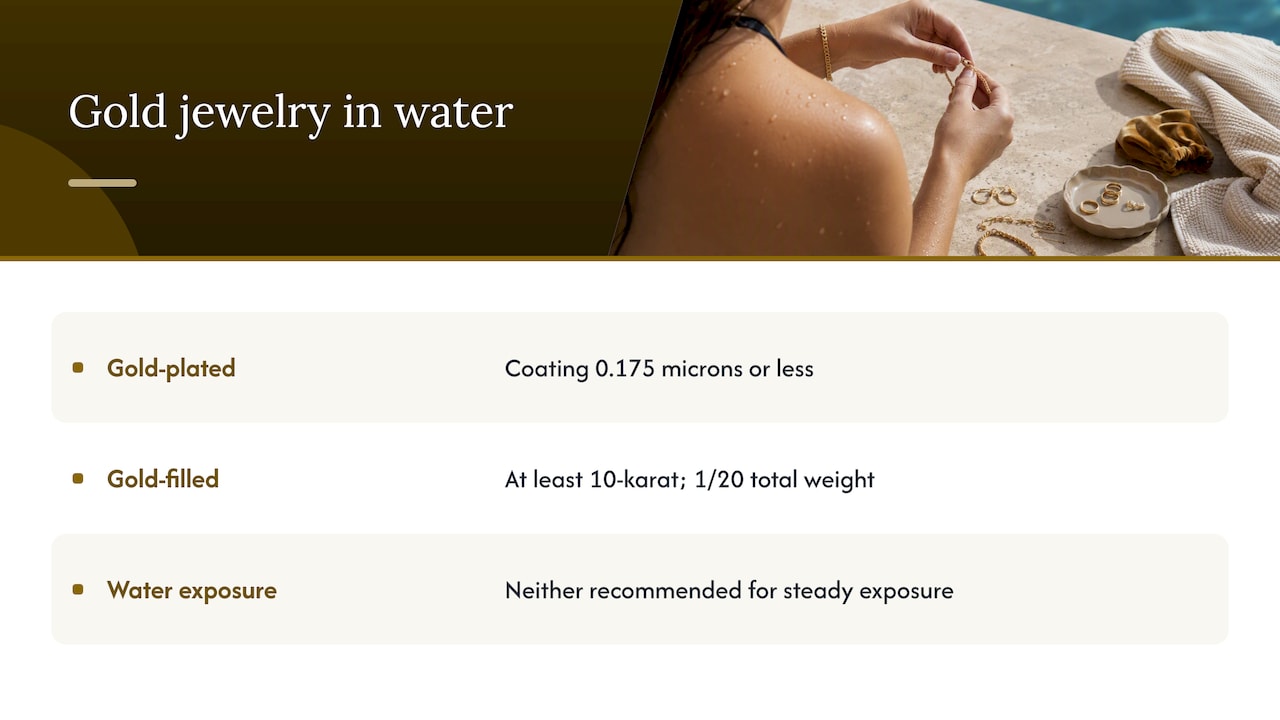
The Federal Trade Commission explains that gold-plated and gold-washed items carry a very thin, non-durable coating, applied by electroplating that can be as thin as 0.175 microns or less. Gold-filled items have a much thicker layer: it must be at least 10 karat gold and make up at least one twentieth of the article’s total weight. That is a far sturdier process. Even so, the FTC notes that neither is recommended for steady exposure to pool chemicals or salt water, which will speed up wear.
So a gold-plated chain that goes into the pool may lose its finish within a few swims, and what shows underneath is a base metal. If you are trying to decide how long a piece should last, our article on gold-filled versus solid gold walks through the trade-offs.
Sterling silver
Sterling silver tarnishes when it meets sulfur, humidity and many chemicals. Chlorine can speed that along. If you love silver, it is perfectly good for dry-land wear, and a soft polishing cloth keeps it bright. Just keep it out of the pool and hot tub.
Platinum
Platinum is dense, durable and does not tarnish, which is why many couples choose it for engagement rings. That does not make it a swimwear metal. The stone, the prongs and any other metal in the piece still matter, and a ring is still easy to lose in the water. Our platinum guide covers the benefits and care in more detail.
Diamonds and gemstones: tough, but not invincible
Diamonds
Diamonds are famously hard, so many people assume they cannot be harmed. The harm comes from two other directions.
First, the setting, as above. Second, oils. Diamonds collect oils from sunscreens and lotions, which dulls their brilliance. The American Gem Society adds that modern products like synthetic sunscreens can coat stones in a layer of oil that attracts dirt, which makes the dulling effect of pool chemicals worse. A day at the beach with sunscreen on your hands is hard on a ring even if you never get it wet.
Pearls, turquoise, coral and other delicate stones
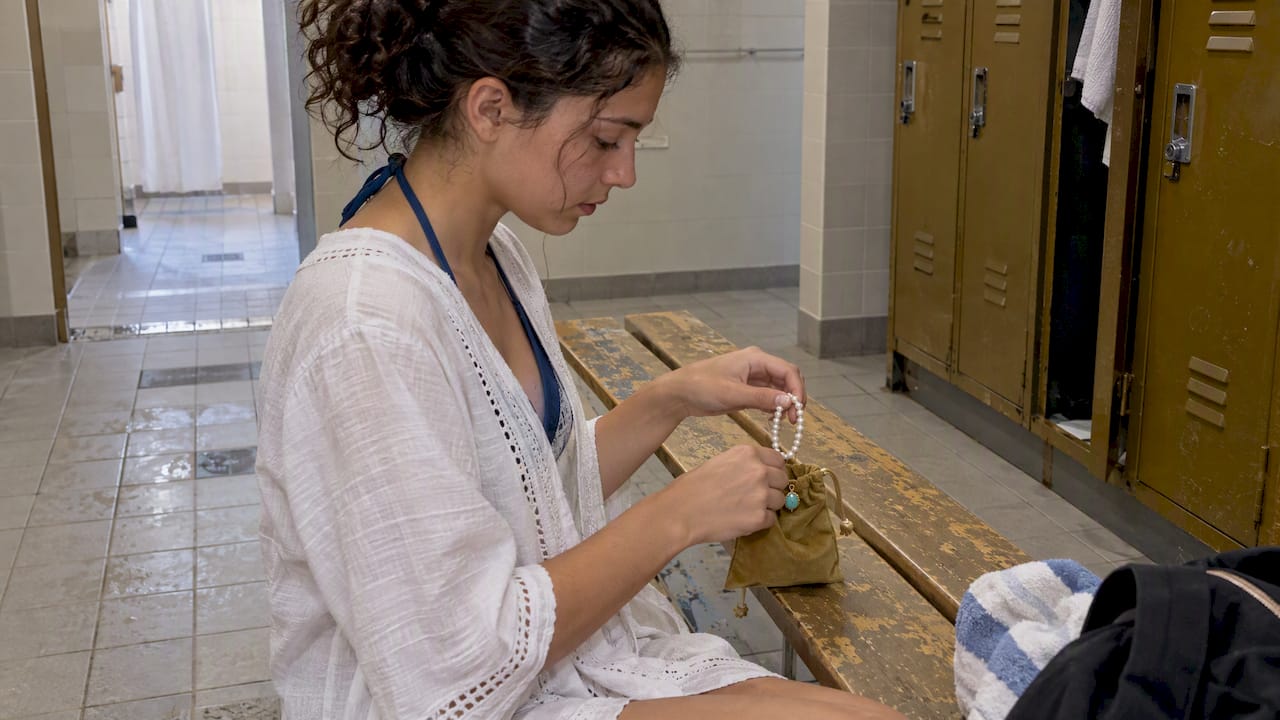
These are the ones to guard most carefully. GIA notes that for pearls, turquoise and coral, chemical exposure is often irreversible and can permanently damage the nacre or surface. They should stay away from chlorinated water, perfume and hairspray.
This matters for gift givers. A pearl bracelet for a teenager or a turquoise pendant for a child is a lovely present, but it is the piece most likely to be ruined at a summer pool party. Tell the person receiving it, and consider a small pouch to go with it.
What about salt water and the ocean?
The ocean brings its own problems. Sand scratches metal, waves tug at chains, and a ring that fits in the morning can be loose after hours in cold water. We do not have a firm number for how fast salt water harms any specific alloy, so we will not invent one. Our practical advice is the same as for the pool: leave valuable pieces behind, and if you do wear something, rinse it in fresh water afterward and dry it well.
Many readers also ask about hot tubs. They are often worse than pools, because the water is warm and heavily treated. GIA includes hot tubs in the same warning as chlorinated pools.
Can you wear a necklace or chain swimming?
A chain is not the same as a ring. It is not holding a stone, so there are no prongs to loosen. But it has a clasp, and the clasp is a small mechanism that can corrode, stick or open. A fine chain can also snag on a swimsuit strap or catch on a pool ladder.
If you must wear one, choose solid gold, make sure the clasp is secure, and rinse and dry it afterward. For children, safety matters more than shine: see our parent’s guide to safety clasps for children’s fine jewelry. Most kids’ pieces are better off in a drawer on swim days.
Our perspective: why we say “take it off”
We are a family business, and we have been making jewelry in-house since 1999. When we build a ring, we think about the next twenty years, not the next summer. That is why we make our pieces solid, not hollow or plated, and why we are honest about what that does and does not mean.
Solid construction makes a piece last. It does not make it waterproof. What we see most often is not a ruined diamond, but a small problem that grew: a prong worn thin, a clasp that stopped closing, a chain that dulled. All of them are easier to prevent than repair. We would much rather you keep a ring dish in your beach bag than call us after a lost stone.
Our view is simple. Wear your jewelry for every moment that matters, and take it off for the few where it can be hurt: the pool, the hot tub, the gym, the dishes. If you want a piece you can wear nearly all the time, choose solid gold or platinum, a lower, sturdier setting, and thicker links. Then keep it clean and checked.
— Joseph
If you already swam in it: what to do
Don’t panic. One dip is rarely a disaster. Here is what to do.
- Rinse right away. Use fresh, lukewarm water to wash off chlorine or salt, as GIA recommends.
- Soak gently. A bowl of warm water with a few drops of mild dish soap works well. Use a soft-bristled brush to clean around the stone and under the setting.
- Rinse and pat dry. Use a soft, lint-free cloth.
- Check the stone. Gently tilt the ring near your ear and listen for a rattle. Look for prongs that no longer touch the stone.
- See a jeweler if anything is off. Discoloration, dullness that won’t clean, or a loose stone all call for a professional look before you wear it again.
We suggest avoiding harsh cleaners and ultrasonic machines on settings you are unsure about, since GIA notes they can compromise the setting. For full step-by-step care by metal, see our guide on how to clean jewelry at home, and for the bigger picture our jewelry care guide. The American Gem Society also publishes home cleaning methods by gemstone, which is worth reading if your stone is not a diamond.
Where to put your jewelry while you swim
Taking it off is only half the plan. Where it goes matters.
- Don’t wrap it in a towel. Towels get shaken out, left on chairs and thrown in the wash.
- Use a zip pouch or small jewelry case that stays in your bag or a locked locker.
- Keep pieces separate. Chains tangle and hard stones scratch softer metals. Our jewelry storage guide shows how to prevent scratches and tarnish.
- Put it back on dry. Hands should be dry and free of sunscreen, which will otherwise coat the stone again.
A lot of couples now wear a simple band while swimming, or leave the engagement ring at home on vacation. If you travel often, a stand-in band is a practical idea.
Choosing jewelry that fits an active life
If you love the water, the best jewelry is not “swim-proof,” but the kind that handles ordinary life well and is easy to take off and put back.
- Pick solid metals. Solid gold or platinum over plated alternatives.
- Choose protective settings. Bezel and low-profile settings have no tall prongs to loosen.
- Keep chains sturdy. Thicker links and a secure clasp reduce snagging and breakage.
- Avoid delicate stones for daily wear. Pearls and similar stones suit special occasions, not pool days.
If you are choosing between metals for a ring, our comparison of platinum and gold engagement rings lets you choose by priority.
Build a piece made to last with us
At USA Jewels, you can design your own jewelry and choose the metal, the diamond shape and the diamond quality that suit your life. Our design-your-own tools start at $399 for a diamond ring, $149 for a chain, $199 for earrings or a pendant, and $499 for a diamond bracelet. Ready-to-ship engagement rings start from $346, platinum jewelry from $327, and sterling silver from $46. You can also browse our solid 14K and 18K gold jewelry.
Every piece comes with free insured shipping and a 30-day money-back guarantee, and our diamonds are certified and conflict-free. Our lifetime diamond upgrade program means your first ring can grow with you.
FAQ
Can I swim with my gold ring?
It is best not to. Solid gold is more forgiving than plated gold, but chlorine can still affect the alloy and the settings that hold stones. A plain band is a smaller risk than a ring with prongs, yet the safest choice is to take either off and keep it in a pouch.
Can you put a chain in water?
A solid gold chain will survive getting wet, such as in a shower or a quick rinse. Chlorine, salt and long soaks are harder on clasps and links, and plated chains can lose their finish. Rinse with fresh water and dry it well if it does get wet.
Can gold-plated jewelry get wet?
It can, but it should not be wet often. According to the FTC, gold plating is a very thin coating, and even thicker gold-filled layers are not recommended for regular pool or salt water exposure. Water speeds up wear, so remove plated pieces before swimming and showering.
Can you wear a necklace swimming?
You can, but there are risks. Clasps can corrode or open, and necklaces can snag on ladders and straps. If the necklace has pearls or other delicate stones, leave it at home. If it is a sturdy solid gold chain, rinse and dry it afterward.
What should I do if my diamond ring was in a hot tub?
Rinse it in fresh water straight away, then soak it briefly in warm water with mild dish soap and brush gently. Check that the diamond is firm in its setting. If it is loose, or the metal looks dull or discolored, have a jeweler inspect it before you wear it again.
Sources
- Traveling in Style: A Guide to Traveling with Jewelry, GIA 4Cs
- Jewelry Hazards to Avoid, American Gem Society
- Jewelry & Gemstone Cleaning Methods to Use at Home, American Gem Society
- Consumer advice on gold, gold-plated and gold-filled jewelry, Federal Trade Commission
Recommended
- Hypoallergenic Jewelry Metals: Why Nickel Release Beats Labels
- Jewelry Storage Guide: Prevent Scratches & Tarnish
- How to Clean Jewelry at Home: Safe Methods for Every Metal
- Jewelry Care Guide: Cleaning, Storage & Maintenance

Deep Mehta is the Co-Owner of USA Jewels, a family-owned jewelry business she has led since 2013 in Deerfield Beach, Florida. With over 13 years of hands-on experience in fine jewelry retail, manufacturing, and diamond importing, Deep specializes in engagement rings, wedding bands, and custom jewelry design. She also co-manages Kaash Group Talent Acquisition. Deep is a University of Florida graduate and oversees every aspect of USA Jewels’ operations, from product development to marketing.
Fine Jewelry Collection

You May Also Like
Bar Setting Rings: How to Balance Sparkle and Resizing With USA Jewels
Resetting Heirloom Diamonds: What You Need to Know