Diamond Cut Grades: How GIA’s Five Levels Change What You See
A diamond’s cut grade measures how well its proportions, symmetry, and polish work together to return light as brightness, fire, and sparkle, and the GIA rates it on a five-point scale from Excellent to Poor. Only standard round brilliant diamonds receive this overall grade, and among the 4Cs, cut often has the biggest visible effect on how alive a diamond looks.
TL;DR:
- GIA grades round brilliant diamonds from 0.15 carats in colors D through Z; fancy shapes receive polish and symmetry scores, but no overall cut grade.
- GIA uses a deductive system, so the weakest component can cap the final grade, and proportion combinations may lower a stone despite individually strong measurements.
- A 1.00 carat, D color VVS1 diamond can cost up to 40% more than a comparable VS1 stone, despite often looking identical without magnification.
- Set a minimum cut grade before choosing color, clarity, or carat; Very Good often offers near Excellent appearance for a lower price.
Table of Contents
- What the GIA cut grading system actually measures
- How GIA turns measurements into a final cut grade
- What each grade actually looks like in the real world
- Where cut fits against color, clarity, and carat
- How to evaluate cut quality before you buy
- Why we treat cut as the starting point, not an afterthought
- Browse certified diamonds or design your own setting
- FAQ
- Sources
What the GIA cut grading system actually measures
When GIA grades a round brilliant’s cut, graders are not judging a single trait. They are weighing three broad categories built from seven individual components, and understanding that framework makes every other number on a grading report make sense.
The first category is face-up appearance, which covers what you actually see when you look down into the stone: brightness (the total light reflecting back to your eye), fire (the flashes of color as light splits into a spectrum), and scintillation (the pattern of light and dark areas, plus sparkle, as the diamond or light source moves). These three qualities are what most people mean when they say a diamond “has life.”
The second category is design, which looks at weight ratio and durability. A diamond cut to preserve carat weight at the expense of proportion can look smaller or duller than its weight suggests, and poor durability characteristics, like an extremely thin girdle, raise the risk of chipping.
The third category is craftsmanship, covered by polish and symmetry. These are graded and reported separately from the overall cut grade, though they factor into it. Polish describes the smoothness of each facet’s surface, while symmetry describes how precisely the facets align and meet.
Together, these seven elements, brightness, fire, scintillation, weight ratio, durability, polish, and symmetry, feed into one overall grade. According to GIA’s 4Cs cut page, this grading scale applies only to standard round brilliant diamonds in the D-to-Z color range weighing 0.15 carats or more.
A few scope details worth keeping in mind:
- The five-point scale runs Excellent, Very Good, Good, Fair, and Poor, in that order.
- Fancy shapes, like ovals, cushions, and emerald cuts, do not receive this overall cut grade because their facet patterns vary too widely for one standard.
- Fancy-shaped diamonds still get polish and symmetry grades, just not a combined cut score.
- The grading applies across the full D-to-Z color spectrum, not just colorless stones.
That last point surprises a lot of buyers. A grading report tells you how well a diamond was cut relative to its own proportions, not how its cut compares to diamonds of different colors or clarities. That separation is exactly what makes cut such a useful, independent lever when you are deciding where to put your budget, a point we come back to later.
How GIA turns measurements into a final cut grade
GIA’s method for assigning a cut grade is deductive, meaning the overall grade can be capped by whichever component scores lowest, rather than averaged across all seven factors. A diamond with excellent brightness and fire but a flaw in symmetry will not earn an Excellent overall grade just because most of its numbers look good elsewhere.
That deductive structure starts with physical measurements. Graders record a set of proportions for every stone, then combine those measurements with visual assessments of finish. The main measured parameters include:
- Table percentage, the width of the flat top facet relative to the diamond’s total width.
- Crown angle and pavilion angle, which control how light enters and exits the stone.
- Lower half length and star facet length, smaller facets that shape the sparkle pattern.
- Girdle thickness, which affects durability and how the stone handles on a ring.
- Culet size, the tiny facet (or point) at the very bottom of the stone.
- Total depth percentage, the stone’s height measured from table to culet as a percentage of its width.
None of these numbers work in isolation. According to GIA’s estimating-cut-grade methodology, the interaction between table size, crown angle, and pavilion angle is especially critical: a table and crown combination that would support an Excellent grade on its own can be pulled down if the pavilion angle falls outside its supporting range.
One of the more counterintuitive facts in diamond grading: even when every individual measurement falls within the top-tier range, parameter interactions can still lower the final grade, which is why two diamonds labeled Excellent can still look noticeably different face-up.
Polish and symmetry, meanwhile, are assessed visually rather than purely by measurement. Graders examine facets under magnification for surface marks, then check facet alignment for precision. GIA’s own Facetware cut estimator, along with precise lab measuring instruments, helps standardize how these proportions are captured before a final grade is issued. For a buyer, the practical takeaway is simple: the grade on the report already accounts for how these pieces interact, so it is a more reliable signal than any single proportion number taken alone.
What each grade actually looks like in the real world
Grade names only mean something once you can picture what they look like on a finger. Here is roughly what to expect face-up at each level, along with the proportion ranges commonly associated with them.
An Excellent cut grade typically shows strong, even brightness across the stone, noticeable fire when it catches light, and a balanced scintillation pattern with no dead or dark zones. Representative ranges in this band include a table percentage around 52% to 62%, a crown angle near 34 to 35 degrees, and a pavilion angle close to 40.6 to 41.8 degrees, according to GIA’s cut estimation chart. To qualify for an overall Excellent grade, polish and symmetry generally need to be Very Good or better.
Very Good diamonds look close to Excellent in most lighting and often cost noticeably less. Proportions sit a bit further from ideal, maybe a slightly steeper crown or a touch more depth, but the difference is subtle enough that even trained eyes sometimes struggle to tell the two apart without a loupe.
Good cut diamonds still perform respectably but show visibly less brightness or a less lively sparkle pattern compared to the two grades above. They remain a reasonable choice on a tighter budget, though the compromise in face-up appearance becomes easier to spot.
Fair and Poor grades indicate proportions, like an overly shallow or overly deep stone, that let light leak out the bottom or sides instead of reflecting back to the eye. These diamonds often look dull or glassy even when their color and clarity grades are high.
A few more specifics worth noting:
- Crown angles across the full Excellent-to-Poor range span roughly 31.5 to 36.5 degrees.
- Total depth percentage outside the high-50s to low-60s range tends to push a stone toward lower grades.
- Girdle thickness that is too thin risks chipping, while too thick adds hidden weight without adding beauty.
- Culet size is ideally none or very small, since a larger culet can create a dark spot visible through the table.
Keep in mind that these ranges overlap at the edges, and personal taste plays a role too. Some people prefer the fire-heavy sparkle of a slightly different proportion set over the balanced brightness GIA’s top grade rewards.
Where cut fits against color, clarity, and carat
Cut is the one quality among the 4Cs that depends entirely on human skill rather than the diamond’s natural characteristics, and it is also the factor most responsible for face-up brilliance. A well-cut diamond can look brighter and more lively than a larger stone with a lower cut grade, even when the larger stone has better color or clarity on paper.
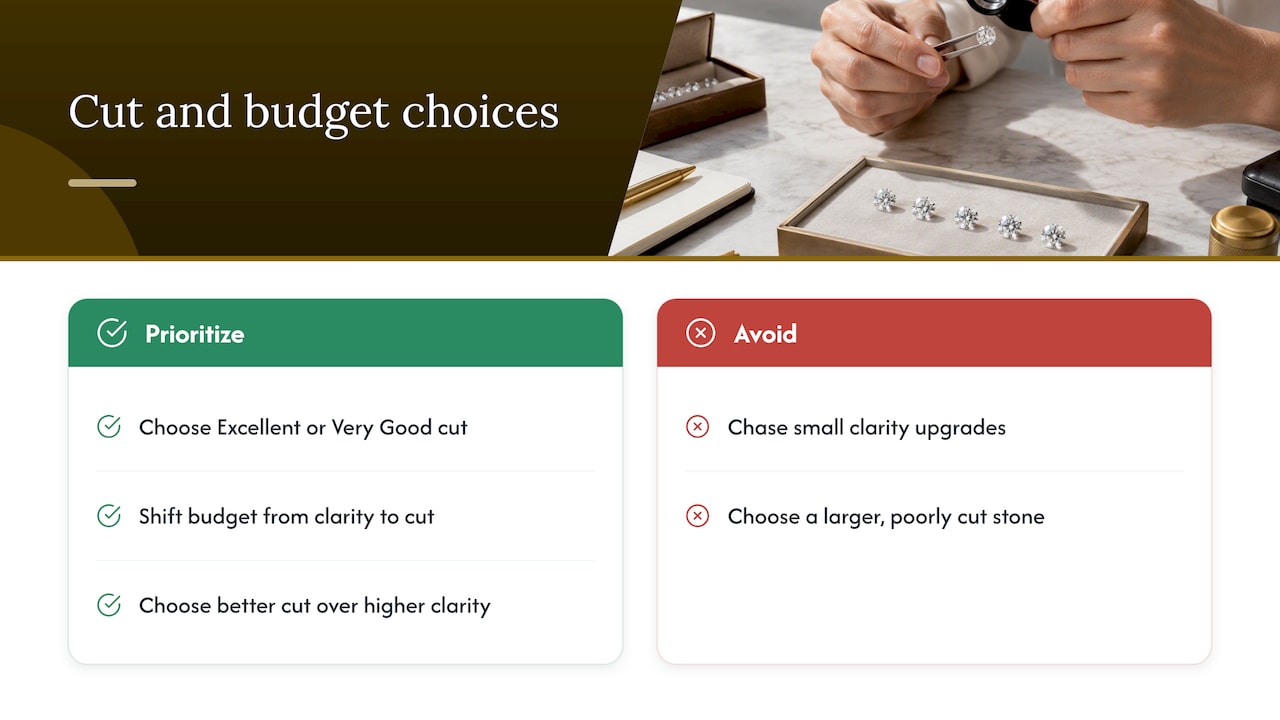
This matters most when you are deciding where your budget actually goes. Clarity differences, in particular, tend to cost more than they visibly deliver. According to GIA’s comparison of VVS and VS clarity, a 1.00 carat, D-color VVS1 diamond can run up to 40% more than a comparable VS1 stone, despite the two often looking identical to the unaided eye. That gap makes a strong case for shifting budget away from marginal clarity upgrades and toward a better cut grade instead.
As a general rule, we’d point you toward Excellent or Very Good for a round brilliant before chasing small clarity upgrades that are unlikely to be visible on the hand. GIA’s own guidance echoes this: Excellent and Very Good cut grades consistently deliver the strongest balance of brilliance, fire, and scintillation, with Very Good often standing out as the better value since the visual difference from Excellent is minor but the price gap is not.
Pro Tip: Choose an Excellent-cut diamond with a slightly lower color or clarity grade over a larger, poorly cut stone. It will almost always look brighter and more alive on the hand.
For a deeper look at how all four qualities interact, our 4Cs buying guide breaks down how to balance tradeoffs based on your priorities, and our color and clarity guide goes further into where those two qualities matter most.
How to evaluate cut quality before you buy
Once you know what the grade means, the next step is knowing what to look for on paper and in person. Here is a practical sequence to follow when you are comparing diamonds:
- Start with the grading report. Check the overall cut grade, then look at the proportions diagram, which shows table percentage, crown and pavilion angles, and total depth in a visual format.
- Review polish and symmetry separately. These sit next to the cut grade on the report; both should be Very Good or Excellent if you want the strongest overall performance.
- Ask for exact measurements. A seller should be able to provide precise table percentage, girdle thickness, and culet size rather than vague descriptions like “well cut.”
- Request photos or light-performance imaging. Seeing how a specific stone handles light tells you more than specifications alone, since two diamonds with identical grades can still show different personalities.
- Run the numbers through a proportion checker. GIA’s Facetware tool lets you plug in measurements to estimate a cut grade, and any reputable jeweler should be comfortable doing this alongside you.
- Watch for red flags. A missing or unverifiable grading report, reluctance to share proportion numbers, or vague answers about polish and symmetry are all reasons to pause.
Our diamond cut guide walks through how these proportions translate to brilliance in more detail, and our round brilliant guide explains why this particular shape is the only one that receives an overall GIA cut grade. If you want a broader read on construction quality signals beyond diamonds, a guide on identifying high-quality craftsmanship covers finish and construction cues that apply across fine jewelry generally.
Why we treat cut as the starting point, not an afterthought
Most buyers walk in asking about carat size first and cut grade last, and we think that order has it backward. Carat weight is the easiest number to compare, so it gets the attention, while cut, the quality that actually determines whether a diamond looks alive or flat, gets treated as a technicality to confirm after the fact.
That instinct is understandable but costly. Two diamonds of identical carat weight and color can look completely different on a hand once cut enters the picture, and the diamond with better proportions will almost always win that comparison, even if it carries a slightly lower clarity grade. If there is one habit worth building before you shop, it is this: decide your cut grade floor first, then shop color, clarity, and carat within that constraint, not the other way around.
The parameter ranges and grading logic we’ve walked through here are not abstractions. They are the same numbers that separate a diamond that photographs beautifully from one that looks dull despite a strong report. Treat them as a checklist, not a mystery.
— Joseph
Browse certified diamonds or design your own setting
We price our diamonds and settings directly, without the markups that come from middlemen, and we back every piece with free insured shipping, a money-back guarantee, and diamond upgrade options. If you already know you want control over cut grade alongside color, clarity, and carat, our design-your-own ring tool lets you build a setting around a diamond that meets your own standards.

Prefer to start with the stone itself? Our certified loose diamonds page lets you filter by cut grade and the rest of the 4Cs, all ethically sourced and ready to pair with a setting whenever you’re ready.
FAQ
Is a VS clarity grade good for a diamond?
Yes, VS (Very Slightly Included) clarity is generally considered a strong, practical choice, since inclusions at this level are typically not visible to the unaided eye. Many buyers choose VS clarity specifically to redirect budget toward a higher cut grade or larger carat weight instead of paying a premium for clarity gains that are hard to see.
What is a lower-cost diamond alternative called?
Diamond simulants, like cubic zirconia and moissanite, are sometimes informally called budget-friendly substitutes, though they differ materially from natural diamonds in hardness, optical properties, and long-term durability. For a closer look at how lab-created stones compare instead, see our lab-created diamonds guide.
How many carats can you get for around $1,000?
Carat weight for a given price depends heavily on color, clarity, and cut grade, so there is no fixed carat size that matches a specific price point. A lower color or clarity grade paired with a strong cut can stretch a modest budget further while still looking bright and lively face-up.
What is the difference between a brilliant cut and an Excellent cut?
“Brilliant cut” refers to a facet style, the round brilliant being the most common, designed to maximize light return through a specific arrangement of facets. “Excellent” is a cut grade describing how well a specific diamond’s proportions, polish, and symmetry were executed within that style, so a round brilliant diamond can earn any grade from Excellent to Poor depending on how it was cut.
Sources
Recommended
- Diamond Cut Guide — How Cut Grades Affect Brilliance
- Diamond Clarity Chart — FL to I3 Grades Explained
- Diamond Quality 4Cs Breakdown: Your Buying Guide
- GIA Certification Diamonds: What Buyers Need to Know

Deep Mehta is the Co-Owner of USA Jewels, a family-owned jewelry business she has led since 2013 in Deerfield Beach, Florida. With over 13 years of hands-on experience in fine jewelry retail, manufacturing, and diamond importing, Deep specializes in engagement rings, wedding bands, and custom jewelry design. She also co-manages Kaash Group Talent Acquisition. Deep is a University of Florida graduate and oversees every aspect of USA Jewels’ operations, from product development to marketing.
Fine Jewelry Collection

You May Also Like
Why Two-Tone Engagement Rings Are So Popular
How to Measure Your Wrist for the Right Bracelet Size