Personalized Couples Jewelry Ordering Steps Made Easy
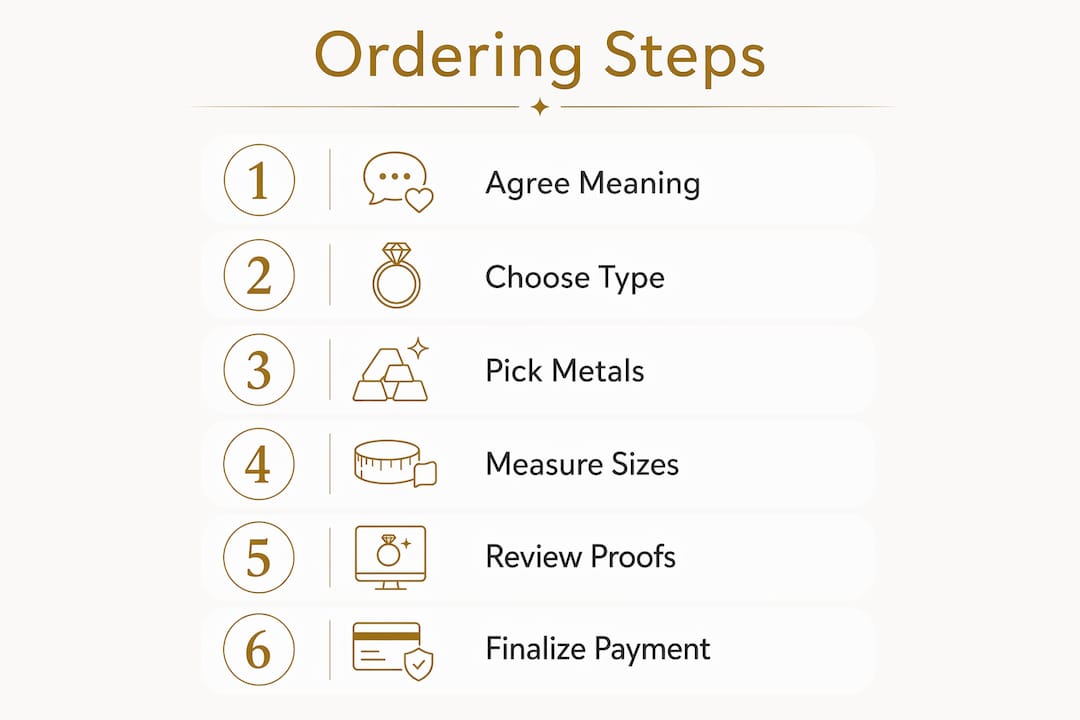
Ordering personalized couples jewelry follows six clear steps: agree on meaning and style → choose jewelry type and materials → select personalization options → measure sizes → review proofs and confirm → finalize payment and shipping. Get those six steps right, and you avoid the most common mistakes: misspelled engravings, wrong ring sizes, and pieces that arrive too late for the occasion. Simple engraved pieces typically ship in 3–10 business days, while fully bespoke fine jewelry usually requires 4–12 weeks from design approval to delivery. Usajewels, a family-owned in-house manufacturer with a tradition of trust since 1999, walks every couple through each of these stages so nothing falls through the cracks.
Before you contact any jeweler, confirm these five things:
- Agreed spelling of all names, dates, or phrases to engrave
- Both partners’ correct sizes (ring, bracelet, or necklace length)
- Target delivery date and whether rush production is needed
- Proof or CAD review approved in writing before production starts
- Payment method and deposit amount confirmed
Table of Contents
- What Are the Personalized Couples Jewelry Ordering Steps?
- How do you choose metals, finishes, and personalization options?
- How do you get accurate sizes for rings, bracelets, and necklaces?
- What should you expect for timelines, costs, and shipping?
- What questions should you ask before placing an order?
- Why does in-house manufacturing matter for couples’ custom orders?
- Key Takeaways
- What couples get wrong when ordering custom jewelry
- Usajewels makes the custom process personal from the first conversation
- Useful sources and next steps
- FAQ
What Are the Personalized Couples Jewelry Ordering Steps?
The six steps below are the backbone of every successful custom order, from a simple engraved pendant to a matched set of fine diamond rings. Work through them in order, and you will have everything a jeweler needs to produce exactly what you envisioned.
Step 1: Agree on meaning and style together
Start with the story you want the pieces to tell. Do you want matching rings that are identical, or coordinated pieces that share one design element — say, the same engraved date on the inside of both bands? Choosing one shared detail (a hidden stone, a finish, a phrase split across two pieces) connects the set without forcing both partners into an identical style. Collect three to five reference images before you speak to a jeweler. Most designers can work from a photo or a short description rather than a finished sketch, so you do not need to arrive with a blueprint.
Step 2: Choose jewelry type and matching approach
Decide whether you want rings, necklaces, bracelets, or a mixed set. Matching pieces share the same design; coordinated pieces share a single element while the rest of the design suits each wearer’s taste. For guidance on designing matched or coordinated ring sets, Usajewels offers detailed examples of both approaches. Write down your choice before the consultation so the jeweler can quote accurately.
Step 3: Pick metal, finish, and personalization format
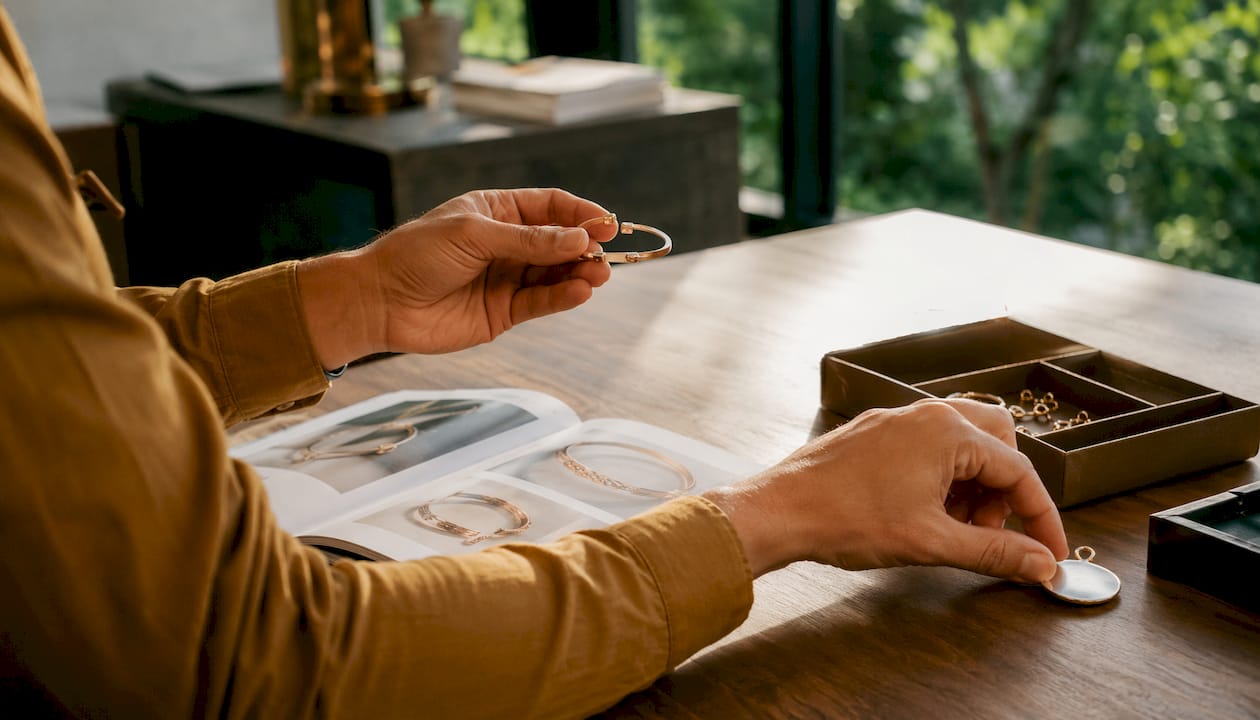
Choose your metal family (yellow gold, white gold, rose gold, platinum, or sterling silver) and finish (polished, matte, hammered, or black rhodium). Then decide on your personalization: inside engraving, outside engraving, coordinates, a split phrase across two pieces, or a birthstone setting. Confirm the engraving method — laser engraving holds detail well on curved surfaces; hand engraving adds a slightly organic texture; stamped text suits simpler, bolder fonts.
Step 4: Measure sizes accurately
Collect ring sizes, bracelet wrist measurements, and preferred necklace lengths for both partners before the order. Sizing details are covered fully in the dedicated section below.
Step 5: Review proofs and confirm in writing
CAD models and design proofs are the critical gate in any custom order. Small changes cost almost nothing at the digital stage; after casting or stone-setting begins, corrections become expensive and time-consuming. Read every character of the engraving on the proof. Save a screenshot or email confirmation of your approval.
Pro Tip: Never approve a proof on a small phone screen. Open the image on a laptop or tablet, zoom in on the engraving, and read it aloud to your partner before clicking “approve.”
Step 6: Finalize payment and shipping
Confirm the deposit amount, the balance due date, your shipping address, and whether the package requires a signature on delivery. Ask for an order confirmation number in writing. If the piece is a gift, verify the packaging and whether a gift note can be included.
Pro Tip: If you have a hard event date, count backward from it. Start complex custom projects at least 10 weeks ahead; most pieces complete in 4–8 weeks from design approval, but revision rounds add days.
How do you choose metals, finishes, and personalization options?
Material choices affect how the pieces look on day one and how they hold up over years of daily wear. Getting this right for two people with different skin tones, lifestyles, and budgets takes a little more thought than a solo purchase.
Metal families compared
- Yellow gold (14K or 18K): Warm, classic, and the most traditional choice for engraved couples pieces. 14K is more durable for daily wear; 18K is richer in color but softer.
- White gold: Bright and modern, rhodium-plated for a mirror finish. Replating every few years keeps it looking new.
- Rose gold: Warm pink tone that photographs beautifully; pairs well with champagne or morganite stones.
- Platinum: The most durable and hypoallergenic option, naturally white, and heavier than gold. Higher cost reflects the metal’s density and rarity.
- Sterling silver: Affordable and versatile, but requires more maintenance to prevent tarnish. Best for pieces worn occasionally rather than daily.
Finishes and daily-wear tradeoffs
Polished finishes show scratches more readily but are easy to re-polish. Matte and brushed finishes hide minor wear and suit a more understated look. Hammered textures add visual depth and are forgiving of everyday contact. Black rhodium plating creates a dramatic contrast but can wear in high-contact areas over time.
Personalization options that work for two people
- Inside engraving: Hidden and intimate; ideal for dates, initials, or short phrases. Most bands accommodate 15–25 characters depending on width.
- Outside engraving: Visible and decorative; coordinates, names, or a word in a script font work well.
- Split phrases: One half of a phrase on each piece (“You are my” / “greatest adventure”). Meaningful and visually connected without being identical.
- Coordinates: Latitude and longitude of a meaningful location. Confirm the format (decimal degrees vs. degrees/minutes/seconds) with your jeweler before engraving.
- Birthstones: One stone per partner, set into matching bezels or prongs. Pair stones that complement each other in color — sapphire and aquamarine, for example, share a blue family without being identical.
Pro Tip: Engraving on a narrow band (under 3mm wide) limits you to small fonts and fewer characters. Ask your jeweler for a character-count limit and a font legibility test at actual size before you finalize the text. What looks elegant at 72pt on a screen can become unreadable at 1.5mm tall on metal.
For more detail on engraving text length and font placement, Usajewels publishes practical guidance on what works on small surfaces.
How do you get accurate sizes for rings, bracelets, and necklaces?
Wrong sizes are the single most common reason a custom piece needs to be remade or returned. Measure carefully, and measure twice.
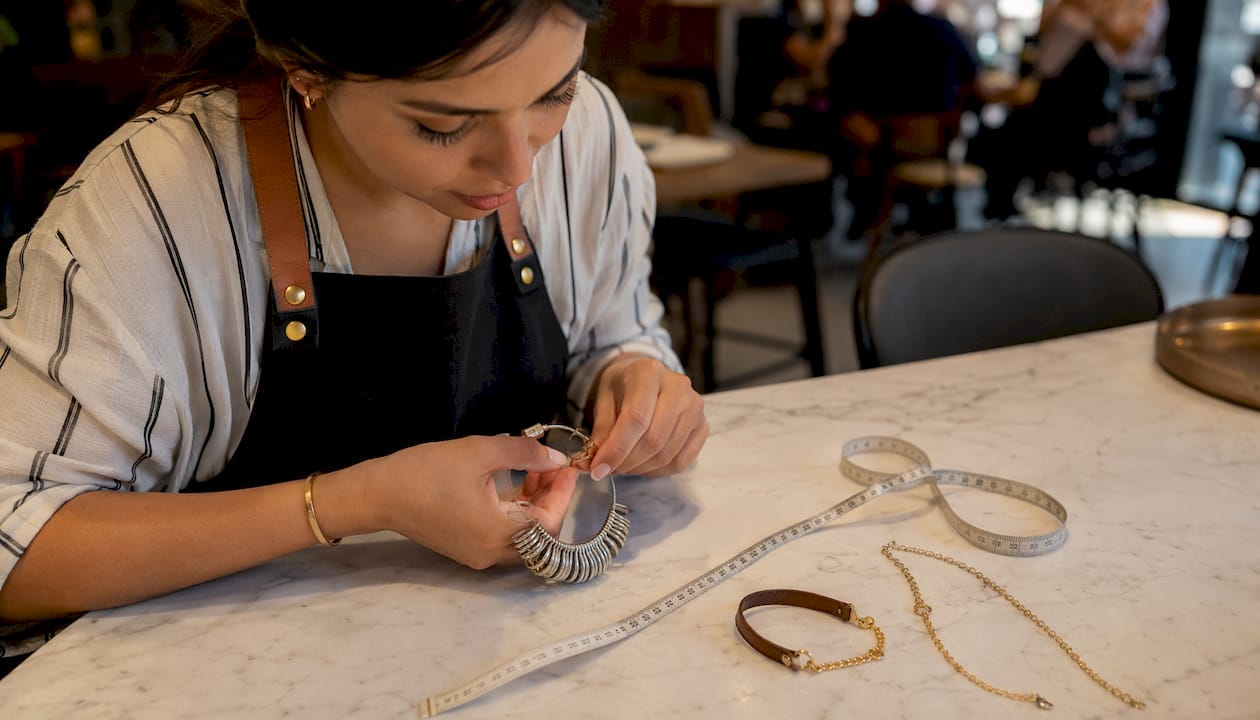
Ring sizing
- Printable ring sizer: Download a printable sizing guide, cut it out, and wrap it around the finger. Accurate for most people; less reliable if printed at the wrong scale.
- Measure a well-fitting ring: Place an existing ring on a ruler and measure the inside diameter in millimeters. Cross-reference against a standard US ring size chart.
- In-store sizing: The most accurate method. A jeweler uses a set of metal sizing rings to find the exact fit, accounting for knuckle size and finger shape.
- Width matters: A wide band (8mm+) fits tighter than a narrow one. If you are ordering a wide band, go up half a size from your usual measurement.
- Comfort-fit interiors: Rounded inside edges make wide bands easier to slide on. Ask whether the design includes a comfort-fit profile.
- Fallback: If size is genuinely unknown, ask about resizing policies before ordering. Many jewelers offer one free resize within a set window; confirm this policy in writing before you pay.
Bracelet sizing
Measure the wrist with a soft tape measure or a strip of paper, then add a comfort allowance. For a snug fit, add ½ inch; for a standard fit, add ¾ inch; for a loose, relaxed fit, add 1 inch. Chain bracelets often have adjustable clasps that cover a range of sizes, which makes them a practical choice when one partner’s size is uncertain. For a detailed bracelet selection and sizing guide, the bridal retail resource at The Wedding Garter covers the key considerations.
Necklace length
Standard chain lengths and where they fall on the body:
- 16 inches: Sits at the collarbone; suits pendants worn close to the neck.
- 18 inches: The most versatile length; falls just below the collarbone.
- 20 inches: Sits at the top of the chest; works well with larger pendants.
- 24 inches: Falls at or below the sternum; suits layered looks.
When both partners are ordering necklaces, they may prefer different lengths so the pieces layer naturally when worn together. Pendant size also affects perceived length: a large pendant pulls the chain down visually, so a shorter chain often works better with a substantial pendant.
Troubleshooting unknown sizes: Adjustable chains (with a sliding bead or multiple clasps), removable links, and open-ended bangles are practical solutions when you cannot measure in advance. Ask your jeweler which designs offer built-in size flexibility.
What should you expect for timelines, costs, and shipping?
Setting realistic expectations before you order prevents the most stressful part of the custom jewelry experience: discovering the piece will not arrive in time.
Typical production timelines
| Order type | Typical lead time |
|---|---|
| Simple engraved pendant or chain | 3–10 business days |
| Stock piece with name/date personalization | 5–10 business days |
| Semi-custom (modified existing design) | 2–4 weeks |
| Full bespoke with CAD and stone sourcing | 4–12 weeks |
The CAD and sketching phase alone typically runs 1–2 weeks, and production adds another 2–6 weeks for complex pieces. Build at least one revision round into your schedule.
What drives cost
- Metal choice: Platinum costs more than gold; gold costs more than silver. Heavier pieces use more metal.
- Stone type and quality: Diamond quality (cut, color, clarity, carat) is the largest single cost variable in fine jewelry.
- Custom work complexity: More design revisions, hand engraving, and intricate settings all add labor cost.
- Rush fees: Expedited production typically adds a percentage surcharge; ask for the exact figure upfront.
- Shipping and insurance: Insured, signature-required shipping for fine jewelry is worth the added cost. Never ship an uninsured piece.
Deposits, payments, and returns
Many bespoke jewelers require a non-refundable deposit of around 50% to begin a custom commission, because design time and sourced materials cannot be resold. The balance is typically due before shipping. For personalized pieces, return windows are often restricted or unavailable once engraving or stone-setting is complete. Confirm the exact return and resizing policy before you pay anything.
Planning for a special date: For a proposal, anniversary, or holiday gift, count backward from the event. Complex custom projects should start at least 10 weeks ahead; most custom pieces complete in 4–8 weeks from design approval, while simple engraved jewelry typically ships in 3–10 business days. Ordering online for wedding-related jewelry carries its own timing considerations, and ordering wedding jewelry online can be a practical option when you plan ahead and confirm production timelines with the maker.
What questions should you ask before placing an order?
A good jeweler welcomes these questions. One who deflects them is a red flag.
Key questions to ask
- Where is the piece manufactured, and who does the work in-house?
- What does the proof or CAD review process look like, and how many revisions are included?
- What is your deposit policy, and is it refundable under any circumstances?
- What is your resizing policy, and is one resize included in the price?
- How is the piece shipped, and is it insured and signature-required?
- What is the gemstone’s origin, and do you provide certification?
- What is your return window, and does personalization affect it?
Red flags to watch for
- Vague or shifting timelines with no written confirmation
- No proof, CAD, or design preview before production begins
- Unwillingness to put deposit terms, timelines, or policies in writing
- Pressure to skip the proof review and go straight to production
- No clear answer on gemstone origin or quality grading
Final pre-order checklist
Before you submit payment, confirm every item on this list:
- Engraving text spelled correctly (read it aloud, character by character)
- Both partners’ sizes confirmed and recorded
- Proof or CAD screenshot saved and approval sent in writing
- Delivery address verified, including apartment or suite number
- Contact phone number provided for delivery signature
- Agreed production timeline and event date confirmed in writing
- Order confirmation number received and saved
Document every approval. Save designer emails, screenshot proofs, and keep your order confirmation number accessible until the piece arrives and you have inspected it.
Why does in-house manufacturing matter for couples’ custom orders?
When a jeweler manufactures in-house, every stage of the process stays under one roof. That means faster design iterations, clearer accountability, and direct quality control at each step — no outsourcing to a third-party workshop you cannot contact.
Usajewels has operated as a family-owned, in-house manufacturer since 1999. Their workflow maps directly onto the six ordering steps: consultation → CAD and proof review → deposit → production → quality assurance → insured shipping. Ethical sourcing and conflict-free materials are built into their process, not an afterthought. Their lifetime diamond upgrade program means a piece purchased today can grow with the relationship over time. With over 222 Google reviews reflecting consistent customer satisfaction, the track record speaks clearly.
What you get from in-house production:
- Faster design revisions because the designer and the bench jeweler are in the same facility
- Direct provenance on materials — you can ask exactly where a stone came from
- One point of contact from first sketch to final delivery
- Quality checks at each production stage, not just at the end
Before your consultation with Usajewels, prepare your pre-consultation checklist: budget range, inspiration images, known sizes, metal preferences, and your target date. Arriving with those details ready shortens the design phase and gets your piece into production faster.
Key Takeaways
Ordering personalized couples jewelry successfully comes down to six ordered steps, accurate measurements, written proof approval, and enough lead time to avoid rush fees.
| Point | Details |
|---|---|
| Follow the six-step order | Agree on meaning → pick type and materials → choose personalization → measure → approve proof → pay and ship. |
| Build in enough time | Simple engraved pieces typically ship in 3–10 business days; fully bespoke fine jewelry usually requires 4–12 weeks from design approval. |
| Approve proofs in writing | Save a screenshot or email of every proof approval; changes after casting are costly. |
| Confirm deposit terms upfront | Many bespoke jewelers require a non-refundable deposit; get the policy in writing before paying. |
| Usajewels for in-house custom work | Family-owned since 1999, with ethical sourcing, lifetime diamond upgrades, and numerous positive Google reviews backing their process. |
What couples get wrong when ordering custom jewelry
The most common mistake is assuming that “personalized” means fast. A couple orders matching rings two weeks before an anniversary, selects a fully bespoke design, and then discovers the production window alone is four to six weeks. The fix is simple: treat the timeline section of this guide as a non-negotiable planning tool, not optional reading.
The second mistake is approving a proof too quickly. Engraving errors are almost always caught at the proof stage — and almost never caught after the piece ships. One letter transposed in a name, a date with the month and day swapped, a font that looked elegant on screen but is illegible at 1.5mm. Read every character aloud. If you are ordering as a surprise gift and cannot ask your partner to review, have a trusted friend read the proof with fresh eyes.
The third mistake is skipping the resizing conversation. Many couples assume resizing is free and unlimited. It often is not, especially for engraved bands or pieces with stones set around the full circumference. Confirm the resizing policy before you pay the deposit, not after the piece arrives and does not fit.
One practical fix for all three: contact the maker early, share your event date on the first call, and ask directly about proof turnaround, revision limits, and resizing terms. A jeweler who answers those questions clearly and in writing is one you can trust with a piece that matters.
Usajewels makes the custom process personal from the first conversation
Usajewels was built on one straightforward idea: quality custom jewelry should not require a luxury-house budget or a middleman who adds cost without adding value. As a family-owned, in-house manufacturer, they offer fine jewelry collections and fully personalized couples pieces — engraved sets, coordinated necklaces, matched rings, and birthstone designs — all produced under one roof with direct pricing and no unnecessary markups.
The couples who work with Usajewels get a clear proof review process, ethical and conflict-free sourcing, and a lifetime diamond upgrade program that makes the investment grow with the relationship. Their team has been doing this since 1999, and the 222+ Google reviews reflect what that experience looks like in practice. Whether you are starting with a design idea or just a feeling, their consultation process is built to meet you where you are. Browse the jewelry collections to find your starting point, or reach out directly to begin a custom consultation and get your design into production.
Useful sources and next steps
Use these links based on where you are in the process:
- Ready to start a design: Visit the design-your-own guide for a step-by-step walkthrough of the custom commission process at Usajewels.
- Choosing a ring style: The engagement rings collection shows matched and individual options with clear customization paths.
- Personalization ideas: Browse personalized jewelry gift ideas for engraving styles, metal pairings, and gemstone options across different budgets.
- Planning for a surprise or special date: The custom jewelry gift surprise planning guide covers timing, logistics, and how to order without spoiling the moment.
- Name necklaces and monograms: Read what name necklace jewelry is for style guidance before you order.
- Gift presentation: The gift ideas page includes packaging and presentation options for couples’ orders.
Before you contact any jeweler, prepare your checklist: agreed spelling, both sizes, inspiration images, metal preference, budget range, and your target date. Arriving with those details ready is the single fastest way to move from idea to finished piece.
FAQ
How long does personalized couples jewelry take to make?
Simple engraved pieces typically ship in 3–10 business days; fully bespoke fine jewelry usually requires 4–12 weeks from design approval to delivery. Plan for at least 4–8 weeks to be safe for most custom orders; simple engraved pieces typically ship in 3–10 business days, while fully bespoke fine jewelry usually requires 4–12 weeks from design approval to delivery.
How do you personalize couples jewelry?
Choose a shared design element — a matching engraving, a split phrase, coordinated birthstones, or the same finish — then provide the exact text, sizes, and metal preferences to your jeweler before the proof stage.
What is a couple chain, and how does it work?
A couple chain is a necklace set where each partner wears one piece that connects symbolically to the other, often through a split pendant, complementary shapes, or a shared engraving. Each person wears their own chain; the pieces are designed to feel like two halves of one whole.
Do jewelers require a deposit for custom couples jewelry?
Yes. Many bespoke jewelers require a non-refundable deposit of around 50% to begin a custom commission, covering initial design work and material sourcing. Confirm the exact deposit terms in writing before you pay.
Can you resize an engraved couples ring after ordering?
Resizing is possible for many ring styles, but engraved bands and rings with stones set around the full circumference may have restrictions. Always confirm the resizing policy with your jeweler before placing the order.
Recommended
- How Jewelry Personalization Options Work for Gifts
- Personalized Jewelry Gift Ideas for Every Occasion
- Wedding Jewelry | Bridal Rings & Earrings | USA Jewels
- How to Personalize Engraving on an Engagement Ring

Deep Mehta is the Co-Owner of USA Jewels, a family-owned jewelry business she has led since 2013 in Deerfield Beach, Florida. With over 13 years of hands-on experience in fine jewelry retail, manufacturing, and diamond importing, Deep specializes in engagement rings, wedding bands, and custom jewelry design. She also co-manages Kaash Group Talent Acquisition. Deep is a University of Florida graduate and oversees every aspect of USA Jewels’ operations, from product development to marketing.
Fine Jewelry Collection

You May Also Like
Custom Jewelry Gift Surprise Planning: Your 2026 Guide
GIA Certification Diamonds: What Buyers Need to Know