
Sleeping With Your Engagement Ring: Is It Safe?
You can sleep with your engagement ring on, and nothing dramatic will happen tonight. But jewelers and insurers still advise taking it off before bed, because the small risks add up over months and years. Prongs snag, bands bend, fingers swell, and the stone you saved for can quietly work loose while you dream.
This guide explains exactly what can go wrong, which rings are riskier than others, the few cases where a nighttime exception is reasonable, and how to make “ring off at bedtime” an easy habit instead of a chore. We are a family jewelry maker, so we have seen what years of wear do to settings. We will tell you plainly what we think.
TL;DR
- Sleeping in your ring occasionally is unlikely to ruin it, but jewelers recommend removing it before bed because snagging on sheets or hair can weaken prongs and risk stone loss.
- Sharp-edged shapes such as pear, marquise and princess cuts are the riskiest to wear at night, for you and for your partner.
- Hands can swell overnight. If your ring feels tight in the morning, take it off sooner rather than later.
- Pick one permanent spot, like a dish on your nightstand, so the ring never gets misplaced.
- Have the prongs checked about every six months, and choose a secure setting if you plan to wear the ring a lot.
Table of Contents
- What actually happens to a ring overnight
- Does the shape of your ring change the risk?
- Swollen fingers: the health side
- Our perspective: why we say “off at night”
- When sleeping in your ring is reasonable
- How to build the habit of taking it off
- Check the setting every six months
- Choosing a ring you can live with day and night
- Design a ring made for everyday wear
- Frequently asked questions
- Sources
What actually happens to a ring overnight
Nobody lies perfectly still for eight hours. You roll, tuck your hand under a pillow, pull up the blanket and push hair off your face. Each of those movements gives your ring a chance to catch on something.
A diamond is usually held by prongs, which are narrow metal supports, typically used in groups of four to six. They are strong enough for daily life, but they are thin by design so the stone can show. A prong that catches on a loose thread and bends a fraction of a millimeter may not look different in the morning. Do it often enough and the gap grows.
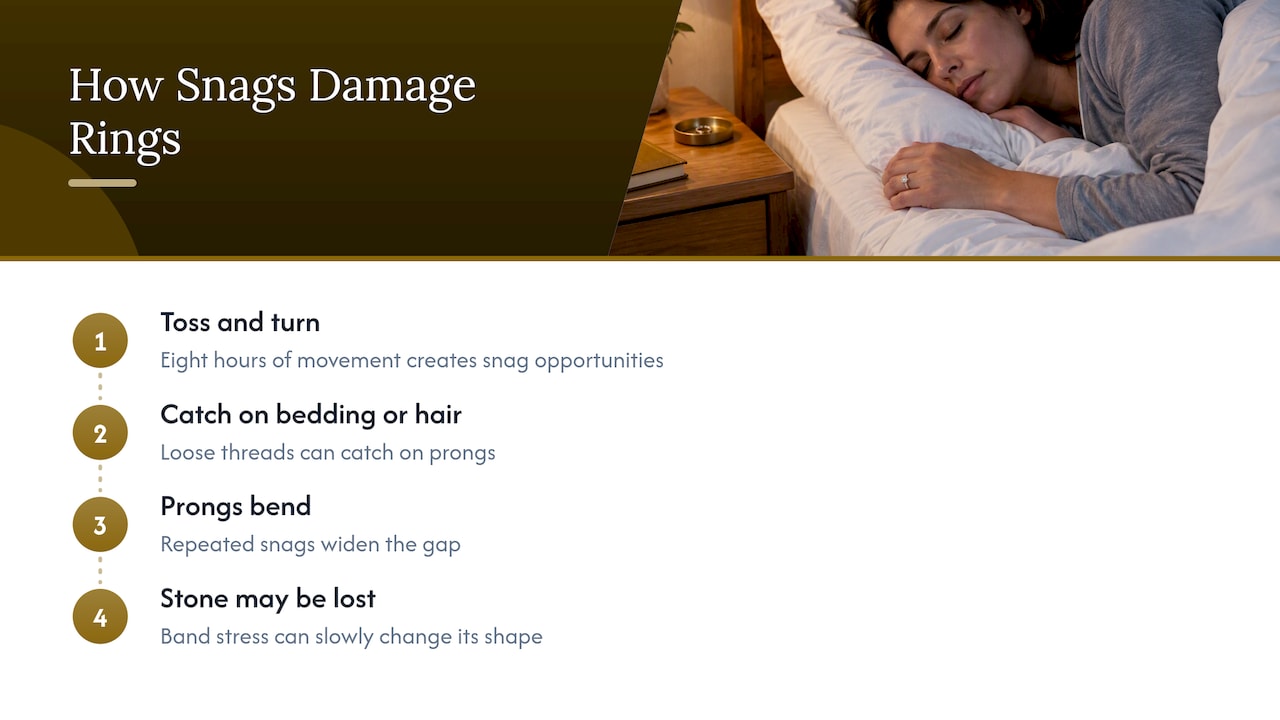
Professional jewelers say frequent snagging on bedding or hair can weaken prongs and eventually cost you the center stone or an accent stone. They also note that tossing and turning can put stress on the band and slowly change its shape. That guidance comes from Jewelers Mutual, an insurer that handles ring claims, so it is worth taking seriously.
The four things that go wrong
- Snagged prongs. Sheets, blankets, sweaters and hair are the usual culprits. This is the main way stones get lost.
- A bent or distorted band. Pressing your hand under your head or body for hours puts uneven force on thin bands, especially delicate ones.
- Scratches. Metal rubs against metal and fabric. Your skin, your partner’s skin and your face can all take a scratch from a raised setting.
- Swelling and skin irritation. Moisture, oils and a snug fit overnight can leave skin red or sore under the band.
Does the shape of your ring change the risk?
Yes. A low, smooth, bezel-style ring with a round stone is one thing. A tall solitaire with pointed corners is another.
Experts point out that stone shapes with sharp edges, such as pear, marquise and princess cuts, carry a specific and avoidable risk of scratching you and your partner during sleep. Large stones add leverage, which gives the setting more to catch on. Intricate designs with open galleries, milgrain detail or lots of small pavé stones also give threads and hair more places to hide.
| Ring feature | Nighttime risk | Why |
|---|---|---|
| Tall, high-set center stone | Higher | Catches on fabric and hair easily |
| Pointed corners (pear, marquise, princess) | Higher | Sharp points can scratch skin |
| Four-prong setting | Moderate | If one prong bends, less holds the stone |
| Six-prong setting | Lower | More metal holding the diamond if one prong catches |
| Smooth plain band | Lowest | Little to snag, though it can still dent or press on skin |
If you are still choosing a shape, our guide to the best diamond shapes for engagement rings covers how each one holds up to daily wear. For a closer look at one common comparison, see cushion vs. princess, which includes durability.
Swollen fingers: the health side
This is not only about the ring. Hands can puff up overnight, and a ring that slid on easily at dinner may feel tight at breakfast. Zola’s wedding advice notes that some people get slight hand swelling overnight, which is one reason it recommends leaving rings off at bedtime.
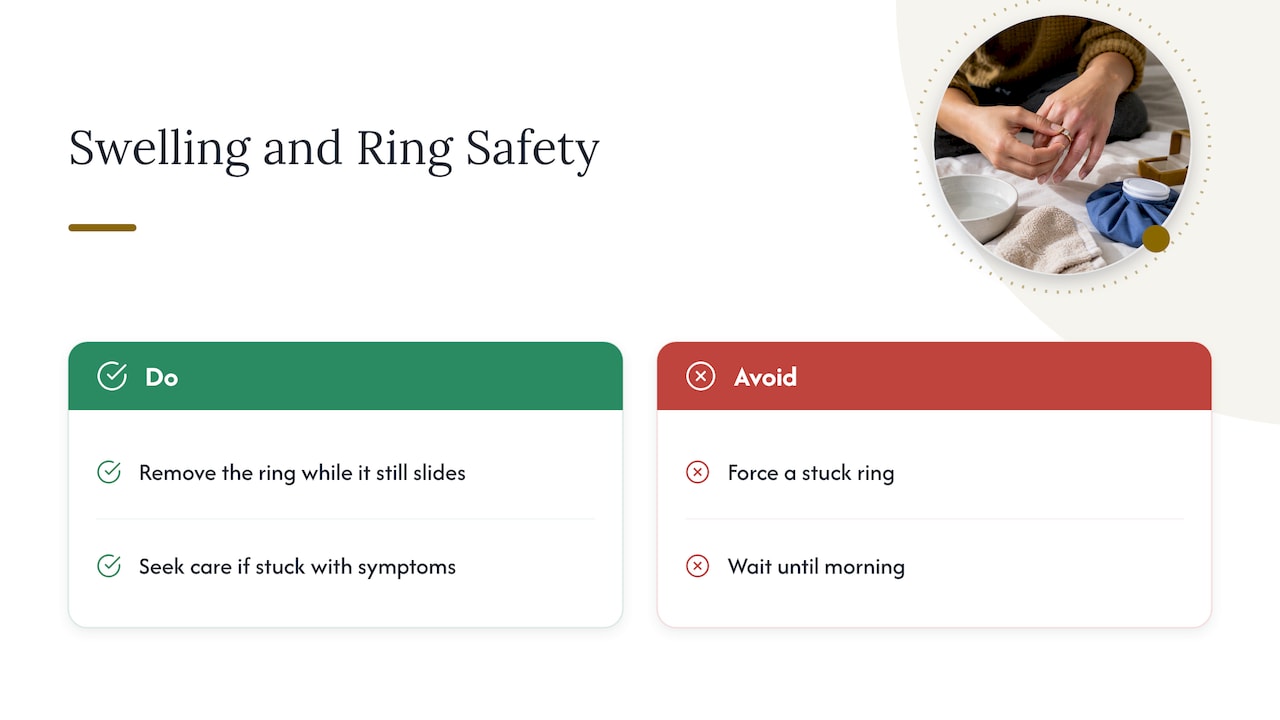
A ring that will not come off is a real problem. The Mayo Clinic’s guidance on hand swelling describes people whose fingers get so puffy they cannot remove their rings. Its separate advice on minor burns says to take off rings and other tight items quickly and gently before the area swells.
So the practical rule is simple. If your finger swells for any reason, such as a minor injury, a workout, a sunburn or a hot night, remove the ring right away while it still slides. If a ring is stuck and the finger looks discolored, feels numb or hurts, see a doctor or urgent care instead of forcing it. Do not wait until morning.
If the ring is tight most days, that is a fit issue. A jeweler can often resize it, and it is better to fix that than to fight the ring every night. We also wrote about the opposite problem, a loose ring that rotates, in our guide to stopping ring spinning.
Our perspective: why we say “off at night”
We are a family-owned jeweler. We have made rings in-house since 1999, so we have seen plenty of settings come back after years of wear. The pattern is almost always the same. Nobody dropped the ring or hit it with a hammer. A prong wore thin from many small catches, and one day a stone went missing.
Here is what we tell couples who sit down with us to design a ring:
- The ring should fit your life, not just your photos. If you want to wear it every day, we help you choose a lower setting, sturdier prongs and a shape that suits how you live.
- Solid construction matters. Our pieces are solid, not hollow or plated, which gives a setting the strength to hold up to years of wear. It does not make a ring immune to snags, though, so the nightly habit still helps.
- Nights are for resting, not for testing your setting. Eight hours of rolling around is the least useful stress test you can give a diamond.
- A lost ring is a bigger risk than a lost night. That is why we suggest one fixed home for the ring, so taking it off feels safe, not scary.
If you buy a diamond from us, we back it with our lifetime diamond upgrade program, free insured shipping and a 30-day money-back guarantee. Still, no program replaces taking care of the ring you already love.
— Joseph
When sleeping in your ring is reasonable
We are not here to scold. Real life happens, and a single night will not undo your ring. Here are the situations where we think it is fine, and how to keep the risk low.
- A simple, smooth band. Plain wedding bands with no stones and no raised parts have little to snag. One jeweler guide says simple bands are far less of a concern, though we would still remove one if your fingers swell.
- The night of the proposal or wedding. Nobody takes a brand-new engagement ring off on the first night. Just keep your hair tied back and your hands out of your pillow.
- Travel or an emergency. If you are in a hospital, a hotel or a hurry, keeping the ring on may be safer than leaving it somewhere unfamiliar. Move it to a pocket in your bag in the morning.
If you do wear it to bed once in a while, check it the next day. Run a fingertip around the setting and look for a prong that stands up or a stone that tilts.
How to build the habit of taking it off
Some people say that taking the ring off more often raises the chance of losing it. That is a fair point. Brides reports experts suggesting a dedicated, permanent place where the ring lives each night, which balances safety with habit.
- Choose one spot. A small dish on your nightstand works well. Vogue’s ring care advice suggests the same: a small dish near the bed.
- Make it the last step. Put the ring in the dish when you brush your teeth or put your phone on the charger. Link it to something you already do.
- Use the same hand, same motion. Habit sticks when it is physical. Slide it off, set it down, done.
- Keep the dish away from the edge. Pets, children and a sleepy elbow can all knock a dish off a nightstand. A shallow, weighted dish is better than a small cup.
- Put it on first thing. Make the ring part of your morning routine too, so it does not sit there all day.
- Travel with a pouch. A small soft pouch in your bag gives the ring a home on the road.
If you share a bed, tell your partner where the ring lives. If you find it missing one morning, you will both know where to look first.
Check the setting every six months
Nightly care is only half the story. GIA’s guide to protecting your engagement ring recommends having a jeweler check your ring for loose prongs about every six months. An easy way to remember it is to tie one checkup to your anniversary and the other to six months after.
You can also run a quick home test. GIA suggests gently pushing the center stone with a stylus or toothpick. If the diamond moves at all, the prongs need professional tightening. Do not push hard, and do not wear the ring until it is fixed. Hold it up to your ear and tap lightly: a rattle is a bad sign.
At home, look for these signs between checkups:
- A prong that is shorter, flatter or lifted away from the diamond
- Tiny gaps between the metal and the stone’s edge
- A stone that looks cloudy because dirt has built up under it, or one that looks tilted
- Metal that looks thin at the tips of the prongs
Choosing a ring you can live with day and night
If you have not bought the ring yet, or you are designing it now, you can build in some protection from the start.
- Choose a six-prong setting. GIA notes that six prongs can offer more protection than four, because the stone stays more secure if one prong catches or bends. See our prong style guide for the options.
- Consider a lower profile. The less your stone sits above the finger, the less it catches on fabric.
- Think about the shape. Round, oval and cushion cuts have no sharp points to scratch skin. If you love a pear or marquise, ask about protective V-prongs at the tips.
- Match metal to lifestyle. Platinum and gold both work well for daily wear. Our platinum jewelry and gold jewelry collection pages show the range.
- Avoid the common design mistakes. We listed them in 10 engagement ring design mistakes to avoid.
Budget matters too, and a more protective ring is not necessarily a more expensive one. The old idea of spending three months’ salary is a marketing myth that came from diamond industry advertising, not a financial rule. Set a number that feels comfortable for you. If you would rather spread the cost, some retailers offer financing options at checkout for jewelry, so it is worth asking what is available before you buy.
Design a ring made for everyday wear
We make rings in our own workshop and sell direct, so there is no retail middleman adding markup. You choose the diamond shape, the quality and the metal, and we help you balance beauty with durability.
- Browse ready-to-ship engagement rings, from $346.
- Start from scratch with Design Your Own Diamond Ring, from $399, on our home page. Our step-by-step design guide walks you through each choice.
- Pick a certified loose diamond, from $142, and have it set the way you want.
Tell us you plan to wear the ring daily, and we will point you to settings built for that.
Frequently asked questions
Should you sleep with your engagement ring on?
It is best not to. Sleeping in it once will not ruin it, but regular nights increase the odds that a prong snags and loosens, that the band bends, or that your skin gets irritated. Jewelers and insurers advise taking it off and keeping it in a dish by the bed.
Can I wear my engagement ring 24/7?
You can, but it will wear faster and you will take more risks. The ring also meets soap, lotion, cleaning products and everyday knocks. If you wear it nearly all the time, have the prongs checked about every six months and take it off for sleep, workouts and chores.
Is it okay to sleep with a wedding ring on?
A plain wedding band with no stones is much lower risk than a diamond engagement ring, because it has nothing to catch. It can still press on swollen fingers or dent over time. If it feels tight in the morning, take it off at night. A ring with stones or a raised setting should come off.
Why do my fingers swell at night, and what should I do?
Hands can swell overnight, and the cause may be minor, such as salty food, heat or a small injury. Remove the ring as soon as you notice swelling, before it gets tight. If a ring is stuck, or your finger is numb, discolored or painful, see a doctor rather than forcing it off.
Could my ring scratch my partner while we sleep?
Yes, especially with pointed shapes like pear, marquise and princess cuts, or with tall settings. Taking the ring off at night protects your partner’s skin, your own face and your bedding.
Sources
- Should You Sleep with Your Engagement Ring On? (Jewelers Mutual)
- How to Protect Your Diamond Engagement Ring (GIA 4Cs)
- Should You Sleep With Your Engagement Ring On? (Brides)
- Where You Can (and Can’t) Wear Your Engagement Ring (Zola)
- Hand swelling during exercise (Mayo Clinic)
- Treating a minor burn at home (Mayo Clinic News Network)
- Engagement Ring Care: 10 Tips with the Experts (Vogue)
- What Is the 3 Month Salary Rule for Engagement Rings? (LegalClarity)
- Jewelry and bridal financing
Recommended
- 10 Engagement Ring Design Mistakes to Avoid
- Stop Ring Spinning: DIY Guards, Jeweler Fixes, Custom Contoured Bands
- Pick Ring Setting Style Guide for Every Buyer
- Engagement Ring Budget Guide

Deep Mehta is the Co-Owner of USA Jewels, a family-owned jewelry business she has led since 2013 in Deerfield Beach, Florida. With over 13 years of hands-on experience in fine jewelry retail, manufacturing, and diamond importing, Deep specializes in engagement rings, wedding bands, and custom jewelry design. She also co-manages Kaash Group Talent Acquisition. Deep is a University of Florida graduate and oversees every aspect of USA Jewels’ operations, from product development to marketing.
Fine Jewelry Collection

You May Also Like

Gemstone Color Meaning: Choose Stones That Express You
3 Chain Types Every Jewelry Buyer Should Know to Match Pendant Weight