Avoid Stone Loss: When to Resize or Remake an Eternity Band
A full eternity band, where stones circle the entire ring, is rarely practical to resize because there is no plain metal left to cut and solder, unlike many rings that offer alternative styles and materials. Half and three-quarter eternity bands often can be adjusted since they keep a plain section on the shank. Practical options include sizing beads or spring inserts for small changes, liners for slight downsizing, or a remake when the change is larger. When stones run continuously, we recommend a professional assessment before any work begins.
TL;DR:
- Resizing full eternity bands is challenging because there is no plain metal section to cut and solder, making remakes often the safest choice for significant size changes.
- Half and three-quarter eternity rings usually retain a plain underside or section, permitting resizing options such as beads, spring inserts, or minor liners.
- Continuous stone settings like pavé and channel make resizing risky due to potential loosening or displacement of stones during effort, especially when enlarging.
- For minimal adjustments, sizing beads typically handle up to half a size, while spring inserts can allow for one to two sizes, with larger changes often requiring a complete remake.
- Always confirm the specific setting type and interior profile of your ring before proceeding to resize, and request detailed documentation, a warranty, and a clear timeline from your jeweler.
Table of Contents
- What an eternity band is and why construction matters
- Why resizing an eternity band is harder than a plain band
- Comparing your resizing options
- How to assess your ring before visiting a jeweler
- Getting the fit right: measuring and testing
- What to expect from a professional repair
- How an in-house manufacturer handles sizing and remakes
- When to repair versus remake
- A straightforward option for remakes and custom sizing
- FAQ
- Sources
What an eternity band is and why construction matters
An eternity band sets stones, usually diamonds, around a portion or the entirety of the ring’s circumference. The three common styles are full eternity, where stones circle the whole band, half eternity, where stones cover roughly the top half facing outward, and three-quarter eternity, which falls between the two. Each style can use different setting types, and the setting matters as much as the style when it comes to resizing.
- Pavé settings hold small stones close together with tiny metal beads, leaving very little plain metal between them.
- Channel settings run stones between two metal walls with no visible prongs, creating a continuous rigid structure.
- Bezel settings surround each stone with a metal rim, which can sometimes leave small plain gaps a jeweler can use.
Construction determines whether a jeweler has any uninterrupted shank section to work with. A full eternity ring typically has no such section at all, which is why resizing one safely is so limited. A half eternity ring usually keeps a plain underside, giving a jeweler room to cut, adjust, and solder without disturbing the stones.
Band width and interior profile also shape fit. A wider band touches more of the finger, which changes how snug a given size feels, and a comfort-fit interior (rounded rather than flat) wears differently than a flat band of the same labeled size. Both details matter before anyone decides a ring needs resizing at all, since the right size for a wide eternity band is not always the size you would choose for a thin plain band.
Why resizing an eternity band is harder than a plain band
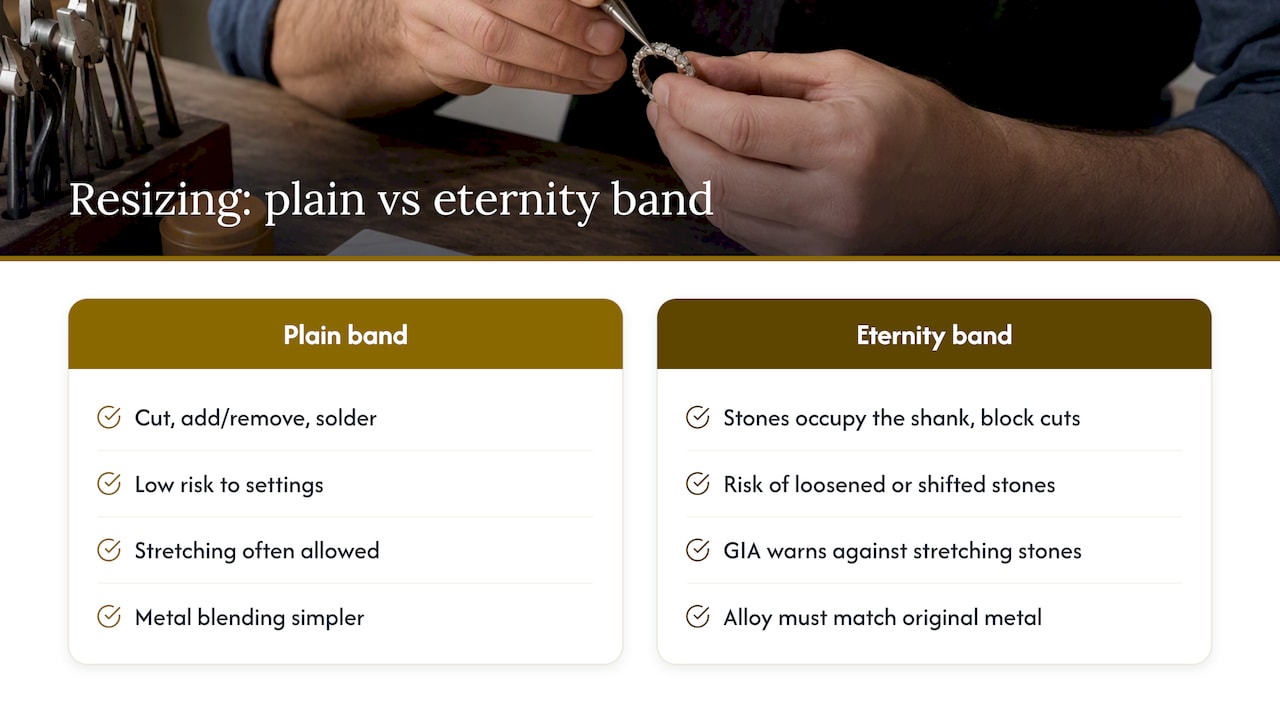
Resizing a plain band is routine work: a jeweler cuts the shank, adds or removes a small piece of metal, and solders it back into a seamless circle. An eternity band complicates every part of that process because the stones themselves occupy the area a jeweler would normally alter.
Cutting near continuously set stones risks loosening prongs or channel walls, which can create small gaps where a stone later works itself free. Even careful work can shift a setting’s internal tension enough that a stone feels secure in the shop but loosens weeks later. This is why GIA’s sizing benchmarks specifically warn against stretching rings that hold stones, since stretching can displace or loosen them even when the band itself survives the process.
Metal matching adds another layer of difficulty. A jeweler adding metal to resize a band needs an alloy that matches the original in color and finish, or the seam will be visible as a faint line or tone shift. For certain platinum alloys, GIA’s alloy guidance notes that sizing stock may need to come from the original manufacturer to avoid exactly this mismatch.
One size increment on a ring corresponds to a small change in inside diameter, with a half size increasing less than a millimeter and a full size somewhat more, according to GIA’s sizing benchmarks. That is a small amount of metal to work with safely around a continuous row of stones, which is why wide bands and dense settings often rule out stretching or simple soldering entirely.
Comparing your resizing options
Once you know your band’s setting type, the realistic choices narrow quickly. Each method changes size differently, carries its own risk to the stones, and fits a different budget.
- Sizing beads: small beads of metal added to the inside of the shank, suitable for a half size or less, according to Jewelers of America’s repair guidance; they are reversible and inexpensive but can be felt on the inside of the band.
- Spring inserts: a flexible metal piece built into the shank, generally covering about one to two full sizes per the same guidance; they allow more range than beads but add slight bulk to the band’s interior.
- Liners: a thin metal sleeve fitted inside the band for minor downsizing, mostly invisible from the outside but not suited for upsizing.
- Cut-and-add with stone reset, or full remake: used when the setting is continuous or the size change is large; this involves removing stones temporarily, reworking or rebuilding the shank, and resetting each stone, which carries more labor and more handling risk to the diamonds.
Laser welding and stretching remain options for plain bands but are rarely appropriate once stones are set continuously around the shank. GIA’s benchmarks outline the narrow conditions under which stretching a ring without stones is safe, and those conditions simply do not exist on a full pavé or channel-set eternity band.
Pro Tip: Ask your jeweler to show you, on your specific ring, exactly where the plain section is before agreeing to a sizing method; if they cannot point to one, a remake is probably the safer route.
For a half eternity ring with a modest plain section, sizing beads or a spring insert are often enough. For a full eternity ring, a stone reset or complete remake tends to be the only path that protects the setting, even though it costs more and takes longer than a simple bead or insert job.
How to assess your ring before visiting a jeweler
A short self-assessment before your appointment helps you ask sharper questions and sets realistic expectations for cost and timeline.
- Identify the pattern. Determine whether your band is full, half, or three-quarter eternity, and note the exact setting (pavé, channel, or bezel).
- Measure the band width and interior. Note whether the inside is flat or comfort-fit, since this affects both fit and how much room a jeweler has to work with.
- Estimate the size change you need. A half size or less often fits a bead, one to two sizes often fits a spring insert, and anything beyond that typically points toward a remake.
- List your questions for the jeweler. Ask how they will match the alloy, what joining method they plan to use, how they will test stone security afterward, and whether they provide written documentation and a warranty.
Walking in with these answers already worked out saves time and helps you evaluate whether a jeweler’s proposed approach matches what your ring actually needs. It also makes it much easier to compare quotes if you decide to get a second opinion, which is worth doing for any full eternity band.
Getting the fit right: measuring and testing
Accurate sizing starts with the right tool. GIA recommends using a finger-sizing gauge that matches the finished band’s width, since a narrow gauge will not predict how a wide band actually feels. Bands over a certain moderate width typically need a slightly larger size than narrower bands for the same finger, per the same GIA guidance, because more metal contacts the finger and creates a snugger feel at the same nominal size.
Fit testing matters as much as measuring. Try the ring on at different times of day, since fingers swell slightly in heat and shrink in cold, and test it over the knuckle as well as at the base of the finger.
- A ring that slides on easily but spins freely at the base is likely too loose for daily wear.
- A ring that requires real effort to pass the knuckle may be too tight, even if it feels fine once seated.
- Comfort-fit interiors often wear slightly larger than flat-interior bands of the same labeled size.
As a quick reference, sizing beads typically handle up to about a half size, spring inserts cover roughly one to two sizes, and a remake has no real limit beyond your ring’s design and budget.
What to expect from a professional repair
Before any work begins, ask for a written estimate and a condition report describing the stones and setting as they currently stand. Jewelers of America’s repair guidance recommends documenting the proposed method and the ring’s finished quality, which protects both you and the jeweler if a question comes up later.
Turnaround varies by method. Sizing beads or spring inserts often take just a few days to a week, while a stone reset or full remake can take several weeks depending on parts, stone sourcing, and labor involved.
- Ask to see the seam after the work is done, it should be invisible to the naked eye.
- Check that the finish matches the rest of the band in color and texture.
- Confirm each stone has been tested for security, not just visually inspected.
Pro Tip: Insist on a written warranty covering workmanship and stone security for at least several months after the repair, so you have recourse if a stone loosens after normal wear.
A jeweler who resists putting any of this in writing is worth a second opinion before you hand over a ring with sentimental or financial value.
How an in-house manufacturer handles sizing and remakes
Working in-house gives us more control over alloy matching and turnaround when a ring needs a remake rather than a simple resize.
Our approach includes family-owned in-house manufacturing, custom design options, ethical sourcing, lifetime diamond upgrades, and positive customer reviews reflecting trust. If you request a remake with us, expect condition documentation of your existing ring, a written estimate, and a clear timeline before any work starts.
When to repair versus remake
Our honest advice: for continuous settings, lean conservative. A stone reset or full remake usually protects the diamonds and the finish better than cutting into a channel or pavé shank. If you suspect your size will change again, a half eternity design gives you more room to resize safely down the road. Whatever you choose, keep your documentation, estimate, and warranty on file.
— Joseph
A straightforward option for remakes and custom sizing
If a remake turns out to be the right call, we build each piece in-house, which means we control alloy matching and can offer diamond upgrades as your needs change. Every custom order includes documented condition notes, a written estimate, and a clear timeline.

We are one option among several, not the only route forward, but if you would rather start fresh than risk a continuous setting, explore our design your own ring options and get a quote built around your exact stones and sizing needs.
FAQ
Can an eternity band be resized bigger?
Half and three-quarter eternity bands with a plain shank section can often be sized up using beads, spring inserts, or added metal, depending on how much change is needed. Full eternity bands are much harder to size up because there is no plain metal to work with, and a remake is usually the safer route, according to GIA’s sizing benchmarks.
What rings cannot be resized?
Rings with continuous stone settings all the way around, like full eternity bands, tungsten or ceramic rings, and some heavily inlaid designs, generally cannot be resized through conventional cutting and soldering. GIA notes that stretching is also unsuitable for any ring that holds stones, since it risks loosening or displacing them.
Will a jeweler resize a ring for free?
There is no standard free-resize policy across jewelers, since it depends on the seller’s own guarantees and the complexity of the work required. Jewelers of America’s guidance recommends getting a written estimate and warranty terms before agreeing to any repair.
Should you size up or down with an eternity band?
Many people find it easier to size an eternity band slightly up rather than down, since downsizing a continuously set shank is more restrictive than adding a bit of room. Whichever direction you need, GIA recommends measuring with a gauge that matches your band’s width, since wider bands often need a half to a full size more than narrow ones for the same comfortable fit.
How much does it typically cost to resize an eternity band?
Cost depends heavily on method and setting complexity: sizing beads and spring inserts are the least expensive options, while a stone reset or full remake costs more due to the labor and stone handling involved. Getting a written estimate from your jeweler, as recommended by Jewelers of America, is the only reliable way to know the cost for your specific ring.
Sources
For technical detail beyond this guide, GIA’s benchmarks cover sizing methods and finger measurement, Jewelers of America outlines what a proper repair intake looks like, and our own education pages walk through eternity ring styles in more depth.
Recommended
- Half Eternity Rings: Practical Elegance
- Full Eternity Rings: Complete Circle of Diamonds
- Eternity Ring Guide: Full & Half Eternity Bands Explained

Deep Mehta is the Co-Owner of USA Jewels, a family-owned jewelry business she has led since 2013 in Deerfield Beach, Florida. With over 13 years of hands-on experience in fine jewelry retail, manufacturing, and diamond importing, Deep specializes in engagement rings, wedding bands, and custom jewelry design. She also co-manages Kaash Group Talent Acquisition. Deep is a University of Florida graduate and oversees every aspect of USA Jewels’ operations, from product development to marketing.
Fine Jewelry Collection

You May Also Like
How to Stack Bracelets: A Guide

What Does Diamond Provenance Mean for Your Purchase?