Tennis Bracelet Costs: What 2–3 Carats Buy and How to Save 40–70%
A tennis bracelet can run anywhere from about $150 for a crystal or cubic zirconia version to over $50,000 for a high-carat natural diamond piece. Most shoppers land their best value in the 2 to 3 carat total weight range, often in lab-grown diamonds, which stretch a budget further per carat. Before you buy anything, ask for the total carat weight and the average diameter of each stone. Those two numbers tell you more about real-world sparkle than the price tag alone.
TL;DR:
- A typical 2 to 3 carat tennis bracelet costs between $1,200 and $8,000 depending on the stone source and brand, with lab-grown stones being 40 to 70% cheaper.
- Total carat weight alone is not enough; stone size, distribution, cut, color, clarity, metal choice, and clasp type all significantly influence the final price.
- Resale value is low, especially for smaller stones and lab-grown diamonds, so buying for wear rather than investment is advised.
- Additional costs such as sales tax, insured shipping, customization, and insurance can add several hundred dollars to the initial price.
- Buying timing matters: prices fluctuate with gold and diamond markets, demand peaks in holiday seasons, and lab-grown prices have been decreasing steadily.
Table of Contents
- How Much Does a Tennis Bracelet Cost by Stone Type and Carat Weight?
- What Actually Drives the Price of a Tennis Bracelet?
- Lab-Grown, Moissanite, or Natural: Which Actually Makes Sense?
- How Should You Shop for a Tennis Bracelet?
- Why Buyers Turn to Usajewels for Transparent Pricing
- What Else Does a Tennis Bracelet Cost You Beyond the Sticker Price?
- Does Tennis Bracelet Pricing Change Throughout the Year?
- A Buying Philosophy Worth Following
- Ready to See What Your Budget Actually Buys?
- Sources
- FAQ
How Much Does a Tennis Bracelet Cost by Stone Type and Carat Weight?
The honest answer depends on two things: what the stones are made of, and how much total weight you’re buying. We’ll break both down, because the “tennis bracelet cost” question really has four different answers depending on material.
Crystal and cubic zirconia bracelets sit at the entry point, typically priced in the lower hundreds. They photograph well and work fine for costume jewelry, but they lose brilliance faster and scratch more easily than mineral stones. Moissanite bracelets generally cost more, offering more fire and durability than CZ at a modest premium.
Lab-grown diamond bracelets are where the value conversation gets interesting. A market guide pegs entry natural diamond pieces at $1,200 to $3,000, mid-range 2 to 3 carat pieces at $3,000 to $8,000, and high-end 4-plus carat pieces at $15,000 and up, with lab-grown equivalents often coming in 40 to 70% cheaper for the same visual size. Real-world listings and buyer reports on forums like r/Diamonds back up that mid-thousands range for popular 2 to 3 carat styles.
Here’s how the numbers typically break down by total carat weight (TCW):
A few things worth knowing as you scan those bands:
- The 2 to 3 carat tier is the sweet spot most jewelers point to for everyday wear, based on TCW-to-size data showing 2 carats across roughly 50 to 60 stones averages about 2.1mm per stone.
- Brand and metal choice can shift the same TCW into a wildly different price bracket. Retail listings from major names like Tiffany & Co. show that identical carat weights carry very different price tags once brand premium and platinum settings enter the picture.
- Anything above 7 carats is generally showpiece territory, with per-carat pricing increasing due to sourcing challenges for larger, well-matched stones.
What Actually Drives the Price of a Tennis Bracelet?
Total carat weight gets all the attention, but it’s only half the story. Two bracelets with identical TCW can look, and cost, completely different depending on how that weight is distributed.
A 3-carat bracelet built from 30 larger stones reads very differently on the wrist than a 3-carat bracelet built from 60 tiny ones, even though the total weight is the same. That’s why average stone diameter matters more for visual impact than TCW by itself. If a listing only gives you total carat weight, you’re missing half the picture.
Beyond size distribution, several other variables move the price:
- The 4Cs, applied to melee stones. GIA’s 4Cs framework, cut, color, clarity, and carat, still governs quality even when a bracelet contains 50 tiny stones instead of one center stone. Higher color and clarity grades across dozens of stones add up fast.
- Metal choice. 14k gold costs less than 18k gold, which costs less than platinum. Platinum’s density and durability justify its premium, especially for a piece worn daily.
- Setting style. Prong settings show off more of the stone but expose it to more wear; bezel settings protect the stone at a slight cost to sparkle.
- Clasp and security hardware. A box clasp with a safety latch costs more to manufacture than a simple lobster clasp, but it’s the difference between a bracelet that stays on your wrist and one that doesn’t.
Pro Tip: Always ask a seller for the average stone diameter and clasp type before comparing two bracelets by price alone. Two pieces with the same sticker price can have very different everyday durability.
Lab-Grown, Moissanite, or Natural: Which Actually Makes Sense?
Lab-grown diamonds share the same optical properties as natural diamonds, and in small melee sizes used across a tennis bracelet, that similarity is essentially invisible to the naked eye. That’s the core insight driving the shift toward lab-grown for this particular piece of jewelry: you’re not buying one big stone where origin might matter more to you, you’re buying dozens of small ones where consistency and size matter most.
The tradeoffs break down like this:
- Natural diamonds hold long-term rarity value and remain the traditional choice, but you pay a substantial premium for that pedigree at every carat tier.
- Lab-grown diamonds deliver the same brilliance and hardness at 40 to 70% less cost for comparable visual size, per the market guide cited earlier.
- Moissanite and CZ cost even less but carry different resale dynamics and slightly different light performance up close.
On resale: don’t buy any tennis bracelet expecting to recoup your purchase price. Specialist guidance is blunt about this. Resale offers on small-stone pieces typically land at a steep markdown from retail, even for high-end natural diamonds. Buy it to wear, not to flip.
How Should You Shop for a Tennis Bracelet?
A little homework before you buy protects you from paying luxury prices for a bracelet that won’t hold up. Here’s the sequence we’d walk through with a friend:
- Ask for total carat weight and average stone diameter. Both numbers together, not just TCW, tell you what you’re really getting.
- Request grading documentation. For natural stones, that means GIA or IGI certificates. For melee-heavy pieces, ask how parcel grading was done, since not every tiny stone gets individually graded.
- Confirm the clasp type and setting security. GIA’s own buying guidance specifically flags secure settings and consistent stone quality as top criteria for multi-stone pieces like this.
- Get the return policy and warranty in writing. A verbal promise from a salesperson means nothing once you’re home.
- Ask about insurance and care. Tennis bracelets take daily wear and tear on the clasp more than any other jewelry style, so insurance riders and periodic prong checks matter.
Pro Tip: If a seller can’t tell you the average stone diameter or hesitates on clasp details, treat that as a red flag. Vague answers on TCW breakdown or missing paperwork usually mean vague quality control, too.
Watch for unclear TCW listings, no mention of clasp type, and missing certificates. Those three gaps together are the clearest signal that a deal is too good to be true.
Why Buyers Turn to Usajewels for Transparent Pricing
We built Usajewels around a simple frustration: quality jewelry shouldn’t require paying for three layers of middlemen. As a family-owned, in-house manufacturer, we provide direct pricing on custom jewelry by cutting out the markups that traditional jewelers pass along.
You can design your own piece, choosing diamond quality and metal type to match your budget and the size you want. We’re committed to ethical sourcing, and every purchase comes with a lifetime diamond upgrade option. Online jewelers often accumulate positive customer reviews over time by focusing on honest pricing and craftsmanship.
What Else Does a Tennis Bracelet Cost You Beyond the Sticker Price?
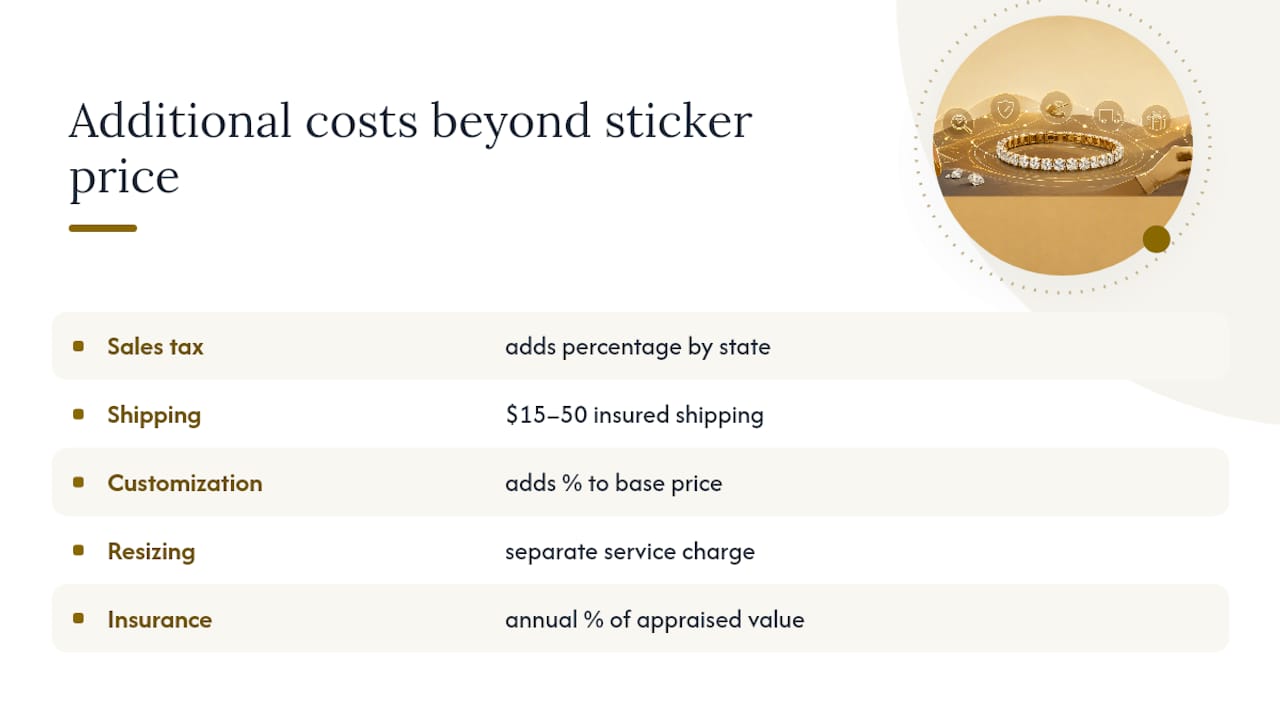
The listed price is rarely the full number you’ll pay. Sales tax applies based on your state and, in most cases, adds a meaningful percentage to any purchase over a few thousand dollars, so factor that in before you commit to a budget ceiling.
Shipping costs vary by seller. Many online jewelers offer free insured shipping on pieces above a certain price point, but cheaper bracelets or smaller retailers may charge $15 to $50 for insured delivery, since a diamond bracelet needs signature confirmation and tracking, not a standard envelope.
Customization fees are where budgets often get surprised. Requesting a longer length, a different clasp style, or a metal upgrade from 14k to 18k gold typically adds a percentage to the base price rather than a flat fee. Resizing after purchase, whether to add or remove links, usually carries a separate service charge if it happens outside the original order.
One cost people forget entirely: insurance. A standalone jewelry rider or a scheduled addition to a homeowner’s policy typically runs a small annual percentage of the appraised value. It’s not required, but given how much wear a tennis bracelet’s clasp takes, it’s worth budgeting for from day one rather than treating it as an afterthought.
Does Tennis Bracelet Pricing Change Throughout the Year?
Diamond and gold commodity prices move throughout the year, and that movement filters into retail tags over time, especially for pieces sold by weight rather than fixed collections. Gold price swings in particular can nudge the cost of a 14k or 18k setting up or down by a noticeable margin within the same calendar year.
Seasonal demand plays a role too. Prices on ready-to-ship, popular styles tend to firm up heading into November and December, and again ahead of Valentine’s Day, simply because demand for gift-ready jewelry spikes and inventory of popular carat weights tightens. Shoppers who buy in quieter months, like late summer, sometimes find more room to negotiate or more promotional flexibility from sellers carrying excess stock.
The lab-grown diamond market has also shifted the pricing conversation. Production efficiency has increased over recent years, which has kept lab-grown prices trending downward even as natural diamond and gold costs have stayed firmer. That gap between lab-grown and natural pricing has become one of the more consistent trends shoppers can count on, rather than a temporary discount.
If you’re timing a purchase around a proposal or anniversary, buying a month or two ahead of the actual date gives you room to compare sellers without the pressure of a looming deadline, and without paying whatever premium a last-minute purchase might carry during peak season.
A Buying Philosophy Worth Following
Buy the largest total carat weight you can afford within a quality band you’re comfortable with, not the largest carat weight period. In practice, that usually lands you in the 2 to 3 carat range, which tends to read best on the wrist for daily wear.
If resale matters to you, natural diamonds hold value slightly better. If size and everyday sparkle matter more, lab-grown wins on nearly every practical measure.
— Joseph
Ready to See What Your Budget Actually Buys?
Now that you know how total carat weight, stone size, and metal choice shape the final number, the next step is seeing those variables applied to real pieces. Some in-house manufacturing models provide price transparency by reflecting the diamond and metal choices without additional retail markup.
Browse our diamond tennis bracelet collection to see current pieces across natural and lab-grown options, or start from scratch with a custom design where you pick the carat weight, stone quality, and metal yourself. Every piece ships with the grading documentation and clasp details this guide told you to ask for, and our lifetime diamond upgrade program means the bracelet you buy today can grow with you later. Start browsing, or reach out to talk through a custom build that fits your budget.
Sources
Price bands and buying criteria in this guide draw on GIA’s diamond quality standards, specialist tennis bracelet market data, and our own diamond education pages for readers who want a deeper dive into the 4Cs.
- Diamond quality factors | GIA
- Tennis bracelet buying guide | 4Cs (GIA)
- Tennis bracelet buying guide | TheCaratCut
FAQ
How much should you pay for a tennis bracelet?
Budget approximately low to mid thousands for an entry-level natural diamond piece, more for a popular 2 to 3 carat mid-range piece, with a comparable lab-grown version costing substantially less.
How much is a real tennis bracelet?
A “real” (natural diamond) tennis bracelet typically starts in the low thousands for smaller total carat weights and can exceed tens of thousands for high-carat luxury pieces, depending on stone quality and metal.
Are tennis bracelets worth it?
They’re worth it as an everyday luxury piece rather than an investment. Resale offers usually fall well below retail price, so buy one to wear and enjoy, not to resell for a profit.
How much is a 1-carat tennis bracelet worth?
A 1-carat natural diamond tennis bracelet generally retails for low to mid thousands, while a lab-grown equivalent is available at noticeably lower prices for the same total carat weight.
Recommended
- Bracelet Guide: Tennis, Bangle & More
- Diamond Bracelets | Tennis Bracelets & Bangles
- Tennis Bracelet Guide: How to Choose the Perfect One
- Diamond Tennis Bracelets, Radiant Brilliance

Deep Mehta is the Co-Owner of USA Jewels, a family-owned jewelry business she has led since 2013 in Deerfield Beach, Florida. With over 13 years of hands-on experience in fine jewelry retail, manufacturing, and diamond importing, Deep specializes in engagement rings, wedding bands, and custom jewelry design. She also co-manages Kaash Group Talent Acquisition. Deep is a University of Florida graduate and oversees every aspect of USA Jewels’ operations, from product development to marketing.
Fine Jewelry Collection


You May Also Like

How Diamond Quality Tiers Are Priced: A Buyer’s Guide
Ring Resizing Cost: A U.S. Budgeting Guide for 2026