Cloudy Diamond Fix: What Works and What Doesn’t
In most cases, yes, a cloudy diamond can be fixed, because the cloudiness is usually a film of lotion, soap and skin oil sitting on the stone, not a flaw inside it. A careful soak and soft brushing brings the sparkle back. If the haze is still there after a deep, professional cleaning, it is most likely inside the diamond, and no cleaning will remove it. This guide shows you how to tell the two apart, what to do for each, and how to avoid buying a stone that looks hazy in the first place.
TL;DR
- Most cloudy diamonds are dirty, not damaged. Grime on the surface and under the stone blocks light, so the diamond looks dull.
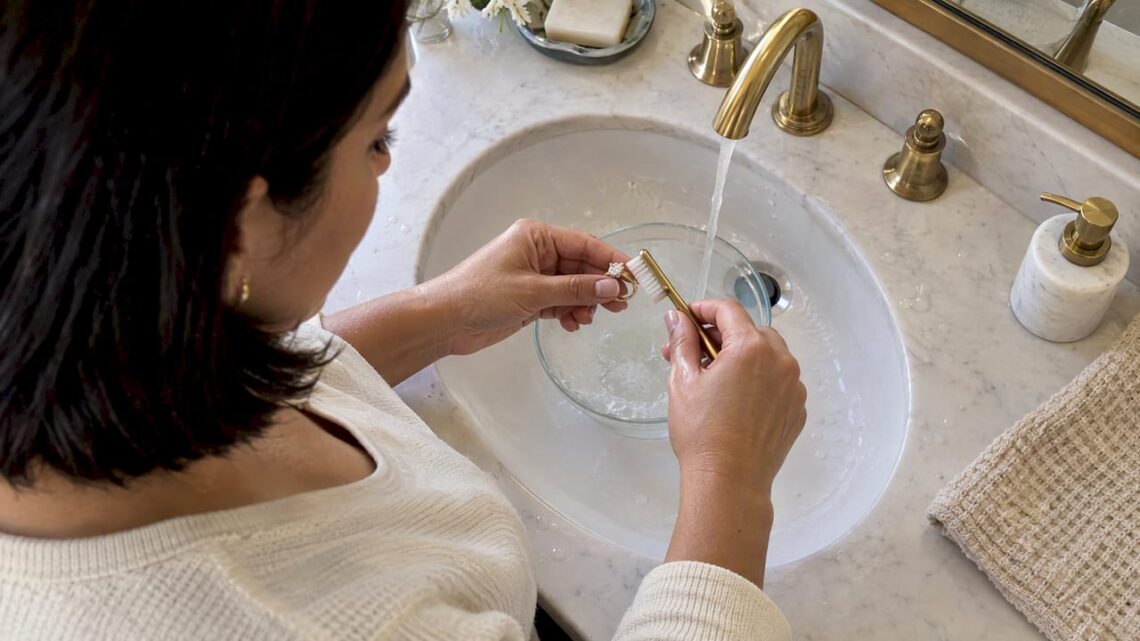
- Soak the ring in warm water with a few drops of mild dish soap for 15 to 20 minutes, brush gently with a soft toothbrush, rinse and pat dry with a lint-free cloth.
- If the haze survives a professional cleaning, it is probably internal (inclusions, a treatment or, rarely, fluorescence) and cannot be removed.
- Skip bleach, chlorine, abrasive cleansers, and home ultrasonic or steam machines unless a jeweler has confirmed your stone is safe for them.
- If you are shopping, choose a stone with a grading report and judge how it looks in person or in video, not by grade alone.
Table of Contents
- Why a diamond looks cloudy
- How to fix a cloudy diamond at home
- When the haze won’t go away
- What about lab-grown diamonds?
- Should you use an ultrasonic or steam cleaner?
- Keep it from clouding again
- Our perspective: prevention starts at the purchase
- How to choose a diamond that stays bright
- Find a diamond you’ll love
- FAQ
- Sources
Why a diamond looks cloudy
A diamond sparkles because light enters through the top, bounces around inside, and returns to your eye. Anything that gets in the way of that light makes the stone look flat. Jewelry designer Jade Trau told Vogue that diamonds never technically lose their sparkle, and that what changes is what sits between the stone and the person looking at it.
That gives you one question to answer before you do anything else: is the cloudiness external or internal?
| External cloudiness | Internal cloudiness | |
|---|---|---|
| Cause | Lotion, soap residue, oils, dust, grease | Inclusions, cracks, a treatment, or in rare cases fluorescence |
| Where it hides | Top of the stone, and especially underneath it | Inside the diamond |
| Typical sign | The ring was brighter a few weeks ago | The stone looked soft or milky from the start |
| Can it be fixed? | Yes, with cleaning | No, only managed or replaced |
GIA, the lab that created the grading system most jewelers use, makes the same distinction in its diamond care and cleaning guidance: surface film clears with a gentle clean, while haze that remains after a deep professional cleaning is likely to be part of the stone.
The usual suspects on the surface
If you wear your ring every day, you put it through a lot. Hand cream, sunscreen, hair products, cooking oils, soap scum and even the oil from your fingertips settle on the facets. Because diamonds attract grease, a thin film can build up quickly.
The spot people miss is underneath. The back of the stone, inside the setting, collects the most residue, and that is where light is supposed to enter and bounce. A ring that looks fine head-on but dull from the side often has buildup under the stone.
How to fix a cloudy diamond at home
Start here. It costs almost nothing, and it fixes the problem more often than not.
What you need
- A small bowl of warm (not hot) water
- A few drops of mild dish soap, without added moisturizers
- A soft-bristled toothbrush that has never been used on anything else
- A lint-free cloth
Step by step
- Cover the drain or work over a towel. Rings disappear down sinks every day. Set up your bowl on a towel before you start.
- Soak for 15 to 20 minutes. GIA’s guidance is to soak the piece in warm water with mild soap, which loosens oil and film so you do not have to scrub hard.
- Brush gently. Work the toothbrush around the top, along the sides, and under the setting where the stone meets the metal. Short, light strokes are enough.
- Rinse well. Soap left behind is itself a film, so rinse under lukewarm running water, with the drain covered.
- Pat dry. Use a lint-free cloth, not a paper towel, which can leave fibers behind.
- Look again in good light. Check the stone from the top and from the side.
For a ring worn every day, the same guidance suggests repeating this every one to two weeks so grime never builds into a thick layer.
What to keep away from your diamond
A diamond is hard, but your setting is not, and some products cause damage you cannot undo.
- Bleach and chlorine. GIA advises against these because they can damage the metal. Take your ring off at the pool and before using cleaning products.
- Powdered or abrasive cleansers. They can scratch metal and dull a polished finish.
- Home ultrasonic and steam machines. More on these below, because they are the most tempting shortcut.
When the haze won’t go away
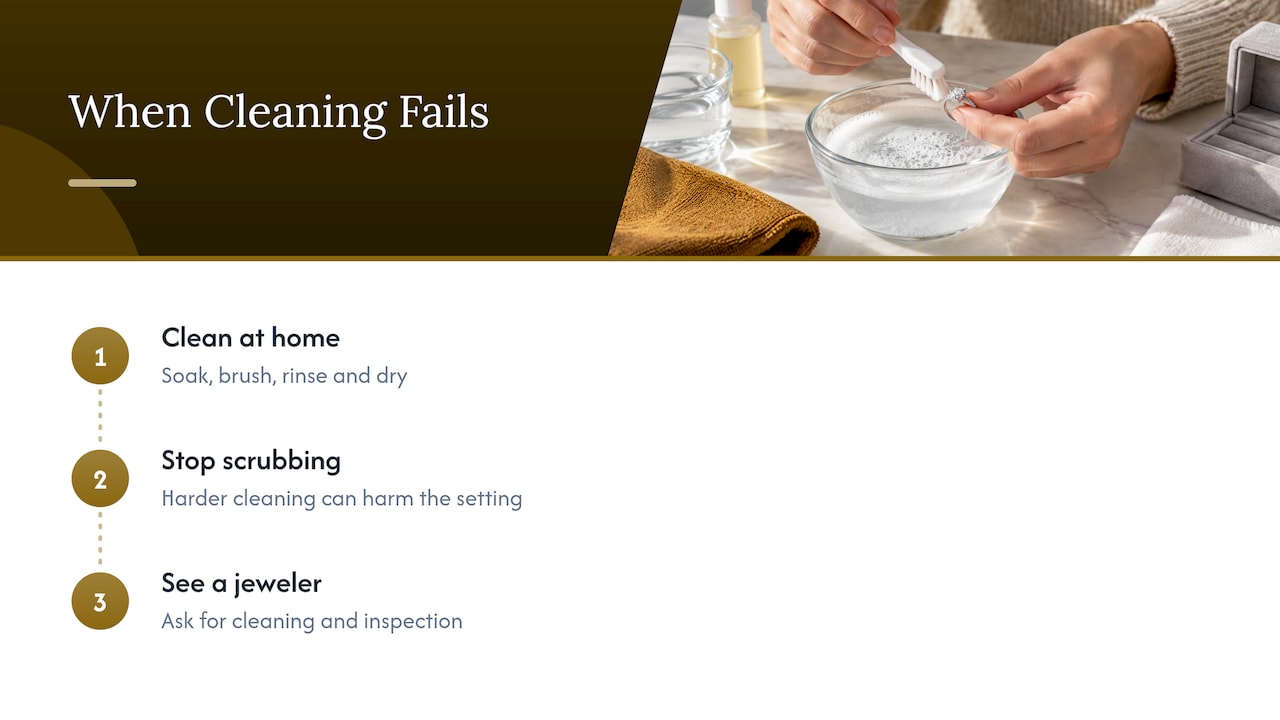
So you soaked, brushed, rinsed and dried, and the stone still looks milky. Do not keep scrubbing. Harder cleaning will not help and can harm the setting. Take the ring to a jeweler you trust and ask for a professional cleaning and inspection. Many jewelers do this as part of routine maintenance, and some offer it free, though there is no standard national price. Policies vary, so ask first.
A professional also checks something you cannot: whether your prongs are secure. Cleaning is a natural moment to look at the setting, which is one reason periodic professional attention is worth it even if your ring looks fine.
If the stone is still hazy afterward, one of the following is probably at play.
Inclusions inside the diamond
Inclusions are natural features formed as the diamond grew. A few tiny ones are invisible without magnification. A cluster of very small ones, sometimes called a cloud, can scatter light and give a stone a soft or milky look. This is part of the stone and cannot be polished or cleaned out. It is a good reason to look closely at clarity when you choose, not just the letter on the report.
Treated diamonds
Some diamonds are treated to look clearer, for example with fracture filling. If you have one, harsh cleaning can be a real problem: ultrasonic and steam cleaners can damage or remove the filler that improves the stone’s appearance. If a stone’s clarity changed suddenly after a cleaning, tell your jeweler exactly what was used.
A treatment should have been disclosed when you bought the stone. Under the FTC’s jewelry guidance, businesses must describe what they sell truthfully. If you are unsure what you own, a grading report or an independent appraisal will tell you.
Fluorescence, in rare cases
Fluorescence is a natural property that makes some diamonds glow under UV light. It is not a mark of low quality. GIA says that fewer than 0.2% of fluorescent diamonds look hazy because of it, so the vast majority are unaffected. If yours is one of the rare cases, it is an optical property, not dirt, and cleaning will not change it. We explain how to think about it in our piece on whether diamond fluorescence matters.
A damaged stone
Diamonds are very hard but not unbreakable. A hard knock at the girdle or at an exposed point can chip a stone, and a chip or crack can catch light unevenly. GIA’s engagement ring myths article covers how chips happen. A jeweler can examine under magnification and tell you whether re-polishing is possible.
Is it even a diamond?
If a ring seems to cloud quickly and cleaning never brings it back, it is fair to ask whether the center stone is a diamond at all. Simulants such as glass or cubic zirconia can scratch and dull in ways a diamond does not. A jeweler can test it in a minute.
What about lab-grown diamonds?
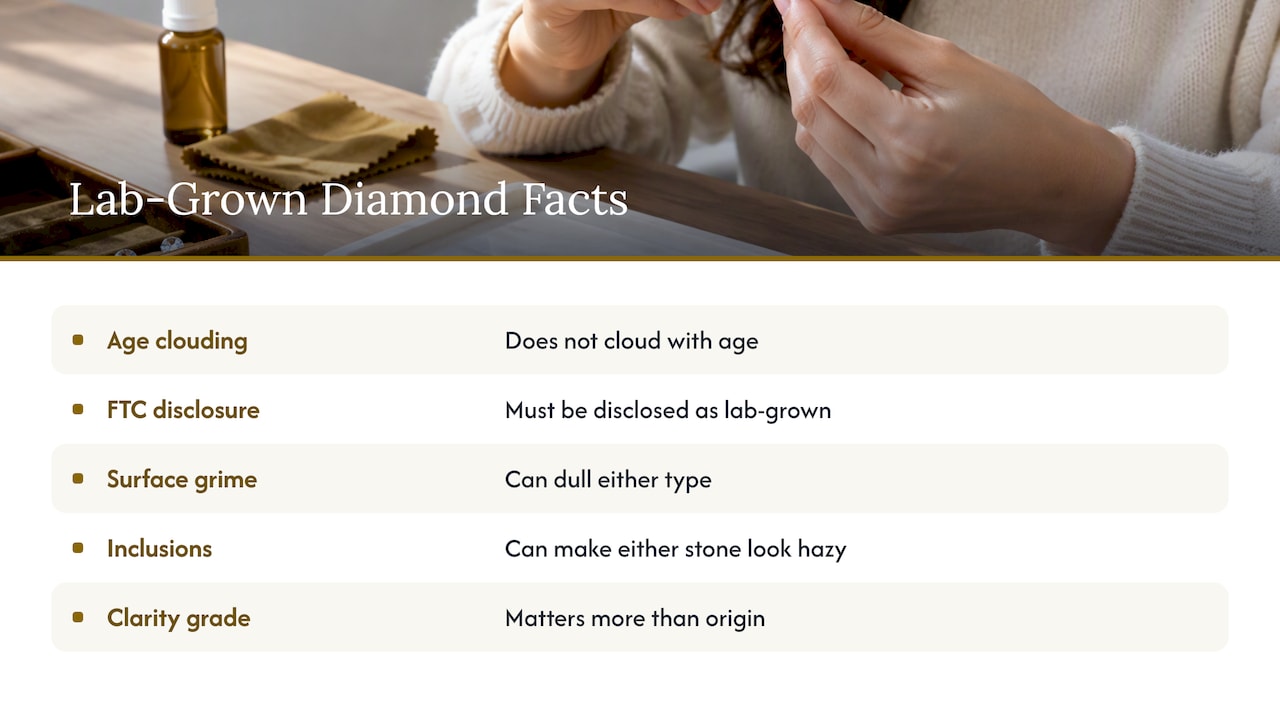
Lab-grown diamonds do not cloud with age. They have essentially the same optical, physical and chemical properties as mined diamonds, and the FTC’s jewelry guidance says they must be clearly disclosed as lab-grown. Like any diamond, a lab-grown stone gets dull from surface grime, and like any diamond, one with internal inclusions will look hazy no matter how it is cleaned.
The lesson is the same for both types: the clarity grade and the actual look of the stone matter more than where it came from. If you are weighing the two, our lab-grown vs natural diamonds guide lays out the differences.
Should you use an ultrasonic or steam cleaner?
These machines are popular, and portable ultrasonic units can cost $150 or less. They work by sending high-frequency sound waves through a cleaning solution, and they can clean well. But GIA’s guidance on ultrasonic cleaners warns that they can shake stones loose from their settings, and that they can harm fracture-filled diamonds or stones with inclusions that reach the surface.
Here is a practical way to decide:
- Plain, untreated diamond in a sturdy, secure setting: a jeweler may use an ultrasonic safely. Let them make that call.
- Loose prongs, delicate or vintage setting, other gemstones, or any chance the diamond is treated: stay with soap, warm water and a soft brush.
- Not sure: soap and water. It will never cause the kind of damage a machine can.
Keep it from clouding again
A few habits do most of the work.
- Put your ring on last when you get ready, after lotion, sunscreen and hair products.
- Take it off for cooking, cleaning, gardening and the gym.
- Store it separately, in a soft pouch or lined box, so it does not rub against other pieces.
- Rinse and dry it after washing your hands when you can.
- Have the setting checked by a jeweler on a regular schedule, and ask about cleaning at the same visit.
Our perspective: prevention starts at the purchase
We are a family-owned business that has been making jewelry since 1999, and we manufacture in-house. We hear the cloudy-diamond question often, and our honest answer has two halves.
The first half is reassuring. Nearly every time, a ring that has lost its sparkle needs a gentle clean, not a replacement. Please do not panic, and please do not reach for harsh cleaners.
The second half is about choosing well from the start. If a stone looks soft or milky to you, the cause may be built into it, and that is much easier to avoid than to fix. That is why we sell certified diamonds, so you can read the grading report that describes the stone you are buying. We encourage you to read it alongside the diamond itself, and to ask questions. Our diamond certification guide explains how GIA, AGS and IGI reports differ, and our overview of GIA certification shows what to look for.
We also build every piece to be worn and loved for years, using solid construction rather than hollow or plated pieces. And if your tastes or budget change, our lifetime diamond upgrade program means a diamond is not a one-time decision you are stuck with.
— Joseph
How to choose a diamond that stays bright
If you are replacing a stone or buying new, these checks help you avoid haze.
- Ask for a grading report. It documents clarity and any treatments, so nothing is a surprise later.
- Look at the stone, not only the grade. Two diamonds with the same clarity grade can look different. If a stone looks hazy to you, trust your eyes. GIA makes this point about fluorescence too: judge appearance, not just a label.
- Ask directly about treatments. A reputable seller will answer plainly.
- Pick a setting you can clean. Open designs with room under the stone are far easier to keep bright than tightly packed ones.
- Ask about the return window. You should be able to look at the diamond at home in your own light.
When you buy from us, shipping is free and insured, and you have a 30-day money-back guarantee, so you can see the stone in everyday light before you commit.
Find a diamond you’ll love
If you are ready to replace a hazy center stone or start fresh, you can browse our certified loose diamonds, which start at 142 USD. Or choose a ready-made style from our engagement rings, from 346 USD. If you want to pick the stone, shape and metal yourself, our design-your-own guide walks you through each step.
FAQ
Can a cloudy diamond be fixed?
If the cloudiness comes from grime, yes. A warm soapy soak, gentle brushing and a thorough rinse usually restore the sparkle. If the haze remains after a professional cleaning, it is probably inside the stone, such as inclusions or a treatment, and cannot be removed.
How much does it cost to get a diamond cleaned?
There is no standard national price. Many jewelers clean rings for free during routine maintenance checks or as part of a larger repair, while others charge a fee. Call a local jeweler and ask before you go.
Does Dawn dish soap clean a diamond ring?
A mild dish soap works well. GIA’s home method calls for warm water with a few drops of mild dish soap. Choose a plain formula without added moisturizers, because moisturizers can leave their own film.
Do lab-grown diamonds get cloudy?
Not with age. Lab-grown diamonds share the optical and physical properties of mined diamonds, so they get dull from surface dirt the same way and clear up with the same cleaning. Internal inclusions can still make a lab-grown stone look hazy, and those cannot be cleaned away.
Is it safe to use an ultrasonic cleaner at home?
It carries risk. These machines can loosen stones in their settings and damage fracture-filled diamonds. Unless a jeweler has told you your ring is safe for one, soap, warm water and a soft toothbrush is the safer choice.
Sources
- GIA: Diamond Care and Cleaning Guide
- GIA 4Cs: Ultrasonic Cleaners for Gems
- GIA 4Cs: Diamond Engagement Ring Myths
- Vogue: How to Clean a Diamond Ring at Home Without Damaging It
- FTC: In the Loupe, Advertising Diamond, Gemstones and Pearls
Recommended
- Save 30–50% with Clarity Enhanced Diamonds: GIA Facts and What to Ask
- Diamond Quality 4Cs Breakdown: Your Buying Guide
- Diamond Clarity Chart — FL to I3 Grades Explained

Deep Mehta is the Co-Owner of USA Jewels, a family-owned jewelry business she has led since 2013 in Deerfield Beach, Florida. With over 13 years of hands-on experience in fine jewelry retail, manufacturing, and diamond importing, Deep specializes in engagement rings, wedding bands, and custom jewelry design. She also co-manages Kaash Group Talent Acquisition. Deep is a University of Florida graduate and oversees every aspect of USA Jewels’ operations, from product development to marketing.
Fine Jewelry Collection

You May Also Like
Double Prong Settings: Two Claws Add Grip, Not More Contact Points

Avoid Overpaying: How HPHT vs CVD Diamonds Change What the 4Cs Mean