Stop Ring Spinning: DIY Guards, Jeweler Fixes, Custom Contoured Bands
If your ring spins around your finger, try a removable stabilizer like a plastic coil or silicone guard first. It’s the fastest, safest fix while you figure out the real cause. If the problem turns out to be a top-heavy setting or a gap between your knuckle and the base of your finger, you’ll want a jeweler to install a permanent fix like sizing beads, a spring insert, or a reshaped shank. We’d hold off on full resizing until you know which one you’re dealing with.
TL;DR:
- Temporary fixes like silicone guards or plastic coils are effective for seasonal finger swelling or uncertain causes but require regular replacement.
- Permanent solutions such as sizing beads or spring inserts are suitable when the cause is a knuckle-to-base differential or a top-heavy setting, respectively.
- Resizing alone often does not stop ring spinning if the issue stems from weight distribution or a top-heavy design, which may require reshaping or special shank options.
- Diagnosing whether the cause is size, weight, or design is crucial before committing to a fix; reversible options should be tested first.
- Avoid unprofessional modifications like gluing or non-specific soldering; always ask your jeweler about specific installation methods, costs, and guarantees.
Table of Contents
- Why rings spin: a quick diagnostic checklist
- Quick, reversible fixes you can try at home
- Permanent and professional fixes a jeweler can install
- How to choose the right fix and what to ask your jeweler
- When design is the cause: contoured bands and safe alternatives
- A discreet alternative: design-aware replacements and fitted bands
- FAQ
- Sources
- A note from Joseph
Why rings spin: a quick diagnostic checklist
Most spinning comes down to one of two things: your knuckle is bigger than the base of your finger, or the ring itself is unbalanced. Jewelers call the first one knuckle-to-base differential, and it’s common for people with larger joints or arthritis. The second cause, a top-heavy setting, happens when the weight of a large stone or an ornate head pulls the band around to the bottom of your finger, no matter how well it fits.
A few simple tests at home can tell you which one you’re facing.
- Slide the ring over your knuckle: if it’s noticeably tighter going over the joint than it feels at the base, you likely have a knuckle differential.
- Do a gentle handshake or drop test: let your hand hang and give it a light shake. If the ring stays put, sizing is probably fine and the issue is weight distribution.
- Check whether the ring “settles” back to center after you turn it, or if it keeps sliding toward your palm, a sign the head is heavier than the band can support.
Band width and metal hardness matter too. A wide, flat band grips more skin and resists turning better than a thin one, and softer metals like 18-karat gold flex more overtime than platinum, which can change how a ring sits on your hand.
Quick, reversible fixes you can try at home
Before committing to anything permanent, a few inexpensive, non-invasive options can buy you time and comfort.
- Plastic coil or spiral adjusters wrap around the back of the band and tighten the fit from the inside. They work best for temporary situations, like seasonal finger swelling, and most people can install them at home by simply winding the coil around the shank until it feels snug.
- Silicone ring guards sit inside the band and are nearly invisible when worn. They’re easy to remove for cleaning and tend to feel more comfortable than coils for all-day wear, though they can trap moisture if you don’t rinse them regularly.
- Spacer or stacking bands are thin rings worn alongside your engagement ring and wedding band. They act as a buffer, filling the gap between the two and keeping both from twisting. Our ring stacking guide walks through how to pair spacers with an existing set.
A few things to avoid: never use superglue or any permanent adhesive to “fix” a ring in place. It can damage the metal, trap dirt and bacteria against your skin, and make future resizing much harder. If you want extra padding, stick to products made for ring sizing, like reusable silicone strips, rather than tape or rubber bands that can degrade and leave residue.
Pro Tip: Keep a spare silicone guard in your bag or car. Finger size shifts with heat, exercise, and time of day, so a quick fix on hand saves you from an awkward, spinny afternoon.
Permanent and professional fixes a jeweler can install
Once you’ve confirmed the cause, a jeweler can offer several lasting solutions depending on whether the problem is sizing, shape, or both.
- Sizing beads: small bumps of metal soldered to the inside of the band at the base of the finger. According to GIA’s sizing guidance, beads typically use up about half a size of internal space, and jewelers usually recommend them when the knuckle-to-base difference is around 1.5 sizes.
- Spring (tension) inserts: a curved metal strip added inside the band that flexes slightly to grip the finger. The GIA notes that these inserts need to be laser welded rather than torch soldered, since torch heat can anneal the metal and destroy its springiness.
- Euro or flat-back shanks: a redesigned band profile that sits more securely against the finger, often chosen for bridal sets that need to match a specific engagement ring shape.
- Hinged or adjustable shanks: a mechanical hinge built into the band for large knuckle-to-base gaps. These cost more and require more structural change to the ring, so jewelers generally reserve them for the toughest fit cases.
One important note: resizing alone doesn’t always solve spinning. If your ring is top-heavy, shrinking the band without addressing the weight up top can leave you right back where you started.
A long-running practitioner discussion on sizing beads echoes this: beads are a low-cost, widely used fix that most people adjust to quickly, though some jewelers prefer sheet inserts or contoured strips depending on comfort and the ring’s design.
How to choose the right fix and what to ask your jeweler
Start by diagnosing the cause before you spend money. Try a reversible option first if your situation is seasonal or uncertain, and only move to a permanent modification once you understand why the ring spins.
- Diagnose first. Use the knuckle and handshake tests from earlier to narrow down whether it’s a sizing issue, a weight issue, or both.
- Try reversible fixes like coils or guards if you’re not ready to commit, especially if your finger size fluctuates.
- Choose a permanent fix only once you and your jeweler agree on the cause, then ask about installation method, cost, and turnaround time.
When you sit down with a jeweler, ask how the fix will affect the setting, whether they’ll laser weld or torch solder any inserts, what it will cost, what guarantee comes with the work, and how long it will take. Reputable jewelers answer these clearly and check the fix against your existing band before touching the ring.
Pro Tip: Walk away from anyone who can’t explain their installation method in plain terms. A vague answer about “soldering it somehow” is a red flag, as is a jeweler who skips diagnostics and jumps straight to resizing.
When design is the cause: contoured bands and safe alternatives
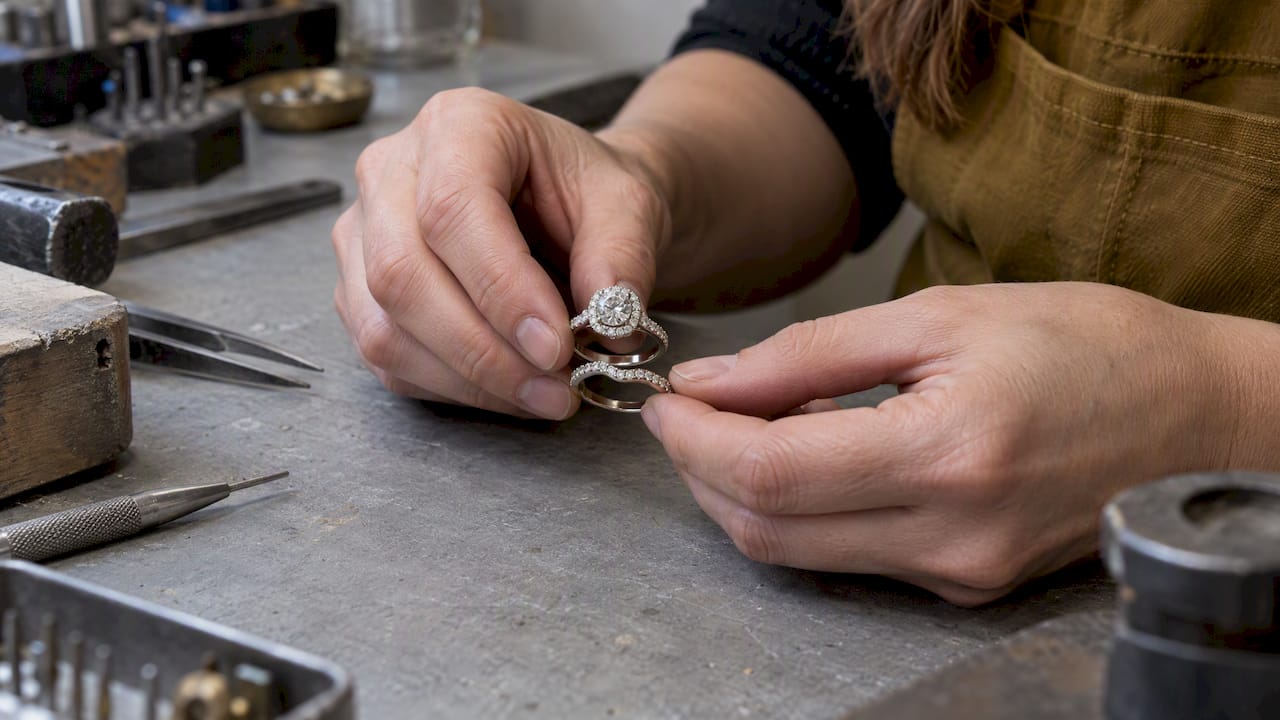
Sometimes the ring itself is the problem; exploring engagement ring matching band options can help find the perfect style and fit to prevent spinning. Halo settings and low baskets can create gaps that cause rotation, and forcing a flush fit by resizing or bending a straight band can put pressure on delicate prongs and chip stones. The GIA’s own sizing notes point out that some settings simply can’t be safely resized, which is where a custom-contoured or chevron-style band comes in. These bands are shaped to trace the engagement ring’s profile instead of fighting it, which keeps both rings secure without putting stress on the setting.
A discreet alternative: design-aware replacements and fitted bands
If repeated adjustments haven’t solved the spinning or your current setting simply wasn’t built to pair with a flush band, a custom-contoured wedding band is often the more lasting answer. Through our design your own process, you can shape a band around your existing engagement ring instead of forcing a standard profile to fit, and our in-house manufacturing keeps that kind of custom work priced without the usual retail markup.

This route isn’t the only answer. In-shop modifications like beads or spring inserts solve plenty of spinning problems on their own, and we’d never suggest replacing a ring that just needs a small adjustment. But if your current set was never quite compatible or you’re ready for a band built around your specific ring, our engagement ring collection is a good place to start exploring fitted options.
FAQ
How do I get my ring to stop spinning?
Start with a removable fix like a plastic coil or silicone guard, which stops rotation without any permanent change to the ring. If spinning continues or you want a lasting solution, a jeweler can add sizing beads, a spring insert, or reshape the band depending on what’s causing the movement.
Is it normal for my ring to spin?
Some rotation is common, especially with wide bands, heavier settings, or fingers that are slimmer at the base than at the knuckle. Frequent or dramatic spinning usually signals a fit or weight distribution issue worth addressing rather than something to ignore.
Is a ring too big if it spins?
Not always. Spinning can mean the ring is genuinely too big, but it can also mean the setting is top-heavy or that your knuckle is noticeably larger than the base of your finger, both of which cause spinning even on a well-sized band.
What is the 3 month rule for rings?
Many jewelers suggest waiting a few months after getting a new ring before resizing, since finger size can shift with temperature, swelling, and daily wear. This waiting period helps confirm whether the fit issue is temporary or something that needs a permanent fix.
Sources
- Accurate Determination of Finger and Ring Sizes | GIA
- Ring Size Guide: Tips and ring size chart | GIA 4Cs
- Sizing Beads – Ganoksin Orchid
A note from Joseph
Most of the spinning rings we hear about turn out to be simple fixes, a coil or guard solves the issue while someone decides whether a permanent change makes sense. The cases that need real intervention are usually about weight, not size, so that’s always the first thing worth ruling out.
— Joseph
Recommended
- Design a Custom Wedding Ring Set That’s Truly Yours
- Bar Setting Rings: How to Balance Sparkle and Resizing With USA Jewels
- Finish Your Engagement Ring in 4–8 Weeks Without Retail Markup
- Pick Ring Setting Style Guide for Every Buyer

Deep Mehta is the Co-Owner of USA Jewels, a family-owned jewelry business she has led since 2013 in Deerfield Beach, Florida. With over 13 years of hands-on experience in fine jewelry retail, manufacturing, and diamond importing, Deep specializes in engagement rings, wedding bands, and custom jewelry design. She also co-manages Kaash Group Talent Acquisition. Deep is a University of Florida graduate and oversees every aspect of USA Jewels’ operations, from product development to marketing.
Fine Jewelry Collection

You May Also Like

How to Choose Jewelry for Occasions: A Style Guide

Avoid Deferred Interest on a $5,000 Ring: U.S. Ring Financing