Split Shank Ring: 5 Buyer Priorities to Boost Center Stone Presence
A split shank ring divides the band into two or more strands as it approaches the center stone, framing it with metal instead of one solid line. The split creates the illusion of a larger stone, adds architectural detail to the shoulders, and gives your finger a fuller, more dramatic look. It suits buyers who want visual presence, need help balancing a bigger stone, or simply want a ring that feels less plain than a traditional band.
TL;DR:
- Wide, symmetrical split shanks help balance larger center stones by drawing more attention to the shoulders.
- Pavé-lined split strands enhance sparkle without competing with the main gem, but require regular cleaning and inspection.
- Resizing heavily split or intricate shanks can be complex, especially if the design includes gemstone settings or reinforcement features.
- Choosing the right metal and finish, such as platinum or rose gold, affects both visual appeal and durability of the split shank ring.
- Pairing a wedding band with a split shank requires a contoured or curved style to avoid gaps, with custom-fit options often necessary for wide or detailed splits.
Table of Contents
- What a Split Shank Is and How It Changes a Ring’s Look
- Split Shank Styles You’ll Actually See in Stores
- Best Center Stone Shapes and Sizes for a Split Shank Setting
- Metal Options and Finishes That Suit a Split Shank
- Pairing a Wedding Band With Your Split Shank Ring
- Durability, Cleaning, and Resizing: What to Ask Before You Buy
- How to Choose or Customize a Split Shank Ring
- Why We Think Split Shanks Deserve More Attention Than They Get
- Ready to Design Your Split Shank Ring?
- Sources
- FAQ
What a Split Shank Is and How It Changes a Ring’s Look
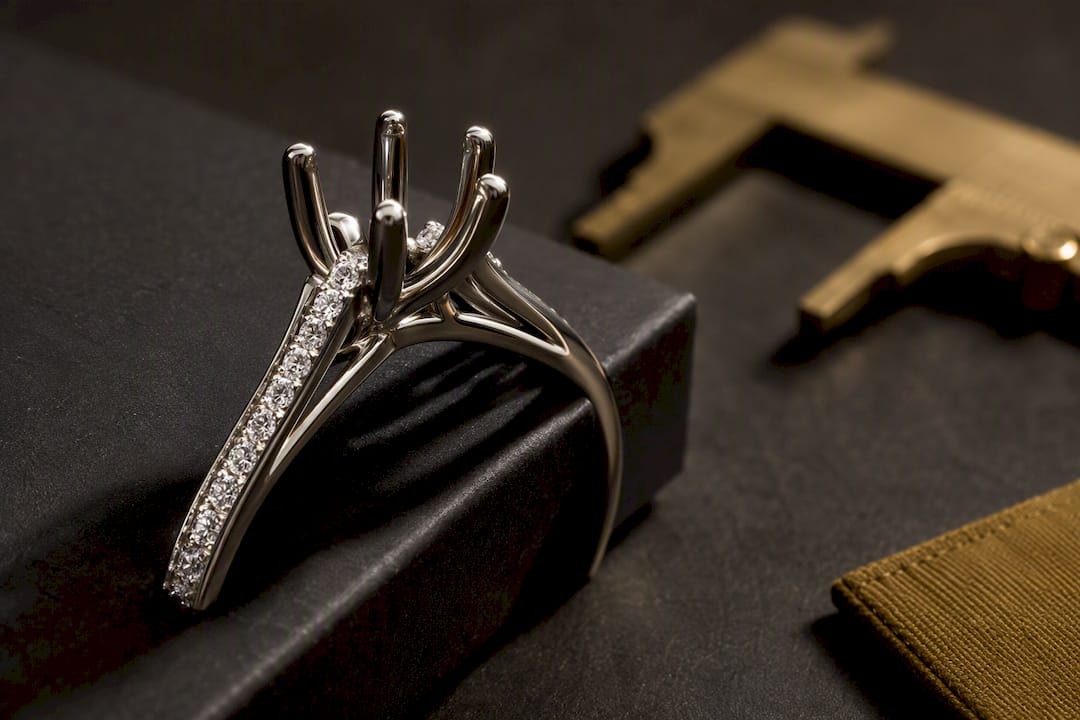
Every ring has two basic parts: the head, which holds the center stone, and the shank, the band that wraps your finger. A split shank takes that shank and divides it into two or more strands right before it reaches the head, then those strands rejoin to cradle the stone. That divide is where all the visual magic happens.
The width of the split, whether the strands sit symmetrically or curve unevenly, and whether they carry pavé diamonds all change how heavy or delicate the ring reads on your hand. A wider, symmetrical split reads bold and modern. A narrow, subtle split feels closer to a traditional band with a twist.
- Wider splits draw more eye toward the shoulders, which helps balance medium and large center stones
- Pavé-lined strands add sparkle without competing with the main stone
- Asymmetrical or twisted splits create movement and a less formal silhouette
Split Shank Styles You’ll Actually See in Stores
Not every split shank looks the same, and the differences matter more than most first-time buyers expect.
- Classic parallel split. Two even strands run side by side into the head. It’s the most versatile version and pairs well with almost any stone shape.
- Twisted or crossover split. The strands cross or spiral before meeting the stone, a look often chosen for its symbolic, romantic feel rather than pure geometry.
- Criss-cross split. Similar to the crossover but with a tighter, more woven pattern, giving the shoulders a basket-like texture.
- Pavé shoulders. Diamonds line each strand for maximum sparkle, at the cost of slightly more delicate upkeep.
Add a knife-edge profile or milgrain detailing to any of these and the ring shifts toward vintage. Keep the strands polished and rounded, and it reads clean and modern.
Best Center Stone Shapes and Sizes for a Split Shank Setting
A split shank engagement ring works with nearly any stone shape, but some pairings look more intentional than others. Round and oval stones are the most forgiving because their curves echo the flow of a split, while cushion and pear cuts lean vintage or elongated when set this way.
- Stones in moderate carat weights often look noticeably larger against a split shank, since the divided metal draws the eye outward
- Larger stones benefit from split shanks to balance visual weight, helping the ring avoid a top-heavy appearance
- Pointed shapes like pear or marquise need secure prong placement at the tips, where a split shank’s head connects
- Cushion and oval cuts generally tolerate more head styles without compromising stone security
Metal Options and Finishes That Suit a Split Shank
Metal choice affects both how the split reads visually and how long it holds up.
- Platinum offers a bright, silvery tone and holds up to daily wear better than most alternatives, making it a strong pick for open, split metalwork
- White, rose, and yellow gold each shift the ring’s warmth. Rose gold in particular has become popular for split shanks because the warmer tone softens the geometric lines
- Two-tone accents, like a yellow gold base with white gold pavé, can highlight the split itself rather than blending it into the rest of the band
- Finish choices matter too: a high polish emphasizes clean lines, a brushed finish softens them, and a knife-edge profile adds a sharper, more tailored look
Pairing a Wedding Band With Your Split Shank Ring
Stacking a wedding band next to a split shank engagement ring takes more planning than pairing with a plain solitaire band. Because the shoulders flare outward, a straight wedding band can leave a visible gap at the base of the strands.
- Curved or contoured bands generally sit flush against split shanks, closing that gap
- Thin diamond or plain metal bands complement wide split shoulders without crowding them
- Very wide or heavily detailed splits sometimes need a fully custom-contoured band made to match the exact curve of your engagement ring
Pro Tip: Bring your engagement ring with you when shopping for a wedding band, or better yet, order both from the same jeweler at once. Matching a contoured band to a split shank after the fact is far harder than designing them together.
Durability, Cleaning, and Resizing: What to Ask Before You Buy
A split shank’s open metalwork is decorative first, structural second. The design doesn’t automatically add strength to a ring, so metal thickness and construction quality determine how well it holds up to daily wear.
- Ask your jeweler about the gauge of metal used in each strand, especially if you plan to wear the ring every day
- Pavé-set shoulders need periodic professional cleaning and inspection rather than at-home ultrasonic cleaners, since loose pavé stones are a common failure point
- Avoid chlorine and harsh household chemicals, which can weaken prongs over time on any open setting
Resizing is where split shanks get complicated. A wide or heavily worked split shank can be significantly harder to resize than a plain band, since jewelers have to adjust each strand proportionally. Some designers reinforce the base of each strand or add a gallery rail underneath to keep larger stones stable, which also affects how the ring can be resized later. If your weight fluctuates or you’re unsure of your long-term size, ask about resizing limits before you commit to a heavily split design.
How to Choose or Customize a Split Shank Ring
Walking into the buying decision with a short list of priorities saves time and prevents costly changes later.
- Decide on metal first. Platinum, white gold, yellow gold, or a two-tone combination sets the tone for everything else.
- Lock in your stone specs. Carat weight, shape, and grade determine how much visual “room” the split shoulders need to fill.
- Choose your head style. A halo, solitaire, or hidden-halo head changes how much the split contributes to overall size perception.
- Decide on pavé versus plain metal shoulders. Pavé adds sparkle and cost; plain metal is easier to maintain.
- Confirm shank width and contouring needs, especially if you already know you’ll stack a wedding band.
When working with a jeweler or a design-your-own tool, ask directly about construction method, warranty coverage, and resizing policy before finalizing anything. Budget trade-offs usually come down to one choice: put more of your budget into metalwork and pavé detail, or put more into a larger center stone and keep the shoulders simple. Custom split shank designs typically take a few weeks longer than in-stock settings, so build that lead time into your timeline if you’re working toward a proposal date.
Why We Think Split Shanks Deserve More Attention Than They Get
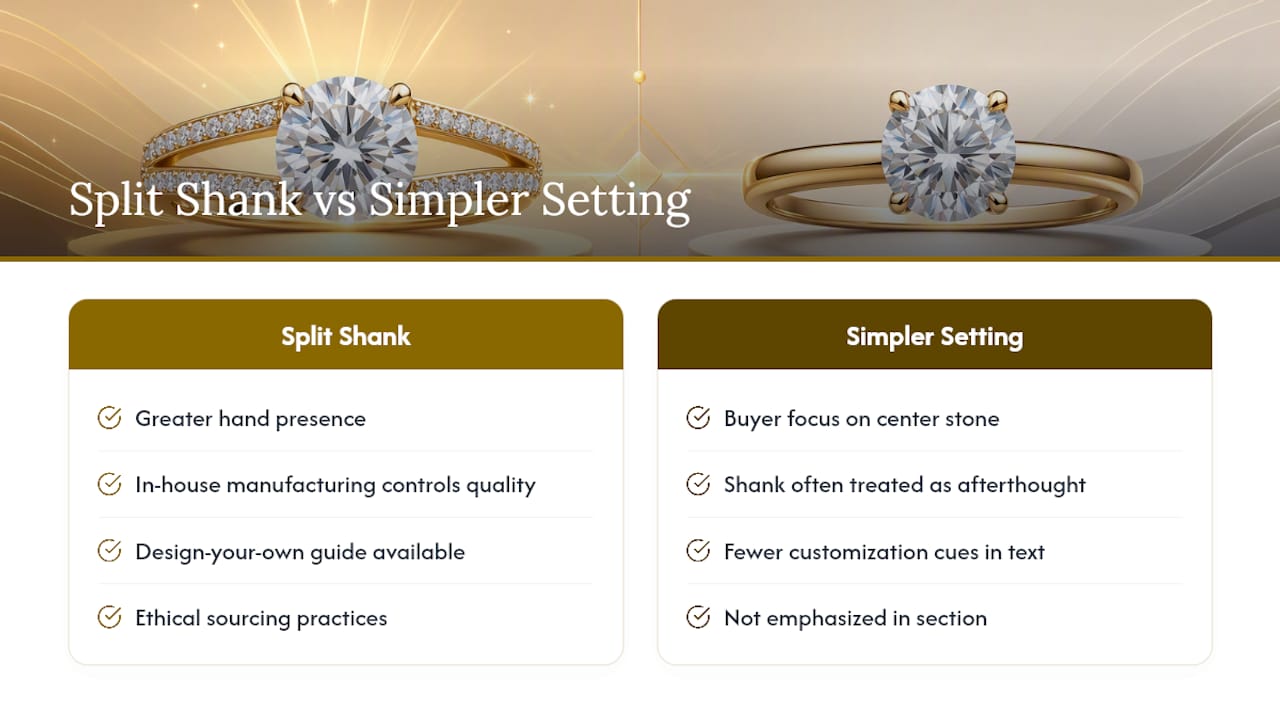
Most buyers walk into a jewelry conversation focused entirely on the center stone, treating the shank as an afterthought. That’s backwards. The shank is what your hand actually sees and feels every day, and a well-built split shank does more work toward making a ring look substantial than a slightly larger stone would.
This jeweler emphasizes in-house manufacturing to control construction quality on every strand of a split shank, not just the parts a customer inspects at purchase. Combined with our design-your-own guide, ethical sourcing practices, and lifetime diamond upgrade program, that gives buyers real control over the trade-offs discussed above, backed by 222+ Google reviews from customers who went through the process. If you’re weighing a split shank against a simpler setting, it’s worth consulting a design guide or booking a consultation before you decide.
— Joseph
Ready to Design Your Split Shank Ring?
Many jewelers sell fixed settings off the display case. This jeweler builds your split shank ring from scratch, so every strand, prong, and pavé detail reflects your actual specifications instead of whatever happens to be in stock.
By manufacturing directly and cutting out the middlemen, this approach aims to offer solid, non-plated construction without traditional jeweler markups. Our design-your-own engagement ring guide walks you through metal, stone, and shank choices step by step, and every custom piece comes backed by a 30-day money-back guarantee and lifetime diamond upgrades. If you already know you want a split shank silhouette, start browsing our engagement ring collection or begin a custom design today to see exactly how your ring will look before you commit.
FAQ
What are split shank rings also called?
They’re most often just called “split shank” or “split band” rings, referring to the divided section of the shank near the center stone. You may also see the term used alongside style names like “twisted split shank” or “criss-cross split shank” to describe specific variations.
Can you wear a wedding band with a split shank engagement ring?
Yes, though a curved or contoured wedding band typically fits better than a straight one, since straight bands can leave a gap where the shoulders flare outward. Thin diamond or plain metal bands generally pair best with wider split shoulders, and very wide splits sometimes call for a custom-contoured band made to match.
What does “shank” mean on a ring?
The shank is the circular band of a ring that wraps around your finger, distinct from the head, which holds the center stone. On a split shank, this band divides into two or more strands as it approaches the head instead of staying as one continuous piece.
Are split shank engagement rings popular?
Split shanks remain one of the most requested engagement ring styles because they add visual size and detail without requiring a larger, more expensive center stone. Their popularity spans multiple sub-styles, from classic parallel splits to twisted and halo combinations, giving buyers flexibility within one design family.
Recommended
- Ring Guide: Engagement Settings & Styles
- Pick Ring Setting Style Guide for Every Buyer
- Settings Guide: Prong, Bezel & Channel
- Role of Center Stone in Engagement Rings: Full Guide

Deep Mehta is the Co-Owner of USA Jewels, a family-owned jewelry business she has led since 2013 in Deerfield Beach, Florida. With over 13 years of hands-on experience in fine jewelry retail, manufacturing, and diamond importing, Deep specializes in engagement rings, wedding bands, and custom jewelry design. She also co-manages Kaash Group Talent Acquisition. Deep is a University of Florida graduate and oversees every aspect of USA Jewels’ operations, from product development to marketing.
Fine Jewelry Collection

You May Also Like
Pick One of 3 Paths to an Ethical Engagement Ring You Can Verify
Are Lab-Grown Diamonds Worth It? A Practical 2026 Guide