Wedding Band Width: How Wide Should Yours Actually Be?
Pick your starting point from three practical buckets: delicate (1.5–2mm), classic (2–3.5mm), or substantial (4–8mm+). Most women gravitate toward 2–3mm for a refined, everyday feel, while many men land closer to 5–6mm or wider for a band that reads as solidly present on the hand. Neither tendency is a rule. We’ve fitted slender hands into 6mm statement bands and broad hands into featherweight 2mm rings, and both looked exactly right, because proportion is personal.
Here’s your fastest path to a decision:
- Try one width from each bucket (a 2mm, a 3mm, and something in the 5mm+ range) at a jeweler’s counter.
- Wear each for a few minutes while making a fist and gripping something, not just admiring it under a light.
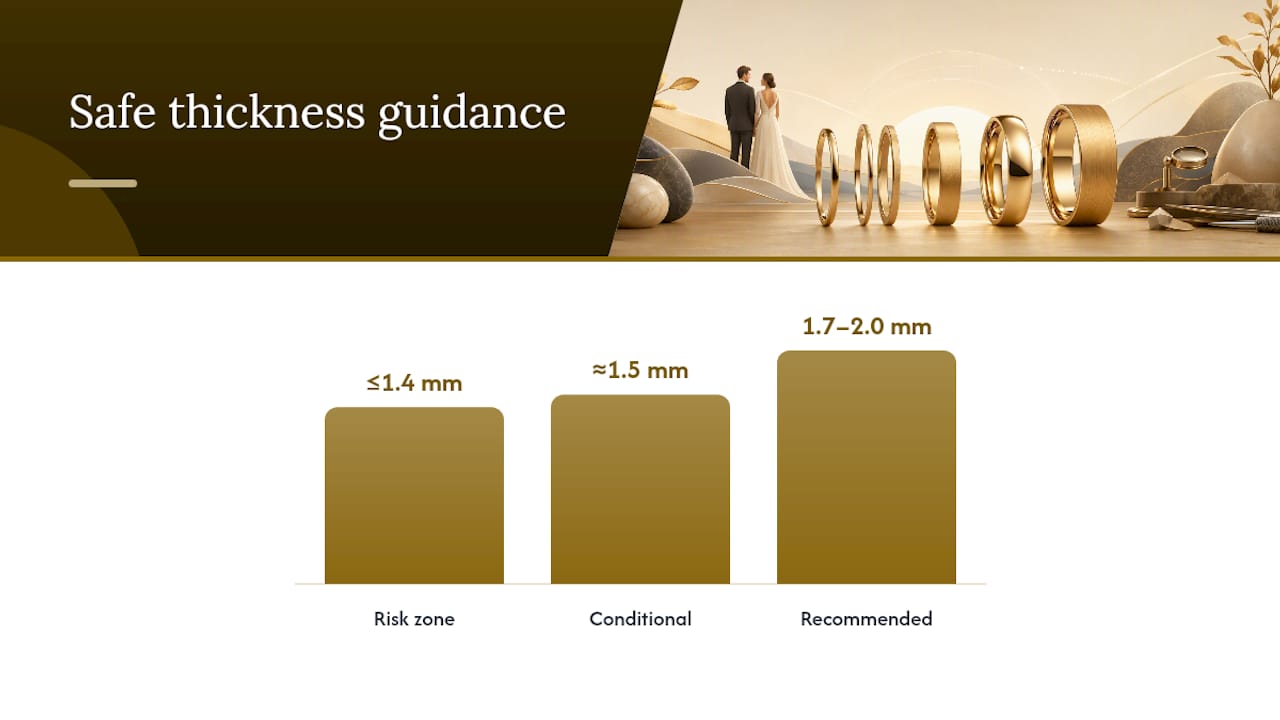
- Check thickness alongside width. A wide band under 1.4mm can feel flimsy no matter how good it looks on paper.
- If you’re pairing with an engagement ring, bring it or a photo so you can judge the stack, not just the band alone.
Once you’ve narrowed to a bucket, the sections below cover the mm charts, durability math, and profile choices that turn “it felt fine for five minutes” into “it feels fine for fifty years.”
Key Takeaways
Choosing the right wedding band width means matching a width bucket to your hand and lifestyle, then pairing it with a thickness of roughly 1.7 to 2.0mm for daily durability.
| Point | Details |
|---|---|
| Start with three buckets | Test delicate (1.5–2mm), classic (2–3.5mm), and substantial (4–8mm+) before deciding. |
| Separate width from thickness | Width shapes the look; thickness (aim for 1.7–2.0mm) determines whether the band bends over time. |
| Match stacked rings closely | Keep your wedding band within about 0.3mm of your engagement ring for a seamless stack. |
| Size up for wider bands | Bands 5mm and wider often need a quarter to half size larger than narrow bands. |
| Get it built to your exact spec | Usajewels crafts custom width, thickness, and comfort-fit interiors in-house rather than limiting you to preset sizes. |
Table of Contents
- What Width Actually Means (and Why Thickness Is a Different Question)
- A Practical Chart for Common Wedding Band Widths
- How to Choose the Right Width for Your Hand and Life
- Thickness, Metal, and What’s Actually Safe for Everyday Wear
- Your Try-On Checklist Before You Commit
- Getting Your Exact Width and Thickness Right
- The One Piece of Advice Most Guides Skip
- Design a Band Built to Your Exact Measurements
- Sources
- FAQ
What Width Actually Means (and Why Thickness Is a Different Question)
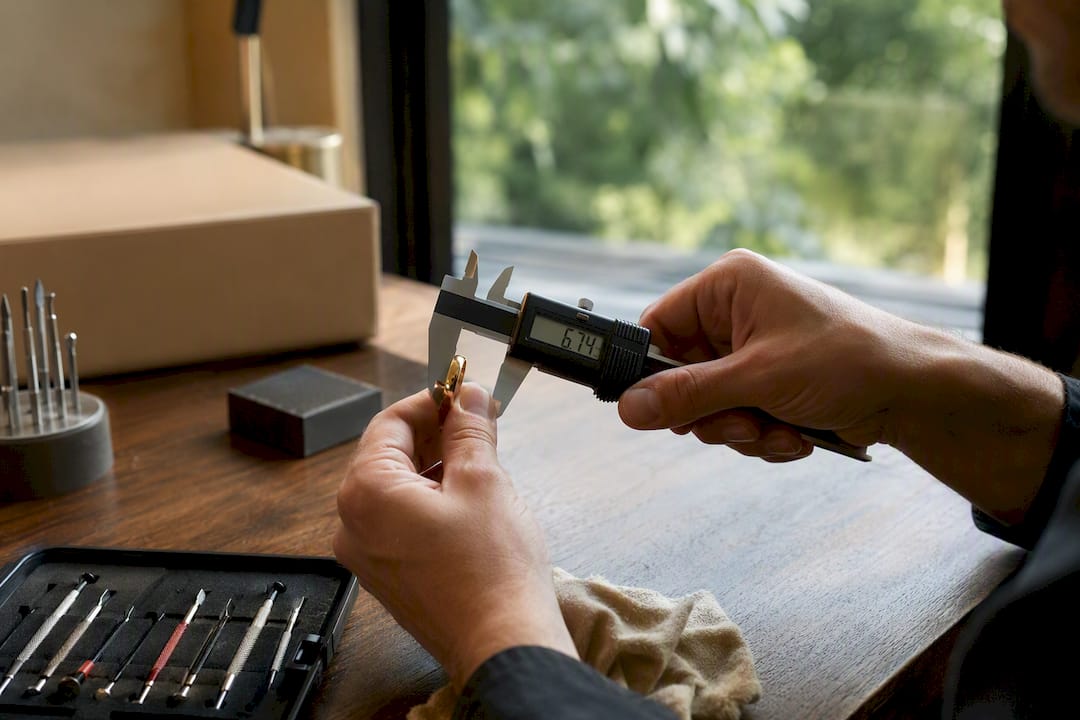
Width is the horizontal measurement across the top of the band, expressed in millimeters. It’s the number that determines whether a ring looks like a thread of gold or a substantial cuff around the finger. Thickness is something else entirely: it’s the vertical depth of the metal, measured from the inner surface to the outer surface, and it’s the number that determines whether the ring survives forty years of dishwashing, gym sessions, and door handles.
Designers and trade sources are consistent on this point: width governs visual presence, thickness governs structural integrity, and shoppers routinely conflate the two. A ring can be wide and flimsy, or narrow and nearly indestructible. The two measurements move independently.
There’s a third variable worth knowing: profile, which is the outer shape of the band as viewed from the side. A flat profile reads differently on the hand than a rounded court or a domed profile, even at identical width and thickness. Profile changes how light catches the metal and how the band feels against the adjacent finger when you make a fist.
Pro Tip: Ask a jeweler to show you the same width in a flat profile next to a court (rounded) profile. Most people are surprised how different 3mm can look depending on which one they’re holding.
Standard thickness ranges break down roughly like this:
- Light (about 1.4–1.7mm): Comfortable for daily wear in stronger alloys, but it’s the floor before durability becomes a real concern.
- Standard (about 1.7–2.0mm): The range most jewelers recommend as the everyday-wear sweet spot, balancing comfort with resistance to bending.
- Robust (2.0mm and up): Chosen for active lifestyles, softer metals, or anyone who wants a band that will outlast decades of hard use.
A band that’s 6mm wide but only 1.2mm thick will bend faster than most people expect. Thin metal doesn’t get stronger just because there’s more of it spread sideways.
A Practical Chart for Common Wedding Band Widths
Once you understand the width versus thickness split, the actual numbers become easy to map to real outcomes. Here’s how the standard range breaks down, from barely-there to unmistakably bold:
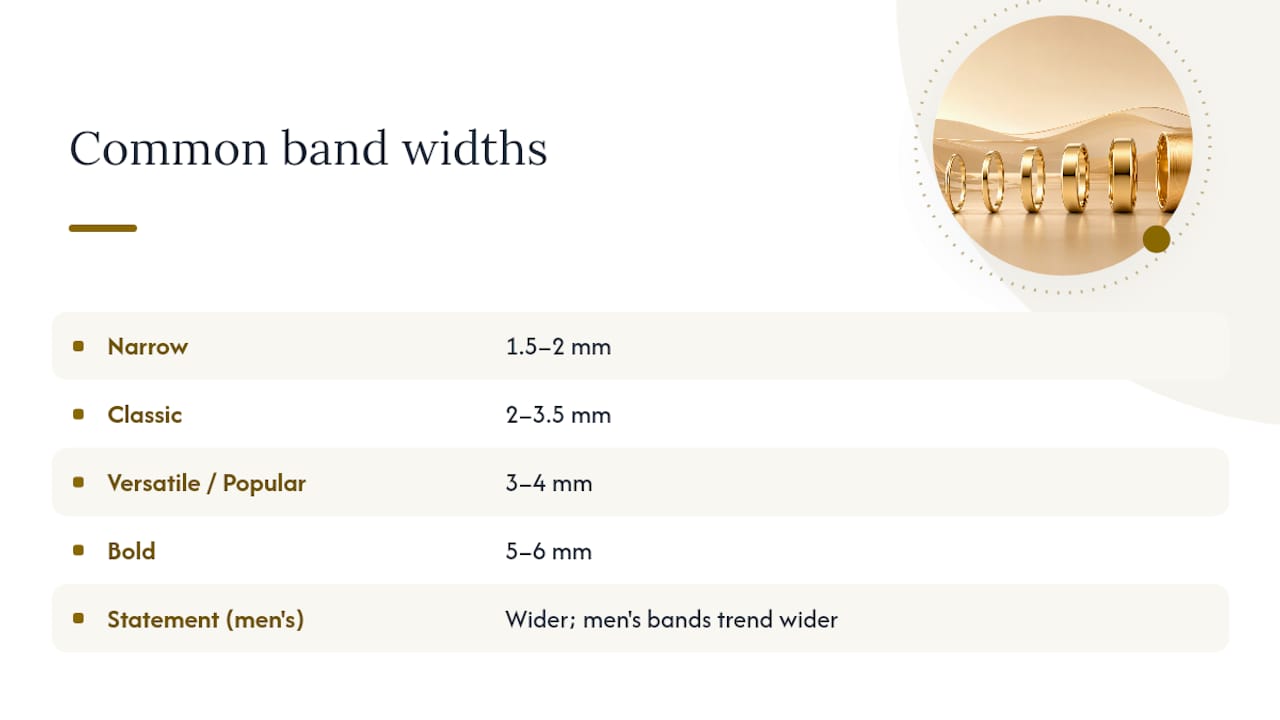
- 1.5–2mm (very narrow): Delicate, minimalist, easy to stack. Common for women who wear multiple rings together and want the wedding band to disappear into the set.
- 2–2.5mm (delicate to classic): The most common default for engagement bands, and a frequent choice for wedding bands worn solo. Enough presence to register, not enough to dominate.
- 3–4mm (versatile, most common): The width that shows up most often across both men’s and women’s bands because it reads as substantial without looking heavy. If you genuinely can’t decide, this is the safest test width.
- 5–6mm (bold, traditional men’s range): The default zone for men who want a band that feels deliberate on the hand, especially paired with a matte or brushed finish.
- Statement widths are chosen for men’s bands or fashion-forward styles where the ring is meant to be noticed rather than just worn.
Stacking changes the math. If you’re wearing your wedding band with an engagement ring, keeping the two within roughly 0.3mm of each other produces a seamless, unified look. Push the gap to 0.5mm or beyond and the mismatch becomes visible, sometimes intentionally styled that way, but usually not the effect people are going for when they didn’t plan it. A 2mm wedding band next to a 2.5mm engagement band reads as a matched set. A 1.5mm band next to a 3mm engagement ring reads as two different rings that happen to share a finger.
How to Choose the Right Width for Your Hand and Life
Start with proportion and body type, not preference. Shorter or narrower fingers tend to look best in 2–3mm widths, since anything wider can visually shorten the finger and crowd the knuckle. Longer or broader fingers carry 4mm and up comfortably, often looking under dressed in anything thinner. This isn’t a hard law, plenty of people break it happily, but it’s the honest starting point if you’re unsure.
Lifestyle matters just as much as proportion, and it’s the piece most shoppers skip:
- Manual work or frequent tool use favors narrower, lower-profile bands that won’t catch on equipment or take repeated impact.
- Gym and sports activity points toward comfort-fit interiors and slightly narrower widths, since wider bands transfer more pressure across the finger during grip-heavy movement.
- Musicians who play stringed or keyed instruments often prefer thinner, lower-profile bands that don’t interfere with finger placement.
- Frequent glove use (medical, industrial, cold-weather) benefits from a band without sharp edges or a wide flare that catches fabric.
- Constant handwashing is easier on comfort-fit interiors, since a flat interior can trap moisture and irritate skin over time.
Profile and interior shape do real work here too. A comfort-fit or rounded court interior makes a wider band feel noticeably slimmer on the hand than a flat interior at the same width, because the curved inside surface reduces the contact area against the finger. This is why two 6mm bands from different jewelers can feel completely different: one uses a comfort-fit interior and slides on easily, the other has a flat interior and feels like a clamp.
Sizing itself needs adjustment for wider bands. A band at 5mm or wider typically needs to run about somewhat larger than a comparable narrow band, because more metal surface contacts the finger and creates a tighter perceived fit at the same nominal size. If you’ve always worn a size 9 in a 2mm band, don’t assume that same size 9 in a 6mm band will feel identical. It usually won’t.
Choosing the right metal also shapes how a given width performs against your specific routine, which is exactly the tradeoff the next section walks through.
Thickness, Metal, and What’s Actually Safe for Everyday Wear
For daily wear, aim for thickness between roughly 1.7mm and 2.0mm regardless of how wide the band is. Below about 1.4mm, especially in softer gold alloys, you’re looking at a band that can develop a visible bend within a few years of normal wear, not decades of abuse.
Metal choice changes this equation. Platinum is denser and generally more resistant to permanent deformation than 14k or 18k gold at the same thickness, which is part of why platinum bands can feel noticeably heavier even at identical dimensions. The density difference is the same physical principle that makes a platinum coin heavier than a gold coin of the same size. GIA’s lifestyle guidance for platinum notes it’s often the better choice for anyone whose hands see heavy daily use.
A narrow band under 1.5mm thick isn’t automatically a bad idea. It works well when:
- The metal is platinum or a higher-karat, harder alloy rather than very soft gold.
- The band is reinforced with a slightly thicker profile at the shank’s weakest points.
- It’s intended as a stacking or occasional-wear piece rather than a daily-wear solo band.
Explore how gold wedding bands and platinum options compare on strength before locking in a width you plan to wear every day for the rest of your life.
Your Try-On Checklist Before You Commit
Testing in person catches problems no chart can predict. Work through this before you finalize anything:
- Try three widths, one from each bucket, and wear each one for several minutes while making a fist, gripping a coffee cup, and typing on a keyboard.
- If you’re stacking with an engagement ring, test the pairing directly and check for knuckle clearance when you bend your finger fully.
- Measure your finger at more than one time of day. Fingers swell in heat and humidity and shrink in cold, so a size that fits perfectly in the morning might feel tight by evening.
- Ask about comfort-fit interiors on anything 4mm or wider, since they meaningfully reduce the sensation of bulk.
- Confirm the resizing policy and any resizing costs before you order, particularly for wider bands, which can be more complex to resize than narrow ones and sometimes face limits on how many sizes they can shift.
Getting Your Exact Width and Thickness Right
We’ve been family owned since 1999, and every band we make runs through our own in-house workshop, which means width and thickness aren’t presets you choose from a limited rack. You tell us the exact millimeter you want, and we build it that way.
Here’s what that looks like in practice:
- Custom width and thickness, specified together so the finished band matches both the visual proportion and the durability level you actually need.
- Comfort-fit interiors available on any width, which matters most once you cross into 4mm and wider territory.
- Lifetime diamond upgrades for anyone pairing a wedding band with a diamond piece down the road.
- 222+ Google reviews from customers who’ve gone through this exact sizing conversation with us.
If you’ve read this far and still aren’t sure whether you want 2mm or 5mm, that uncertainty is normal, and it’s exactly what a real conversation with someone who builds rings for a living can resolve.
The One Piece of Advice Most Guides Skip
Most wedding band advice treats width like a fashion decision and thickness like an afterthought. That’s backward. Width is reversible in the sense that you’ll adjust to how it looks within a week. Thickness mistakes are the ones people regret at year three, when a thin band has already taken on a visible bend from a decade of gym sessions or manual work.
The conventional wisdom of “just pick what looks good” isn’t wrong, exactly, but it’s incomplete. It skips the structural half of the decision entirely. If I had to rank priorities for someone standing at the counter overwhelmed by seven similar-looking gold bands, I’d tell them: settle on thickness first based on how hard you are on your hands, then let width be the flexible, personal choice layered on top.
The other underrated factor is profile. People fixate on the mm number and ignore that a comfort-fit interior can make a 6mm band wear like a 4mm one. If you’ve ruled out a wide band because a flat-profile version felt bulky, try it again in a court profile before you write off the width entirely.
Design a Band Built to Your Exact Measurements
Standard size charts get you close. A custom order gets you exact. Usajewels builds every band to the specific width, thickness, and interior profile you choose, rather than asking you to compromise on whichever preset happens to be in stock. That’s the real advantage of working with a family-owned, in-house manufacturer instead of picking from a fixed retail assortment: you’re not settling for the closest available option, you’re specifying the actual ring.
If you’ve landed on a target width from this guide, say 3mm with a comfort-fit interior in 14k gold, that’s exactly the kind of spec our design team builds from every day. Browse our fine jewelry collection to see finished examples across widths and metals, or start a custom order specifying your exact width and thickness so the band that arrives is the one you actually tried on in your head, not an approximation of it.
Sources
FAQ
How Wide Should Your Wedding Band Be?
Most women choose between 2mm and 3.5mm for comfort and proportion, while men often choose 5mm to 6mm or wider; the right width depends on hand size, stacking needs, and daily activity.
Is a 2mm Band Too Thick?
No, 2mm is one of the most common widths for delicate wedding and engagement bands and is not considered thick by any standard measure. It’s often the narrower end of the classic range, not the wide end.
What Is the Typical Width of a Wedding Band?
Typical wedding bands range from about 1.5mm to 8mm, with 3mm to 4mm being the most common overall because it balances visibility with comfort.
What Are the Common Widths of Wedding Bands?
The standard range breaks into narrow (1.5–2mm), classic (2–3.5mm), versatile and most popular (3–4mm), bold (5–6mm), and statement widths chosen for men’s bands or fashion-forward styles, with men’s bands trending toward the wider end.
Do I Need to Size Up for a Wider Band?
Yes, bands 5mm and wider commonly need about a quarter to half size larger than a narrow band at the same nominal fit, since more metal surface contacts the finger.
Recommended
- Wedding Ring Guide: How to Choose the Perfect Wedding Band | USA Jewels
- Design a Custom Wedding Ring Set That’s Truly Yours
- Gold Wedding Bands, Radiant Brilliance | USA Jewels
- Wedding Jewelry | Bridal Rings & Earrings | USA Jewels

Deep Mehta is the Co-Owner of USA Jewels, a family-owned jewelry business she has led since 2013 in Deerfield Beach, Florida. With over 13 years of hands-on experience in fine jewelry retail, manufacturing, and diamond importing, Deep specializes in engagement rings, wedding bands, and custom jewelry design. She also co-manages Kaash Group Talent Acquisition. Deep is a University of Florida graduate and oversees every aspect of USA Jewels’ operations, from product development to marketing.
Fine Jewelry Collection


You May Also Like

How to Personalize Engraving on an Engagement Ring

Hidden Halo Ring: Spot Under Prong Quality and Care Twice a Year