Elongated Cushion vs. Cushion Cut: How to Choose
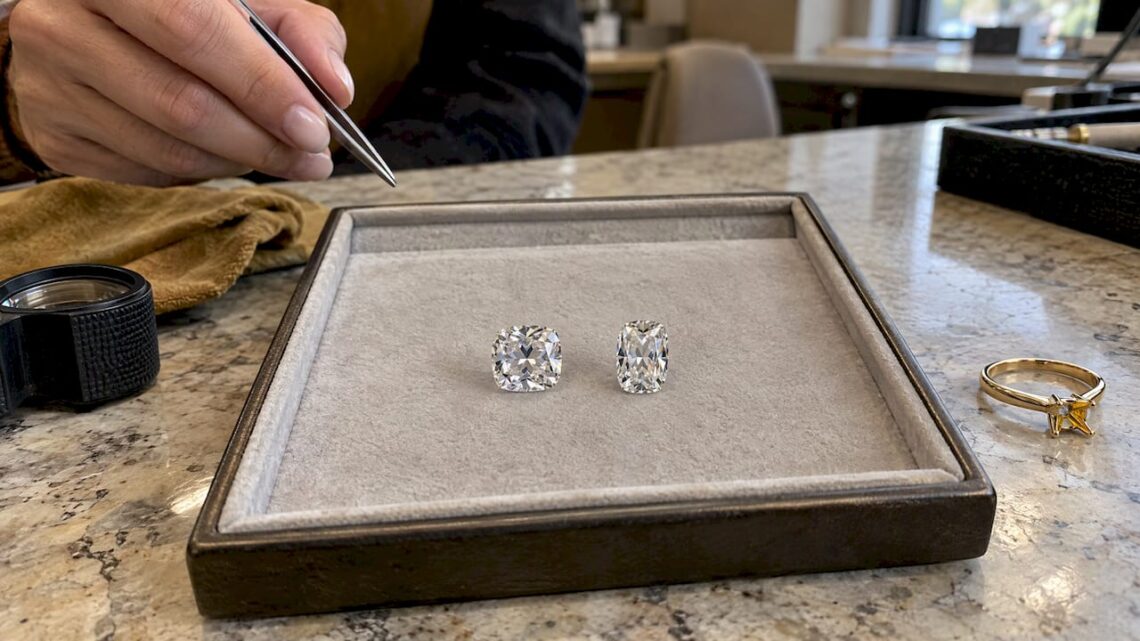
The difference comes down to outline. A classic cushion cut is close to square with softly rounded corners. An elongated cushion keeps those pillowy corners and the same style of faceting, but stretches the stone into a rectangle. Choose the square cushion if you want a compact, vintage look. Choose the elongated cushion if you want more length on the finger and a stone that looks larger for its weight. If you are also weighing it against an oval, the elongated cushion is the one with softer, boxier corners and straighter sides.
We have cut, set and sold diamonds since 1999, and this is one of the most common shape questions couples ask us. Below is how to decide, what to measure, and how to see both shapes in your own design before you order.
TL;DR
- A cushion is near square. An elongated cushion is a stretched rectangle with the same rounded corners and a similar faceting style.
- Elongated cushions have more “spread,” so they usually look bigger face-up than a square cushion of the same carat weight.
- The length-to-width ratio is the number that matters most. Compare ratios on the grading report, not just carat weight.
- Versus an oval: an elongated cushion has straighter sides and squarer corners, while an oval is a smooth curve with no corners.
- You can pick either shape, plus your diamond quality and metal, in our design-your-own ring builder.
Table of Contents
- What is a cushion cut diamond?
- What is an elongated cushion cut?
- Elongated cushion vs. cushion: side by side
- Why an elongated cushion can look bigger
- What length-to-width ratio should you choose?
- Elongated cushion vs. oval: the question behind the question
- Which shape suits your hand and your life?
- What to check when you compare stones
- Natural or lab-grown in either shape
- Cushion vs. other shapes
- Our perspective
- Design your cushion ring with us
- FAQ
- Sources
What is a cushion cut diamond?
A cushion cut has a square or nearly square outline with rounded corners and curved sides, like a pillow. The shape dates back to older diamond cutting traditions, which is why it carries a vintage, romantic feel. Many modern versions are cut to bring out more brilliance than those antique stones did.
In practice, “cushion” on a listing usually means the square or slightly rectangular version. The shape’s length-to-width ratio (the length divided by the width, so a perfect square is 1.00) sits close to 1. If you want a deeper look at this classic, our cushion cut diamond guide covers its history and styles.
What is an elongated cushion cut?
An elongated cushion is a cushion cut that has been stretched along one axis. The corners stay rounded, the sides stay gently curved, and the outline becomes a soft rectangle. Jewelers sometimes call it a rectangular cushion.
There is no single official ratio that turns a cushion into an “elongated” cushion. The more the ratio rises above 1.00, the more rectangular the stone looks. A stone a little longer than wide reads as a subtly relaxed cushion. A stone clearly longer than wide reads as a true elongated shape. That is why we always ask which look you are picturing, not just which name.
Elongated cushion vs. cushion: side by side
| What you compare | Classic (square) cushion | Elongated cushion |
|---|---|---|
| Outline | Near square, rounded corners | Soft rectangle, rounded corners |
| Length-to-width ratio | Close to 1.00 | Clearly above 1.00 |
| Look on the hand | Compact, centered, vintage | Longer, more graceful, modern-romantic |
| Apparent size for the weight | Can look smaller from the top | Usually looks larger for the same weight |
| Setting styles | Solitaire, halo, three-stone | Solitaire, halo, three-stone, east-west |
| Best for | Those who love a traditional, balanced look | Those who want finger length and visual presence |
Why an elongated cushion can look bigger
Carat measures weight, not size. Two diamonds with the same carat weight can look different from above because of how that weight is distributed. IGI explains that deep shapes such as cushions carry more of their weight in the body of the stone and so can look physically smaller from the top. It also notes that spread, meaning the stone’s average length and width, is a better indicator of apparent size than carat weight.
That is the reason an elongated cushion often gets a “bigger” reaction. Stretching the outline puts more of the stone’s surface in view. For the same budget in carats, you often see more diamond across the top.
A quick example. Suppose you are comparing two 1.50 carat cushions. One is nearly square. The other is clearly rectangular. Ask for the millimeter measurements of both on the grading report. The elongated stone will usually show a longer length, and that extra length is what your eye reads as size.
What length-to-width ratio should you choose?
For elongated cushions, the ratio is a matter of taste, and it helps to see the range for a closely related shape. GIA’s guide to oval diamonds describes how ratio changes the look of a stretched stone: ovals at 1.30 to 1.40 look gently rounded, 1.41 to 1.50 are the popular traditional elongated range, and anything above 1.50 is rarely cut. That guide is about ovals, but it shows the principle: a lower ratio looks softer and rounder, and a higher ratio looks sleeker and longer.
For an elongated cushion, we suggest thinking in three simple steps:
- Slightly longer than wide. A gentle stretch that still feels close to a classic cushion. A good choice if you like the vintage shape but want a little more length.
- Clearly rectangular. A balanced elongated look that most couples picture when they say “elongated cushion.”
- Dramatically long. A bold, sleek outline. It looks striking on slender fingers, but it is a stronger style statement.
Pick the ratio by looking at the stone, not only the number. Photos and 360-degree videos of the exact diamond tell you far more than a figure alone.
Elongated cushion vs. oval: the question behind the question
Many couples land on this page because they are deciding between an elongated cushion and an oval. Both are long, flattering shapes, and from across a room they can look alike. Up close, they differ in a few clear ways.
- Corners. An oval is a continuous curve with no corners. An elongated cushion has four rounded corners and straighter sides.
- Personality. An oval tends to read as sleek and modern. An elongated cushion tends to read as soft, romantic and timeless.
- Ratio guidance. GIA’s guidance on oval proportions puts the optimal oval ratio at 1.33 to 1.66, and notes that ovals appear larger because of their elongated shape. An oval at the low end of the range, about 1.20 to 1.29, can resemble a rounded cushion, which is why the two shapes get mixed up.
- Setting. The corners of an elongated cushion suit a halo or a bezel that follows the squared outline. An oval sits naturally in a simple prong setting.
If you love the softness of an oval but also the vintage character of a cushion, the elongated cushion is the shape that sits between them. For an oval-versus-round comparison, see our guide to oval versus round diamonds.
Which shape suits your hand and your life?
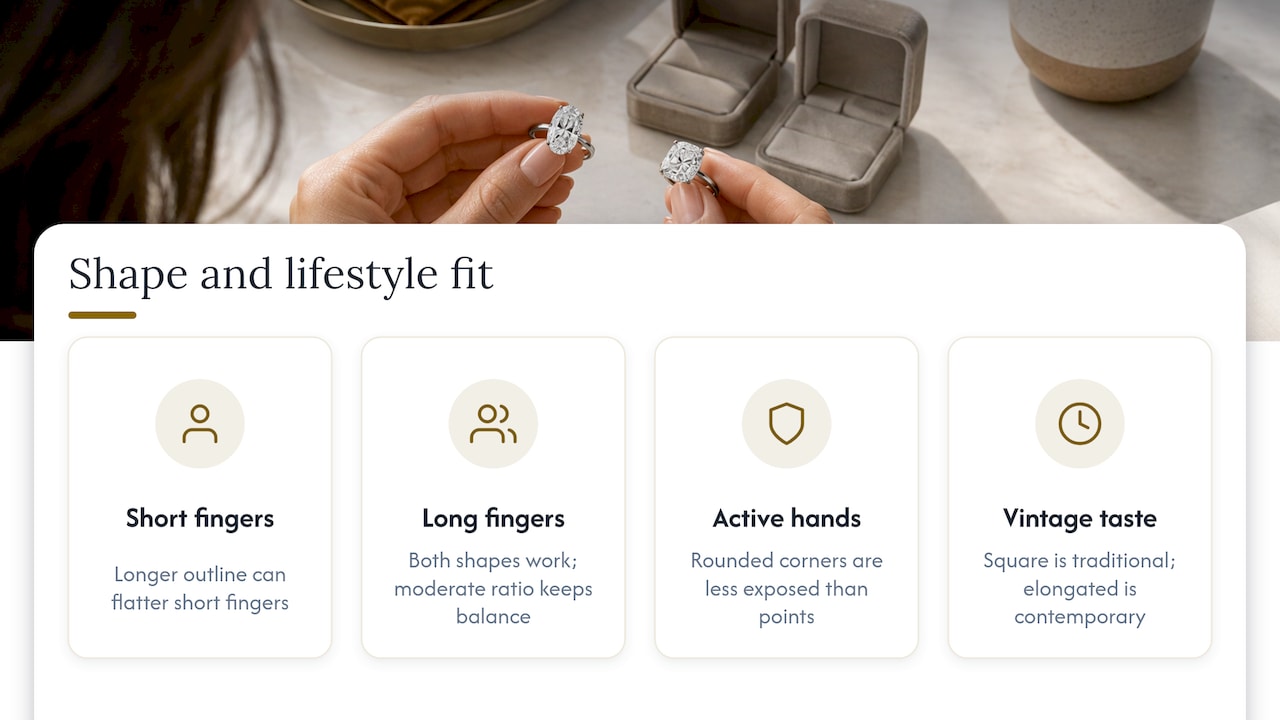
Short or small fingers. A longer stone extends the line of the finger, which many people find flattering. Our guide to diamond shapes for short fingers goes through what flatters and why.
Long, slender fingers. Both shapes work. A square cushion gives a balanced, centered look, and an elongated cushion with a moderate ratio keeps proportions harmonious.
Active hands. Rounded corners are a practical feature of both shapes. They are less exposed than sharp points, so either shape suits everyday wear when it sits in a well-made setting.
Vintage taste. Both are rooted in the same tradition. A square cushion is the more literal vintage choice, and the elongated one is its more contemporary relative.
What to check when you compare stones
Whatever you choose, GIA advises comparing stones of the same shape, similar carat weight and cutting style, using grading reports and viewing them in daylight. Here is the short checklist we use with couples:
- Measurements. Length, width and ratio. Two elongated cushions at the same weight can have different ratios and look quite different.
- Cut quality. Fancy shapes like cushions do not receive the same cut grade as rounds, so look closely at the photos and video. Our guide to diamond cut grades explains what the grading levels mean for what you see.
- Color and clarity. The large, open facets of cushion shapes show color and inclusions in their own way, so choose a grade you are happy with in the actual stone. Our 4Cs breakdown walks through the trade-offs.
- Certification. A grading report from a recognized laboratory gives you the facts in writing. See our diamond certification guide for how the major labs compare.
- Carat weight. Weigh it against spread. Our carat weight guide shows how weight, size and price relate.
Natural or lab-grown in either shape
Both the square and the elongated cushion are available as certified natural and lab-grown stones with us. Lab-grown diamonds have the same chemical and physical nature as mined ones, and many couples choose them to put more of the budget into size or quality. If you want to understand the process, our guide to lab-created diamonds explains it. Our diamonds are ethically sourced and conflict-free, which matters to many of the couples we work with.
Cushion vs. other shapes
If you are still narrowing down, two comparisons help. For a square-versus-square decision, our article on cushion versus princess covers durability, certificates and price. For a wider view, see our ranking of diamond shapes for engagement rings and the diamond cut comparison guide.
Our perspective
We are a family business and we have made jewelry in-house since 1999. Over those years we have watched couples fall for a shape in a photo and then change their minds when they see it on a real hand.
That is why we think the cushion question is really a question about proportion. A square cushion is calm and traditional. An elongated cushion gives you length, presence and a softly modern look, often with more visible size for the weight. Neither is the “right” answer. The right answer is the one that makes you smile when you picture it every day.
We make our jewelry ourselves, so there is no middleman between you and the person who builds your ring. That lets us offer direct pricing, solid construction (not hollow or plated), free insured shipping, a 30-day money-back guarantee and lifetime diamond upgrades, so the stone you choose today can grow with your story.
Take your time, compare measurements, and choose the stone that feels like yours.
Joseph
Design your cushion ring with us
You can choose between a square and an elongated cushion in our design-your-own ring builder, starting from $399, and pick your diamond quality and metal along the way. If you would rather start with the stone, our certified loose diamonds start from $142. Ready-made options are also available in our engagement ring collection, from $346.
If you want a walk-through of each choice, our step-by-step design guide takes you from shape to setting.
FAQ
What is the difference between an elongated cushion and a cushion cut?
A classic cushion cut is square or nearly square, with a length-to-width ratio close to 1.00. An elongated cushion is stretched into a rectangle, with the same rounded corners and a similar faceting style. The stretched outline gives it more length and often a larger look from above.
Is an elongated cushion bigger than a cushion?
For the same carat weight, it often looks bigger. IGI notes that spread, meaning length and width, is a better indicator of apparent size than carat weight. A longer outline shows more diamond across the top, so ask for the millimeter measurements of each stone you compare.
What is the difference between an elongated cushion and an oval?
The main difference is the outline. An oval is a smooth curve with no corners, while an elongated cushion has four softly rounded corners and straighter sides. Ovals with a lower ratio, about 1.20 to 1.29, can resemble a rounded cushion, so look at the corners to tell them apart.
What is a good ratio for an elongated cushion?
It depends on the look you want. A slight stretch feels close to a classic cushion, and a higher ratio looks sleeker and more rectangular. GIA’s oval guidance shows the same principle: lower ratios look rounder and higher ones more elongated. Choose by viewing the actual stone.
Which is better for an engagement ring?
Both make beautiful engagement rings. Choose a square cushion for a compact, traditional look, and an elongated cushion for more finger length and visual size. Either one can be set in solid gold or platinum, with your choice of diamond quality.
Sources
- Oval Cut Diamond Buying Guide, GIA 4Cs
- Expert Tips for Buying Fancy Shaped Diamonds, GIA 4Cs
- Same Carat Weight, Visible Size Differences, IGI
Recommended
- Engagement Buyers: Cushion vs Princess, Durability, Certificates, Price
- Cushion Cut Diamond Guide: Vintage Charm with Modern Sparkle
- Diamond Cut Comparison Guide for Engagement Rings
- Best Diamond Shapes for Engagement Rings Ranked

Deep Mehta is the Co-Owner of USA Jewels, a family-owned jewelry business she has led since 2013 in Deerfield Beach, Florida. With over 13 years of hands-on experience in fine jewelry retail, manufacturing, and diamond importing, Deep specializes in engagement rings, wedding bands, and custom jewelry design. She also co-manages Kaash Group Talent Acquisition. Deep is a University of Florida graduate and oversees every aspect of USA Jewels’ operations, from product development to marketing.
Fine Jewelry Collection

You May Also Like
Why Custom Jewelry Is a Meaningful Gift for Any Occasion
Tennis Bracelet Costs: What 2–3 Carats Buy and How to Save 40–70%