Lab Diamond Color: What the D-to-Z Grades Mean
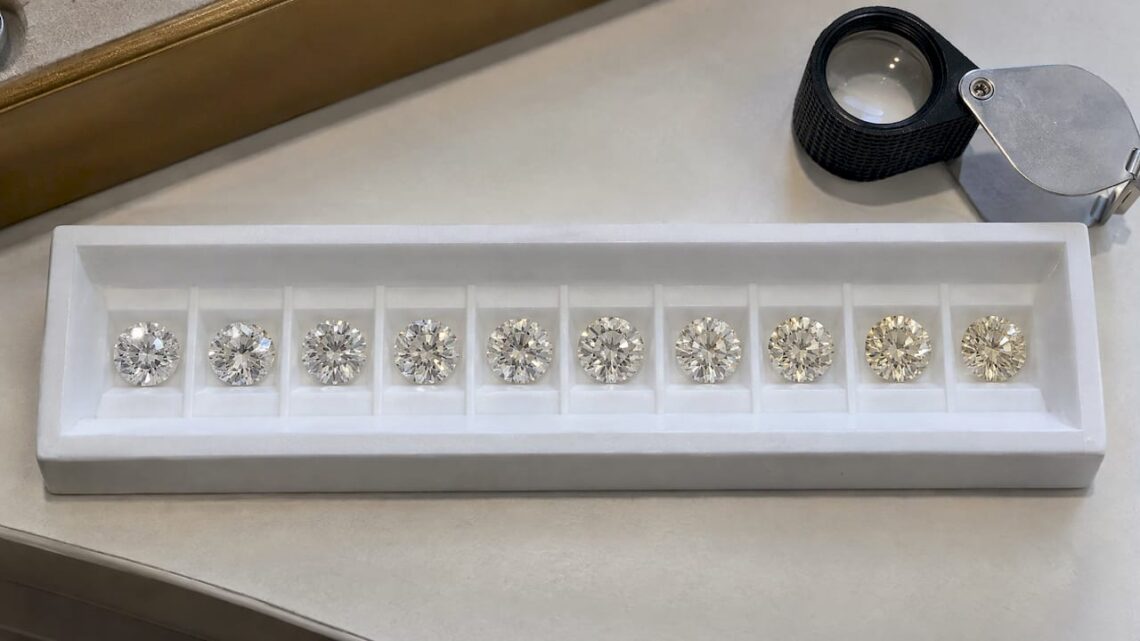
Lab diamond color is graded on the same D-to-Z scale as mined diamonds: D is completely colorless, and each letter after it shows a little more yellow or brown. For most rings, a grade in the colorless to near-colorless range looks white once the stone is set, so you rarely need to pay for the top letter. At USA Jewels, our certified loose diamonds start at $142, and you can choose the color grade that fits your ring, your metal and your budget.
Below, we explain what the letters mean, why some lab stones are tinted, how your setting changes what you see, and how to pick a grade with confidence.
TL;DR
- Lab-grown diamonds use the D-to-Z color scale. D is colorless, Z has visible yellow or brown tint.
- D–F are colorless and G–J near-colorless. The step between neighboring letters is very small to the eye.
- Metal matters: a slightly warmer stone can look colorless in yellow or rose gold.
- Fancy colors (pink, blue, yellow and others) are graded on a separate system, not on D-to-Z.
- Compare color together with cut, size and the certificate, not on its own.
Table of Contents
- How lab diamond color is graded
- Why some lab diamonds have color
- White diamonds versus fancy-color diamonds
- How color grade affects price and look
- What changes how color looks in a ring
- Which color grade should you choose?
- Lab diamond color for gifts and first-time buyers
- How we help you choose
- Our perspective
- FAQ
- Sources
How lab diamond color is graded
A lab diamond is real diamond, so gemologists judge it the same way. IGI, one of the major grading laboratories, views each stone face-down through the pavilion (the pointed underside) and compares it with a master set of stones of known color. D means colorless. As the letters increase, the stone shows more yellow or brown, down to Z.
IGI groups the scale like this:
| Grade | Group | What it means for you |
|---|---|---|
| D–F | Colorless | The whitest look and the highest prices in the standard range |
| G–J | Near-colorless | Looks white to most people, especially once mounted |
| K–M | Faint | A light warm tint, easier to see in a white metal |
| N–R | Very light | Tint is visible to the naked eye |
| S–Z | Light | Clear yellow or brown tone |
The International Gem Society gives the same groupings. It also notes that color is hard to judge by eye even for experts, which is why gemologists use master stones or a colorimeter, an instrument that measures color, to assign the grade.
Why does the scale start at D? GIA explains that earlier systems used A, B and C in inconsistent ways, so its scale began at D to avoid confusion with them. There is no hidden meaning in the letters.
Are D, E and F really different?
IGI describes D as completely colorless, and says E and F differ from D only in ways that are barely detectable. A trained grader sees it with stones side by side under controlled light. You will not see it across a dinner table.
A note on GIA reports
GIA has used its own wording for lab-grown stones. Its Laboratory-Grown Diamond Report, introduced in July 2019, described color with categories (Colorless, Near Colorless, Faint, Very Light, Light) instead of single D-to-Z letters. If a certificate looks different from another, that is usually the reason. Our diamond certification guide compares how GIA, AGS and IGI report.
Why some lab diamonds have color
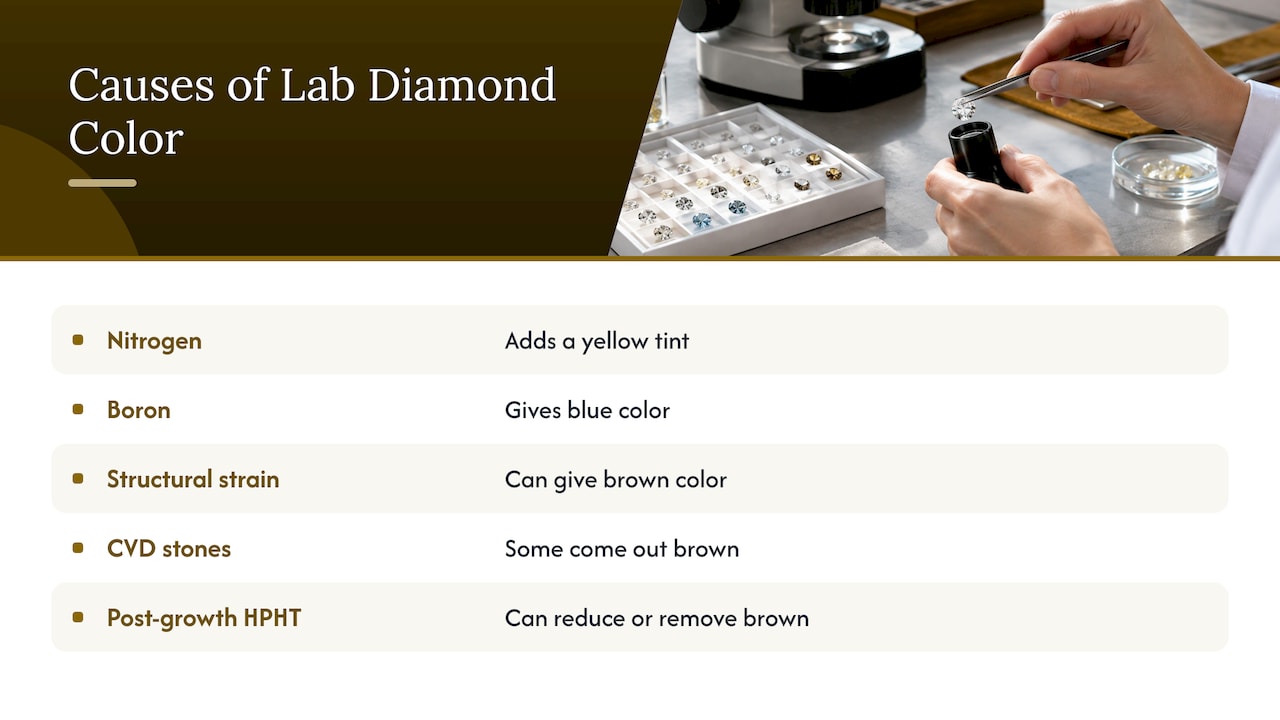
Lab diamonds get their color from what happens inside the crystal as it grows. Nitrogen atoms add a yellow tint. Boron gives blue. Structural strain can give brown. GIA’s research summary says early lab diamonds grown by the HPHT method (high pressure, high temperature) were often yellow-orange from nitrogen or blue from boron, and that manufacturers have since largely removed nitrogen. The same page notes that some CVD stones (grown from a gas, layer by layer) come out brown, and that a post-growth HPHT treatment can reduce or remove that brown.
That is why today’s lab diamonds in jewelry are so often colorless or near-colorless: growers control the process. Our guide to how lab-created diamonds are made walks through both methods.
White diamonds versus fancy-color diamonds
This is the most common point of confusion. A diamond with a tint that gets stronger than Z is not simply “a lower grade.” IGI says stones with more color than Z, or with other hues such as orange, pink and blue, are fancy colored and graded on a separate report. The International Gem Society adds that fancy color uses hue, tone and saturation instead of the D-to-Z letters.
In plain terms:
- Hue is the color itself: pink, blue, yellow.
- Tone is how light or dark it is.
- Saturation is how strong or vivid it is.
GIA’s guide says white diamonds are valued more highly as they get closer to colorless, but fancy colors such as pink and blue sit outside that rule. For a fancy stone, a vivid, even color is the goal. If you love color, see our colored diamond guide and our blue diamond jewelry and black diamond jewelry collections.
How color grade affects price and look
IGI says D–F are the rarest and most expensive grades in the standard range, while G–H balance a near-colorless look with better value. Lab diamond prices have also fallen in recent years as production has grown, so a given grade costs less than it once did. The exact price you see depends on carat weight, shape, cut and the day you shop, which is why we show each certified stone’s price on its own page.
A useful way to think about it: you pay a premium for the letter on paper. What you get for your eyes is the same stone. If a G looks white to you in person, the extra money for a D buys a number, not a visibly whiter diamond.
What changes how color looks in a ring
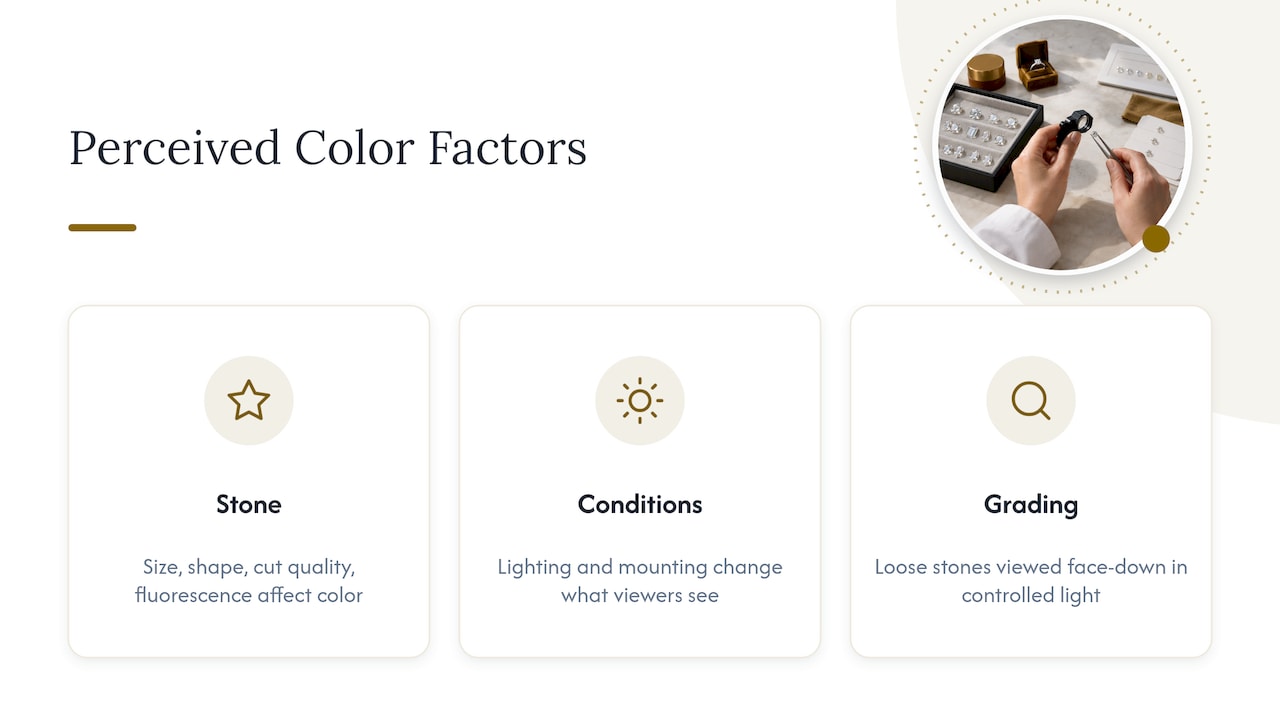
The grade is measured on a loose stone, face-down, in controlled light. You will see the diamond face-up, mounted, in a living room, an office and sunlight. IGI notes that size, shape, cut quality and fluorescence can affect perceived color, and that lighting and mounting also change what viewers see. Its lab views stones face-down precisely to limit those effects.
Metal
The International Gem Society says K–M stones can show yellow tint loose but may look colorless in yellow or rose gold, while N–Z stones show stronger tint that can stay visible to the naked eye. A warm metal reflects its own glow into the stone, so a slight tint disappears. White gold and platinum act like a white backdrop and show the stone’s true tone. Our guide to the best diamond color for yellow gold goes deeper on this.
Shape and size
Larger stones and shapes with big open facets, such as emerald and Asscher cuts, show color more easily, because light travels further through the stone. Brilliant shapes like round and princess hide a little more. Our diamond shapes guide compares them.
Cut
A well-cut stone returns more light and looks brighter and whiter. A poor cut can make a high color grade look dull. That is why we suggest cut first, then color. Read how GIA’s five cut levels change what you see.
Which color grade should you choose?
Here is a simple starting point, based on the groupings above and how each grade behaves in a setting. It is a guide, not a rule.
| Your ring | Grades to look at | Why |
|---|---|---|
| White gold or platinum, stone under about 1.5 carats | G–H (near-colorless) | Reads as white and keeps more budget for cut and size |
| White gold or platinum, larger or emerald-cut stone | D–F, or a strong G | Bigger facets show more tint |
| Yellow or rose gold | H–J, sometimes K | The warm metal blends with a slight tint |
| Earrings or pendants | G–I | You view them from a distance, and pairs just need to match |
| Fancy color | Choose by hue, tone and saturation | The D-to-Z scale does not apply |
For a deeper look at how color trades off against clarity, see Diamond Color & Clarity Explained and cut first, then color versus clarity.
What to compare before you buy
- The certificate. Confirm the lab, the color grade and that the stone is identified as lab-grown. Our GIA certification guide explains what each line means.
- Cut grade. It drives sparkle more than a one-letter color change.
- Your metal. Choose the metal first, then the color grade that suits it.
- Shape and size. The bigger the face-up area, the more color shows.
- Total budget. Money saved on color can go toward carat weight or a better cut.
A worked example
Say you are choosing a round lab diamond for a platinum engagement ring. Two stones have the same carat weight and cut grade. One is a D, one is an H. Set side by side face-up in the ring, the difference is very small for most people, yet the D carries the higher price in the standard range. If you choose the H and apply the difference to a larger stone, the ring looks bigger every day. If you are buying a very large stone, or you want the top letter for the certificate, choose D–F. Both are good choices. They suit different priorities.
Lab diamond color for gifts and first-time buyers
If you are buying a gift, or this is your first diamond, color is the part that feels most technical, yet it is the easiest to simplify. Pick your metal, pick a near-colorless grade, and put your attention on cut. For earrings and pendants, which are seen at a distance, you can lean toward the value end of the scale. Many parents buying for a child’s milestone gift choose this way, because the sparkle comes from the cut and the piece feels special regardless of the letter.
If conflict-free sourcing matters to you, every lab-grown stone is made in a controlled setting, and we also hand-select our natural diamonds with ethical sourcing in mind. Our lab-grown versus natural guide helps you decide.
How we help you choose
We manufacture in-house and sell direct, so there are no middlemen between you and the stone. You can browse certified loose diamonds from $142, or start a design-your-own diamond ring from $399 and pick the diamond shape, quality and metal yourself. Our engagement rings start at $346.

Every order ships free and insured, comes with a 30-day money-back guarantee, and is covered by our lifetime diamond upgrade program. If you want to see how a grade looks in a specific metal, start in our design tool and try the combinations.
Our perspective
Over the years, we have watched the same moment happen again and again. A couple finds two diamonds, one a D and one a G, and wonders whether the letter will change how the ring feels on her hand. Most of the time, it will not.
We believe color is best chosen with the whole ring in mind: the metal, the cut, the shape and the person who will wear it. A well-cut near-colorless stone in the right setting gives you the bright, white look you want, and it leaves room in the budget for the things you will see every day, like size and craftsmanship.
That is why we build our rings in-house and sell direct. You get solid, certified jewelry at fair pricing, a certificate you can read, and a lifetime upgrade program if your story grows. Choose the color that makes you smile when you look down at your hand.
Joseph
FAQ
What is the best color for a lab-grown diamond?
For most rings, G–H in white gold or platinum looks white once set, and H–J works well in yellow or rose gold. D–F is the colorless group, which suits large stones or buyers who want the top letter on the certificate.
Is lab diamond color different from natural diamond color?
No. Lab diamonds are graded on the same D-to-Z scale by the same laboratories. The color comes from tiny traces in the crystal, such as nitrogen or boron, and growers today control them closely.
Can a lab diamond change color over time?
A diamond’s color grade does not fade with normal wear. A stone can look different as lighting or its setting changes, or when dirt collects behind it, so gentle regular cleaning keeps it bright.
What are fancy-color lab diamonds?
They are diamonds with a distinct hue, such as pink, blue or yellow, stronger than the Z grade. They are graded on hue, tone and saturation on a separate report instead of D-to-Z.
Sources
- IGI: Diamond Color, Grading Scale and Its Impact on Value
- GIA: Why GIA provides fewer grade categories for color and clarity of laboratory-grown diamonds
- GIA: 4Cs Color, D-to-Z
- International Gem Society: Grading Lab-Grown Diamonds
Recommended
- Diamond Color Chart — D-to-Z Color Scale Explained
- Best Diamond Color for Yellow Gold Rings
- Diamond Color & Clarity Explained: What to Buy
- What Does E Color Diamond Mean: Buyer’s Guide

Deep Mehta is the Co-Owner of USA Jewels, a family-owned jewelry business she has led since 2013 in Deerfield Beach, Florida. With over 13 years of hands-on experience in fine jewelry retail, manufacturing, and diamond importing, Deep specializes in engagement rings, wedding bands, and custom jewelry design. She also co-manages Kaash Group Talent Acquisition. Deep is a University of Florida graduate and oversees every aspect of USA Jewels’ operations, from product development to marketing.
Fine Jewelry Collection

You May Also Like
Are Lab-Grown Diamonds Worth It? A Practical 2026 Guide
What Graduation Jewelry Symbolizes: A Gift-Giver’s Guide