Family Owned Jeweler: What It Means and How to Choose
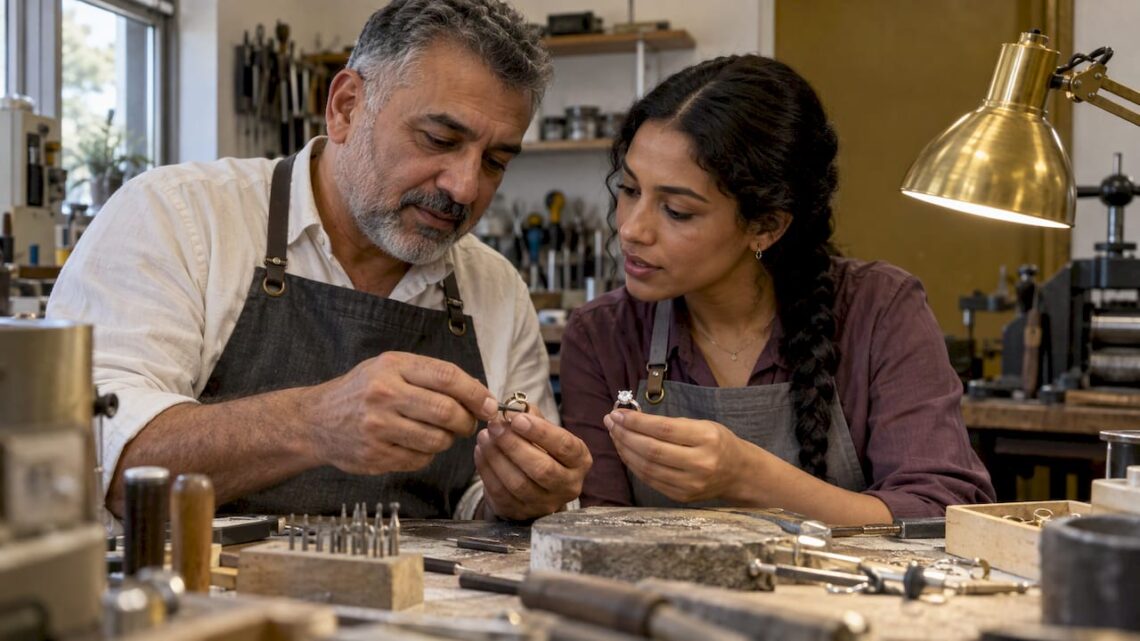
A family owned jeweler is a business where the people who run it are the people whose name is on the door. They answer for the piece, the price and the promise. That usually shows up as direct access to the owners, custom work made to your idea, and a relationship that lasts well beyond the sale. Below, we explain what to look for, what to ask, and how to tell real family ownership from a good slogan.
TL;DR
- A family owned jeweler is accountable to you personally: the owners handle service, repairs and problems themselves.
- Independent jewelers lean heavily on custom design. 95% offer it, so ask to see how the process works.
- Test any jeweler on transparency: can they explain the price, the metal, the diamond paperwork and the return terms in plain words?
- Ask for written proof of diamond sourcing and a clear policy on returns, repairs and upgrades.
- We are a family-owned, in-house manufacturer, so we sell direct with no middlemen. Our prices start at $46 for sterling silver and $142 for certified loose diamonds.
Table of Contents
- What a family owned jeweler really is
- The benefits you can expect
- Family owned versus chain: a side-by-side look
- How to tell real family ownership from a slogan
- Questions to ask before you buy
- Checking that a diamond is conflict-free
- Designing a custom engagement ring with a family jeweler
- Our perspective
- Where we fit
- A simple checklist for your visit
- FAQ
- Sources
What a family owned jeweler really is
The phrase means a jewelry business owned and run by a family, often across more than one generation, rather than by a national chain or a private equity group. The owners are in the building, at the bench or on the phone. When something goes wrong, there is a person to call, not a ticket number.
That is the typical shape of American independent jewelry, too. According to INSTORE Magazine’s Big Survey 2026, the typical independent jeweler is still a one-store downtown operation. Most are in small to medium-sized cities, offer a full range of services, and take pride in the edge their custom design skills give them.
Three things tend to separate a family owned jeweler from a large retailer:
- Decisions are made by the owners. Pricing, exceptions, repairs and remakes do not wait for corporate approval.
- Reputation is personal. A bad piece harms a family name, so there is a strong reason to make it right.
- Craft is part of the offer. Many keep design and repair skills close by, which is why custom work is so common among them.
The benefits you can expect
Benefits are only real if you can check them. Here is what to expect and how to confirm each one.
Service you can reach
You should be able to speak to someone who knows your order, whether that is by phone, email or in a showroom. Ask who will handle your piece from sketch to delivery. A family business can usually name the person.
Custom design without a corporate filter
The INSTORE survey found that 95% of independent jewelers offer custom design. Compare that with the standard catalog model, where you pick from a fixed set of settings. With a custom-minded jeweler, you choose the diamond shape, the quality and the metal, and the piece is built around those choices. Our own Design Your Own Diamond Ring tool starts at $399, and Design Your Own Earrings and pendants start at $199.
Services after the sale
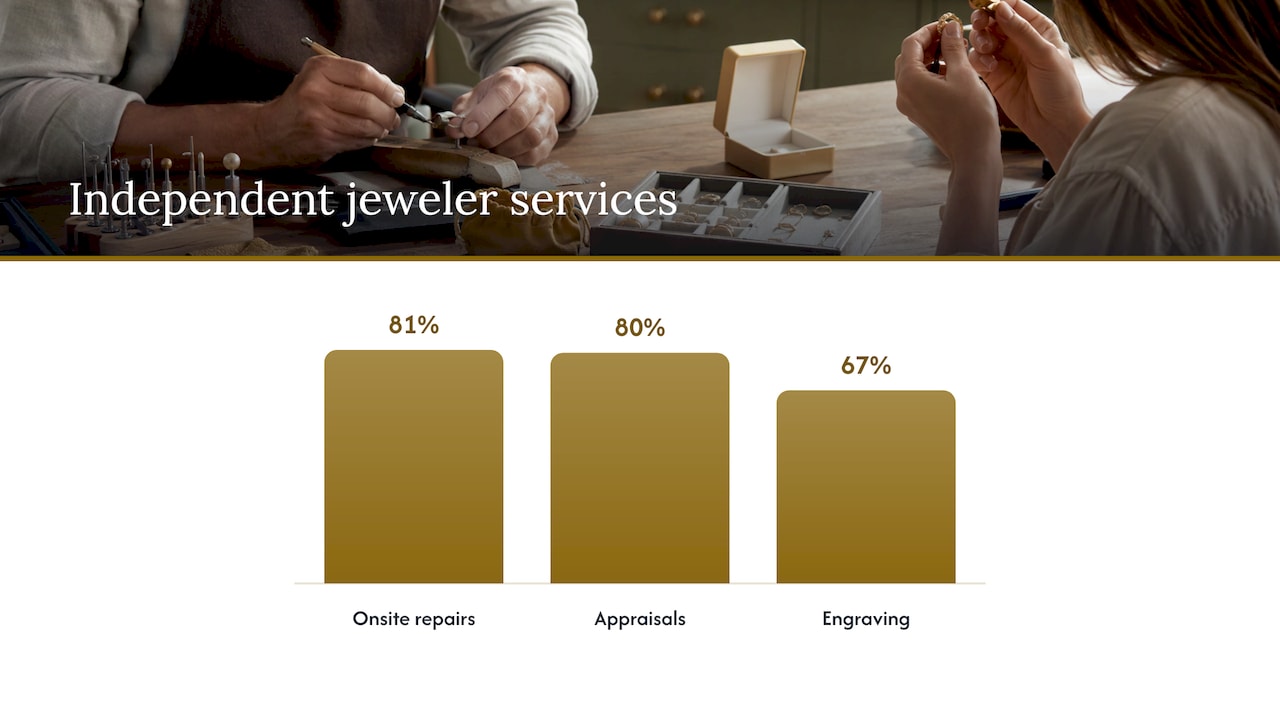
The same survey reports that 81% of independents offer onsite repairs, 80% offer appraisals and 67% offer engraving. Those services matter because jewelry is worn daily. Prongs loosen, rings need resizing, chains need cleaning. Our jewelry repair guide explains when to fix, resize or restore a piece.
A full-service jeweler also helps with the small things. If you wear a watch, adjusting the strap is a routine job, and guides on adjusting a watch bracelet show what the work involves. Ask any jeweler you are considering which of these services they handle themselves.
Pricing that makes sense
When the maker is also the seller, there are fewer hands between the bench and you. That is the idea behind our model: we manufacture in-house and sell direct, so there is no middleman markup layered onto the price. Our fine jewelry collections start at $176 for earrings, $492 for pendants, $668 for rings, $866 for necklaces and $1,303 for bracelets.
Family owned versus chain: a side-by-side look
| What you care about | Family owned jeweler | Large chain or mall store |
|---|---|---|
| Who decides on exceptions | The owners | Corporate policy |
| Custom work | Common, often built to your idea | Usually limited to catalog options |
| Repairs | Often handled by the same team | Often sent out, with varying turnaround |
| Relationship | Personal, can span years | Transactional |
| Pricing | Can be direct if the jeweler makes its own pieces | Includes retail overhead and brand premium |
This is a general pattern, not a rule. Some family jewelers resell other people’s goods, and some chains do good work. The point of the table is to show you what to ask, not to settle the question for you.
How to tell real family ownership from a slogan
Anyone can write “family owned” on a website. Look for proof in the details.
- A story with names and dates. We have been in business since 1999, and we say so plainly. A jeweler that cannot tell you when it started or who runs it is worth a second look.
- A real showroom or address. You should be able to find where the business operates.
- Reviews that describe the experience. We have more than 222 Google reviews, and the useful ones talk about the people, the process and the piece, not just the stars.
- Making, not only selling. Ask whether the jeweler manufactures in-house or buys finished goods. Our in-house manufacturing is the reason we can offer solid construction, not hollow or plated pieces.
- Policies in writing. Returns, upgrades and repair terms should be written down and easy to find.
Our guide on how to choose a certified ethical diamond jeweler goes deeper on the paperwork side.
Questions to ask before you buy
About price
A trustworthy jeweler can explain the total price in plain language. Ask for a breakdown that separates the metal, the labor, the stones, the setting, any certification and taxes. For gold, ask the karat and approximate weight in grams, and ask how the making charge is calculated. If the answer is vague, keep asking until it is clear. Comparing a written quote with one other seller is a fair habit.
Price differences between handmade pieces are normal and have reasons. Our article on why handcrafted jewelry costs differ walks through them.
About craftsmanship
Pick the piece up. Check that the weight feels right, that the stones sit evenly and that the clasp closes cleanly. Ask whether it is solid gold or platinum, or hollow or plated. Our guides on how to spot quality craftsmanship and evaluating craftsmanship for a first purchase give a checklist you can carry into any store.
About diamonds
Ask for a grading report from an independent lab and match the report to the stone. Our diamond certification guide compares GIA, AGS and IGI. If you want to browse stones first, our certified loose diamonds start at $142, in both natural and lab-grown options.
About returns, repairs and upgrades
Get the terms before you pay. Policies vary a lot between jewelers. As one example, a regional custom jeweler profiled by the Tri-Cities Area Journal of Business gives a full refund on a natural diamond in the first 100 days, store credit afterward, and lifetime maintenance on natural diamond engagement rings. That is one store’s policy, not an industry standard, but it shows the kind of detail you should expect to see in writing.
Our terms are simple: a 30-day money-back guarantee, free insured shipping and a lifetime diamond upgrade program.
Checking that a diamond is conflict-free
“Conflict-free” is a promise, so ask how it is backed. Three layers matter.
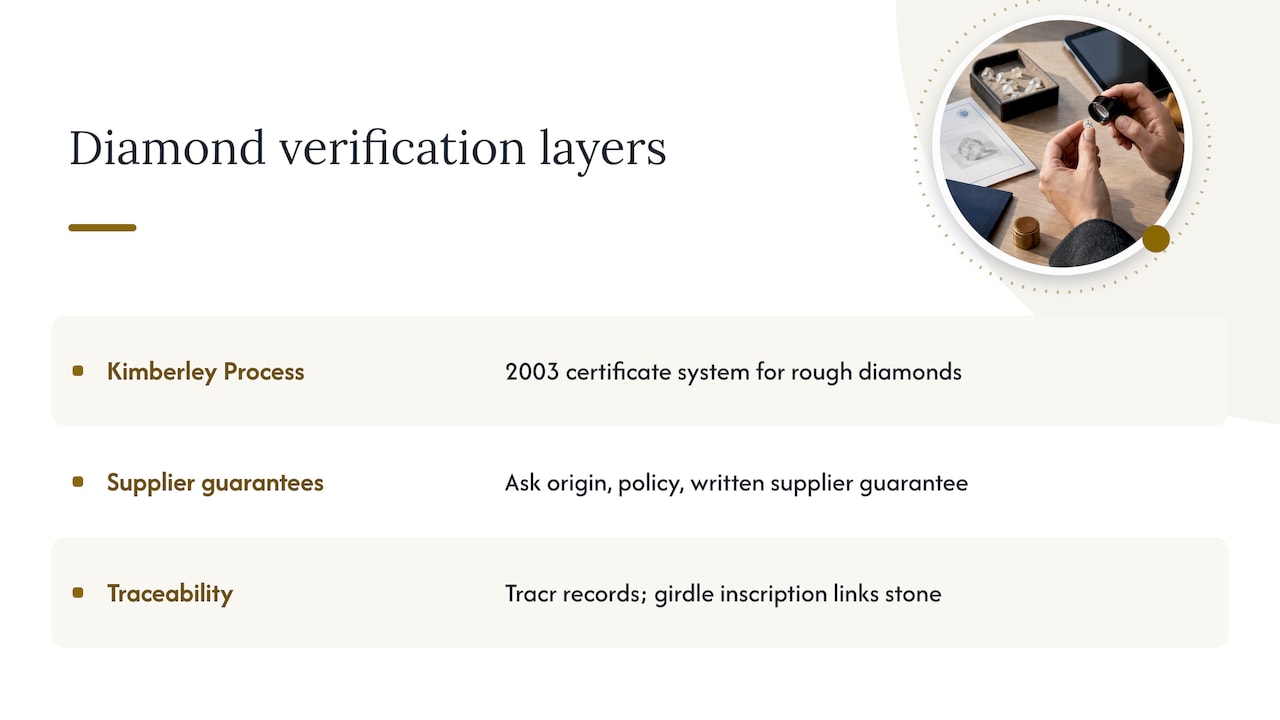
The Kimberley Process. According to the U.S. Census Bureau, the Kimberley Process Certification Scheme began in 2003 as an international certificate system controlling the flow of rough diamonds. Participating countries, including the United States, trade only with other participants. The U.S. backs it with the Clean Diamond Trade Act of 2003. We explain what the certificate does and does not cover in Kimberley Process diamonds: what the certificate means.
Written supplier guarantees. NBC News suggests three questions worth asking any seller: where do your diamonds come from, can I see your conflict diamond policy, and can you show a written guarantee from your supplier that the stones are conflict-free? A jeweler who welcomes those questions is a good sign.
Traceability. ORIGIN by De Beers Group explains that some responsibly sourced diamonds are recorded on digital platforms such as Tracr, and many carry a microscopic girdle inscription linking the stone to its record. Our piece on what diamond provenance means covers how to read that kind of documentation.
If you prefer a lab-grown stone, read about lab-created diamonds and what the evidence shows on lab diamond sustainability. For couples who want a route they can verify, three paths to an ethical engagement ring lays out the options.
Designing a custom engagement ring with a family jeweler
Custom work is where a family owned jeweler shines, because the person you talk to is close to the person who makes the ring. Bring these questions:
- What does the process look like, step by step? Sketch, approval, build, finishing. Our custom engagement ring design process guide shows the stages.
- How long will it take? The Tri-Cities profile cites about four to six weeks for a unique piece at that shop. Ask your jeweler for its own timeline.
- Is the stone priced separately? At the same shop, the base price for custom work does not include stones, which are chosen and priced separately. Ask whether your quote is for the setting, the diamond or both.
- Which metals can I choose? We offer gold, platinum and sterling silver. Our platinum jewelry starts at $327.
- What happens if I want to upgrade the diamond later? Ask for the policy in writing.
- Can I see the piece before it ships? Showroom visits and detailed photos both help.
Our design your own engagement ring guide and diamond shapes guide help you arrive prepared.
Our perspective
We started in 1999 with a simple belief: good jewelry should not require a jeweler’s markup. So we make our pieces in-house and sell them directly to you.
That choice shapes everything. It lets us offer solid construction, not hollow or plated pieces, at prices that feel fair. It lets us hand-select diamonds and back them with certification. And it lets us stand behind our work with a 30-day money-back guarantee, free insured shipping and lifetime diamond upgrades.
We think a family owned jeweler should be judged by what happens after the purchase. Will someone answer when you call? Will the ring be resized and cleaned for years? Will the diamond story hold up when you ask for paper? We want those answers to be yes, and we want you to ask.
The people who come to us are often marking a moment: an engagement, an anniversary, a child’s first piece of real jewelry. We treat each one as the start of a relationship, not a transaction.
Joseph
Where we fit
If you want a jeweler that makes its own pieces, sells direct and lets you design the details, start with our engagement rings, which begin at $346, or build your own from $399.
Browse gold jewelry, gemstone jewelry, chains and wedding jewelry, or start on our home page to design your own. Gifts for a child or a first fine-jewelry purchase can start with sterling silver from $46.
A simple checklist for your visit
- Can the owners tell you their story and how long they have been in business?
- Is the price explained in plain language, with metal, labor and stones separated?
- Are the pieces solid, and can the jeweler tell you the karat and weight?
- Is there a written policy on diamond sourcing and grading?
- Are returns, repairs and upgrades spelled out before you pay?
- Do the reviews describe real service?
If the answer to each is yes, you have likely found a jeweler worth keeping for life.
FAQ
What is the main benefit of a family owned jeweler?
Personal accountability. The owners are close to the work, so you can reach someone who knows your order and can solve problems directly. Many also offer custom design and repairs, which keeps the relationship going after the sale.
Are family owned jewelers more expensive than chains?
Not necessarily. A jeweler that manufactures in-house and sells direct avoids layers of markup. That is how we work, with pieces starting at $46 and diamonds from $142. Compare written quotes that separate metal, stones and labor.
How do I know a diamond is conflict-free?
Ask for the seller’s written conflict diamond policy and a supplier guarantee, plus an independent lab report. The Kimberley Process and the U.S. Clean Diamond Trade Act form the legal backdrop, and some stones carry traceable digital records.
Can a family owned jeweler make a custom engagement ring?
Yes, and most do. According to INSTORE Magazine’s 2026 survey, 95% of independent jewelers offer custom design. Ask about the process, the timeline, stone pricing and upgrade terms before you commit.
What should I ask about repairs and warranties?
Ask what is covered, for how long and at what cost: sizing, polishing, cleaning, prong checks and stone loss. Get the terms in writing before you pay.
Sources
- The Big Survey 2026: The Basics, INSTORE Magazine
- Jeweler aims to sparkle with quality, craftsmanship, Tri-Cities Area Journal of Business
- Are Your Rough Diamonds Kimberley Process Certified?, U.S. Census Bureau
- A diamond’s journey: Beyond blood diamonds, NBC News
- A Practical Guide to Ethically Sourced Diamonds, ORIGIN De Beers Group
Recommended
- Why Jeweler Reputation Matters When Buying Fine Jewelry
- Why Custom Jewelry Beats Store-Bought: Quality and Value
- How to Evaluate Jewelry Craftsmanship for Your First Buy
- Handcrafted vs. Mass-Produced Children’s Jewelry Guide
Deep Mehta is the Co-Owner of USA Jewels, a family-owned jewelry business she has led since 2013 in Deerfield Beach, Florida. With over 13 years of hands-on experience in fine jewelry retail, manufacturing, and diamond importing, Deep specializes in engagement rings, wedding bands, and custom jewelry design. She also co-manages Kaash Group Talent Acquisition. Deep is a University of Florida graduate and oversees every aspect of USA Jewels’ operations, from product development to marketing.
Fine Jewelry Collection

You May Also Like
Promise Ring vs Engagement Ring: What’s the Real Difference?
Why Custom Jewelry Beats Store-Bought: Quality and Value