Responsible Gold Sourcing: What It Means and How to Check
Responsible gold sourcing means a company can show where its gold comes from, checks that supply chain for harm such as conflict financing, forced labor and mercury pollution, and keeps improving what it finds. It is a process, not a single label. As a buyer, you can judge it by asking which standard a jeweler follows, which refinery processed the metal, and what evidence backs the claim.
We are a family-owned jeweler that has made fine jewelry in-house since 1999, and these are the questions our customers ask us most. This guide gives you the plain-English version.
TL;DR
- Responsible sourcing is ongoing, risk-based due diligence across the supply chain. It reduces risk and does not promise perfection.
- Standards you will meet include LBMA refiner rules, the Responsible Jewellery Council (RJC) Code of Practices and Chain of Custody, and Fairmined certification.
- Fairmined gold is tied to certified mining organizations. Recycled gold on its own tells you the metal was refined again, not where it first came from.
- A claim is only as strong as its evidence: ask for the specific certification, the refinery and written records.
- Brand-wide statements and product-level proof are different things. Ask which one you are getting.
Table of Contents
- What responsible gold sourcing actually means
- What the standards are trying to prevent
- The standards and labels you will see
- Fairmined gold vs. recycled gold
- Responsible is not the same as conflict-free
- Questions to ask any jeweler about their gold
- Our perspective
- Shop gold with confidence
- Putting it together when you shop
- FAQ
- Sources
What responsible gold sourcing actually means
Gold travels a long way before it becomes a ring or a chain. It is mined, often moves from the mine as doré (a rough gold-silver alloy), is refined by specialist refiners, and then goes to manufacturers and retailers. Responsible sourcing is the work of looking for problems at each step and fixing them.
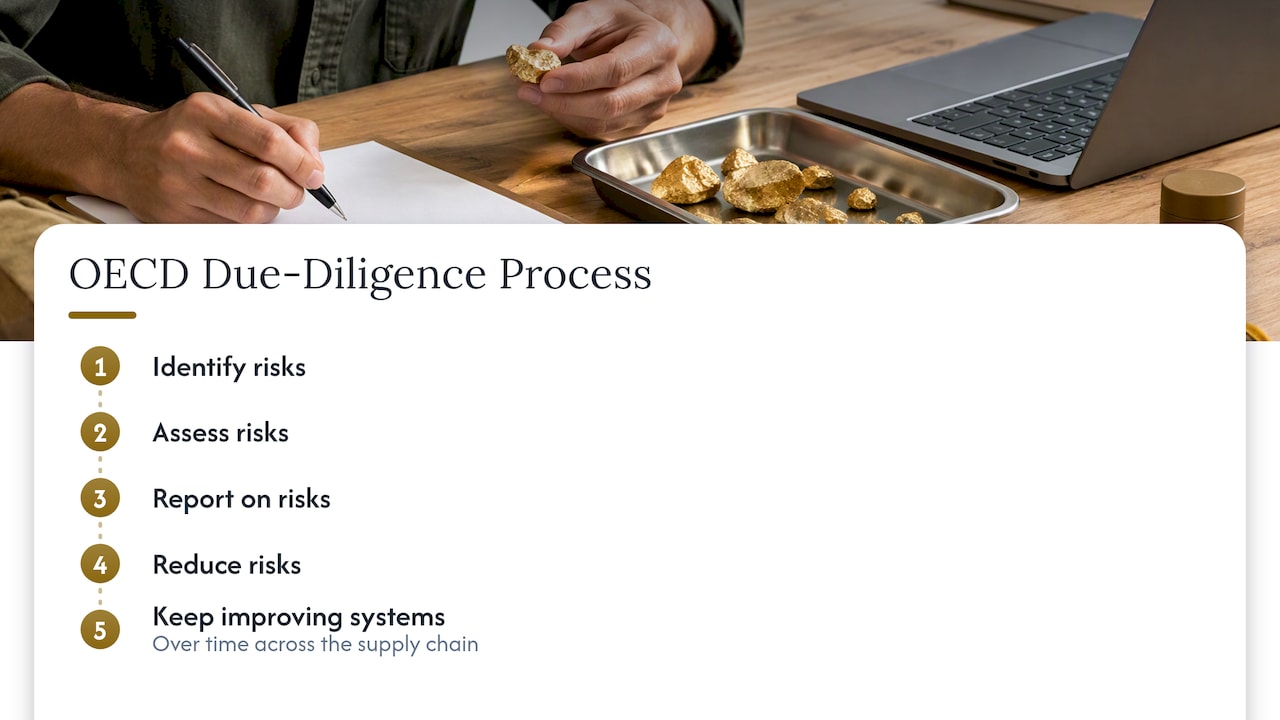
The international benchmark is the OECD’s approach. It describes ongoing, risk-based due diligence: identify risks, assess them, report on them, reduce them and keep improving the supply-chain systems over time. The OECD is clear that this does not provide 100% certainty that gold is conflict-free. It is a method for finding and reducing harm, and for showing your work.
That is why the best jewelers talk about steps, systems and evidence rather than slogans. “Ethical gold” is the phrase most shoppers type, and it points at the same thing: gold that comes through a supply chain with checked social and environmental standards.
What the standards are trying to prevent
The harms are specific. The OECD’s due diligence guidance for mineral supply chains names the financing of conflict, terrorism, money laundering, child or forced labor, and serious environmental damage among the risks companies should assess from mine to retail. Mercury pollution from small-scale gold extraction is one of the best-known environmental examples.
On the jewelry side, the RJC’s 2025 Code of Practices guidance covers ethical, social, human-rights and environmental practices, including employment terms, working hours, pay, harassment, forced labor, freedom of association and non-discrimination.
These are also the things jewelers themselves say they expect. A market analysis of the North American gold jewelry trade found that jewelers wanted fair labor practices, strong environmental standards including less mercury use, and assurance that purchases would not support conflict.
The standards and labels you will see
No single logo covers everything. Each program checks a different link in the chain, so it helps to know what each one can and cannot tell you.
| Standard | Who it applies to | What it establishes |
|---|---|---|
| LBMA Responsible Gold Guidance | Refiners | Mandatory, independently assured responsible sourcing requirements for refiners |
| RJC Code of Practices | Jewelry businesses that are RJC members | Responsible business practices, checked through independent third-party audits |
| RJC Chain of Custody | RJC members who choose to certify | Voluntary, and goes further than the Code by requiring members to trace feedstock origins from beginning to end |
| Fairmined | Artisanal and small-scale mining organizations and the businesses that buy from them | Gold tied to certified mining organizations and the conditions they mine under |
| Recycled gold claims | Any seller | That metal was refined again. Origin is not covered by the claim alone |
How the RJC Code works
The RJC’s 2024 Code asks members to apply OECD-aligned due diligence, publish a supply-chain policy, check that suppliers are legitimate and not tied to money laundering, terrorism financing, fraud, sanctions or serious human-rights abuses, and review the process at least once a year. Think of it as a standard for how a company behaves. The Chain of Custody certification is the one that follows the metal itself.
Why the supplier’s paper is not enough
The RJC itself points out that a certificate from a supplier does not by itself show where purchased materials came from or give you their supply-chain policy. A company needs that underlying information to run its own due diligence. As a shopper, treat a certificate as a starting point for questions, not the end of them.
Fairmined gold vs. recycled gold
This is the comparison buyers ask about most, and the two do different jobs.
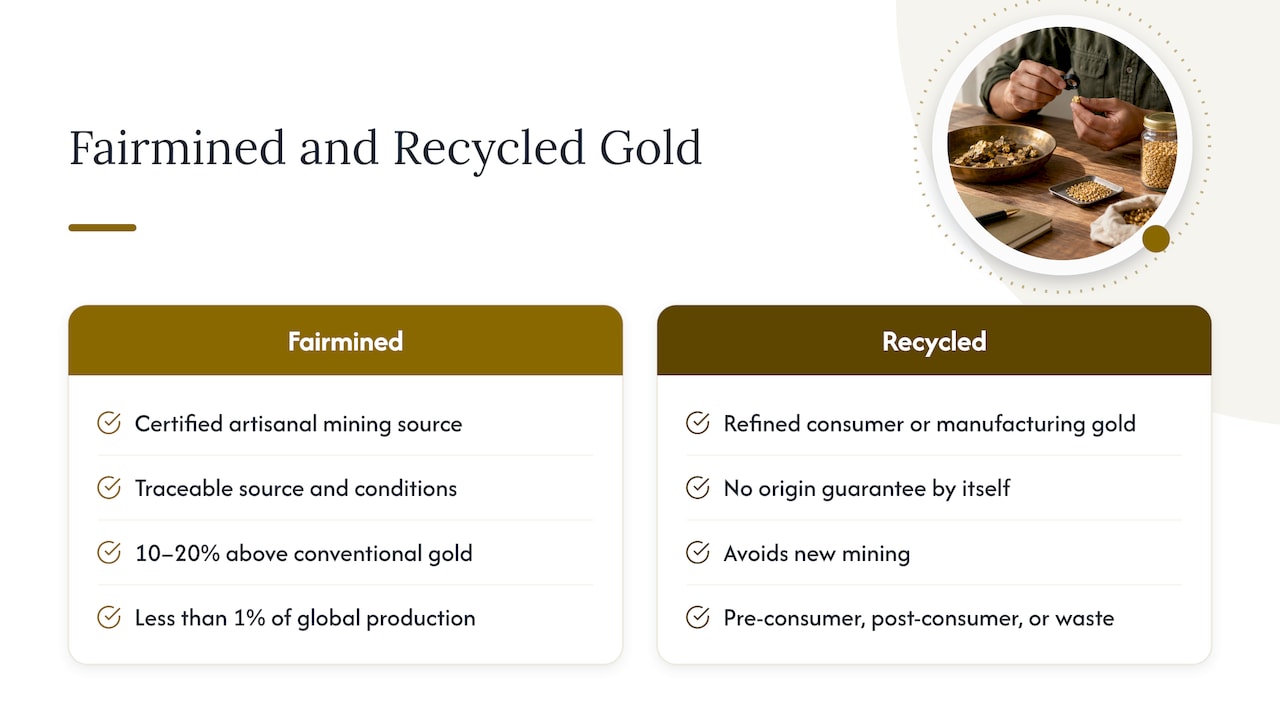
Fairmined gold comes from artisanal and small-scale mining organizations certified to the Fairmined Standard. It is traceable to those certified sources and the conditions under which the gold was mined. Fairmined states that it typically costs 10 to 20% more than conventional gold and makes up less than 1% of global production, so supply is limited and prices reflect that.
Recycled gold is gold refined again from consumer products or manufacturing byproducts. Fairmined notes that, by itself, recycled gold gives no guarantee about the gold’s origin, meaning the original mine, the extraction conditions or any earlier abuses. Recycling does avoid new mining, which matters to many buyers. It just answers a different question than provenance does.
The RJC adds a useful detail: recycled material can be pre-consumer, post-consumer or waste material, and its requirements call for clearer declaration of the recycled-material type. So “recycled” is a starting point, and you can ask what kind.
Reading claims carefully
Fairmined’s own claims rules separate two kinds of statement. A product may be called Fairmined only when it meets the system’s requirements, while a company may state the amount or percentage of Fairmined gold it bought in a given year without implying that any one piece is Fairmined. If a jeweler says “we support Fairmined gold,” ask whether the piece in your hand is certified or whether the statement is about the company’s purchasing.
Responsible is not the same as conflict-free
Shoppers often use “conflict-free” and “responsible” as if they were the same. They overlap, but they are not identical.
“Conflict-free” speaks to one risk: that buying the gold did not fund armed groups. Responsible sourcing is wider. It covers labor conditions, environmental harm and the quality of a company’s own checks, and it accepts that risk is managed rather than eliminated. The OECD describes due diligence as a process to identify, prevent and mitigate risks and improve practices over time, not a guarantee.
The same OECD guidance encourages buying from legitimate artisanal and small-scale miners when proper due diligence is in place, and warns that companies pulling out of high-risk areas should weigh the harm that withdrawal can cause. In other words, the goal is not to avoid small-scale mining. It is to buy from it responsibly, which is exactly what programs like Fairmined aim to do.
If you also care about diamonds, our guide to certified ethical diamond jewelers walks through the same questions for stones.
Questions to ask any jeweler about their gold
Human Rights Watch published a practical checklist for consumers. Its questions, in our words, are below. You do not need answers to every one, but a jeweler who takes sourcing seriously should be able to speak to most of them. They draw on Human Rights Watch’s guidance for jewelry buyers.
- Traceability. Do you trace your gold from mine to retail, fully or partly, and what share of your gold is covered?
- Human-rights risk. Do you assess human-rights risks across your whole supply chain, not only at your own workshop?
- Written evidence. Do your suppliers give you written proof of how they source?
- Audits. Do qualified third parties audit, with site visits and interviews with stakeholders?
- Grievance channels. Can workers and communities raise complaints, and are they acted on?
- Transparency. Do you publish the mines of origin, your suppliers, the risks found and how you fixed them?
Two follow-ups are worth adding. Ask which refinery processed the gold, since refiner standards such as the LBMA guidance are the most developed checkpoint in the chain. And ask whether any certification applies to the specific piece or to the company in general. The RJC says a provenance claim needs both a truthful commitment and the systems that substantiate it.
Traceability tools
Bag-and-tag programs and chain-of-custody records help a company see where gold came from. The OECD frames these as tools for due diligence rather than an end in themselves. A neat tracking system with no risk assessment behind it is not responsible sourcing, and a risk assessment with good records is.
Red flags
- Vague words like “ethical” or “green” with no named standard.
- A certification logo with no member number, scope or date.
- “Recycled” used as if it proved good labor conditions.
- No answer, or a long delay, when you ask for the refinery or the records.
Our perspective
We have been a family business since 1999, and we make our jewelry in-house. That matters to how we think about this topic. When the people who design and build a piece are the same people who answer your questions, there are fewer hands between you and the metal, and fewer places for a story to get lost.
We would rather you ask hard questions than take our word for anything. Responsible sourcing is about evidence, and a jeweler should welcome the conversation. Ask us about the gold in a piece you are considering, and ask every other jeweler the same questions in the checklist above. Compare the answers.
What we can speak to plainly is how we build and sell. Our pieces are solid, not hollow or plated. We offer certified, conflict-free diamonds, a 30-day money-back guarantee, free insured shipping and lifetime diamond upgrades, because we want a piece to stay in your family for a long time. Direct pricing means you pay for the jewelry, not for a chain of middlemen.
Choose a jeweler you trust, learn the vocabulary, and buy something that carries your story.
Joseph
Shop gold with confidence
If you are ready to look at gold, you can start with our gold jewelry collection, which includes 14K and 18K chains, rings and more. Our gold jewelry guide on karats, purity and types helps you pick the right purity before you buy.
Want something made your way? Choose the metal, the diamond shape and the quality yourself with our design tools: design your own gold jewelry starts from $149, a custom chain from $149, and a custom diamond ring from $399.
Engagement ring shoppers can browse engagement rings from $346, or pick a certified loose diamond from $142 and build around it. Prices are as published on our site and can change, so check the product page for the current figure.
Putting it together when you shop
You do not have to become a supply-chain auditor. A short routine works for most purchases.
- Decide what matters most. Origin and labor conditions point toward Fairmined or RJC Chain of Custody. Avoiding new mining points toward recycled. Many buyers want a mix.
- Ask for the named standard. Which program, which member, which scope.
- Ask for the refinery. Refiners that follow the LBMA guidance meet mandatory, independently assured requirements.
- Separate company claims from product claims. Ask whether the certification covers the piece you are buying.
- Check the build too. A responsibly sourced piece that falls apart has not done its job. Our article on how jewelry quality is verified in manufacturing covers what to look for, and the jewelry certification types guide explains the paperwork you may be shown.
For engagement rings in particular, our ethical engagement ring paths piece lays out three routes you can verify, including lab-grown stones, which we explain in how lab-grown diamonds are ethically produced.
FAQ
What is the difference between responsible and ethical gold sourcing?
In everyday use they mean the same thing: gold obtained through a supply chain that is checked for human-rights, labor and environmental harm. “Responsible sourcing” is the term used in standards such as the OECD guidance and the LBMA and RJC programs. “Ethical” is the word most shoppers use. Either way, look for a named standard and evidence behind it.
Is Fairmined gold better than recycled gold?
They answer different questions. Fairmined gold is traceable to certified mining organizations and the conditions there. Recycled gold is metal refined again, and on its own it says nothing about the original mine or working conditions. Which is better depends on whether you care more about supporting certified small-scale miners or about avoiding new extraction.
Can any jeweler guarantee gold is conflict-free?
No one can promise absolute certainty. The OECD says due diligence is a continuing, risk-based process that identifies and reduces risk, not a guarantee. A credible jeweler will tell you which standards it follows, which refiners it uses and how it checks its suppliers.
What should I ask a jeweler before buying gold?
Start with which standard applies, which refinery processed the gold, and whether the certification covers your specific piece. Then ask whether the company traces its gold, uses independent audits and publishes its suppliers or risks. Written answers are better than verbal ones.
Does solid gold matter for ethical buying?
It matters for longevity. A solid piece lasts for generations, so you buy less over a lifetime. Our pieces are solid, not hollow or plated. Sourcing and build quality are separate questions, and a good purchase answers both.
Sources
- OECD: Responsible Supply Chains in Artisanal and Small-Scale Gold
- OECD Due Diligence Guidance for Responsible Supply Chains of Minerals
- RJC Code of Practices Guidance 2025
- RJC Code of Practices 2024
- Responsible Jewellery Council FAQs
- World Gold Council: Responsible Sourcing
- Asahi Refining Canada on RJC Chain of Custody certification
- Fairmined: Fairmined vs. recycled gold
- Fairmined: Ways to engage with Fairmined
- Human Rights Watch: Is Our Jewelry Company Sourcing Responsibly?
- Global Communities: American Gold Jewelry Market analysis
Recommended
- Pick One of 3 Paths to an Ethical Engagement Ring You Can Verify
- How to Choose a Certified Ethical Diamond Jeweler
- Jewelry Certification Types Guide: What U.S. Buyers Need
- What Does Diamond Provenance Mean for Your Purchase?

Deep Mehta is the Co-Owner of USA Jewels, a family-owned jewelry business she has led since 2013 in Deerfield Beach, Florida. With over 13 years of hands-on experience in fine jewelry retail, manufacturing, and diamond importing, Deep specializes in engagement rings, wedding bands, and custom jewelry design. She also co-manages Kaash Group Talent Acquisition. Deep is a University of Florida graduate and oversees every aspect of USA Jewels’ operations, from product development to marketing.
Fine Jewelry Collection

You May Also Like
Diamond Fluorescence: Does It Actually Matter to You?

Diamond Cut Comparison Guide for Engagement Rings