Tennis Bracelet vs. Rivière: What’s the Real Difference?
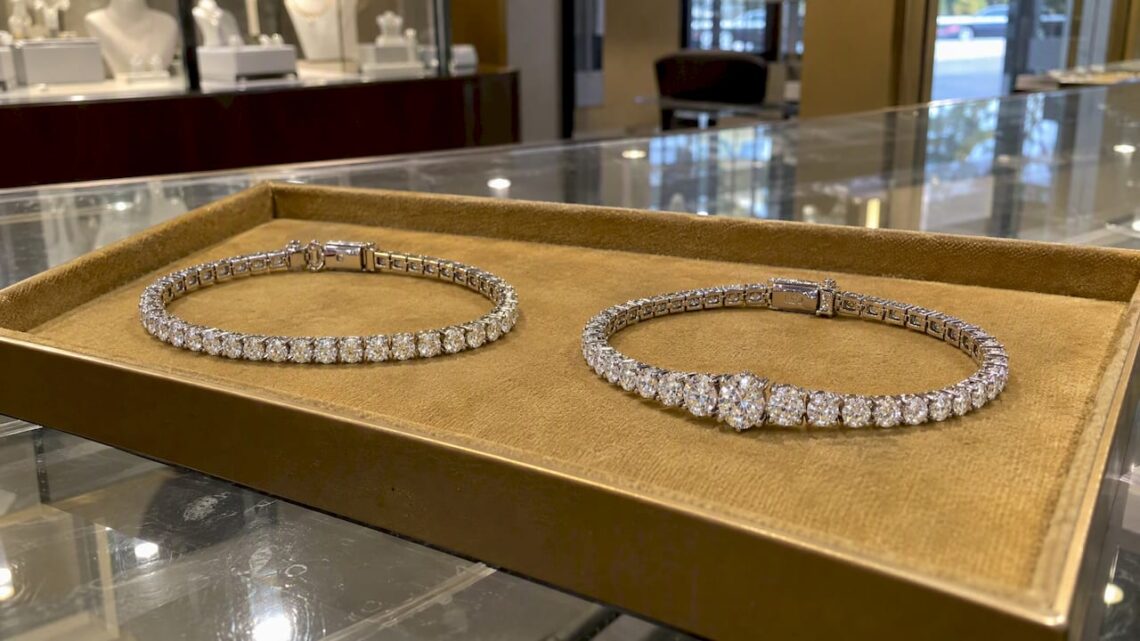
A tennis bracelet and a rivière bracelet are close cousins, and today most jewelers use the two names for the same thing: a flexible line of diamonds set one after another around the wrist. The small difference is in the stones. A tennis bracelet traditionally uses matching diamonds of one size. A rivière traditionally suggests a line that graduates, with the largest stone at the center and smaller ones tapering toward the clasp. The same goes for necklaces.
Below, we walk through where each name comes from, how to tell them apart on a product page, and how to choose the one you will wear for years.
TL;DR
- Same family, different emphasis: tennis usually means a uniform line of matching diamonds, while rivière traditionally means a graduated line, though many sellers use the words interchangeably.
- Bracelet or necklace, the logic is the same: the name describes the arrangement of stones, not the length of the piece.
- Setting matters more than the name: prong, bezel and channel settings change how a piece sparkles, snags and holds up in daily wear.
- Read the specs, not the title: check total carat weight, individual stone size, diamond quality, metal and whether the piece is solid.
- Customizing is an option: you can choose the stones, shape and metal rather than settle for whatever a listing calls it.
Table of Contents
- The short answer: uniform versus graduated
- Where the names come from
- Tennis vs. rivière at a glance
- Bracelet or necklace: does the answer change?
- Stone size and arrangement: how to read a listing
- Settings: the choice that changes daily wear
- Everyday wear or special occasion?
- Beyond white diamonds: color and gemstone options
- How to choose: five questions to settle it
- Why construction matters as much as the name
- Our perspective
- Design yours with us
- FAQ
- Sources
The short answer: uniform versus graduated
GIA, the gemological institute behind the 4Cs, describes a tennis bracelet as a flexible band with a continuous line of individually set diamonds or gemstones encircling the wrist (GIA’s tennis bracelet buying guide). That definition is the common ground. Everything else is about how the stones are arranged.
JCK, a long-running trade publication, notes that the two terms are often used interchangeably today. It adds that rivière traditionally suggests a graduated arrangement and tennis a uniform one (JCK on tennis jewelry and the rivière).
So if you are shopping, think of it this way:
- Tennis: every diamond is roughly the same size, so the line looks even and sporty-elegant from clasp to clasp.
- Rivière: the stones step up in size toward the middle, which draws the eye to a center point and often reads as more formal.
That is a tradition, not a rule. A listing titled “rivière” may have identical stones, and a “tennis” piece may graduate slightly. The product details tell you what you are actually getting.
Where the names come from
“Rivière” is the French word for river, and the image fits: a stream of stones running without interruption. According to JCK, the rivière predates the tennis necklace by centuries and traditionally describes a continuous, often graduated, line of gemstones. National Jeweler adds that the diamond rivière has been popular since the 1700s (National Jeweler on the rivière).
The modern tennis version simplified the idea. JCK reports that it turned the rivière into a uniform line of matching diamonds, which is easier to design, easier to match in quality and easier to wear every day.
That history explains the feel of each. The rivière carries the weight of old-world formality. The tennis style feels relaxed and modern. Both are the same basic idea, a line of diamonds with no break.
Tennis vs. rivière at a glance
| Feature | Tennis | Rivière |
|---|---|---|
| Stone arrangement | Uniform, matching stones | Traditionally graduated, larger at the center |
| Overall look | Even, clean, modern | Focal point, classic, a bit dressier |
| Typical mood | Everyday and layered | Occasion or statement |
| Common today | Very, and often the default name | Used by some sellers for graduated pieces |
| Setting options | Prong, bezel, channel | Prong, bezel, channel |
| Shopping tip | Check the per-stone size | Check the largest and smallest stone sizes |
The table shows one thing clearly: the settings and materials are shared. The real fork in the road is symmetry of stone size.
Bracelet or necklace: does the answer change?
Not really. Many shoppers search for “riviera necklace vs tennis necklace” and expect a different answer than for bracelets. The logic is identical. National Jeweler notes that a diamond rivière is now often called a tennis necklace or diamond-line necklace, which tells you how blurred the terms have become.
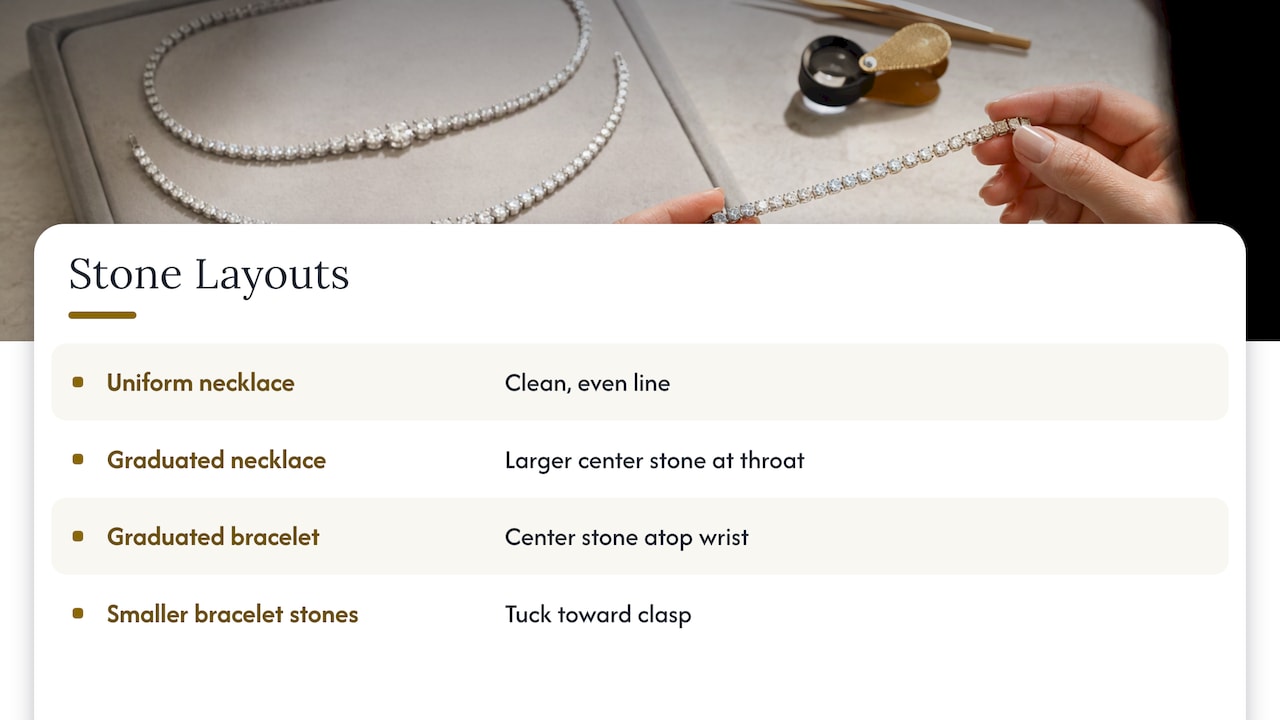
What changes with a necklace is how the arrangement looks against the body. A graduated necklace follows the curve of the collarbone, and a larger center stone sits at the base of the throat. A uniform necklace draws a clean, even line. On a wrist, the center stone of a graduated bracelet usually lands on top of the wrist, and the smaller stones tuck around the sides toward the clasp.
If you are weighing a necklace, our guide to what a tennis necklace is, with styles and sizes covers lengths and layering.
Stone size and arrangement: how to read a listing
The thing that separates these two styles is the way stone sizes run along the piece. Here is how to read it on any product page.
- Look for a single stone size. If the listing gives one diameter, such as a number in millimeters, for every diamond, it is a uniform, tennis-style piece.
- Look for a range. If it lists a smallest and largest stone, it graduates. That is the rivière approach, whatever the title says.
- Check the total carat weight. Total weight spreads across many stones. A bracelet with smaller stones can carry the same total weight as one with fewer, larger stones, and the look is very different.
- Count the stones. More stones at a smaller size means a finer, more flexible line. Fewer, larger stones means a bolder look.
- Ask about the quality range. Look at color, clarity and cut for the stones as a group, since a line is only as good as the stones that make it up.
Carat weight is where most buyers get lost. Our tennis bracelet carat size comparison shows how different total weights look on the wrist.
Because a tennis bracelet often sits next to a watch, it helps to think about proportion too. A slim line of small diamonds works beside something like this black and gold classic watch without competing with it, while a bolder graduated piece usually wants a bare wrist or a simple strap.
Settings: the choice that changes daily wear
Both styles come in the same three constructions. GIA identifies prong, bezel and channel settings as the common choices for tennis bracelets, and it describes the trade-offs plainly:
- Prong settings admit light from multiple angles, so diamonds tend to look more lively.
- Bezel settings wrap each stone in metal, which prioritizes protection and reduced snagging.
- Channel settings hold stones between two walls of metal and create a smooth, flush surface.
Here is how that plays out in real life:
| If you… | Consider |
|---|---|
| Want maximum sparkle for evenings and events | Prong |
| Type all day, wear sweaters or have long hair | Bezel |
| Want a sleek, smooth look that rarely catches | Channel |
| Plan to wear it every day | Bezel or channel for snag resistance, prong if you like brilliance |
We go deeper on this in our settings guide to prong, bezel and channel. It is worth reading before you commit, because the setting shapes both the look and the upkeep.
Everyday wear or special occasion?
National Jeweler says modern tennis necklaces can be worn casually as everyday accessories, whereas historical rivières were more often reserved for special occasions. It also reports that smaller-diamond tennis necklaces have become more suitable for daytime wear and easier to layer.
That gives you a simple rule of thumb:
- Daily wear: a uniform line of smaller stones, in a bezel or channel setting, is the easiest to live with.
- Milestones and formal events: a graduated line with a noticeable center stone has more presence, which suits an anniversary, a wedding or a big birthday.
- One piece for both: a medium-size uniform line in a secure setting can go from jeans to dinner.
JCK’s view is that tennis has not replaced the rivière so much as broadened a classic silhouette. People want everyday wearability with more individual character. Designers are varying stone sizes, mixing cuts, and using bolder bezels and sculptural gold settings, including fancy-cut diamonds and colored gemstones. In other words, the lines between the two styles are being redrawn in a way that favors choice for the buyer.
Beyond white diamonds: color and gemstone options
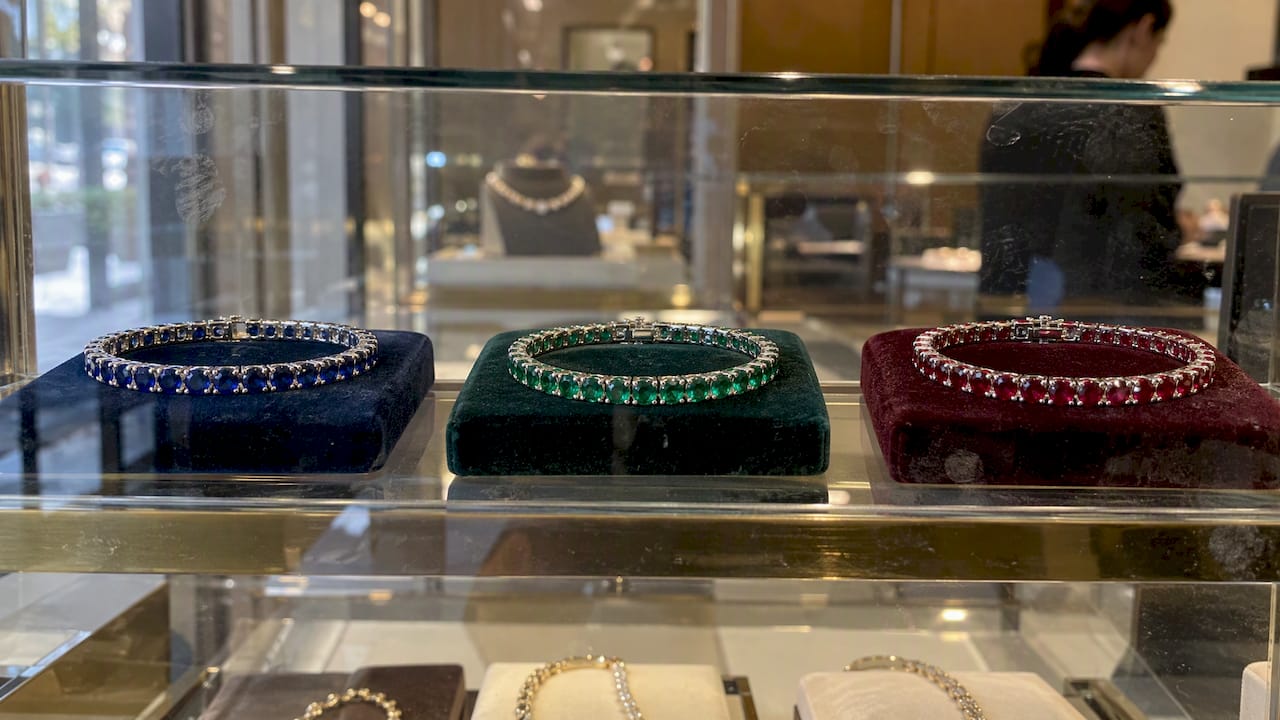
The same line concept works with other stones. If you like the shape but want something with more color, a line of sapphires, emeralds or rubies reads very differently from white diamonds. Our gemstone bracelets show how a continuous line looks with color, and our gemstone jewelry collection has more to explore.
Black and blue diamonds are another route for a bolder look. Browse black diamond jewelry or blue diamond jewelry if you want something that stands apart from the classic white line.
How to choose: five questions to settle it
- Who is it for, and when will it be worn? Daily wear points to uniform stones and a protective setting. A single big occasion points to graduation.
- What size wrist and what proportion? A slender wrist can look overwhelmed by large stones. A broader wrist can carry them well. Our tennis bracelet buying guide covers carat, setting and size together.
- Which metal? White gold, yellow gold, rose gold and platinum all work. White metals keep the focus on the diamonds, while yellow gold adds warmth. See our platinum jewelry and gold jewelry collection for the options.
- Natural or lab-grown? Both can be certified. Read our diamond certification guide comparing GIA, AGS and IGI so you know what a report tells you.
- What is the budget? Total carat weight drives cost more than any other factor. Our piece on what 2 to 3 carats buy in a tennis bracelet breaks it down.
If you want a broader look at other styles, such as bangles and cuffs, our bracelet guide and tennis bracelet guide are good next reads.
Why construction matters as much as the name
A line of diamonds only works if the piece holds together. Each stone is a small moving part, and the links between them flex every time you move your wrist. That is why we always look at three things before anything else: whether the piece is solid metal rather than hollow or plated, how secure each setting is, and how safe the clasp is.
A few habits will protect your investment, whichever name is on the box:
- Choose a clasp with a built-in safety latch or a secondary lock.
- Have a jeweler check the stones and settings periodically, since a loose stone is much easier to fix early.
- Take it off for heavy lifting, gardening and workouts.
- Store it flat or in its own pouch so it does not tangle or scratch other pieces.
Our perspective
We have been a family-owned jeweler since 1999, and we make our pieces in-house. After all those years, here is what we tell the couples and gift givers who ask us this question.
Do not let the name decide for you. Tennis and rivière describe the same idea, and the two words will keep blurring in stores and online. What matters is how the stones are arranged, how well they are set, and whether the piece is built to last. We insist on solid construction, not hollow or plated, because a diamond line is worn and bumped every day.
We also believe you should be able to choose. That is why we let you pick the diamond quality, the shape and the metal, and why every diamond we sell is certified and ethically sourced. When you buy direct from the people who make the piece, you are not paying for middlemen, and you can put the money into stones that look right on your wrist.
And because life changes, our lifetime diamond upgrade program means a piece can grow with you. A first bracelet today can become a bigger one for a milestone anniversary.
Joseph
Design yours with us
If you would like a line of diamonds built around your taste, start with our Design Your Own Diamond Bracelet, which starts at $499. You choose the diamond quality and the metal, and we make it in-house. You can also browse ready-to-ship pieces in our fine jewelry collections, where bracelets start at $1,303, or look at our diamond tennis bracelets and diamond bracelets.

Every order includes free insured shipping and a 30-day money-back guarantee. If you are buying loose stones for a custom piece, our certified loose diamonds start at $142.
FAQ
Is a rivière bracelet the same as a tennis bracelet?
In everyday shopping, yes, the names are often used for the same piece. Traditionally, rivière suggests a graduated line of stones and tennis suggests a uniform one. Check the stone sizes in the listing to see which arrangement you are getting.
Is a tennis necklace the same as a rivière necklace?
Mostly. National Jeweler notes that a diamond rivière is now often called a tennis necklace or diamond-line necklace. If you want a graduated look with a larger center stone, look for a listing that gives a range of stone sizes rather than one.
Which is better for everyday wear?
A uniform line of smaller diamonds in a bezel or channel setting is generally the easiest to wear daily, since those settings protect stones and reduce snagging. Prong settings give more light but sit a little higher. Pick based on your routine.
Are tennis and rivière styles still popular?
Yes. JCK reports that tennis jewelry continues to return to the spotlight, with designers varying stone sizes, mixing cuts and using bolder bezels and sculptural gold settings. Fancy-cut diamonds and colored gemstones are part of that shift.
Can I customize one?
Yes. With our design-your-own bracelet, you choose the diamond quality and metal, and we build it in-house. Browse the options on our homepage to get started.
Sources
- GIA 4Cs: Tennis Bracelet Buying Guide
- JCK: Tennis Jewelry Is Evolving, and the Rivière Is Leading the Way
- National Jeweler: Current Jewelry Trend, Don’t Call It a Tennis Necklace
Recommended
- Tennis Bracelet Guide: How to Choose the Perfect One
- Tennis Bracelet Meaning: Chris Evert Origin and Care
- Diamond Tennis Bracelet Buying Guide: Carat, Setting & Size
- Tennis Bracelet Costs: What 2–3 Carats Buy and How to Save 40–70%

Deep Mehta is the Co-Owner of USA Jewels, a family-owned jewelry business she has led since 2013 in Deerfield Beach, Florida. With over 13 years of hands-on experience in fine jewelry retail, manufacturing, and diamond importing, Deep specializes in engagement rings, wedding bands, and custom jewelry design. She also co-manages Kaash Group Talent Acquisition. Deep is a University of Florida graduate and oversees every aspect of USA Jewels’ operations, from product development to marketing.
Fine Jewelry Collection

You May Also Like

Design a Custom Wedding Ring Set That’s Truly Yours

How Engagement Ring Appraisal Works: 2026 Guide