Double the Original Price? Estimate Your Diamond Trade In Credit
Most diamond trade-in credit comes as store credit, not cash, and typically covers only a portion of what you originally paid. Many upgrade programs also require your new diamond purchase to reach a minimum value, often around double your original price, before you qualify for full credit. Your best first step is simple: pull your certificate and original receipt, then reach out to a jeweler with a clear lifetime upgrade policy.
TL;DR:
- Jewelers use their retail pricing and inventory needs, so identical diamonds can receive different offers that rarely match resale value on the open market.
- A GIA or AGS report, original invoice, and undamaged stone support stronger offers; chips, worn prongs, or repairs can reduce credit.
- Get the credit percentage, minimum purchase, condition rules, and insured shipping process in writing before handing over or mailing your diamond.
- Trading up suits buyers seeking a noticeably better stone or preserving sentimental continuity, not those expecting to recover their original purchase price.
Table of Contents
- Which factors determine how much trade-in credit you get
- Common trade-in program rules and realistic expectations
- Step-by-step: estimate your diamond trade-in credit
- Why consider USA Jewels’ upgrade option: proof points and how it works
- Common trade-in scams or pitfalls to avoid
- Editorial perspective: when trading up is the right move
- How to request an upgrade quote from USA Jewels
- FAQ
- Sources
Which factors determine how much trade-in credit you get
Trade-in offers vary widely because jewelers weigh several things at once, and no two diamonds (or receipts) look exactly alike.
Carat weight carries the most obvious influence. A larger stone usually carries a higher replacement value, and that replacement value is what most programs use to calculate your credit, not a resale estimate. Cut, color, and clarity matter too, though unevenly: cut has the biggest effect on how a diamond performs in daylight and under store lighting, which shapes how a jeweler values it against current inventory.
Certification changes the conversation entirely. A diamond with a GIA or AGS report gives a jeweler verified facts to work from, while an uncertified stone forces guesswork that tends to work against you. Condition matters just as much: chips, worn prongs, or a mounting that has seen heavy repair work can lower an offer, since the jeweler has to account for extra labor before resale or reset.
Your paperwork trail supports everything else. An original invoice ties your diamond to a documented price and date, which strengthens a trade-in claim far more than memory or a verbal estimate.
Program type is the final variable:
- Lifetime upgrade policies let you trade at any point, often with a published credit structure.
- Store-credit-only programs return value you can spend in-house but never as cash.
- Discretionary in-store appraisals leave the offer up to an individual jeweler’s judgment that day.
Pro Tip: Ask a jeweler to put their trade-in terms in writing before you ship or hand over your diamond, so the minimum purchase requirement and credit percentage are never a surprise later.
Common trade-in program rules and realistic expectations
Upgrade programs tend to run on a handful of recurring rules, and knowing them ahead of time keeps expectations grounded.
- Credit form: Most programs issue store credit rather than cash, meaning your value gets applied toward a new purchase, not deposited into your account.
- Minimum multiplier: A common requirement is that your new diamond costs at least double your original purchase before full credit applies.
- Condition and documentation: Your diamond generally needs to be in its original condition, with its certificate and receipt, to qualify for the advertised rate.
A jeweler offering “100% credit” toward an upgrade is usually offering 100% of your original price as store credit, not as cash, and you may still owe the full price difference between your old diamond and your new one. That distinction shapes the real cost of upgrading more than the headline number does.
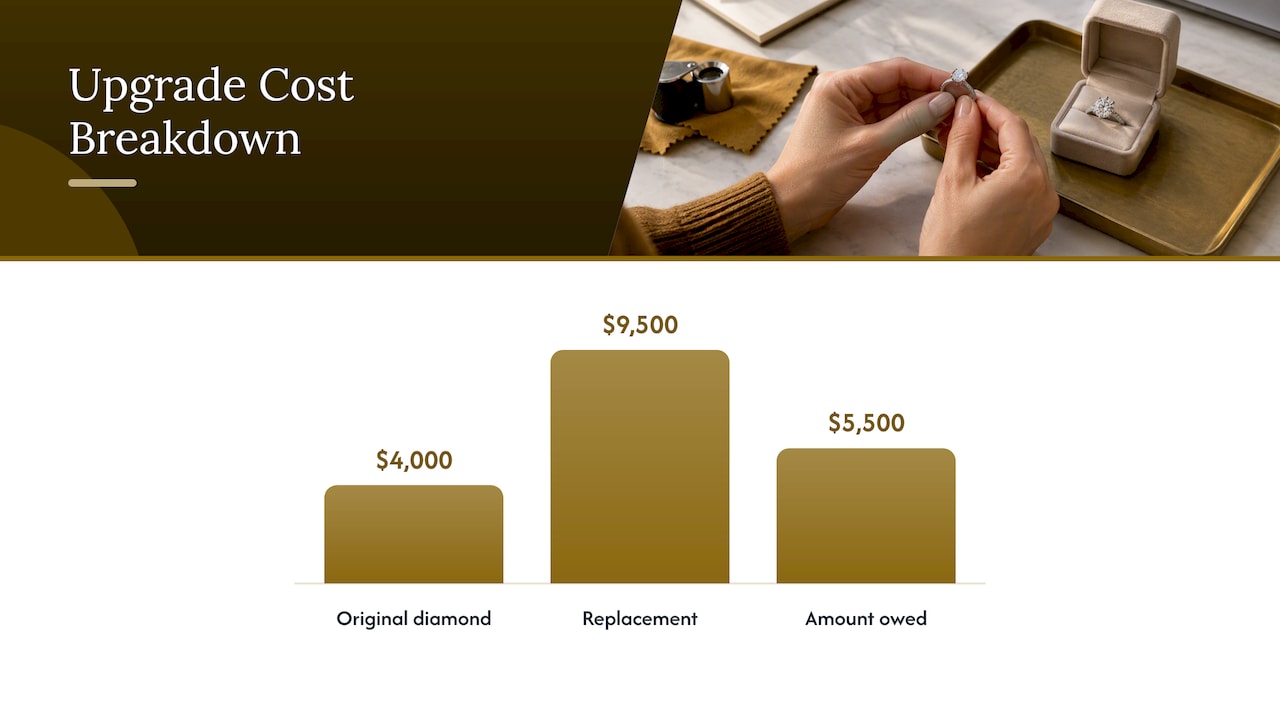
Here is a simple way to picture it. Say your original diamond cost $4,000 and your chosen replacement costs $9,500. With full store credit, you would owe $5,500 toward the new piece, not the full $9,500. That gap, not the credit percentage alone, is what determines whether an upgrade makes financial sense this year.
Jewelers calculate these offers from their own retail pricing and inventory needs, not from an open resale market, which is why two stores can quote very different numbers for the same diamond.
Step-by-step: estimate your diamond trade-in credit
A rough estimate takes less time than most people expect, and it gives you a number to compare against any offer you receive.
- Gather your documents. Pull your certificate, original invoice, any past appraisal, and a few clear photos of the diamond from multiple angles.
- Record the 4Cs and lab name. Write down carat, cut, color, clarity, and whether the report came from GIA, AGS, or another lab, since the certifying lab affects how an offer is calculated.
- Check current retail prices. Look at what comparable certified diamonds cost today to establish a realistic replacement price, not a resale guess.
- Apply a conservative multiplier. Many programs base credit on your original purchase price rather than today’s replacement cost, so estimate your likely credit as a percentage of what you originally paid, then confirm the real figure with the jeweler.
- Ask for the exact program rules before assuming your estimate matches what you will receive.
Before you call or visit a jeweler, have these questions ready:
- Do you accept certificates from every major lab, or only specific ones?
- What is the minimum value required on my new diamond?
- What documentation do you need from me?
- How does shipping and appraisal work if I am not local?
Why consider USA Jewels’ upgrade option: proof points and how it works
We built our business on in-house manufacturing, which allows us to provide upgrade quotes directly, aiming to reduce markup layers. That direct pricing, paired with our certification guide, gives you a clearer picture of what your credit actually buys.
Our business has been operating for many years, and we aim to build lasting relationships with every customer who walks through our door or visits us online. We offer ethically sourced diamonds and have a diamond upgrade program that allows customers flexibility to trade up.
Before requesting a quote from us, have the following ready:
- Your diamond’s certificate (GIA, AGS, or equivalent)
- Your original receipt or invoice
- Clear photos of the diamond and setting
Pro Tip: If you’re mailing your diamond for evaluation, store it in a secure place until your shipping label and insurance are confirmed. Safes and Security Direct outlines what to look for in a jewelry-rated safe if you don’t already own one.
Common trade-in scams or pitfalls to avoid
A few recurring pitfalls catch people off guard during the trade-in process, and knowing them ahead of time protects both your diamond and your wallet.
Watch for vague verbal promises that never make it into writing. If a jeweler tells you “we’ll give you full value” without specifying whether that means cash or store credit, and without a minimum purchase requirement in writing, ask for the terms on paper before you commit anything.
Be cautious of any buyer who pressures you to ship your diamond before discussing terms. A reputable program will walk you through its documentation requirements, insured shipping process, and evaluation timeline before you send anything.
Watch for offers that ignore your certificate entirely. A legitimate program relies on your GIA or AGS report to set a fair value; one that brushes past your paperwork is often lowballing you.
Finally, be wary of “guaranteed” resale promises from anyone outside your original jeweler’s upgrade program. Trade-in credit is an in-house arrangement, not a market transaction, and treating it otherwise sets up unrealistic expectations.
Editorial perspective: when trading up is the right move
Trading up usually makes sense when you want a noticeably better diamond or need to preserve sentimental continuity, not when you’re hoping to recover your original purchase price. If transparency matters to you, a jeweler with a published lifetime upgrade policy removes most of the guesswork from the process. Timing matters too: inventory levels and seasonal pricing can shift what a jeweler is willing to offer, so it rarely hurts to ask for a current appraisal before assuming last year’s numbers still apply.
— Joseph
How to request an upgrade quote from USA Jewels
We make requesting an upgrade quote straightforward. Send us your certificate, original purchase documentation, clear photos, and your target upgrade budget, and we’ll walk you through evaluation and insured shipping options as part of our lifetime upgrade policy.

- Certificate (GIA, AGS, or equivalent)
- Original receipt or invoice
- Clear photos of the diamond and setting
- Your preferred budget for the new piece
Ready to see what your diamond could put toward something new? Browse our certified loose diamonds to start exploring your options today.
FAQ
What percentage of original price is typical trade-in credit?
Trade-in credit is most often issued as store credit equal to 100% of your original purchase price, though it only applies in full once your new diamond meets the program’s minimum value requirement, commonly around double what you originally paid. The exact percentage still depends on your jeweler’s specific policy.
Does a diamond need a certificate to qualify for trade-in?
Most reputable programs require a certificate from a recognized lab such as GIA or AGS before extending trade-in credit, since the certificate verifies the diamond’s quality and specifications. An uncertified diamond can still be evaluated, but it typically receives a less favorable offer.
What is the difference between trade-in value and appraisal value?
Trade-in value is the store credit a jeweler offers toward a new purchase, based on their own retail pricing and program rules. Appraisal value is an independent estimate of what a diamond would cost to replace, and the two numbers are rarely identical since trade-in credit factors in the jeweler’s own program terms rather than a pure market estimate.
How long does a diamond upgrade evaluation usually take?
Many jewelers complete a preliminary evaluation within a few business days, with a full appraisal taking one to two weeks depending on shipping and lab access. Timelines vary by jeweler and current workload.
Does USA Jewels offer a lifetime diamond upgrade program?
We offer a diamond upgrade program. Customers can request it by providing their certificate, original receipt, and photos of their current diamond.
Sources
Recommended
- Diamond Pricing Guide: What Diamonds Cost
- Save 30–50% with Clarity Enhanced Diamonds: GIA Facts and What to Ask

Deep Mehta is the Co-Owner of USA Jewels, a family-owned jewelry business she has led since 2013 in Deerfield Beach, Florida. With over 13 years of hands-on experience in fine jewelry retail, manufacturing, and diamond importing, Deep specializes in engagement rings, wedding bands, and custom jewelry design. She also co-manages Kaash Group Talent Acquisition. Deep is a University of Florida graduate and oversees every aspect of USA Jewels’ operations, from product development to marketing.
Fine Jewelry Collection

You May Also Like
Cathedral Ring Setting: What It Is and How to Choose One

Diamond Quality 4Cs Breakdown: Your Buying Guide