3 Chain Types Every Jewelry Buyer Should Know to Match Pendant Weight
Every necklace chain falls into one of three families: open-link (cable, curb, rolo), solid or woven (box, snake, herringbone), and decorative or fantasy links (figaro, paperclip). The simplest way to choose is to match the chain to its job. Pick strength for a pendant, drape for a dress piece, and texture for something meant to stand on its own.
TL;DR:
- Soldered links significantly improve chain durability, especially for heavier pendants, compared to unsoldered variations that are better suited for costume pieces.
- Open-link chains like cable and rolo are ideal for pendant hanging and layering because their links can be resized or added, while solid or woven chains excel in flat, dressy styles.
- Curb, Cuban, and box chains are among the strongest options for everyday wear due to their interlocking shapes that evenly distribute weight and resist deformation.
- Chain finishes such as diamond cuts increase light reflection and sparkle, whereas hollow chains are lighter and less durable than solid constructions.
- When choosing a chain, consider the pendant’s weight, wear frequency, and whether the links are soldered, with the latter being crucial for longevity under daily use.
Table of Contents
- Chain Types Explained: The Three Families You’ll See Everywhere
- What Are the Most Common Necklace Chain Types?
- How Finishes and Construction Change a Chain’s Look and Feel
- How Do You Choose the Right Chain for Your Pendant?
- Caring for Your Chain: Preventing Kinks and Basic Repairs
- Why Construction Details Decide How Long a Chain Lasts
- What We See Customers Choose, and Why
- Design a Chain That Matches How You Actually Wear It
- Sources
- FAQ
Chain Types Explained: The Three Families You’ll See Everywhere
Once you know the three families, every chain on a jewelry counter starts to make sense. Trade glossaries classify chains this way because it’s the fastest way to predict how a chain will behave, not just how it looks.
Open-link chains are built from individual loops connected one after another, either soldered shut or left open. Cable, curb, and rolo (also called belcher) all belong here. This family is the workhorse of the jewelry case because the links can be sized, resized, and reinforced without changing the chain’s basic character. If you’re hanging a pendant, an open-link chain is almost always your starting point.
Solid and woven chains are made through a more involved process, whether that’s interlocking flat links (herringbone), tube-forming (snake), or hinge-style stacking (omega). These chains prioritize a smooth, continuous surface over individual link movement. They photograph beautifully and catch light in a way open-link styles can’t match, but that same rigidity is what makes them more delicate.
Decorative or fantasy chains break the repeating-loop pattern on purpose. Figaro alternates link shapes for rhythm. Paperclip elongates the loop into a flat, modern rectangle. These exist for style first, with strength and drape as secondary considerations.
Here’s how the three families sort by common use:
- Open-link: Best for pendants, charms, and layering because links can be added, removed, or resized.
- Solid/woven: Best for dressy, flat looks where the chain itself is the statement.
- Decorative/fantasy: Best for standalone necklaces or bracelets where pattern matters more than load-bearing strength.
Knowing which bucket a chain sits in tells you most of what you need before you even ask about metal or price.
What Are the Most Common Necklace Chain Types?
Chain names get thrown around loosely in stores and online listings, which is exactly why confusion around cuban vs curb chain or rope vs cuban chain questions is so common. Here’s what each type actually is, and what it’s actually good for.
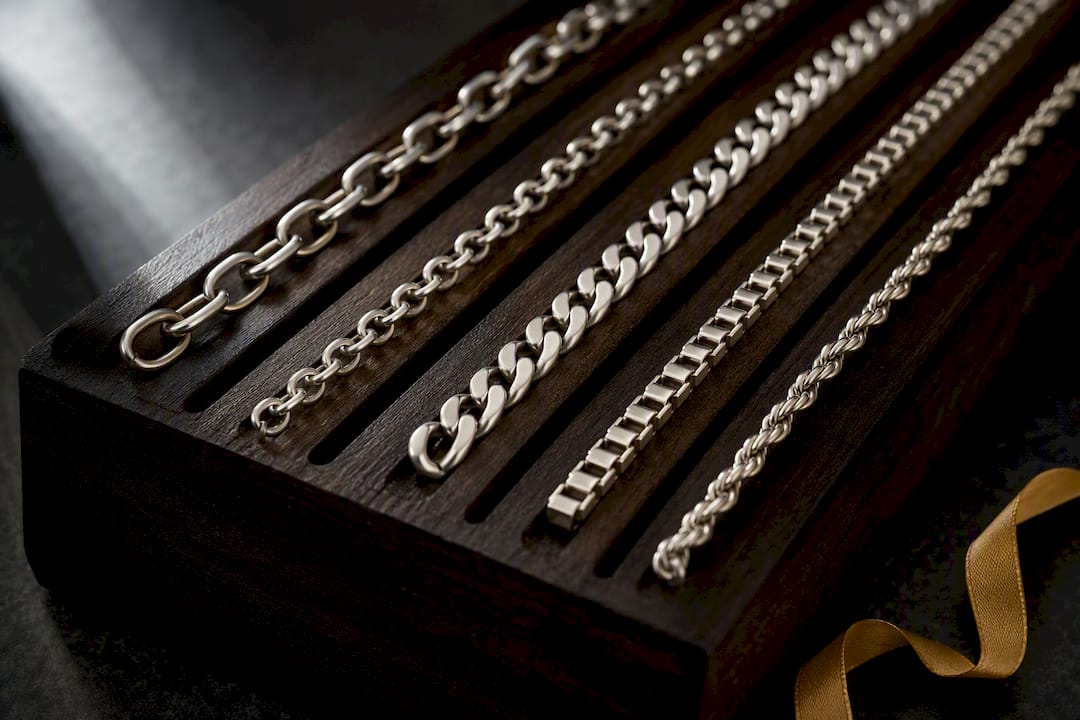
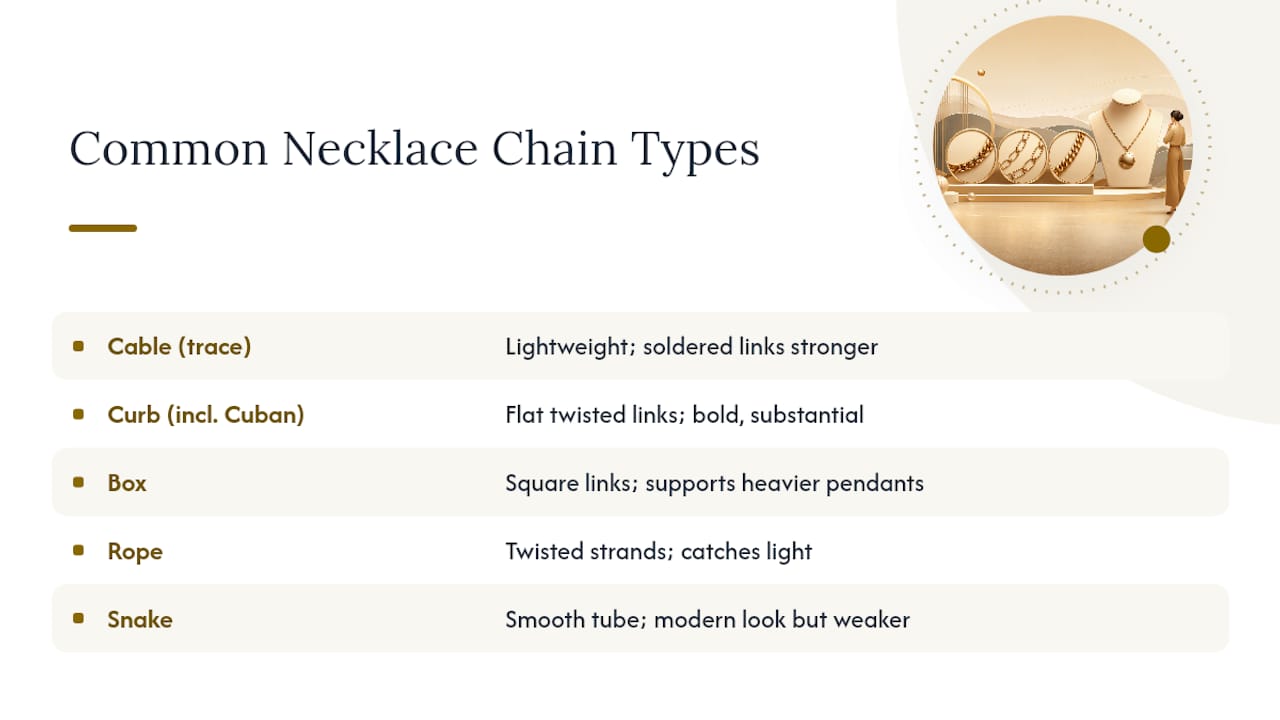
Cable (trace) chain. The simplest construction in jewelry: uniform oval or round links, each one connected to the next in a repeating pattern. It’s lightweight, pendant-friendly, and inexpensive to produce. The one detail that matters most: whether the links are soldered shut. Soldered links are significantly stronger and are the safer choice for anything you plan to wear daily or hang a pendant from. Unsoldered cable is fine for costume pieces you’ll swap often, but it’s not built for permanent wear.
Rolo (belcher) chain. Round, uniform links that sit slightly differently than cable because the loops are rounder and more substantial. Rolo is a favorite base chain for charm bracelets and layered necklace stacks because charms slide and rotate easily on the round profile.
Curb chain. Links are twisted so they lie flat against each other, creating a smooth, interlocking surface that reads as bold and substantial. This is where the cuban link vs curb chain confusion usually starts. A traditional curb chain has a flatter, tighter twist; a Cuban link chain uses a wider, more rounded, and heavier link that sits looser against the skin. Both shapes get marketed under overlapping names, so if you’re comparing curb vs cuban chain options online, ask for the exact link width and profile rather than trusting the label alone.
Figaro chain. A patterned rhythm of one long link followed by several short round ones. It’s been a staple in men’s jewelry for decades because that alternating pattern reads as more dynamic than a uniform chain without sacrificing durability.
Box chain. Square links stacked so tightly the chain looks almost like a solid metal rod. Box construction distributes weight evenly across each link, which is why suppliers commonly recommend box chains for heavier pendants. It’s sleek, doesn’t twist easily, and holds its shape under daily wear better than most open-link styles.
Rope chain. Multiple strands twisted together to mimic braided rope. The twist creates constant movement and catches light from multiple angles, which is why rope chains photograph with more sparkle than a flat chain of the same metal weight. If you’re weighing rope or cuban chain, rope wins on visual movement; Cuban wins on a bolder, flatter silhouette.
Snake chain. Tightly interlocked plates form a smooth tube with no visible individual links. It looks liquid and modern, but that same smooth surface has a real weakness.
Herringbone chain. Flat, densely packed links create a mirror-like ribbon effect. It’s one of the most eye-catching flat chains available, and also one of the least forgiving.
Statistic Callout: Herringbone and snake chains share the same structural vulnerability: their flat, tightly interlocked surfaces drape beautifully but kink permanently if bent sharply, unlike open-link cable or curb chains, which can usually be worked back into shape.
Paperclip chain. Paperclip chains are made by drawing or elongating round links into flat, rectangular shapes, and they’ve become one of the more requested styles in recent years for stacking and layering. The elongated link creates visible negative space, giving the chain a lighter, more graphic look than traditional cable.
Ball (bead) and bar chains. Ball chains use small spheres connected by short bars or wire, giving a dotted, geometric look often used for dog tags or minimalist pendants. Bar chains alternate flat metal segments for a similarly clean, architectural line. Both tend to be simple, cost-effective, and easy to layer against bulkier styles.
How Finishes and Construction Change a Chain’s Look and Feel
The base link shape is only half the story. How a chain is finished changes how it wears, how it photographs, and what it costs.
- Diamond-cut links: Faceted cuts across the link surface increase light return without adding meaningful weight, which is why diamond-cut cable or rope chains sparkle more than their smooth counterparts at the same gauge.
- Flattened or drawn links: Processes that stretch and flatten round wire (used for paperclip and flat cable styles) widen the visual footprint of a chain without proportionally increasing metal weight or cost.
- Hollow versus solid construction: Hollow chains cost less and wear lighter, but they dent and collapse under pressure in a way solid links don’t. Solid construction costs more upfront and lasts longer under daily wear.
- Plating versus solid metal: Plated chains wear down over months or years depending on use, while solid gold or sterling silver chains hold their finish and color for the life of the piece.
Pro Tip: If a chain feels suspiciously light for its size, ask directly whether it’s hollow or solid. Hollow construction isn’t a defect, but you should know what you’re paying for before it shows up on your wrist or neck.
How Do You Choose the Right Chain for Your Pendant?
The right chain depends on four things working together: what you’re hanging on it, how you want it to move, how you’ll wear it, and what it’s made of.
- Match chain strength to pendant weight. A small pendant under a gram or two suits a fine cable or rolo chain. Anything heavier, especially with dense stones, does better on box or curb construction, which spreads the load across a sturdier link.
- Consider gauge and width before length. A thin 1mm chain reads delicate but shows wear faster under a heavy pendant. Going up even half a millimeter in gauge often solves durability problems without changing the overall look.
- Confirm the links are soldered if the chain will see daily wear. A single question, “are the links soldered?”, quickly separates durable chains from decorative ones that were never meant to carry weight.
- Ask about clasp rating and repair policy. A lobster clasp rated for daily use matters more on a heavier chain, and a seller who can’t answer basic repair questions is a seller you should be cautious with.
- Match texture to occasion. Rope adds sparkle and movement, snake and herringbone deliver a dressier, flatter look, and cable stays neutral enough for everyday wear.
Watch for red flags: thin, unsoldered links marketed for pendant use, and herringbone or snake chains sold as “everyday” pieces without any mention of kink risk. If you’re layering multiple chains, mixing link sizes across families, say a fine cable with a chunkier curb or rope, reads better than stacking similar finishes that compete for attention.
Caring for Your Chain: Preventing Kinks and Basic Repairs
Most chain damage comes from two habits: yanking a tangled chain apart and storing it carelessly. Both are easy to avoid once you know what to watch for.
- Preventing kinks: Never pull a knotted chain tight. Lay it flat, use a pin or needle to gently loosen the knot, and work outward instead of pulling the ends.
- Un-kinking a bent flat chain: Herringbone and snake chains that have already kinked usually can’t be fully restored at home; a jeweler can sometimes smooth minor bends, but a sharp fold often leaves a permanent weak point.
- Cleaning by material: Solid gold and platinum tolerate mild soap and warm water. Plated chains should avoid ultrasonic cleaners and harsh chemical dips, which can strip the finish.
- Storage: Hang finer chains individually or store them flat in anti-tarnish pouches. Tossing multiple chains into one drawer is the single most common cause of tangling and scratching.
- When to see a jeweler: Broken clasps, separated solder joints, and stretched links are all standard repairs. A kinked herringbone or snake chain is worth a professional opinion before you decide whether to repair or replace it.
Why Construction Details Decide How Long a Chain Lasts
Everything about a chain’s long-term performance traces back to how it was built, not just how it looks on day one. Trade glossaries separate chains into open-link, solid/woven, and decorative families precisely because construction predicts behavior better than appearance does.
Soldered links carry weight the way welded joints carry structural load: the connection point is sealed rather than simply hooked together. That single manufacturing decision is often the difference between a chain that lasts decades and one that separates within a year of daily wear.
Drawing and swaging, the processes used to flatten or tube-form wire into styles like paperclip and snake, change surface texture and light return, but they also change how forgiving a chain is under stress. Usa Jewels’ chain buyers guide covers these construction distinctions in more depth for shoppers who want to understand exactly what they’re paying for before they buy.
What We See Customers Choose, and Why
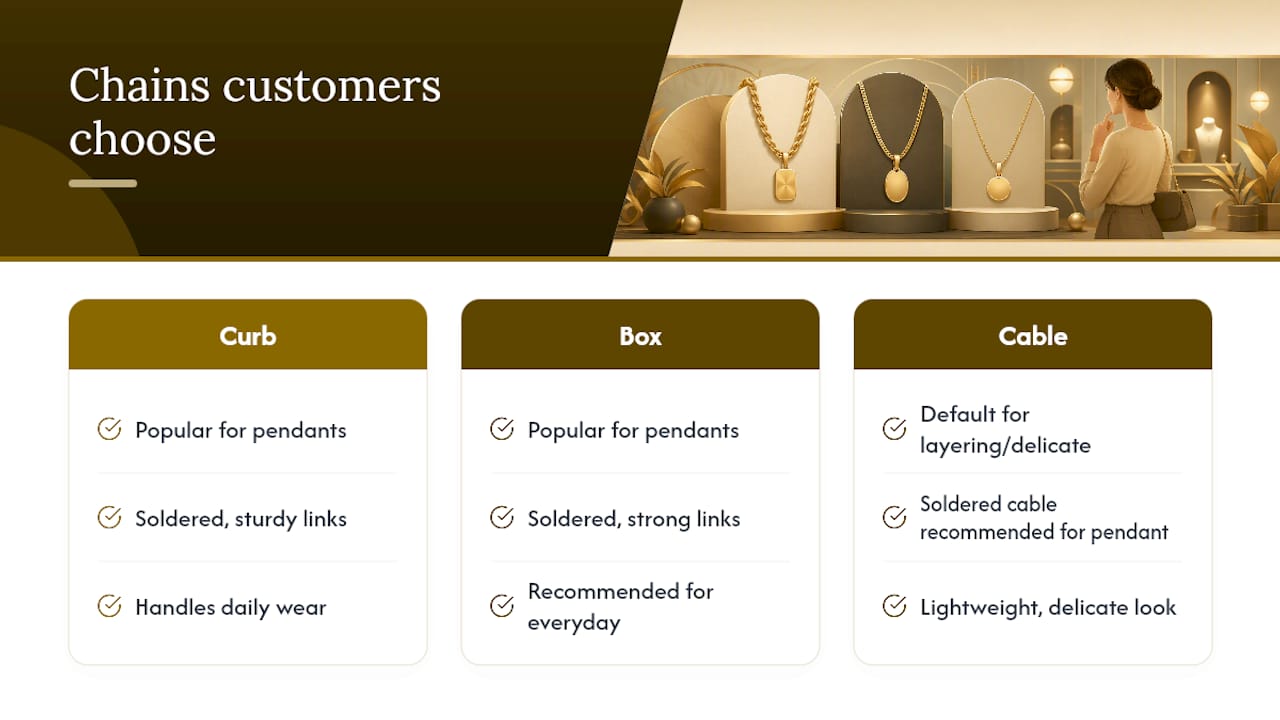
Custom orders tell you a lot about what actually holds up. Curb and box chains dominate requests for pendant wear, and cable remains the default for anything layered or delicate. That pattern matches what our in-house manufacturing process reinforces every day: soldered, properly gauged links outlast trendy but fragile constructions.
Since 1999, we’ve built our reputation, reflected in over 222 Google reviews, on getting these fundamentals right rather than chasing every fashion cycle. Ethical sourcing and lifetime diamond upgrades matter, but so does a clasp that won’t fail in six months.
If you want one recommendation for a pendant and one for everyday wear, we usually point people toward a soldered cable chain for the first and a box chain for the second. Both handle real life without demanding babying.
— Joseph
Design a Chain That Matches How You Actually Wear It
Usa Jewels is the alternative to guessing your way through a chain purchase online. Instead of choosing between a handful of pre-set widths and hoping the clasp holds, our design-your-own process lets you pick the metal, gauge, length, and clasp rating together, so the chain is built for your pendant’s actual weight rather than a generic average.

Our in-house manufacturing means every soldered joint and link gauge is made to spec rather than sourced from a catalog of unknowns, and it’s part of why we’ve built trust with customers since 1999. If you already have a pendant in mind, browse our gold chain collections to see finished options in 14K and 18K, or explore detailed chain styles to compare gauge and finish side by side. Prefer something heavier for a statement piece? Our fine diamond jewelry collection pairs well with box or curb chains built to carry real weight. Reach out through our site to request a custom gauge, clasp, or metal combination, and we’ll build it around the piece you’re actually planning to wear.
Sources
For deeper technical diagrams and terminology, the Halstead jewelry chain glossary and Atlanta Findings chain styles guide cover manufacturing detail beyond this guide’s scope.
- Types of Jewelry Chain Link Styles – Halstead
- Types of Chain Links: A Guide to Jewelry Chain Styles – Atlanta Findings
- Understanding Different Types of Chain – Cookson Gold
FAQ
What Chain Style Is the Strongest?
Box and curb chains are generally the strongest for everyday wear and heavier pendants because their interlocking link geometry distributes weight evenly. Soldered links matter more than the style itself; an unsoldered chain in any shape is weaker than a soldered one.
How Do I Know if My Chain Is Curb or Cuban?
Measure the link width and profile: traditional curb links are flatter and more tightly twisted, while Cuban links are wider, rounder, and sit looser against the skin. Sellers often use the names interchangeably, so ask for exact link dimensions rather than relying on the label.
How Do You Tell What Type of Chain You Have?
Look at the individual link shape first: round links suggest cable or rolo, square links suggest box, and flat interlocking links suggest curb, herringbone, or snake. Checking whether links are soldered or open is the next step, since that detail affects both identification and durability.
How Do I Choose the Right Chain Type?
Match strength to pendant weight, drape to how the chain lies against clothing or skin, and texture to whether you want a subtle base chain or a statement piece on its own. A fine cable chain suits small pendants, while box or curb chains handle heavier pieces and daily wear better.
Recommended

Deep Mehta is the Co-Owner of USA Jewels, a family-owned jewelry business she has led since 2013 in Deerfield Beach, Florida. With over 13 years of hands-on experience in fine jewelry retail, manufacturing, and diamond importing, Deep specializes in engagement rings, wedding bands, and custom jewelry design. She also co-manages Kaash Group Talent Acquisition. Deep is a University of Florida graduate and oversees every aspect of USA Jewels’ operations, from product development to marketing.
Fine Jewelry Collection


You May Also Like

Age-Appropriate Jewelry Examples: A Complete Gift Guide

Top 6 TraxNYC.com Jewelry Alternatives 2026