
Pick Ring Setting Style Guide for Every Buyer
If you wear your ring every day and work with your hands, start with a bezel, flush, or channel setting. If maximum sparkle is the priority and the ring is for special occasions or lighter daily wear, a prong, halo, or pavé setting will serve you better. That single distinction covers most buying decisions before you ever walk into a showroom.
Quick checklist before you shop:
- Lifestyle: Do you work with your hands, exercise regularly, or wear gloves? Lean toward low-profile, snag-free settings.
- Stone shape: Round brilliants work in almost any setting; elongated shapes like oval, pear, and marquise need prong placement that protects their points.
- Desired visual size: Want the stone to look larger than its carat weight? A halo or tapered side-stone arrangement adds perceived size without adding carat cost.
- Maintenance willingness: Pavé and prong settings need professional inspection every 6–12 months. Bezel and channel settings are more forgiving.
- Budget: Labor-intensive settings (pavé, tension, custom filigree) cost more to make and more to repair.
Pro Tip: A half-bezel is the setting most buyers overlook. It wraps metal around the stone’s highest-contact sides while leaving the east and west faces open to light, giving you meaningful protection without sacrificing the brilliance that a full bezel can mute.
Table of Contents
- What does “ring setting style” mean, and why does the difference matter?
- How do you choose the right ring setting?
- The most common engagement ring settings explained
- Which settings make a stone look bigger or brighter?
- Durability, daily wear, and maintenance: what to expect
- What jewelers and makers recommend for real-life wear
- Key Takeaways
- The setting decision most buyers get backward
- Usajewels can help you find and build the right setting
- Useful sources
- FAQ
What does “ring setting style” mean, and why does the difference matter?
The terms “style” and “setting” get used interchangeably in most jewelry stores, but separating them leads to better long-term choices.
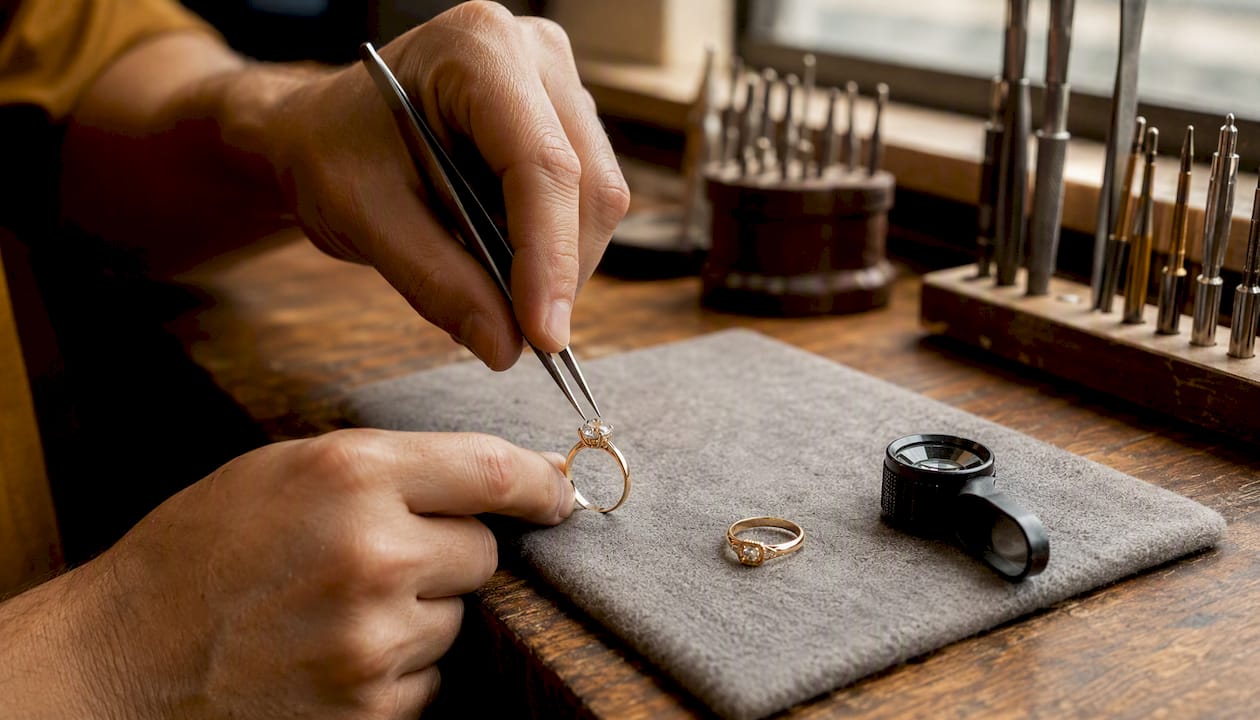
Style is the ring’s overall aesthetic identity: solitaire, vintage, three-stone, halo. It describes what the ring looks like at a glance. Setting is the mechanical method that physically holds the center stone in place: prong, bezel, channel, tension. It determines how the stone behaves during daily wear, how easy it is to clean, and how much protection the stone receives.
A solitaire is a style. That same solitaire can be built with a prong setting or a bezel setting, and the two versions behave very differently in real life.
| Feature | Prong solitaire | Bezel solitaire |
|---|---|---|
| Stone exposure | High — maximum light entry | Lower — metal rim surrounds stone |
| Sparkle | Maximum brilliance | Slightly reduced, warmer look |
| Snag risk | Prongs can catch on fabric | Smooth, snag-free profile |
| Cleaning | Requires more frequent inspection | Easier to wipe clean |
| Resizing | Straightforward | Straightforward |
| Best for | Occasional/office wear | Active daily wear |
The practical takeaway: choose your style first (the look you love), then choose the setting that makes that look work for your life.
How do you choose the right ring setting?
This is where most buyers skip ahead and pay for it later. Work through these steps before you commit.
Step-by-step decision checklist
- Assess your lifestyle honestly. If you exercise, cook, garden, or work in healthcare, a high-profile prong setting will catch on gloves and equipment. A bezel or channel setting is the safer call.
- Know your stone’s hardness. Diamonds (10 on the Mohs scale) tolerate almost any setting. Softer stones like emeralds (7.5–8) and opals (5.5–6.5) need protective settings — bezel or channel — that shield the girdle from impact.
- Consider your finger shape. Longer, slender fingers carry almost any setting well. Shorter fingers benefit from elongated shapes (oval, pear) in low-profile settings that visually lengthen the finger.
- Plan for your wedding band. Some settings — especially high cathedral prongs and certain halo designs — sit too tall to flush against a standard wedding band. Confirm compatibility before you buy.
- Set a realistic budget. Complex settings like pavé, tension, and custom milgrain or filigree require more precise handwork, which raises labor costs. Know what you’re paying for.
Questions to ask your jeweler
- What is the prong gauge, and how often should I have them inspected?
- Can this setting be resized, and by how much?
- Which metal do you recommend for this setting, and why?
- What is your cleaning and inspection policy after purchase?
- Does the warranty cover prong tightening and accent stone replacement?
Red flags to watch for
- A jeweler who cannot specify the prong gauge or metal alloy.
- Tension settings offered without a clear resizing policy. Tension settings rely on lateral compression to hold the stone, and resizing often requires rebuilding the entire shank — confirm this before you buy, especially for a surprise proposal.
- Intricate filigree or vintage-style openwork that hides weak prong seats beneath decorative metalwork. Beautiful, but inspect it carefully. Our vintage engagement ring styles guide covers what to look for in ornate designs.
The most common engagement ring settings explained
Here is a practical rundown of every major setting type, with the trade-offs stated plainly.
Approximately 70% of engagement rings use a prong setting — most commonly a raised solitaire — making it the default starting point for most buyers.
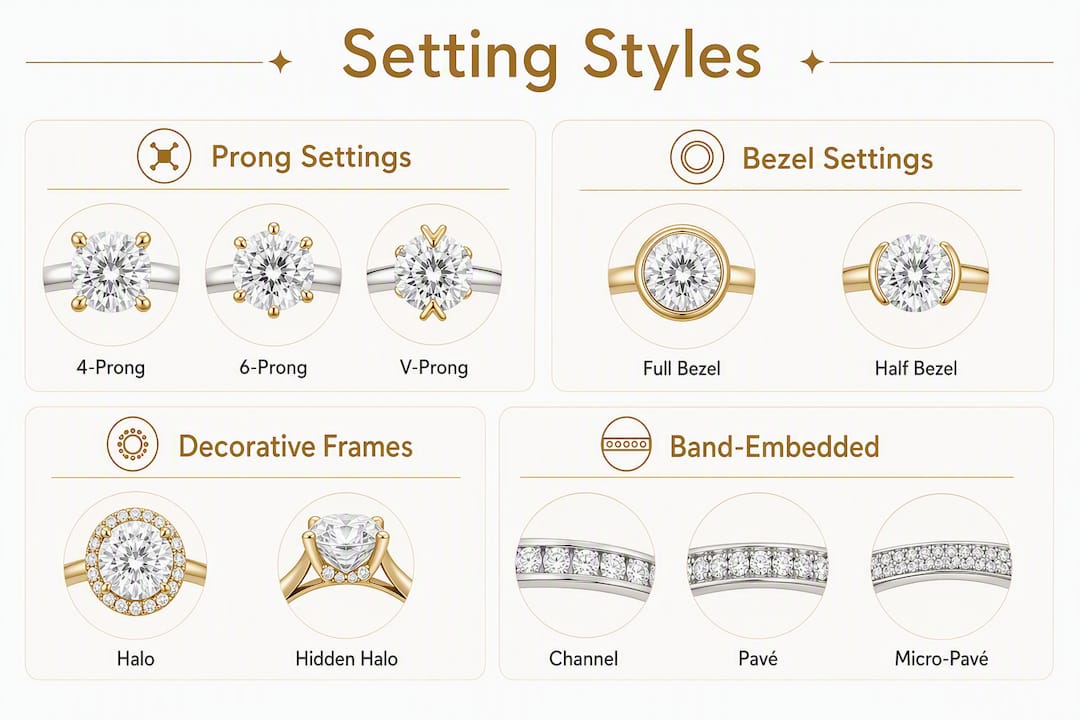
Prong (4-prong, 6-prong, V-prong)
Small metal claws grip the stone at its girdle, lifting it high to maximize light entry. Six prongs offer more security than four; V-prongs protect pointed corners on pear, marquise, and princess cuts. The trade-off is that prongs snag on fabric and need regular inspection. Best for round, oval, and cushion cuts on buyers who prioritize sparkle overprotection.
Bezel (full and half)
A continuous or partial metal rim wraps the stone’s perimeter. Full bezel offers the most protection and a clean, modern look. A half-bezel places metal only on the stone’s highest-contact sides, leaving east and west faces open for light entry — a smart middle ground. Works with round, oval, and cushion shapes. Ideal for active wearers and softer gemstones.
Halo
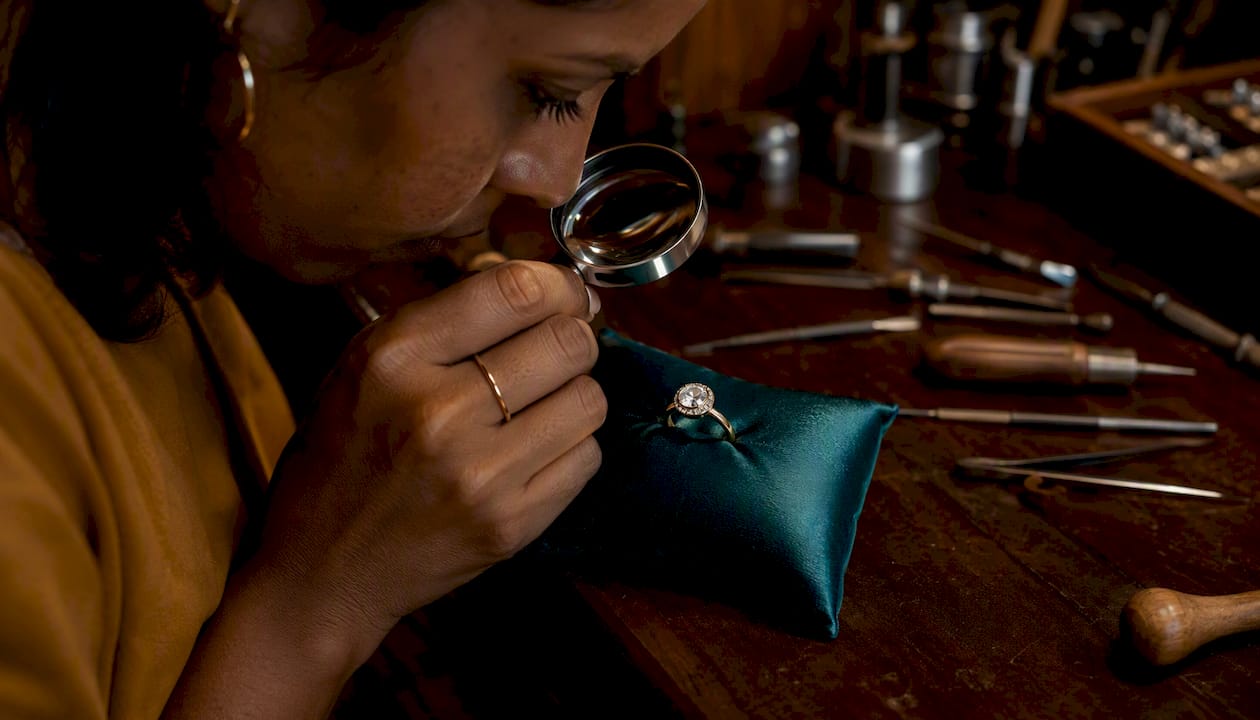
A frame of small accent diamonds surrounds the center stone, amplifying its apparent size. Halo settings are the second-most-popular engagement ring setting and pair well with round, oval, cushion, and pear shapes. The downside: the accent stones need periodic checking, and a halo adds height that may conflict with some wedding bands.
Pavé and micro-pavé
Tiny diamonds set closely along the band create a surface that appears to be entirely covered in sparkle. Pavé settings require more maintenance because individual stones can loosen over time. Micro-pavé uses even smaller stones and demands more precise craftsmanship. Best for buyers who love all-over brilliance and are committed to annual professional inspections.
Channel
Stones sit in a groove between two parallel metal walls, with no prongs exposed. Channel settings protect the stone’s girdle and present a smooth, snag-free surface — excellent for bands with multiple stones, side stones, or men’s rings. Resizing is more complex than with a plain shank.
Tension
The stone appears to float between two ends of the shank, held by compression alone. Visually striking, but engineering-intensive. Resizing is frequently impossible without rebuilding the shank, so this setting suits buyers who are certain of their ring size.
Cathedral
Arching metal supports lift the center stone above the band, creating a dramatic, elevated profile. Gorgeous for formal occasions; the height can catch on clothing during active wear. Pairs well with round and princess cuts.
Solitaire
A style and a setting concept: one center stone, minimal metal, maximum focus on the diamond. Usually built with a prong or bezel setting. Timeless, versatile, and easy to stack with a wedding band.
Three-stone
A center stone flanked by two side stones. The trio symbolizes past, present, and future. Side stones can be matched diamonds or contrasting colored gems. Works with round, oval, and cushion centers.
Hidden halo
A small halo sits beneath the center stone rather than around it, visible only from the side. Adds subtle sparkle without the visual bulk of a standard halo. Popular with buyers who want a clean top-down look.
Bar setting
Thin vertical metal bars separate each stone rather than prongs or a continuous channel. More stone is exposed than in a channel setting, which increases sparkle while still offering reasonable protection.
Gypsy / flush setting
The stone sits level with the metal surface, recessed into the shank. Extremely durable and snag-free. Bezel and flush settings are recommended for very active daily wear because they protect the stone’s girdle and do not catch on clothing.
Tiffany®-style / basket setting
The Tiffany® setting, introduced in 1886, is a six-prong solitaire with a raised, knife-edge band that lifts the diamond high for maximum light exposure. It remains one of the most recognized setting designs in fine jewelry history and is the template from which most modern prong solitaires descend.
| Setting | Best for | Protection | Sparkle | Maintenance | Price impact | Profile height |
|---|---|---|---|---|---|---|
| Prong (4/6) | Sparkle-first buyers | Moderate | Very high | Annual inspection | Low | High |
| Bezel (full) | Active daily wearers | Very high | Moderate | Low | Moderate | Low |
| Half-bezel | Balance of both | High | High | Low | Moderate | Low–medium |
| Halo | Visual size boost | Moderate | Very high | Moderate | Moderate–high | Medium–high |
| Pavé | All-over brilliance | Low–moderate | Very high | High | High | Low–medium |
| Channel | Multi-stone bands | High | Moderate | Low–moderate | Moderate | Low |
| Tension | Statement pieces | Moderate | High | Low | Very high | Medium |
| Cathedral | Formal/occasional | Moderate | High | Moderate | Moderate | Very high |
| Gypsy/flush | Rugged daily wear | Very high | Low | Very low | Low | Flush |
| Three-stone | Symbolic look | Moderate | High | Moderate | Moderate–high | Medium |
For a deeper look at prong variations specifically, our prong style selection guide covers gauge, tip shape, and inspection intervals in detail.
Which settings make a stone look bigger or brighter?
Optical size and actual carat weight are two different things, and the right setting can close the gap between them considerably.
Settings that increase perceived size:
- Halo: The frame of accent diamonds visually extends the center stone’s diameter. A 0.75ct round in a halo can appear close to 1ct to the naked eye.
- Bezel with tapered side stones: The metal rim creates a continuous outline that reads as a larger stone, especially in yellow or rose gold where the warm metal blends with the stone’s edge.
- Pavé band: Diamonds running down the shank draw the eye toward the center, making it appear more prominent by contrast.
Settings that maximize brilliance:
- High-prong and cathedral settings lift the stone away from the finger, allowing light to enter from below as well as above.
- A classic solitaire with a thin, knife-edge band keeps all visual attention on the diamond’s facets.
- Halo with pavé accents combines size amplification with surface sparkle for the most visually dramatic result.
Pro Tip: White gold and platinum settings make colorless diamonds (D–F grades) appear icier and brighter. Yellow gold settings warm up near-colorless stones (G–J) and can actually make slight color less noticeable, which means you can sometimes choose a lower color grade and redirect that budget toward a larger stone or a better cut.
Metal choice also affects how large a stone reads. Our precious metals guide explains how platinum, white gold, yellow gold, and rose gold each interact with different stone colors and setting styles.
Durability, daily wear, and maintenance: what to expect
Setting choice is a maintenance commitment, not just an aesthetic one. Here is what each category realistically requires.
| Setting type | Inspection frequency | Key maintenance concern | Relative upkeep cost |
|---|---|---|---|
| Prong (4/6) | Every 6–12 months | Prong wear, bending, loosening | Moderate |
| Pavé / micro-pavé | Every 6 months | Individual stone loosening | Higher |
| Halo | Every 6–12 months | Accent stone security | Moderate |
| Bezel (full/half) | Every 6–12 months | Metal rim integrity | Lower |
| Channel | Every 12 months | Stone movement within channel | Low–moderate |
| Tension | Every 12 months | Shank compression integrity | Higher (specialist) |
| Gypsy/flush | Every 6–12 months | Stone surface level | Very low |
Pavé and micro-pavé settings carry the highest ongoing maintenance burden because each tiny stone is a potential loose point. A professional inspection every six months is not excessive for an active wearer with a pavé band.
Cost factors worth knowing: labor drives setting price more than material weight in most cases. Intricate pavé, tension, and custom milgrain or filigree work require more precise handwork or machining, which raises the setting’s price premium above a simple prong or bezel. When you’re comparing two rings at similar carat weights, the setting complexity often explains the price difference.
For buyers considering colored center stones — sapphires, emeralds, moissanite, or lab-grown alternatives — setting choice matters even more. Softer stones need bezel or channel protection. Our diamond alternatives comparison covers hardness ratings and setting recommendations for the most popular non-diamond options.
What jewelers and makers recommend for real-life wear
Industry experts consistently advise that high-set styles — tall prongs, cathedral arches — work beautifully for special occasions but are not ideal for continuous active wear. The recommendation for daily wearers is always a low-profile option.
The lifestyle-first rules are straightforward:
- Active or hands-on daily wear: bezel, flush/gypsy, or channel. These settings protect the stone’s girdle, present no snag points, and require the least frequent professional attention.
- Office or mixed wear: low cathedral, half-bezel, or four-prong solitaire. Moderate protection with good sparkle.
- Formal or occasional wear: high cathedral, six-prong Tiffany®-style, or full halo. Maximum visual impact, with the understanding that the ring comes off for physical work.
When commissioning a custom setting, ask your jeweler for these specifics:
- A wax or CAD mockup before metal is poured, so you can see the profile height and prong placement.
- The prong gauge in millimeters (thicker prongs last longer).
- A low-profile head option if you want a prong setting for daily wear.
- A sizing plan that accounts for the setting type — especially critical for tension and channel settings.
Our settings guide covers prong, bezel, and channel construction in plain language, with diagrams that make the mechanical differences easy to see.
Key Takeaways
The single most important decision in this guide is matching your setting to your lifestyle before you fall in love with a look.
| Point | Details |
|---|---|
| Lifestyle drives setting choice | Active daily wearers should prioritize bezel, flush, or channel settings for protection and snag-free wear. |
| Prongs dominate the market | Prong settings are the most common engagement ring setting, but that doesn’t make it right for every buyer. |
| Halo adds perceived size | A halo setting can make a 0.75ct stone appear close to 1ct without increasing the diamond’s actual carat weight. |
| Pavé demands commitment | Pavé and micro-pavé settings require professional inspection every six months due to individual stone loosening risk. |
| Usajewels offers custom options | Usajewels provides design consultations, CAD mockups, in-house manufacturing, and a lifetime diamond upgrade program to help you build the right setting for your stone and life. |
The setting decision most buyers get backward
There’s a pattern we see often at Usajewels: a buyer falls in love with a high-cathedral prong setting in a photo, orders it, wears it for three months, and then stops wearing it because it catches on everything. The ring is beautiful. The setting was wrong for that person’s life.
The conventional advice in most buying guides is to choose the stone first, then the setting. We’d push back on that. The setting is the structural decision. It determines how the ring behaves for the next 20 years. The stone is the emotional decision. Both matter, but the order should be: lifestyle, then setting, then stone shape, then stone quality.
We also think the tension setting gets oversold as a “modern” choice without enough honest disclosure about its resizing limitations. For a surprise proposal where you’re guessing the ring size, a tension setting is a genuine risk. A bezel or prong setting gives you far more flexibility if the size needs adjusting.
One more thing: don’t underestimate the half-bezel. It sits in the middle of almost every trade-off in this guide — protection vs. sparkle, low profile vs. visual presence, easy maintenance vs. high drama. For buyers who can’t decide between a bezel and a prong, the half-bezel is often the answer that was there the whole time.
Usajewels can help you find and build the right setting
Choosing a setting is easier when you can see it on your hand, in your metal, with your stone. At Usajewels, we’ve been helping couples do exactly that since 1999 — as a family-owned, in-house manufacturer that cuts out the middleman and keeps pricing honest.
Here’s what we offer for buyers working through a setting decision:
- Custom design consultations to match your lifestyle, stone shape, and budget to the right setting.
- CAD mockups so you can visualize profile height, prong placement, and band width before anything is made.
- In-house manufacturing with direct pricing — no retail markup, no third-party labor costs.
- Lifetime diamond upgrade program for buyers who want to start with one stone and upgrade later.
- Ethically sourced, certified natural and lab-grown diamonds available for direct purchase.
Browse our fine jewelry collection to see ready-to-ship engagement rings across every major setting style, or start a custom design using our step-by-step design guide. If you have questions about which setting fits your stone or your life, reach out — we’re here to help you get it right the first time.
Useful sources
These resources offer additional detail, visual examples, and authoritative guidance for buyers researching engagement ring settings:
- Engagement Ring Settings 101: Your Expert Guide to Ring Settings — The Knot
- 27 Types of Ring Settings Explained — Twirl Weddings
- Ring Styles vs Ring Settings: What’s the Difference? — Labgrowndiamjewel
- Settings Guide: Prong, Bezel & Channel — Usajewels
- Design Your Own Engagement Ring — Usajewels
- Engagement Ring Buying Guide — Usajewels
FAQ
What is the most durable engagement ring setting?
Bezel and flush (gypsy) settings offer the most protection for daily wear because the metal rim or recessed design shields the stone’s girdle from impact and presents no snag points.
Can a tension setting be resized?
Resizing a tension setting is often impossible or requires rebuilding the shank entirely, since the setting relies on lateral compression to hold the stone. Always confirm the jeweler’s resizing policy before purchasing a tension-set ring.
Which setting makes a diamond look the biggest?
A halo setting creates the greatest increase in perceived stone size by surrounding the center diamond with a frame of accent stones. A 0.75ct stone in a halo can visually read close to 1ct.
How often do prong settings need professional inspection?
Prong settings should be inspected by a jeweler every 6–12 months. Pavé and micro-pavé settings, which have many small accent stones, benefit from inspection every six months.
Does Usajewels offer custom setting options?
Yes. Usajewels provides design consultations, CAD mockups, and in-house manufacturing so buyers can customize the setting, metal, and stone to their exact preferences, with direct pricing and a lifetime diamond upgrade program.
Recommended
- Ring Guide: Engagement Settings & Styles | USA Jewels
- Settings Guide: Prong, Bezel & Channel | USA Jewels
- Engagement Ring Prong Style Selection: 2026 Guide
- Diamond Shapes Guide: Every Shape Compared | USA Jewels

Deep Mehta is the Co-Owner of USA Jewels, a family-owned jewelry business she has led since 2013 in Deerfield Beach, Florida. With over 13 years of hands-on experience in fine jewelry retail, manufacturing, and diamond importing, Deep specializes in engagement rings, wedding bands, and custom jewelry design. She also co-manages Kaash Group Talent Acquisition. Deep is a University of Florida graduate and oversees every aspect of USA Jewels’ operations, from product development to marketing.
Fine Jewelry Collection


You May Also Like
Why Diamond Certifications Differ Globally: 2026 Guide
VVS vs VS: Which Diamond Clarity Should You Buy?