Handcrafted vs. Mass-Produced Children’s Jewelry Guide
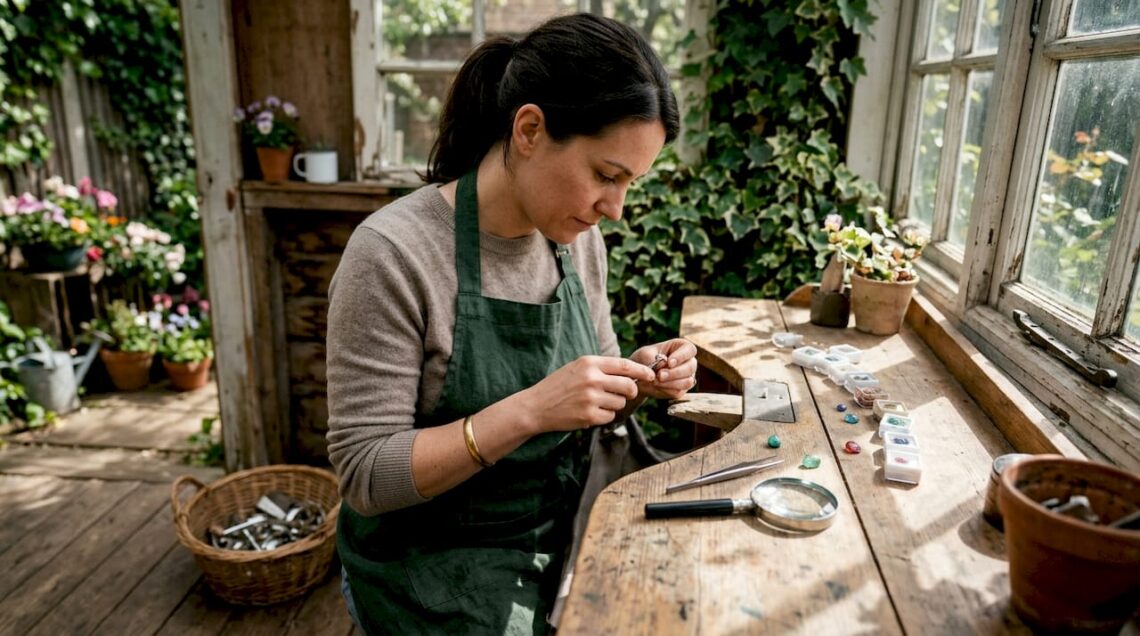
Handcrafted children’s jewelry is defined by a skilled artisan shaping each piece manually, with human judgment guiding every stage of production. Understanding how handcrafted differs from mass-produced children’s jewelry helps parents and gift givers make choices that go beyond price, touching on safety, durability, and lasting meaning. The two production methods create fundamentally different outcomes in material quality, design flexibility, and comfort for kids. Knowing the difference protects your child and makes every gift more intentional.
How handcrafted differs from mass-produced children’s jewelry
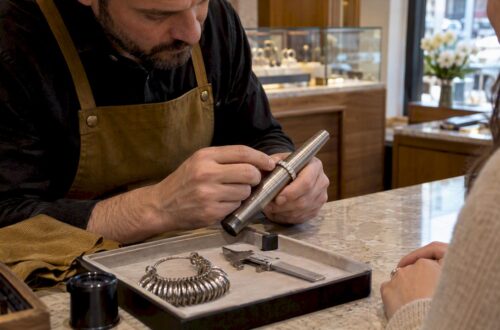
The core distinction is simple: handcrafted jewelry is shaped by human skill at every meaningful stage, while mass-produced jewelry is engineered for volume and uniformity through automated processes. Tools can assist an artisan, but the artisan’s judgment drives the outcome. Mass production uses CAD modeling, casting machines, and assembly lines to replicate identical pieces at scale. The result is reliable consistency, but little room for individual expression or adaptation.
The industry term for what most parents are searching for is “artisan jewelry.” The phrase “handcrafted children’s jewelry” captures the same idea in everyday language. Both refer to pieces where a maker’s hands and decisions are present throughout, not just at the finishing stage. The Jewelry Industry Standards Council recognizes artisan involvement as a key quality marker in fine jewelry production.
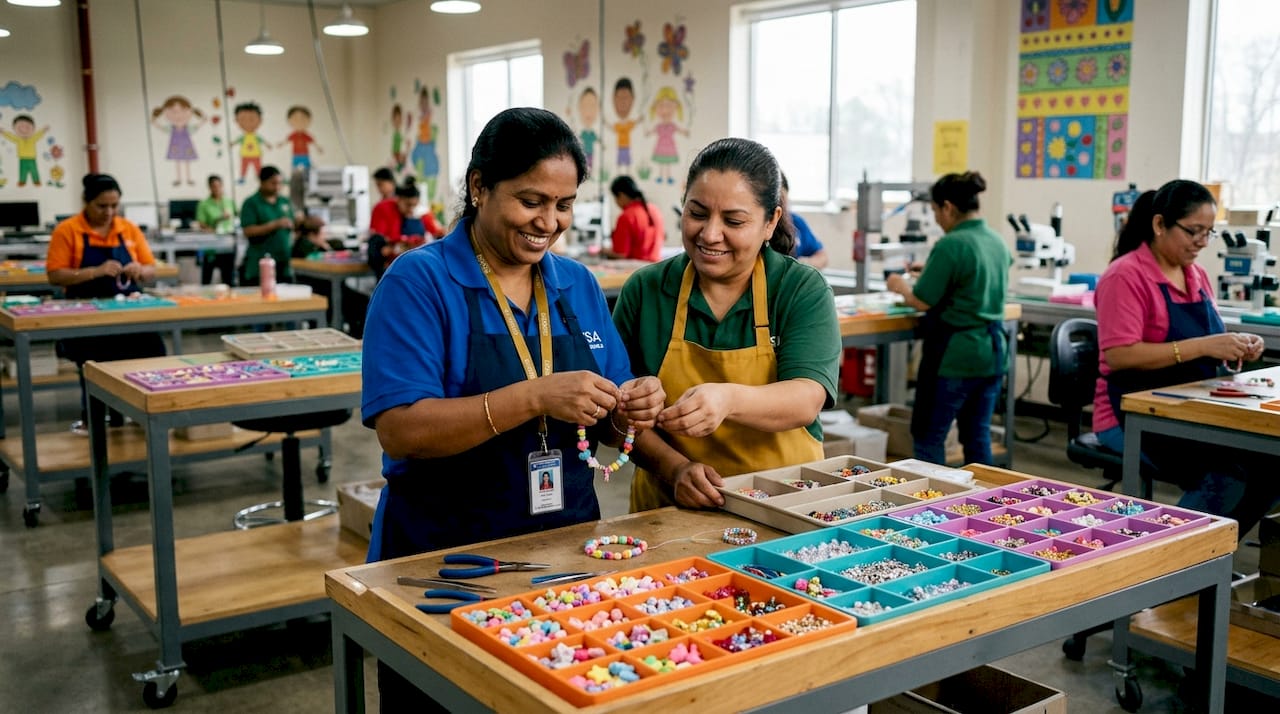
Mass production achieves cost efficiency through material reduction, thinner metal walls, and plated finishes over base metals. Artisan production prioritizes the integrity of each piece over speed. That difference in priority shapes everything from the clasp on a bracelet to the setting holding a stone.
How production methods shape quality and material choices
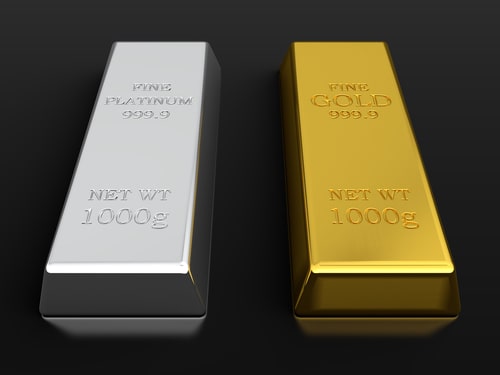
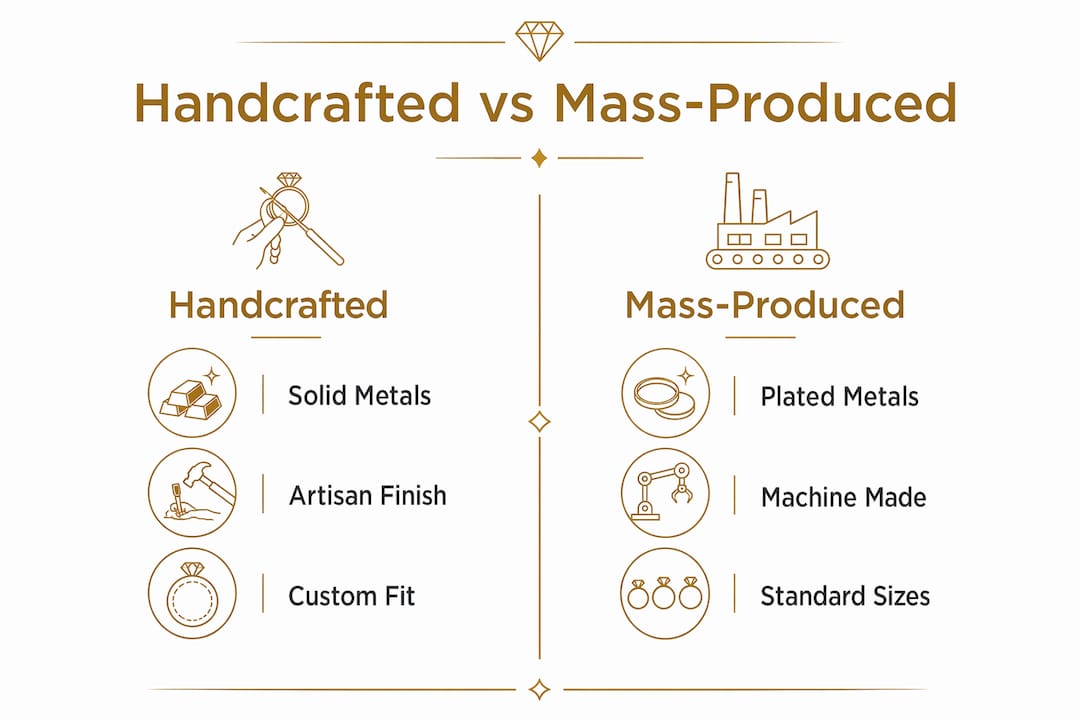
Handcrafted pieces typically use solid precious metals such as solid gold or sterling silver, while mass-produced jewelry often relies on plated base metals over alloys like brass or copper. Plating wears away with daily contact, especially on active children. Solid metal holds its finish and structural integrity far longer.
The practical differences for children’s jewelry include:
- Metal thickness: Artisan pieces feature thicker walls and links, which resist bending and breaking during active play.
- Stone settings: Handcrafted settings are individually checked and tightened, reducing the risk of a stone loosening and becoming a choking hazard.
- Surface finishing: Artisans hand-polish every surface, including the back of pendants and the inside of rings, where rough edges contact skin directly.
- Allergy safety: Solid gold and sterling silver carry far lower nickel content than many base metal alloys used in mass production, making them safer for children with sensitive skin.
Genuine handcrafted pieces are finished with care even on parts you cannot see. Mass-produced pieces may have rough backs or uneven plating in hidden areas. That detail matters when a pendant rests against a child’s neck all day.
Pro Tip: Check the back of any pendant before buying. A smooth, polished reverse side signals artisan finishing. A rough or uneven back suggests factory production.
Learning to spot quality craftsmanship takes only a few minutes and can save you from a piece that irritates your child’s skin within a week.
Why does customization matter for children’s jewelry?
Customization is one of the clearest benefits of handcrafted jewelry for children. Artisans adjust clasp tension, edge sharpness, and stone placement based on the specific needs of the wearer. A factory mold cannot do that. Mass-produced designs are locked into uniform shapes and sizes determined by production runs, not by the child wearing the piece.
Here are four ways artisan customization serves children and gift givers better:
- Size adjustments: An artisan can size a bracelet or ring to fit a small child’s wrist or finger precisely, rather than offering only standard sizes that may slip off or pinch.
- Edge softening: Children’s skin is sensitive. Artisans round and smooth every edge that contacts skin, a step that assembly-line production skips for speed.
- Meaningful design details: A birthstone, an engraved initial, or a specific charm shape can be incorporated into a handcrafted piece. Mass-produced catalogs offer limited variations.
- Clasp selection: Artisans can fit a lobster clasp, a toggle, or a safety clasp based on the child’s age and dexterity, reducing the chance of accidental loss.
Jewelry personalization transforms a gift from a purchase into a keepsake. Research confirms that artisan customization increases emotional value in ways that standardized gifts cannot replicate. For milestone moments like a first birthday, a baptism, or a graduation, that emotional depth matters as much as the physical piece.
Pro Tip: When ordering a handcrafted piece for a child, ask the artisan specifically about clasp type and edge finishing. These two details determine daily comfort more than any other design choice.
What explains the price difference?
Handcrafted children’s jewelry costs more because it takes more time and better materials to produce. Artisan pieces require hours to days per item, while factory production completes equivalent pieces in minutes. That labor cost is real and justified.
The table below shows how the two production approaches compare across the factors that drive price:
| Factor | Handcrafted | Mass-produced |
|---|---|---|
| Metal type | Solid gold or sterling silver | Plated base metal alloys |
| Production time | Hours to days per piece | Minutes per piece |
| Customization | High, artisan-adjusted | Low, mold-constrained |
| Longevity | Years to decades | Months to a few years |
| Repair options | Usually repairable by artisan | Often not cost-effective to repair |
Price differences do not automatically mean one option is better. The right choice depends on your purpose. A handcrafted piece suits a milestone gift meant to last years. A mass-produced piece suits a trendy seasonal item a child will outgrow quickly. Experts advise treating handcrafted jewelry as a durable keepsake and factory jewelry as a replaceable accessory.
One important caution: low prices combined with high-volume “handcrafted” claims are almost always a marketing signal rather than a production reality. Genuine artisan work cannot scale to mass volume at low cost. If a brand offers thousands of identical “handcrafted” pieces at factory prices, the label is likely misleading.
How do comfort and safety differ for kids?
Children wear jewelry differently than adults do. They run, sleep in it, pull on it, and forget it exists. Handcrafted jewelry addresses those realities in ways that factory production does not.
Key comfort and safety advantages of artisan children’s jewelry include:
- Smooth clasps: Artisans test and adjust clasp tension by hand, preventing pinching on small fingers and necks.
- Rounded edges: Every edge that contacts skin is finished individually, eliminating the micro-cuts and irritation that rough factory edges cause.
- Thicker links: Heavier chain links resist kinking and breaking during active movement, reducing the risk of a piece snapping and becoming a hazard.
- Adjustable sizing: Many artisan pieces include adjustable elements that accommodate a growing child over several years, extending the life of the piece.
- Repairability: When a handcrafted piece breaks, an artisan can repair it. Most mass-produced pieces are not worth repairing because replacement costs less than labor.
Artisan attention to fit and finishing directly reduces skin irritation and accidental injury for children. Mass production prioritizes speed and volume, and ergonomic details for small wearers are rarely part of the design brief.
Understanding why 14K gold works well for kids connects directly to these safety points. The metal’s durability and low reactivity make it a practical choice for daily wear on sensitive skin.
Pro Tip: For children under five, ask specifically about adjustable sizing and safety clasps. A piece that fits a three-year-old perfectly may be too tight by age five, making adjustability a practical necessity.
Key Takeaways
Handcrafted children’s jewelry outperforms mass-produced pieces in material quality, safety, customization, and long-term value, making it the right choice for milestone gifts and daily wear.
| Point | Details |
|---|---|
| Production defines quality | Artisan judgment shapes every stage; factory production prioritizes volume and uniformity. |
| Materials matter for safety | Solid gold and silver carry lower allergy risk than plated base metals common in mass production. |
| Customization adds meaning | Artisans adjust size, clasps, and edges for children’s comfort in ways factory molds cannot. |
| Price reflects labor and longevity | Handcrafted pieces cost more but last years longer and can be repaired when needed. |
| Verify “handcrafted” claims | High volume at low prices signals marketing language, not genuine artisan production. |
What I’ve learned after years of watching parents choose children’s jewelry
Most parents walk into a jewelry decision focused almost entirely on price. I understand that instinct. But after years of working with families choosing pieces for children, the question I wish more parents asked first is: “How long do I want this piece to last, and what will it mean to my child in ten years?”
The “handcrafted” label gets misused constantly. I’ve seen factory-produced pieces marketed as handmade simply because a worker applied a clasp by hand at the end of an automated line. That is not artisan work. The real test is whether a skilled maker’s judgment shaped the piece at every meaningful stage, not just the last one. Ask the seller directly: who made this, and what did they do by hand?
Comfort is the detail parents most often overlook. A bracelet that pinches a four-year-old’s wrist will sit in a drawer within a week, no matter how beautiful it is. The artisan pieces I’ve seen children actually wear every day share one trait: someone thought carefully about how a small, active body would interact with the metal and the clasp.
Custom jewelry almost always wins on long-term value when the piece is meant to mark something real. The emotional weight of a piece made specifically for your child, with their birthstone and their size in mind, is something a factory catalog simply cannot produce. That is not sentiment. That is a practical difference in what the gift communicates.
— Joseph
Artisan children’s jewelry crafted with care at Usajewels
Usajewels has been crafting fine jewelry since 1999, with a family-owned, in-house manufacturing model that keeps artisan quality at the center of every piece. Parents and gift givers who want the real difference that handcrafted production makes will find it in the materials, the finishing, and the ability to personalize.

Every piece in the Usajewels jewelry collections is made with hand-selected metals and ethically sourced stones, finished to the standard you expect when a piece will rest against a child’s skin every day. Customization options let you choose metal type, stone quality, and sizing details that factory catalogs cannot offer. With over 222 Google reviews and a lifetime diamond upgrade policy, Usajewels backs every piece with the kind of trust a family gift deserves.
FAQ
What makes handcrafted children’s jewelry safer than mass-produced?
Artisan pieces use solid precious metals with lower nickel content and feature hand-finished edges and clasps that reduce skin irritation and pinching. Mass-produced jewelry often uses plated base metals that wear away and may contain allergy-triggering alloys.
How can I tell if a piece is genuinely handcrafted?
Check the back of the piece for smooth, polished finishing and look for slight natural variations in the design. A brand offering high volume at very low prices and claiming “handcrafted” status is likely using the label as a marketing term rather than a production description.
Is handcrafted children’s jewelry worth the higher price?
For milestone gifts meant to last years, yes. Artisan pieces use better materials, last longer, and can be repaired. For trendy seasonal accessories a child will outgrow quickly, mass-produced options are a practical choice.
Can artisans adjust jewelry specifically for a child’s size?
Yes. Artisans adjust bracelet and ring sizing, clasp type, and edge finishing to fit a child’s specific measurements and comfort needs. Mass-produced pieces come in fixed sizes determined by factory molds.
What does “handcrafted” actually mean in jewelry production?
Handcrafted means a skilled artisan’s judgment shaped the piece at every meaningful stage of production. Tools may assist, but the maker’s decisions drive the outcome. It does not mean the piece was made without any tools or equipment.
Recommended
- How to Spot Quality Jewelry Craftsmanship Like a Pro
- Jewelry Education: Diamond & Gemstone Guides | USA Jewels
- Jewelry Gift Guides: Find the Perfect Gift for Every Occasion | USA Jewels

Deep Mehta is the Co-Owner of USA Jewels, a family-owned jewelry business she has led since 2013 in Deerfield Beach, Florida. With over 13 years of hands-on experience in fine jewelry retail, manufacturing, and diamond importing, Deep specializes in engagement rings, wedding bands, and custom jewelry design. She also co-manages Kaash Group Talent Acquisition. Deep is a University of Florida graduate and oversees every aspect of USA Jewels’ operations, from product development to marketing.
Frequently Asked Questions
Why is solid gold or sterling silver safer for children's jewelry than plated base metals?
What makes stone settings in handcrafted jewelry safer for young children?
Does handcrafted children's jewelry cost more because of quality, or is it just a pricing strategy?
Can you customize handcrafted children's jewelry designs, and how does that differ from mass production?
How do I know if children's jewelry is truly handcrafted versus just hand-finished mass-produced pieces?
Fine Jewelry Collection


You May Also Like
Bar Setting Rings: How to Balance Sparkle and Resizing With USA Jewels
How Diamond Simulants Compare to Real Diamonds