Why Diamond Stud Earrings Are the Best Starter Jewelry
Diamond stud earrings are the single most versatile piece of fine jewelry a person can own, making them the natural first choice for anyone building a collection from scratch. Vogue lists them among the jewelry essentials every wardrobe needs, and for good reason. They sit close to the ear, add sparkle without competing with your outfit, and move effortlessly from a Monday morning meeting to a Saturday night dinner. Whether you are buying your first fine jewelry piece or helping someone else start their collection, diamond studs deliver immediate, lasting value in a form that never goes out of style.
Why diamond stud earrings make the best starter jewelry
Diamond studs earn their place as the foundation of any jewelry collection because their minimal design puts the diamond front and center. There are no dangling elements, no elaborate metalwork, and no bold shapes demanding attention. The result is a piece that adds polish to any look without overwhelming it. That restraint is exactly what makes them so powerful as starter jewelry essentials.
Compare them to other earring styles and the advantage becomes clear:
- Hoop earrings are fashionable but trend-sensitive. Oversized hoops that feel current today can feel dated within a few seasons.
- Drop earrings are occasion-specific. They work beautifully at a formal event but feel out of place at the office or on a casual weekend.
- Chandelier earrings require commitment. They compete with necklines, hairstyles, and other accessories, limiting how often you can actually wear them.
- Diamond studs work everywhere. They complement any outfit across casual and formal occasions without competing with other accessories.
The classic round brilliant solitaire stud is often called the little black dress of fine jewelry, and that comparison holds up. Just as a well-cut black dress adapts to almost any context, a well-made pair of diamond studs adapts to almost any occasion or personal style. They suit every age, every skin tone, and every aesthetic from minimalist to maximalist.
Pro Tip: If you are buying diamond studs as a gift for someone new to fine jewelry, round brilliant cut studs in white gold or palladium are the safest and most universally flattering choice.

How to understand diamond stud sizing and carat weight
Carat weight is the most misunderstood term in diamond earring shopping. When a listing says “1 carat diamond stud earrings,” that figure refers to the total combined weight of both stones, not the weight of each individual diamond. That means each ear holds a 0.5 carat stone. Many first-time buyers expect something larger and feel disappointed when the earrings arrive. Knowing this upfront changes your expectations and your budget planning.
The table below shows common total carat weight options, the approximate diameter of each stone, and how they typically wear in real life:
| Total carat weight (TCW) | Per-ear carat weight | Approximate diameter per stone | Wearability |
|---|---|---|---|
| 0.50 ct TCW | 0.25 ct each | ~4.1 mm | Delicate, ideal for everyday minimalist wear |
| 1.00 ct TCW | 0.50 ct each | ~5.1 mm | Most popular size, versatile for daily and evening wear |
| 1.50 ct TCW | 0.75 ct each | ~5.8 mm | Noticeable sparkle, suits both casual and formal settings |
| 2.00 ct TCW | 1.00 ct each | ~6.5 mm | Bold statement, best for special occasions or confident daily wear |
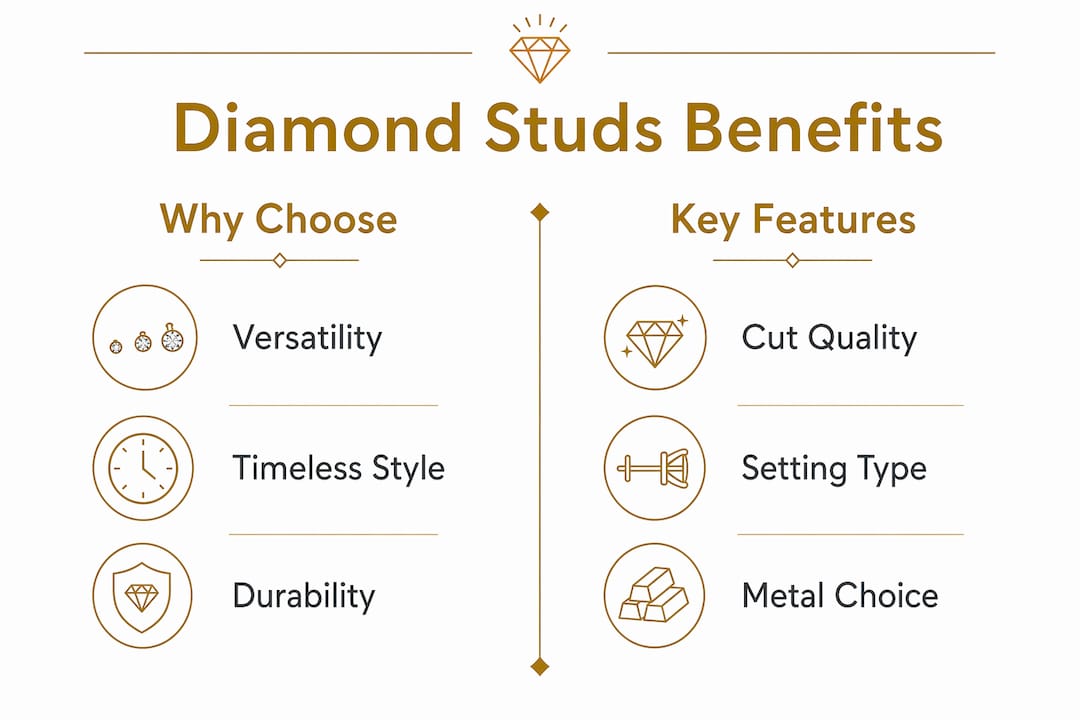
Smaller studs in the 0.25 to 0.5 carat per ear range deliver precise points of light and genuine luxury without bulk, making them ideal for minimalist aesthetics and first-time fine jewelry buyers. The key insight here is that a smaller, well-cut diamond often looks more impressive than a larger stone with a poor cut. Cut quality drives the brilliance you actually see, and brilliance is what makes a stud worth wearing every day.
Pro Tip: Before purchasing, check whether the listing shows TCW or per-ear weight. If the listing only says “1 carat,” ask the seller to confirm the per-ear weight. This one question prevents the most common disappointment in diamond earring purchases.
For a deeper breakdown of how carat weight translates to physical size, the diamond carat weight guide at Usajewels walks through size comparisons with clear visuals.
Why cut, setting, and metal matter more than size
The cut is the single most important quality factor in a diamond stud earring. A well-cut diamond returns light to your eye efficiently, creating the brightness and fire that makes a stud catch attention across a room. A poorly cut diamond of the same carat weight looks dull and flat regardless of its size. Cut drives brilliance and visual performance in every light condition, from office fluorescents to candlelight.
Setting type is the second major variable, and it affects both security and appearance. Here is how the three most common options compare:
| Setting type | Diamond visibility | Security | Best for |
|---|---|---|---|
| Prong (4 or 6 prong) | Maximum, most light enters the stone | Good, but prongs can catch on fabric | Maximizing sparkle and brilliance |
| Bezel | Slightly reduced, metal surrounds the girdle | Excellent, fully enclosed edge | Active lifestyles, sensitive ears |
| Basket | High, open design allows light from below | Very good, deeper seat holds stone firmly | Everyday wear with strong light performance |
Well-constructed settings sit close to the ear, enhancing both security and sparkle. Poorly fitted settings reduce visual appeal and comfort in ways that are hard to fix after purchase. Think of a diamond stud as a small engineering project where every millimeter of prong height and basket depth affects the final result.
Metal choice rounds out the decision. Your three main options each create a different look:
- White gold or palladium reflects a clean, bright tone that makes diamonds appear whiter and more brilliant. Palladium white gold holds its color without heavy rhodium plating, which means less maintenance over time. Metal choice also influences how the diamond’s color grade is perceived against the skin.
- Yellow gold adds warmth and pairs beautifully with lower color grade diamonds, since the warm metal masks any slight yellow tint in the stone.
- Rose gold adds a contemporary, romantic feel and complements warm and olive skin tones particularly well.
For a full breakdown of how different settings affect diamond appearance and durability, the settings guide at Usajewels covers prong, bezel, and basket options in detail.
Practical tips for selecting your first diamond stud earrings
Buying your first pair of diamond studs does not need to be complicated. Follow these steps and you will avoid the most common mistakes:
- Confirm the carat weight format. Always ask whether the listed weight is TCW or per-ear. This single clarification prevents the most frequent source of buyer disappointment.
- Prioritize cut grade over carat size. An Excellent or Ideal cut grade in a smaller stone outperforms a Fair or Good cut in a larger stone. The cut affects apparent size as much as the actual carat weight does.
- Match your setting to your lifestyle. If you are active, cook frequently, or work with your hands, a bezel setting protects the diamond better than an open prong. If you want maximum sparkle for everyday wear, a four-prong or basket setting delivers more light return.
- Consider lab-grown diamonds for budget flexibility. Lab-grown diamond studs offer the same visual quality and hardness as natural diamonds at a significantly lower price point. For a first-time buyer, this means you can access a larger, better-cut stone within the same budget.
- Choose secure backings. Screw-back earring backs are the gold standard for studs. They require a deliberate twist to remove, which means you are far less likely to lose an earring during daily activity.
Pro Tip: When comparing two stones of similar carat weight, ask to see them face-up side by side rather than relying on certification grades alone. Matching diamonds by their actual light performance and tone ensures the pair looks cohesive and balanced when worn together.
You can also explore the diamond shapes guide at Usajewels to understand how round, princess, and cushion cuts differ in their visual impact on stud earrings.
How diamond studs become a foundational investment in your collection
Diamond studs are not just a starting point. They are the piece you return to throughout your life. Their timeless design means they never fall out of fashion, which is something you cannot say about most jewelry trends. The round brilliant solitaire stud has remained the benchmark style for decades and shows no sign of changing.
Their real value as a collection foundation comes from how well they pair with everything else you add over time:
- They sit quietly beside statement necklaces without competing for attention.
- They work with ear cuffs, second-hole studs, and hoops in a curated ear stack.
- They complement engagement rings, tennis bracelets, and layered chains without clashing.
- They adapt through every life stage, from a first job interview to a wedding to a retirement celebration.
Versatility and emotional value combine with durability to deliver lasting appeal that few other jewelry pieces can match. Diamonds score a 10 on the Mohs hardness scale, making them the most scratch-resistant material used in everyday jewelry. With proper care, a well-made pair of diamond studs lasts a lifetime and then some. Viewing them as a personal style investment rather than a one-time purchase changes how you approach the buying decision and how much satisfaction you get from wearing them every day.
Key takeaways
Diamond stud earrings are the best starter jewelry because they combine cut-driven brilliance, universal wearability, and lasting durability in one compact, accessible piece.
| Point | Details |
|---|---|
| Cut quality over carat size | An Excellent cut grade delivers more sparkle than a larger, poorly cut stone. |
| Understand TCW labeling | “1 carat” earrings means 0.5 carat per ear; confirm this before purchasing. |
| Setting affects daily wearability | Bezel settings protect active wearers; prong and basket settings maximize light return. |
| Metal choice shapes appearance | White gold and palladium brighten diamonds; rose gold adds warmth for certain skin tones. |
| Lab-grown diamonds expand access | Lab-grown studs offer identical visual quality at lower prices, ideal for first-time buyers. |
Why I always recommend starting with diamond studs
I have worked with hundreds of customers who were buying fine jewelry for the first time, and the conversation almost always ends in the same place: diamond studs. Not because they are the most dramatic option, but because they are the most reliable one. People wear them constantly. They put them in on Monday morning and forget to take them out until Friday. That is the highest compliment a piece of jewelry can receive.
The misconception I encounter most often is that bigger means better. Customers come in expecting a 1 carat earring to look like a 1 carat ring, and they are surprised when it looks smaller than they imagined. Once I explain the TCW labeling and show them how a well-cut 0.5 carat per ear stone actually performs in light, the disappointment turns into genuine appreciation. A smaller stone with an Excellent cut outshines a larger stone with a mediocre cut every single time.
What I find most rewarding is watching someone put on their first pair of diamond studs and immediately stand a little straighter. There is a quiet confidence that comes from wearing something real, something crafted with care, something that will still look beautiful decades from now. That is the true value of starting your collection here.
— Joseph
Explore diamond stud earrings at Usajewels
Usajewels has been crafting fine diamond jewelry since 1999, and our family-owned, in-house manufacturing model means you get direct pricing without the middleman markup. Whether you are drawn to natural diamonds or prefer the value of lab-grown options, we offer a full range of stud earrings in prong, bezel, and basket settings across white gold, palladium, yellow gold, and rose gold. Every stone is hand-selected, conflict-free, and matched for face-up appearance and light performance. Browse our fine diamond jewelry collection to find the pair that fits your style and budget, and explore our full diamond jewelry collection for even more options across every occasion.
FAQ
What makes diamond studs the best starter jewelry?
Diamond stud earrings are universally flattering, occasion-flexible, and never go out of style. Their minimal design works across casual and formal settings without competing with other accessories, making them the most reliable first fine jewelry purchase.
What does “1 carat” mean on diamond stud earrings?
“1 carat” on earrings refers to the total combined weight of both stones, meaning each earring holds a 0.5 carat diamond. This TCW labeling surprises many first-time buyers who expect a larger stone.
Should I prioritize cut or carat weight in diamond studs?
Cut quality is more important than carat weight. A smaller diamond with an Excellent cut grade returns more light and appears more brilliant than a larger stone with a Fair or Good cut.
Are lab-grown diamond studs a good option for beginners?
Yes. Lab-grown diamonds have the same physical and visual properties as natural diamonds and cost significantly less, giving first-time buyers access to better cut quality and larger sizes within the same budget.
What backing type is best for everyday diamond studs?
Screw-back earring backs are the most secure option for daily wear. They require a deliberate twist to remove, which significantly reduces the risk of losing an earring during normal activity.
Recommended
- Jewelry Collections: Diamond & Gold | USA Jewels
- Earring Guide: Studs, Hoops & Drops | USA Jewels
- Gold Jewelry, Inspired by Beauty | USA Jewels
- Chains | Complete Gold & Platinum Chain Collection | USA Jewels

Frequently Asked Questions
What's the difference between 1 carat and 0.5 carat diamond stud earrings?
Why are round brilliant diamond studs better starter jewelry than other cuts?
Should I choose white gold or palladium for my first diamond studs?
How do I know what carat weight diamond studs will be appropriate for my lifestyle?
Why are diamond studs called the 'little black dress' of fine jewelry?
Fine Jewelry Collection


You May Also Like

Gemstone Color Meaning: Choose Stones That Express You
Double the Original Price? Estimate Your Diamond Trade In Credit