Are Lab-Grown Diamonds Ethical? What to Know Before You Buy
Yes, lab-grown diamonds can be a very ethical choice, and for most buyers they are the simplest way to avoid the conflict and mining concerns that worry people about diamonds. No stone is dug from the ground, so the old blood-diamond risk does not apply to how the diamond is grown. What makes one lab-grown diamond better than another is the honesty of the paperwork and the energy behind it. We are a family-owned jeweler, and we make our own jewelry in-house, so we want you to know exactly what to look for. Our certified, conflict-free lab-grown diamonds start at $142 in our loose diamond collection.
TL;DR
- A lab-grown diamond is grown, not mined, so conventional blood-diamond risk does not apply to the growing process.
- The word “ethical” is a claim, not a certification. Trade guidelines say a blanket claim should be backed by independent verification.
- Energy matters: where and how a diamond is grown changes its carbon footprint a great deal.
- A grading report, a clear description of the growing method and a jeweler who can explain where the stone comes from are the three things to look for.
- Our certified lab-grown diamonds are ethically sourced, and we make your ring in-house with a lifetime diamond upgrade program.
Table of Contents
- What “ethical” means for a diamond
- Conflict: where lab-grown diamonds are strongest
- Labor: ask where the diamond was grown and finished
- The environment: energy is the number that matters
- Why “ethical” on a label is not enough
- How to buy a lab-grown diamond you can feel good about
- Lab-grown or natural: both can be a responsible choice
- A worked example: the couple choosing a ring
- What our family does
- Perspective
- Start with a stone you feel good about
- FAQ
- Sources
What “ethical” means for a diamond
When people ask whether a diamond is ethical, they are usually asking about three things:
- Conflict. Did buying it help fund violence?
- People. Were the workers who mined, cut or polished it treated fairly?
- Planet. How much land, water and energy did it take?
A lab-grown diamond answers the first question cleanly. It is real diamond, carbon in the same crystal structure as a mined stone, grown in a controlled machine instead of dug from the earth. There is no mine, so there is no rough diamond moving through a conflict zone.
The second and third questions depend on the specific stone. That is true of almost every product you buy, and it is why the rest of this article is about how to check, not just how to hope.
Conflict: where lab-grown diamonds are strongest
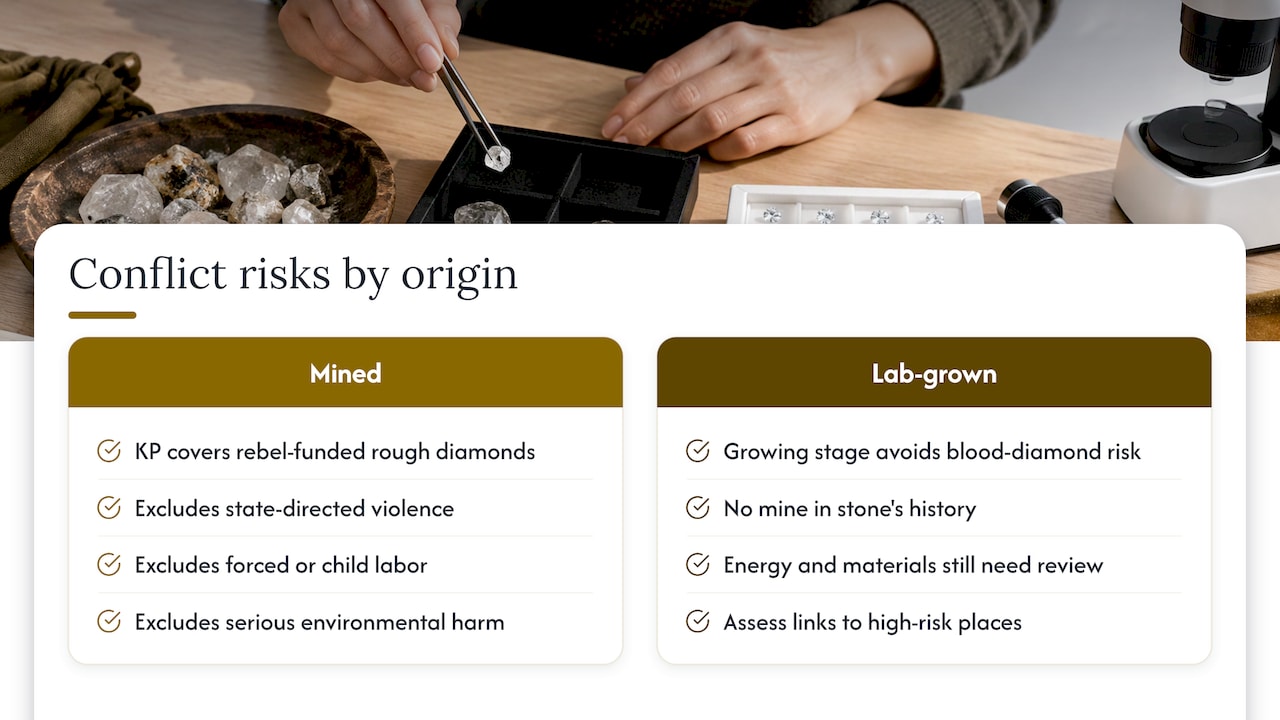
The term “conflict diamond” has a narrow official meaning. The Kimberley Process, the international certification scheme for rough diamonds, defines it as rough diamonds that finance rebel movements against recognized governments. It does not cover state-directed violence, forced or child labor, or serious environmental harm. That is why a jeweler’s “conflict-free” label can mean less than buyers assume with mined stones.
With a lab-grown diamond, that whole concern falls away at the growing stage. The Association for Intelligent Diamond Integrity (AIDI), a professional body, states that conventional blood-diamond risk does not apply to growing a diamond in a lab. It adds that a careful assessment still looks at whether the energy or upstream materials involved connect to high-risk places.
For couples choosing an engagement ring, this is often the deciding point. You can give a stone with no mine in its history.
Labor: ask where the diamond was grown and finished
Not mining does not automatically mean every worker in the chain is well treated. Growing, cutting and polishing are still done by people in factories. Trade coverage has pointed out that the assumption that lab-grown production happens mostly in North America is mistaken: many growers are in India and China. Proposals for sustainability standards in that coverage include audits of factories and cutters that look at wages, working conditions and collective bargaining.
That sounds technical, but the practical question is simple: does the jeweler know where the stone was grown and cut, and will it tell you?
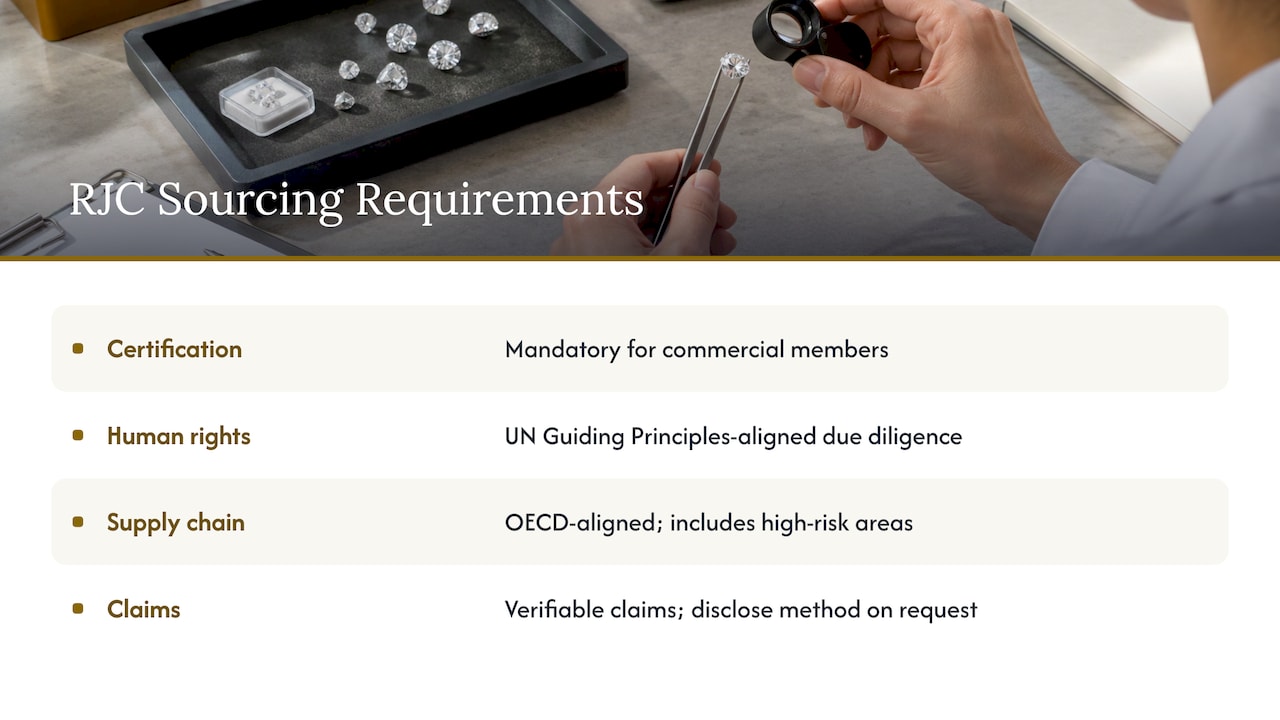
There is also a formal standard in this area. The Responsible Jewellery Council’s Laboratory Grown Material Standard makes certification mandatory for its commercial members handling lab-grown material. It requires human-rights due diligence aligned with the UN Guiding Principles and supply-chain due diligence aligned with OECD guidance, including for conflict-affected and high-risk areas. It also requires members to make no misleading representations, to keep claims verifiable, and to disclose the growing method to customers on request.
A jeweler that talks plainly about sourcing, growing method and certification is doing what these standards describe.
The environment: energy is the number that matters
Growing a diamond takes a lot of electricity. Two methods are used: high pressure, high temperature (HPHT) and chemical vapor deposition (CVD). Which method and, more importantly, which power grid sit behind the stone decide its footprint.
The published ranges are wide:
- Data from the sustainability firm Sphera, cited in Rapaport, shows a CVD stone made with renewable energy can generate as little as 17 kg of CO2e per polished carat, while one from a coal-heavy grid in India can reach 260 kg.
- National Geographic reports a researcher’s calculation that mined diamonds average 350 pounds of CO2 per carat, while lab-grown diamonds in the EU or China can use about 45 pounds, and that renewable-powered or offset labs can go lower still.
- In the US, AP reported that one foundry in Wenatchee, Washington runs on hydropower, and that its CEO says it uses about one-tenth the energy of mining. The same article notes that many large producers are in India, where about 75% of electricity comes from coal.
The takeaway for you: a lab-grown diamond powered by clean electricity sits at the very low end of every comparison, and the cleaner the power, the better. AIDI’s November 2026 commentary puts the principle well: a lab-grown diamond earns its sustainable standing through evidence about its energy mix, carbon, labor and provenance, not simply from the absence of a mine. For a deeper look, see our own guide, Lab Diamond Sustainability: What the Evidence Shows.
Why “ethical” on a label is not enough
You will see “ethical,” “green” and “sustainable” printed on a lot of lab-grown diamond marketing. The International Confederation of Jewellery, Silverware, Diamonds, Pearls and Stones (CIBJO) addresses this directly in its 2024 guidelines: marketers should not make blanket claims of that kind unless they are substantiated and verified by a credible, independent third party. Carbon-neutral claims should say whether they come from the operation itself or from carbon credits.
That is useful guidance for any buyer. Read the claim, then look for what stands behind it.
How to buy a lab-grown diamond you can feel good about
Here is the routine we would follow ourselves.
1. Look for a grading report from a recognized lab
A grading report names the stone as lab-grown, and it records the cut, color, clarity and carat weight. Lab-grown and mined diamonds are the same carbon, but they can be told apart by laser analysis of the atomic structure, which is why a report from an independent lab matters. Our diamond certification guide compares GIA, AGS and IGI so you know what each report tells you.
2. Know the growing method
HPHT or CVD, it should be stated plainly. Our guide to how synthetic diamonds are created walks through both in simple terms.
3. Choose a jeweler that explains sourcing in plain language
A jeweler should be able to say how its stones are sourced and what “conflict-free” means in its own practice. Our article on choosing a certified ethical diamond jeweler lists what good answers sound like.
4. Treat sustainability claims as specific, not general
A statement that names the energy source or the facility carries more weight than a general promise. It is the same logic CIBJO applies to claims: specific, verifiable, independent.
5. Think about the long term
An ethical purchase is also one you keep. Solid construction, not hollow or plated, means a piece that lasts and can be passed on. Our lifetime diamond upgrade program is built for the day you want to move up to a larger stone.
Lab-grown or natural: both can be a responsible choice
Some buyers ask whether choosing lab-grown takes something away from communities that depend on mining. It is a fair question and one reason people value traceability. Mined diamonds can be traced and responsibly sourced, and we also offer certified natural diamonds that are ethically sourced. The choice comes down to what matters most to you: no mine at all, or a natural stone with a documented history.
If conflict-free is your top priority, lab-grown is the most direct path. Our Conflict-Free Diamond vs Lab Grown buyer’s guide and our Lab-Grown vs Natural Diamonds guide lay out both sides, and our piece on how lab-grown diamonds are ethically produced covers the process from start to finish.
A worked example: the couple choosing a ring
Say you are designing an engagement ring and ethics is on your list alongside budget. A sensible order looks like this:
- Decide what ethical means to you. No mining? Low energy use? A documented chain of custody? Write it down, because it sets the stone you choose.
- Pick the stone. Choose lab-grown or natural, then the shape and quality. Our diamond shapes guide helps you compare.
- Choose the metal. Gold or platinum, in a solid, not hollow or plated, setting.
- Confirm the report. The grading report goes with the stone.
- Design the setting. With Design Your Own Diamond Ring, you pick the diamond shape, quality and metal. Our step-by-step design guide walks you through it.
Lab-grown stones also tend to cost less than mined stones of similar size and quality, which lets many couples choose a bigger or higher-quality diamond. Our 2026 price guide explains why. For more on making the full ring ethical, see three paths to an ethical engagement ring.
What our family does
We are a family-owned jeweler, and we have been at this since 1999. We manufacture in-house, which means direct pricing with no middlemen. Our certified loose diamonds, natural and lab-grown, are ethically sourced, and every order comes with free insured shipping and a 30-day money-back guarantee. More than 222 Google reviews come from customers who have worked with us.
Perspective
We started USA Jewels as a family business, and the question we hear most from couples is some version of this one: can I buy a diamond and feel good about where it came from?
Our answer is yes, and we think lab-grown diamonds are one of the clearest ways to do it. There is no mine behind the stone, so the worry about conflict is gone. What remains is a short list of questions every buyer deserves to have answered: what is it, how was it grown, who graded it, and who stands behind it.
That is why we make our own jewelry in-house and sell direct. When the person who builds your ring is the same person who sources your diamond, there are fewer hands between you and the facts. Add a certified report, a solid setting and a lifetime diamond upgrade, and you have a ring built to be kept and passed on, not just bought.
If you are designing something for an engagement, an anniversary or a child’s milestone, start with the stone you feel best about. We will build around it.
Joseph
Start with a stone you feel good about
When you are ready, our certified loose diamonds start at $142, and Design Your Own Diamond Ring starts at $399 on our design page. If you would rather begin with a finished setting, our engagement rings start at $346.
Gifts for children and first jewelry purchases work the same way: our sterling silver jewelry starts at $46, and our fine jewelry collections start at $176.
FAQ
Are lab-grown diamonds conflict-free?
Yes. A lab-grown diamond is not mined, so the blood-diamond risk linked to rough diamonds does not apply to how it is grown. Professional bodies such as AIDI state this directly. The remaining things to confirm are the grading report and the jeweler’s sourcing information.
Are ethical lab-grown diamonds also good for the environment?
They can be, and the energy source is the deciding factor. Published figures range from 17 kg of CO2e per carat with renewable power to 260 kg on a coal-heavy grid. Choosing a jeweler that is open about sourcing helps you pick well.
Is a lab-grown diamond a real diamond?
Yes. It is carbon in the same crystal structure as a mined diamond. Independent labs can tell the two apart with specialized equipment, which is why the grading report states which one you have. Our guide to lab-created diamonds explains the process and value.
Is a lab-grown diamond a good choice for a first fine-jewelry purchase?
Many first-time buyers choose them because they offer a clear sourcing story and a lower price for the same size and quality. Our overview, Are Lab-Grown Diamonds Worth It?, covers what to weigh.
Sources
- CIBJO, The Laboratory-Grown Diamond Guidelines (2024)
- AIDI, Blood Diamond glossary entry
- AIDI, Natural or Lab-Grown, Sustainable Is Decided by Evidence, Not Origin
- Responsible Jewellery Council, Laboratory Grown Material Standard (2025)
- JCK, Can Lab-Grown Diamonds Ever Really Be Sustainable?
- Rapaport, A Pair of Carbon Footprints
- National Geographic, Are synthetic diamonds really better for the planet?
- AP News, Lab-grown diamonds come with sparkling price tags
Recommended
- How Lab-Grown Diamonds Are Ethically Produced
- Lab-Grown vs Natural Diamonds Guide
- Lab Diamond Sustainability: What the Evidence Shows
- Conflict-Free Diamond vs Lab Grown: Buyer’s Guide

Deep Mehta is the Co-Owner of USA Jewels, a family-owned jewelry business she has led since 2013 in Deerfield Beach, Florida. With over 13 years of hands-on experience in fine jewelry retail, manufacturing, and diamond importing, Deep specializes in engagement rings, wedding bands, and custom jewelry design. She also co-manages Kaash Group Talent Acquisition. Deep is a University of Florida graduate and oversees every aspect of USA Jewels’ operations, from product development to marketing.
Fine Jewelry Collection

You May Also Like
Trellis vs Basket Setting: How to Choose Your Ring
How to Personalize Engraving on an Engagement Ring