Verify GIA Reports in 2 Minutes: How to Read a GIA Report
A GIA report is an independent laboratory record of a diamond’s 4Cs, exact measurements, a plotted clarity map, and finish details like polish and symmetry. Before you trust one, run three checks: confirm the report number and date, verify it through GIA Report Check or the QR code, and match the plotted clarity and measurements against the stone’s photos or laser inscription. Do that, and you can compare diamonds on real data instead of a salesperson’s pitch.
TL;DR:
- Verify the report number and date through GIA Report Check or the QR code to confirm the diamond’s details match the official database.
- Ensure measurements, including diameter and depth, are consistent and precise, as wider ranges may indicate less careful cutting or weight hiding.
- Pay close attention to the plotted diagram and comments for internal or surface inclusions, treatments, or unusual features that could affect value or durability.
- Compare the measurements and proportions rather than just the carat and grade, especially for cut quality, to avoid overpaying for superficial differences.
- Check for a microscopic laser inscription matching the report number and review security features like holograms and microprinting before trusting any online claim.
Table of Contents
- How to Read a GIA Report: Where Each Detail Lives
- How to Interpret Each of the 4Cs on the GIA Report
- What Do Polish, Symmetry, and Fluorescence Mean?
- How Do You Verify a GIA Report Is Authentic?
- How to Compare Value Without Overpaying
- Buyer Checklist: Questions to Ask Before You Purchase
- USA Jewels’ Two-Minute Inscription Check
- Decoding the Inscriptions and Symbols on a GIA Report
- What the Comments Section on a GIA Report Really Tells You
- Laboratory Reports vs. Online Listings: Which One Can You Trust?
- The Order That Makes a GIA Report Easy to Read
- Why Verification Isn’t Optional Anymore
- Shop Certified Diamonds With Verification Built In
- Sources
- FAQ
How to Read a GIA Report: Where Each Detail Lives
Every GIA report follows the same layout, so once you know where to look, you can scan one in under two minutes. The report number and issue date sit near the top. Check these first, because that number is what you’ll punch into GIA’s verification database later.
Measurements appear just below, usually written as a range followed by depth, like “6.42 to 6.48 x 4.01 mm.” That first pair is the diameter measured at multiple points around the girdle; the third number is total depth. A round stone with a very consistent range is cut more precisely than one with a wider spread, which can make it face up smaller than its carat weight suggests.
The report includes several distinct sections:
- Grading results: carat weight, color grade, clarity grade, and cut grade (for round brilliants) listed together near the top.
- Proportions: depth percentage, table percentage, girdle thickness, culet size, and finish grades.
- Clarity characteristics: a text list of what inclusions were found and where.
- Plotted diagram: a visual map of the stone showing the approximate location of internal and surface characteristics.
- Comments: a free-text field for anything notable that doesn’t fit elsewhere.
Not every GIA document includes all of this. GIA issues full Diamond Grading Reports for loose natural diamonds weighing 0.15 carats or more, and reports below certain size or color thresholds, like the Diamond Dossier or eReport, skip the plotted diagram entirely and may not include a cut grade. If a listing shows a Dossier number instead of a full grading report, don’t expect to see an inclusion map. That’s normal for smaller stones, not a red flag.
How to Interpret Each of the 4Cs on the GIA Report
The 4Cs aren’t opinions. Each one comes from a specific, repeatable lab procedure, and knowing how the number was produced tells you how much weight to give it.
- Carat. GIA records weight to the nearest hundredth of a carat, so a stone listed at 1.02 ct and one at 0.98 ct are functionally the same size to the eye. What matters more than the number alone is spread, meaning the diameter relative to weight. A diamond cut deep to preserve carat weight can look noticeably smaller face-up than a well-proportioned stone of the same weight. Check the millimeter measurements against typical diameters for that carat weight before assuming bigger numbers mean a bigger-looking stone.
- Color. GIA grades on the D-to-Z scale, with D being colorless and Z carrying visible warm tint. The catch: color differences of one or two letters are often invisible once a diamond is set, especially in yellow or rose gold, which masks faint tint anyway. A G or H color stone in a white gold or platinum halo can look just as bright as an E or F, at a meaningfully lower price. Our diamond color chart walks through what each range actually looks like face-up.
- Clarity. Graders examine the stone under 10x magnification and assign a grade from Flawless down through Included. The number on the report tells you how much a trained eye sees under magnification, not what you’ll see wearing the ring at dinner. Many inclusions in the VS and even SI range are invisible to the naked eye, which is why “eye-clean” matters more than the letter grade itself for most buyers. Our clarity chart breaks down which grades tend to stay eye-clean and which ones are a gamble.
- Cut. For round brilliants, GIA assigns an overall cut grade from Excellent to Poor, which summarizes proportions, symmetry, and polish into one number that closely predicts brightness and fire. For fancy shapes like ovals, pears, or cushions, GIA does not currently issue an overall cut grade, so you’ll need to read the proportions and study face-up photos or video instead.
Pro Tip: If you’re choosing between two rounds with the same clarity and color but different cut grades, pick the higher cut grade every time. Cut affects visible sparkle more than any other single factor, and a Very Good or Excellent cut on a smaller stone often outshines a poorly cut larger one.
Read our full 4Cs breakdown if you want the mechanics behind each grade explained further.
What Do Polish, Symmetry, and Fluorescence Mean?
Beyond the 4Cs, a few smaller fields quietly affect how a diamond performs and what it’s worth.
- Polish and symmetry are graded Excellent to Poor and describe the smoothness of facets and how precisely they align. Weak polish can dull brightness; poor symmetry can cause light to leak instead of reflect back. These differences are often subtle enough that untrained buyers miss them without comparing photos side by side.
- Fluorescence describes how a diamond glows under ultraviolet light. Faint fluorescence rarely changes appearance, and in lower color grades it can occasionally make a stone look slightly whiter. Strong fluorescence, though, can create a hazy or oily look in bright, UV-rich daylight. Ask for a video in direct sunlight if a report lists strong fluorescence.
- Treatments get flagged in the report header or comments, often with an asterisk next to a measurement. Any note about laser drilling, fracture filling, or HPHT treatment must appear on the report by GIA policy, so read that fine print before you assume “natural” means “untreated.”
- The plotted diagram uses colored symbols (red for internal inclusions, green for surface features) placed roughly where each characteristic sits in the stone. Up to four clarity characteristics are typically plotted. Inclusions near the girdle edge or hidden under a prong matter less than ones sitting under the table, where they’re easiest to spot.
How Do You Verify a GIA Report Is Authentic?
A report number alone proves nothing until you check it against GIA’s own database. Here’s the sequence that actually confirms a match.
- Inspect the physical security features. Genuine GIA reports carry microprinting, a security screen pattern, a watermark, and a hologram, along with a printed QR code or barcode.
- Run GIA Report Check. Enter the report number on GIA’s official verification tool or scan the printed QR code directly. A legitimate report returns the exact carat weight, color, clarity, and shape listed on the paper in your hand.
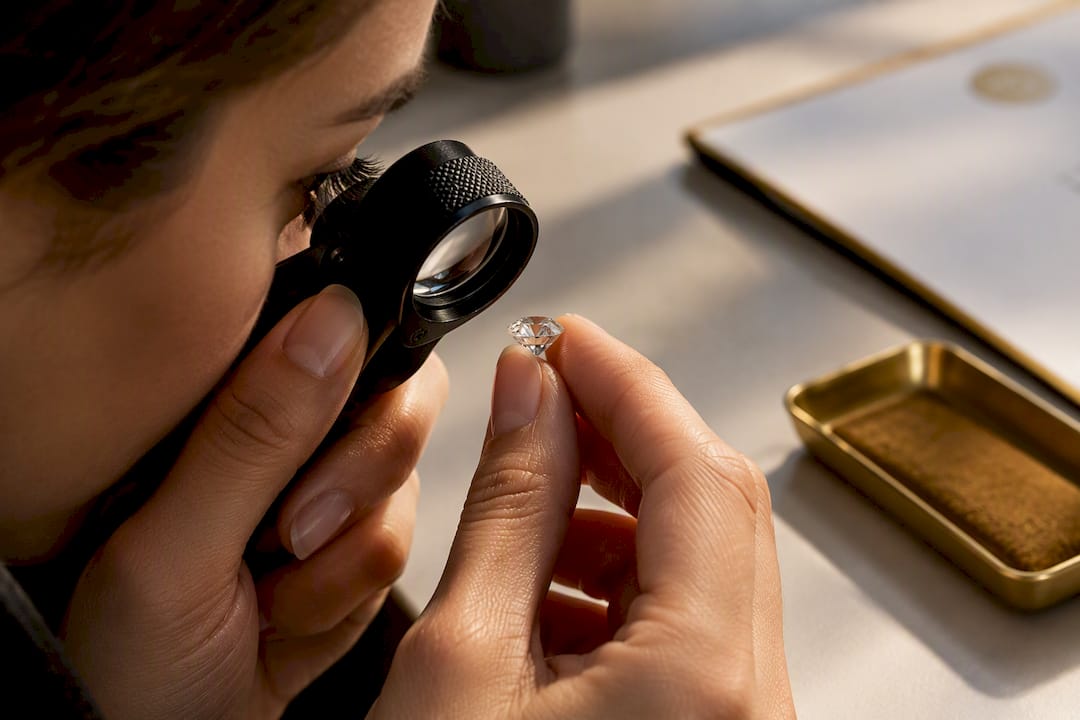
- Confirm the laser inscription. Most GIA-graded diamonds carry a microscopic inscription on the girdle matching the report number. Ask the seller for a magnified photo, or check it yourself with a 10x loupe.
If the report number returns no match, returns different specs than what’s printed, or the seller can’t produce a laser inscription photo on request, treat that as a serious red flag and walk away or demand independent verification before paying.
Pro Tip: Photograph the report and the loose stone together before you leave a showroom or before a mailed stone leaves your sight. If a dispute ever comes up, having that pairing documented protects you.
How to Compare Value Without Overpaying
Price generally follows a hierarchy: carat weight moves the price most, cut and face-up appearance come next, and color and clarity trail behind, especially once a stone is eye-clean and well-cut. Chasing the highest letter grade on paper often means paying a premium for a difference no one will ever see.
Small grade gaps are usually safe to accept. Moving from G to H color, or from VS2 to SI1 clarity, rarely changes appearance in a mounted ring, particularly under warm metal or a busy setting like a halo. Where you shouldn’t compromise is cut grade on round stones. A diamond with weak proportions can look glassy and lifeless regardless of how good its color and clarity numbers look on paper.
A few decision rules make comparing listings faster:
- If two stones share cut, color, and clarity but differ in price, check the measurements. Depth outside an ideal range on a round often means the diamond is hiding weight instead of maximizing spread.
- If clarity is SI1 or better, ask for the plotted diagram before worrying about the grade. Inclusions plotted near the girdle rarely show; inclusions under the table might.
- If color is G or H and the setting is white gold or platinum, don’t pay extra to move up to E or F. The visible difference is minimal in most lighting.
Buyer Checklist: Questions to Ask Before You Purchase
Before wiring money or swiping a card, run through this list:
- Ask the seller for the GIA report number and run it yourself through Report Check rather than trusting a screenshot.
- Request a magnified photo of the laser inscription on the girdle.
- Request loupe or microscope photos of the actual stone, not stock imagery.
- Compare the printed measurements against what’s shown in photos or video.
- Review the plotted diagram and ask where the listed inclusions actually sit.
- Ask directly whether the stone has been treated, and get the answer in writing.
If a seller hesitates on any of these, hedges the answer, or can’t produce a laser inscription photo, that hesitation is itself the red flag. A stone with nothing to hide has documentation that’s easy to produce.
USA Jewels’ Two-Minute Inscription Check
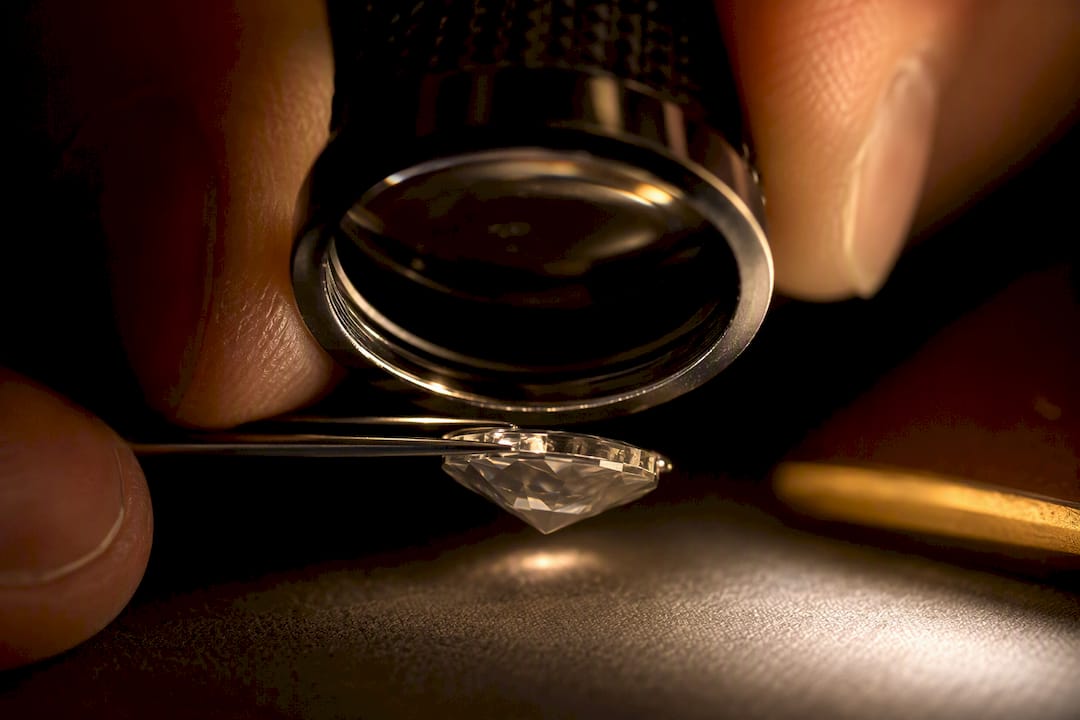
Here’s how we verify a laser inscription ourselves: place the stone table-down under a 10x loupe with the girdle facing up, rotate slowly under strong light, and look for the tiny etched report number, often just 0.5mm tall. Ask any seller for a top-down photo, a side profile with a scale reference, and a close-up of the girdle inscription. Those three images tell you almost everything a loupe would. For more on certification basics, see our guide on GIA certification.
Decoding the Inscriptions and Symbols on a GIA Report
The plotted diagram uses a shorthand key rather than plain English, and it trips up more buyers than any other part of the report. Red markings almost always indicate internal characteristics, things like feathers, crystals, or clouds sitting inside the stone. Green markings typically indicate surface features such as naturals, extra facets, or surface graining.
Each symbol has a name spelled out in the report’s key-to-symbols legend, usually printed along the bottom or side of the plot. Common symbols include a small circle for a pinpoint, a jagged line for a feather, and a cluster of dots for a cloud. The size and position of the symbol on the diagram roughly (not exactly) mirrors where that feature sits inside the real stone.
The girdle also carries its own set of abbreviations. You’ll often see terms like “STK” for sticky sizes, “brilliant cut,” or thickness ranges from “extremely thin” to “extremely thick” describing the diamond’s outer edge. Culet size, when present, ranges from “none” to “very large” and affects whether a small opening appears at the bottom of the stone.
None of this shorthand is meant to obscure information. It’s simply a standardized system GIA uses across millions of reports, so a Diamond Grading Report issued in Antwerp reads identically to one issued in New York. Once you recognize a handful of symbols, the whole plot becomes readable in seconds rather than a wall of unfamiliar marks.
What the Comments Section on a GIA Report Really Tells You
The comments field sits near the bottom of the report, and it’s easy to skip past, but it often carries the most consequential information on the page. GIA uses this space to note anything that doesn’t fit neatly into the standard grading fields above it.
Typical comments mention things like “indented natural present,” “clouds are not shown,” or a note that a specific inclusion is only visible from a certain angle. Some comments describe treatments, such as evidence of laser drilling or HPHT processing, which must be disclosed if detected. Others simply clarify how a clarity characteristic should be interpreted, since the plotted diagram can’t always capture texture or extent precisely.
Never treat an empty comments field as more trustworthy than one with a note in it. An empty field usually just means nothing unusual came up during grading, while a filled field often reflects GIA’s own thoroughness rather than a flaw serious enough to worry about. What matters is reading whatever is written there before you buy, since it can affect both appearance and long-term durability. If a comment mentions a treatment or an unusual internal feature, ask the seller directly how it affects the price relative to a similar untreated stone.
Laboratory Reports vs. Online Listings: Which One Can You Trust?
A “GIA report” printed on paper and a report number typed into an online listing are not automatically the same level of proof. The physical laboratory-issued document carries the security features described earlier, microprinting, holograms, and a scannable QR code, all of which exist specifically so a report can’t be easily forged or altered.
An online listing, by contrast, is just a claim until you verify it. A seller can type any combination of numbers and grades into a product page. That’s precisely why GIA Report Check exists: typing the report number directly into GIA’s own database pulls the actual grading results straight from GIA’s records, independent of whatever the seller has written.
Treat every online listing the same way regardless of how reputable the retailer appears. Copy the report number exactly as printed, run it through GIA Report Check yourself, and compare every field, shape, measurements, carat, color, and clarity, against what’s listed for sale. A mismatch on even one field, like a listing claiming VS1 clarity when GIA’s database shows VS2, is enough reason to contact the seller for an explanation before paying.
The Order That Makes a GIA Report Easy to Read
Reading a GIA report in the sequence it’s printed wastes time, because the layout groups fields by category, not by what a buyer actually needs first. Follow this order instead:
- Report number and date, so you can verify authenticity before evaluating anything else.
- Shape and measurements, to understand the stone’s actual dimensions and spread.
- Carat, color, clarity, and cut, the core value drivers, read together rather than in isolation.
- Proportions and finish (depth, table, polish, symmetry), to judge likely brightness.
- Plotted diagram and clarity characteristics, to see exactly what’s inside and where.
- Comments and treatment notes, to catch anything that changes the picture.
- Security features and laser inscription, as your final authenticity check before purchase.
This order mirrors how a trained appraiser actually works through a stone: confirm it’s real, understand its size and shape, judge its core quality, then dig into finish and disclosure details. Skipping straight to the grades without verifying the report number first is how buyers end up trusting a document that was never checked against GIA’s own records.
Why Verification Isn’t Optional Anymore
Reading the grades is only half the job. A report you haven’t verified is just a piece of paper with someone else’s word attached to it, and the five minutes it takes to run Report Check and check a laser inscription is cheap insurance against a five-figure mistake. Buyers who skip that step aren’t being careless so much as trusting a system they’ve never been shown how to check.
— Joseph
Shop Certified Diamonds With Verification Built In
If reading through security features and running database checks sounds like more work than you want to do alone, some jewelers handle that verification alongside every stone they sell, selecting certified natural and lab-grown diamonds, confirming GIA documentation, and offering lifetime diamond upgrade programs.

Browse our certified loose diamonds to see verified GIA specs listed alongside real photos of each stone, not stock imagery. If you’d rather build a ring around a stone you’ve chosen, our engagement ring designs let you pair a certified diamond with the setting that fits your style, without ever wondering whether the paperwork matches the stone in your hand.
Sources
Confirm any report directly through GIA Report Check, review GIA’s official report guide, and check current proportion standards before comparing stones.
- How to read a GIA report (GIA: analysis and grading sample report)
- International Gem Society: diamond advice
FAQ
Can a Jeweler Fake a GIA Report?
A report itself can be altered or a fake number can be printed on a counterfeit document, which is exactly why GIA built security features like holograms, microprinting, and QR codes into every real report. Always run the report number through GIA Report Check yourself rather than trusting the printed paper alone.
What Is the Best-to-Worst Diamond Color Chart?
GIA’s scale runs from D, completely colorless, down to Z, with noticeable yellow or brown tint, and grades are grouped into ranges like colorless (D to F), near colorless (G to J), and faint color (K to M). Our diamond color chart shows what each range looks like set in different metals.
Is G or H a Better Diamond Color?
G sits one grade above H on GIA’s scale, but the two are nearly impossible to distinguish with the naked eye once a diamond is mounted, especially in white gold or platinum. Most buyers save money by choosing H color without sacrificing any visible brightness or whiteness.
How Do I Tell What Carat My Diamond Is?
The carat weight is printed directly on the GIA report, recorded to the nearest hundredth of a carat during grading. If you don’t have the report, a jeweler can weigh a loose stone on a certified gem scale or estimate weight from millimeter measurements if the diamond is already set.
Recommended
- Buyers: Verify a GIA Laser Inscription in Two Minutes with a 10x Loupe
- GIA Certification Diamonds: What Buyers Need to Know
- Diamond Clarity Chart — FL to I3 Grades Explained
- Jewelry Certification Types Guide: What U.S. Buyers Need

Deep Mehta is the Co-Owner of USA Jewels, a family-owned jewelry business she has led since 2013 in Deerfield Beach, Florida. With over 13 years of hands-on experience in fine jewelry retail, manufacturing, and diamond importing, Deep specializes in engagement rings, wedding bands, and custom jewelry design. She also co-manages Kaash Group Talent Acquisition. Deep is a University of Florida graduate and oversees every aspect of USA Jewels’ operations, from product development to marketing.
Fine Jewelry Collection

You May Also Like

Best Gemstone Alternatives to Diamonds for Rings
5 Bench Steps Every Buyer Should Check for a Flush Setting Ring