Eye Clean Diamonds: How to Get a Flawless Look
An eye-clean diamond shows no inclusions to your unaided eye when you view it face-up, from about 6 to 12 inches away, in normal daylight or retail lighting. That is the whole standard. It has nothing to do with what a jeweler sees under a microscope.
Here’s the one rule to shop by: for most brilliant cuts under about 2 carats, aim for VS2 clarity, or VS1 if you want extra breathing room. Step cuts like emerald or asscher need a grade or two higher, since their open facets show flaws more readily. That gap between lab language and real life is exactly where smart buyers save money.
Key Takeaways
Eye clean means no inclusions visible to the naked eye at 6 to 12 inches in normal lighting, and VS2 delivers that look for most brilliant cuts without the price premium of higher grades.
| Point | Details |
|---|---|
| Know the real standard | Eye clean means no visible inclusions face-up at 6 to 12 inches under daylight-equivalent lighting. |
| Start at VS2 | VS2 is typically eye clean for brilliant cuts under 2 carats; step cuts need VS1 or higher. |
| Vet SI grades individually | SI1 and SI2 can be eye clean, but always check the clarity plot and video before buying. |
| Clean before you judge | Oil and film can mimic cloudiness, so clean a diamond before assuming it has a flaw. |
| Buy from a transparent seller | Usajewels provides certified stones with 360 degree video and in-house inspection to confirm eye-clean claims. |
Table of Contents
- What Does “Eye Clean” Actually Mean?
- Which Clarity Grades Are Usually Eye Clean?
- How Do You Check If an Online Diamond Is Eye Clean?
- What Kinds of Inclusions Show Up in a Diamond?
- How Should You Balance Cut, Color, and Clarity for the Best Value?
- What Should You Check in Person and Ask the Seller?
- What Are the Best Tips for Using a Loupe or Magnifier at Home?
- What Common Mistakes Do Buyers Make About Clarity?
- Sources
- FAQ
What Does “Eye Clean” Actually Mean?
“Eye clean” is trade shorthand, not a grade you’ll find printed on a certificate. The GIA grades every diamond’s clarity under 10x magnification, a loupe standard used to catalog inclusions with scientific consistency. But your eye isn’t a loupe. It sees the stone face-up, at arm’s length, under whatever light happens to be in the room, and that’s a far more forgiving test than the one graders use.
The practical definition shoppers should hold onto: a diamond is eye clean when, viewed face-up at 6 to 12 inches under daylight-equivalent lighting, no inclusion or blemish catches your attention.
A few things worth knowing about how this term actually works in practice:
- It is not an official grade from GIA or the American Gem Society (AGS). Two retailers can look at the same stone and describe it differently.
- Viewing conditions matter more than people expect. A diamond that reads clean under a store’s diffused lighting might show a pinpoint under harsh fluorescent light.
- Eye clean is a threshold, not a certificate of perfection. It only promises invisibility to the naked eye, nothing about what a loupe reveals.
That subjectivity is exactly why relying on grade alone, without inspecting the actual stone, is a gamble.
Which Clarity Grades Are Usually Eye Clean?
Clarity grades give you a starting point, not a guarantee. VS2 is the grade most industry guides point to as the sweet spot for brilliant cuts under roughly 2 carats: clean enough to disappear to the naked eye, without paying the VVS or flawless premium for invisibility nobody will ever notice.
Shape changes the math considerably. Round, cushion, and oval brilliants scatter light aggressively, and that sparkle does double duty by camouflaging small inclusions. Step cuts work the opposite way. Their long, open facets act like clear glass, so an emerald or asscher cut needs VS1 or better to reliably hide what’s inside.
Carat weight shifts the target too. A bigger diamond means bigger facets and more surface area for your eye to scan, so inclusions that were invisible at 0.75 carats can become noticeable at 2.5 carats. A rough guide:
- Under 1.0 carat: VS2 is typically safe for brilliant cuts.
- 1.5 to 2.0 carats: step up to VS1 for peace of mind.
- Above 2.0 carats, or any step cut: favor VS1 or higher regardless of shape.
Pro Tip: Don’t rule out SI1 or even SI2. Some SI1 stones are eye clean because their inclusions are small, few, and tucked near the edge where the setting hides them. The catch is you can’t tell from the grade alone; you have to look at that specific stone.
How Do You Check If an Online Diamond Is Eye Clean?
Shopping for a loose diamond on a screen removes the one advantage you’d have in a showroom: your own eyes. You can still verify eye cleanliness remotely if you know what to demand from the seller.
- Request a 360 degree video of the stone, not just static photos. Video reveals inclusions that shift and catch light as the diamond turns.
- Ask for face-up photos taken at consistent scale and magnification, so you’re not comparing a zoomed-in macro shot to your naked-eye reality.
- Pull up the certificate’s clarity plot. It maps exactly where each inclusion sits, which tells you whether flaws cluster near the center (visible) or hide under the setting (irrelevant).
- Get written confirmation from the seller that the specific stone, not just its grade, has been reviewed for eye cleanliness.
Watch for these red flags before you commit:
- No close-up photo or video available, only a stock image of the shape.
- A vague or restrictive return and upgrade policy.
- Inclusion descriptions in the listing that don’t match what you can see in the provided images.
- Product photography under strange lighting that seems designed to obscure detail rather than reveal it.
A retailer willing to show you the GIA or AGS report alongside real photography has nothing to hide. That transparency is worth more than a marginally better price from a seller who won’t show you the stone.
What Kinds of Inclusions Show Up in a Diamond?
Not all inclusions are created equal, and understanding the difference is what separates a confident buyer from someone gambling on a grade number. Here’s what typically shows up on a clarity report:
- Pinpoints: tiny mineral crystals, often invisible even under magnification unless clustered.
- Crystals or carbon spots: small mineral deposits that can appear as dark or white dots depending on their composition.
- Clouds: hazy clusters of pinpoints that can slightly soften brilliance if dense enough.
- Feathers: small internal fractures, usually harmless but worth scrutinizing if large or reaching the surface.
- Needles: thin, elongated crystal inclusions, generally low-visibility unless numerous.
Dark, opaque crystals and large feathers near the diamond’s table are the inclusions most likely to catch your eye. Tiny pinpoint clusters tucked near the girdle are the ones you’ll never notice. There’s also a durability angle here worth taking seriously: a feather that reaches the diamond’s surface, especially near an edge or point, can pose a chipping risk under everyday wear, which matters far more for a ring worn daily than for a pendant.
How Should You Balance Cut, Color, and Clarity for the Best Value?
Cut comes first. It’s the single biggest driver of how a diamond looks in person, controlling the fire and brilliance that make a stone appear alive rather than glassy. Only after you’ve locked in strong cut quality should you start negotiating carat, color, and clarity against your budget.
Here’s where the real savings live. Moving from VS1 to VS2 on a brilliant cut often costs you nothing in visible quality, since both grades typically read as eye clean, but it can free up meaningful budget toward a larger stone or a better color grade. Stepping from VS2 down to a well-chosen SI1 can save even more, provided you inspect that individual stone’s clarity plot rather than buying on grade alone.
There are situations where cutting clarity corners is a mistake: step cuts, any diamond above roughly 2 carats, and stones with dark or centrally located inclusions all warrant staying at VS1 or better. The interplay between color and clarity also matters, since a warmer color grade can sometimes mask minor inclusions, giving you more flexibility on both fronts at once.
Pro Tip: If you only remember one number from this article, make it VS2. For the majority of brilliant cut shoppers, it delivers the best appearance-to-price ratio on the entire clarity scale.
What Should You Check in Person and Ask the Seller?
Seeing a diamond in a showroom gives you information no photo can replicate. Rotate the stone slowly under different light sources, then step back to the standard 6 to 12 inch face-up distance in daylight or daylight-equivalent lighting. If you’re evaluating a finished ring, look at the diamond both loose and mounted, since prongs and settings can hide or reveal inclusions differently than a bare stone.
Before you buy, ask the seller directly:
- Can I see the GIA or AGS certificate for this exact stone?
- Do you have a clarity plot showing where the inclusions sit?
- Can I get loupe images or a magnified video, not just face-up photos?
- What’s your return and upgrade policy if I’m not satisfied once I get it home?
Compare everything you see against the certificate and the original listing. If something looks different in person than it did online, that’s your signal to ask more questions before finalizing.
Why Trust This Guidance, and How Usa Jewels Helps
Clarity standards here follow the GIA and AGS 10x loupe baseline used across the trade. Usajewels has operated as a family-owned, in-house manufacturer since 1999, which means:
- Every certified loose diamond comes with real photography and grading documentation, not stock imagery.
- A lifetime upgrade program lets you trade up if your priorities change down the road.
- In-house inspection means someone actually looks at the stone you’re buying, not just its paperwork.
What Are the Best Tips for Using a Loupe or Magnifier at Home?
A jeweler’s loupe, typically 10x magnification, is inexpensive and worth owning if you’re comparing multiple stones or verifying a diamond after it arrives. But using one correctly takes a little practice, and misusing it is where a lot of buyers scare themselves over nothing.
Start by understanding what the loupe is for. It shows you what the GIA grader saw when assigning the clarity grade, not what you’ll see wearing the ring. It doesn’t mean the diamond will look flawed on your hand.
Hold the loupe close to your eye, about an inch away, and bring the diamond toward it slowly under strong, direct light until the stone comes into focus. Rotate it in small increments rather than trying to see everything in one glance. A phone camera with a clip-on macro lens can approximate this at home, though the magnification won’t match a proper loupe.
The real test still happens without any tool at all. After you’ve used the loupe to satisfy your curiosity about what’s inside the stone, set it down and look at the diamond face-up from a normal viewing distance. That naked-eye check, not the magnified one, is what actually tells you whether the diamond will read as flawless day to day.
What Common Mistakes Do Buyers Make About Clarity?
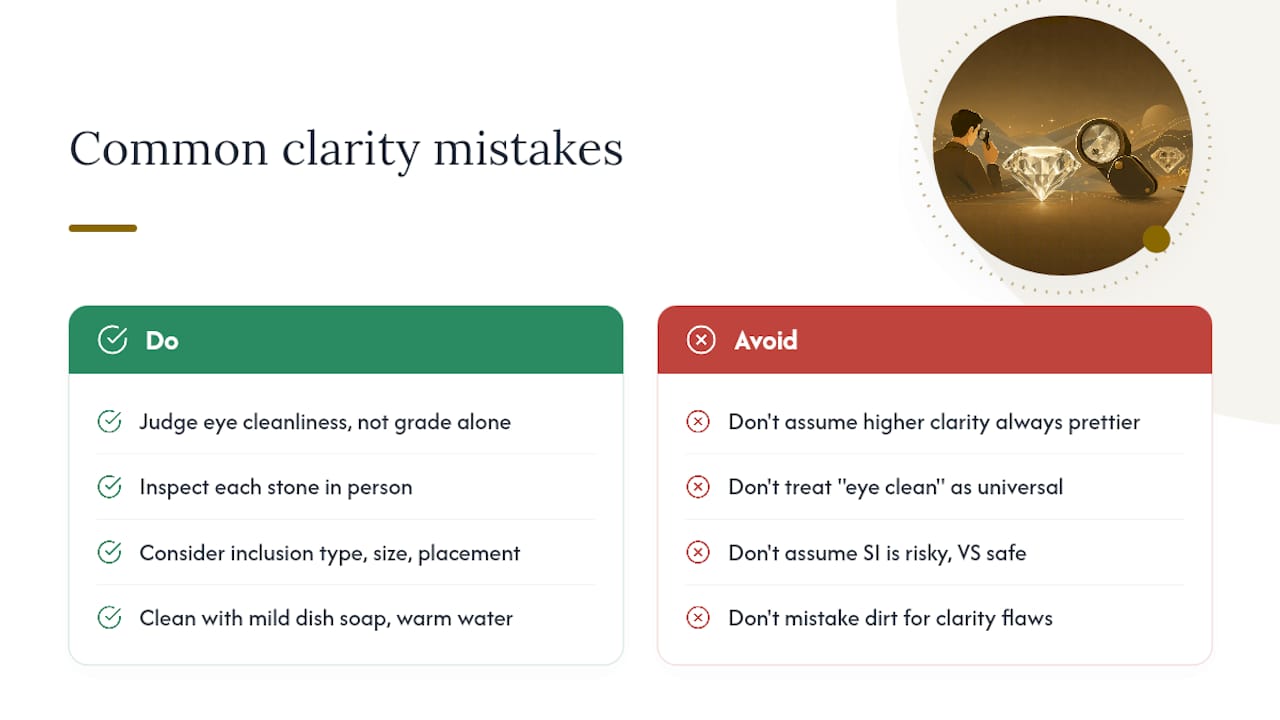
The biggest misconception is assuming a higher clarity grade automatically means a more beautiful diamond. Past the point of eye cleanliness, additional clarity buys you nothing visible. A flawless diamond and a well-chosen VS2 can look identical to every person who ever sees the ring, while the price difference funds a meaningfully larger stone.
A second mistake is treating “eye clean” as a fixed, universal standard. It isn’t. Because the term isn’t standardized across the trade, one retailer’s “eye clean” SI1 might show a visible inclusion under another seller’s lighting standards. Grade alone never substitutes for looking at the actual stone.
A third misconception: assuming every SI grade is risky and every VS grade is safe. Inclusion type, size, and placement matter more than the letter on the certificate. A poorly placed VS2 with a dark crystal dead center can look worse than a well-placed SI1 with pinpoints hidden at the girdle.
Finally, buyers often mistake a dirty diamond for a flawed one. Oil from skin, lotion, or everyday handling builds a film that scatters light and dulls brilliance, mimicking cloudiness that isn’t actually there. A proper cleaning with mild dish soap, warm water, and a soft brush often resolves what looked like a clarity problem and was really just grime.
A Jeweler’s Take on Clarity vs. Carat
For most engagement ring buyers, I’d rather see them choose a well-cut VS2 over a smaller VVS stone. Always ask for GIA or AGS certification, plus loupe video, before you buy.
Let Usajewels Help You Find Your Eye-Clean Diamond
Usajewels gives you something most online sellers won’t: an in-house team that actually inspects the loose diamond you’re considering, not just the paperwork attached to it.

Every certified stone comes with 360 degree media, real clarity plots, and grading documentation so you can verify eye cleanliness before you buy, not after it arrives. Because Usajewels manufactures in-house as a family-owned business, you’re also getting direct pricing without a middleman markup, and the lifetime upgrade program means your choice today doesn’t have to be your last one. Explore certified fine jewelry built around diamonds our team has personally reviewed, or browse the diamond color and clarity guide to map out your priorities before you start comparing stones. When you’re ready, reach out and our team will walk you through specific certificates and video for any diamond that catches your eye.
Sources
For deeper clarity education, consult GIA’s clarity guidance and IGI’s consumer resources. Always review the actual certificate image and clarity plot for any specific stone you’re considering.
- Diamond clarity chart with eye-clean definition – IGI
- Eye Clean Diamond: What It Means + Best Clarity Grades for Value (2026) – Twirl Weddings
- Seven things to know when looking at diamond clarity | GIA 4Cs
FAQ
What Is Considered an Eye Clean Diamond?
A diamond is considered eye clean when no inclusions or blemishes are visible to the unaided eye viewed face-up at 6 to 12 inches under normal lighting. VS2 and above typically meet this standard in brilliant cuts.
Is a VS1 Diamond Eye Clean?
Yes, VS1 is reliably eye clean across nearly all shapes, including step cuts like emerald and asscher, making it a safer choice than VS2 for larger stones or centered inclusions.
What Does “Eye Clean” Mean in Gemstones?
It means the stone shows no visible inclusions to a normal, unaided eye under typical lighting, distinct from the technical clarity grade a lab assigns under 10x magnification.
What Cleans Diamonds the Best?
Warm water, a few drops of mild dish soap, and a soft-bristled brush remove the oil and film that can make a diamond look cloudy or hide its true clarity.
Is VS2 Eye Clean?
VS2 is generally eye clean for most brilliant cut shapes under about 2 carats, though step cuts and larger stones may need VS1 or higher to guarantee the same result.
Recommended
- Emerald Cut Diamond Guide: Sophisticated Step-Cut Beauty | USA Jewels
- Pear Shaped Diamond Guide: Teardrop Elegance | USA Jewels
- Diamond Clarity Chart — FL to I3 Grades Explained | USA Jewels
- Asscher Cut Diamond Guide: Art Deco Square Elegance | USA Jewels

Deep Mehta is the Co-Owner of USA Jewels, a family-owned jewelry business she has led since 2013 in Deerfield Beach, Florida. With over 13 years of hands-on experience in fine jewelry retail, manufacturing, and diamond importing, Deep specializes in engagement rings, wedding bands, and custom jewelry design. She also co-manages Kaash Group Talent Acquisition. Deep is a University of Florida graduate and oversees every aspect of USA Jewels’ operations, from product development to marketing.
Fine Jewelry Collection


You May Also Like

In-House Jewelry Manufacturing: What It Is and Why It Matters

Why Handcrafted Jewelry Costs Differ: A Buyer’s Guide