Gemstone Color Meaning: Choose Stones That Express You
Gemstone color conveys symbolic associations that shape how a piece expresses identity and intention. The role of gemstone color meaning goes well beyond aesthetics: each hue carries cultural history, psychological resonance, and gemological signals that help you match a stone to your personality, wardrobe, and purpose.
Here is what color does for you when you choose a gem:
- Symbolism: Colors carry centuries of cultural meaning. Emerald green has signaled truth and healing across civilizations; ruby red has represented passion and courage since antiquity.
- Personality expression: The color you wear communicates something about who you are, even before a word is spoken.
- Wardrobe and occasion fit: Warm-toned gems like golden topaz complement earth-tone wardrobes; cool blues and purples work beautifully against silver metals and neutral palettes.
- Durability and value tradeoffs: Color choice often determines how hard a gem is and whether it needs special care. A vivid blue sapphire rates 9 on the Mohs scale; a glowing opal sits at a moderate hardness requiring protective settings.
Usajewels has offered gemstone education and buying guidance since 1999, helping customers connect color choices to pieces they will love for a lifetime.
Table of Contents
- How do you choose a gemstone by color?
- Why do colors carry meaning in gemstones?
- Color-by-color symbolism guide with example gemstones
- What are color-shifting gems and how do they affect meaning?
- How do treatments and durability affect your gem’s color?
- Why personal connection often matters more than color lists
- Key Takeaways
- A jeweler’s perspective on color and meaning
- Useful sources for further reading
- FAQ
How do you choose a gemstone by color?
Start with intention, not the color chart. Ask yourself what you want the piece to express: confidence, calm, love, or grounding. That single question narrows your options faster than any reference list.
Once you have your intention, work through these steps in order:
- Clarify your intention. Confidence points toward deep red or vivid blue. Calm and clarity lean into soft blue or pale green. Love and warmth call for pink or rose tones. Grounding and stability suggest brown, black, or deep green.
- Check how often you will wear it. An everyday ring needs a gem rated 7 or higher on the Mohs scale. A statement pendant worn occasionally can afford a softer stone.
- Match your wardrobe and metal. Warm golds pair naturally with yellow, orange, and warm-green gems. White gold and platinum make cool blues, purples, and clear stones pop. Check your most-worn clothing colors before you commit.
- Consider skin tone and contrast. Warm skin tones glow with yellow, orange, and warm-red gems. Cool skin tones are flattered by blue, purple, and pink stones. Neutral skin tones work with almost anything.
- Confirm durability and budget. Hue, tone, and saturation together define a gem’s appearance and market value; vivid saturation often commands the highest prices. A slightly less saturated stone in the same hue can look beautiful and cost significantly less.
- Ask about treatments. Heat treatment, irradiation, and oiling all affect color stability; always ask before you buy.
Pro Tip: When comparing two stones of the same color, look at tone and saturation, not just hue. A medium-toned, highly saturated ruby will outshine a lighter stone of the same nominal “red” in almost any light.
The best gemstone is the one you will actually wear. A stone that matches your wardrobe, fits your lifestyle, and resonates with you personally will always be more meaningful than a perfect symbolic match sitting in a drawer.
Usajewels’s gemstone comparison guides walk through these tradeoffs in detail, including how colored stones stack up against diamonds for engagement rings and everyday wear.
Why do colors carry meaning in gemstones?
Color psychology maps consistent emotional and cultural associations onto hues, and gemstones have carried those associations for thousands of years. Red signals energy and passion across most cultures; blue evokes calm and trust; green suggests growth and healing; purple has long been tied to spirituality and wisdom. These core associations appear in chakra traditions, ancient royal courts, and modern color theory alike.
The physical reason color exists in a gem is precise. Chromium causes ruby’s red and emerald’s green because different host crystal lattices absorb different wavelengths of light. The same element produces entirely different colors depending on the mineral it sits inside. Iron, manganese, copper, and vanadium each create their own characteristic hues across different minerals, which is why the gem world offers such a wide spectrum from a relatively small set of trace elements.
Cultural traditions layered meaning onto these physical realities over centuries. Emerald became a symbol of truth and healing; amethyst was tied to calm and sobriety; turquoise was worn as protection. Those associations are not arbitrary. They grew from the colors themselves and the emotional responses they reliably produced.
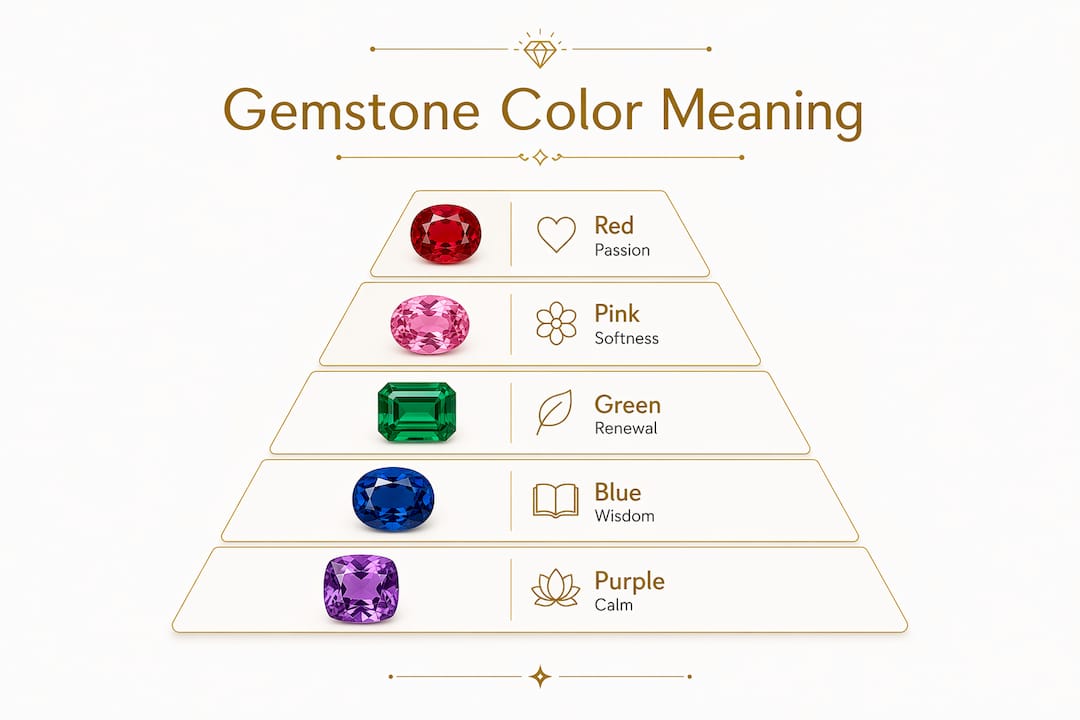
- Red (ruby, garnet): Energy, passion, courage
- Blue (sapphire): Calm, truth, loyalty, wisdom
- Green (emerald, peridot): Growth, healing, renewal
- Purple (amethyst): Spirituality, clarity, calm
Pro Tip: Before committing to a color based on its symbolic meaning, try wearing that color in natural daylight for a day. How it makes you feel in real light matters more than what a reference list says.
Color-by-color symbolism guide with example gemstones
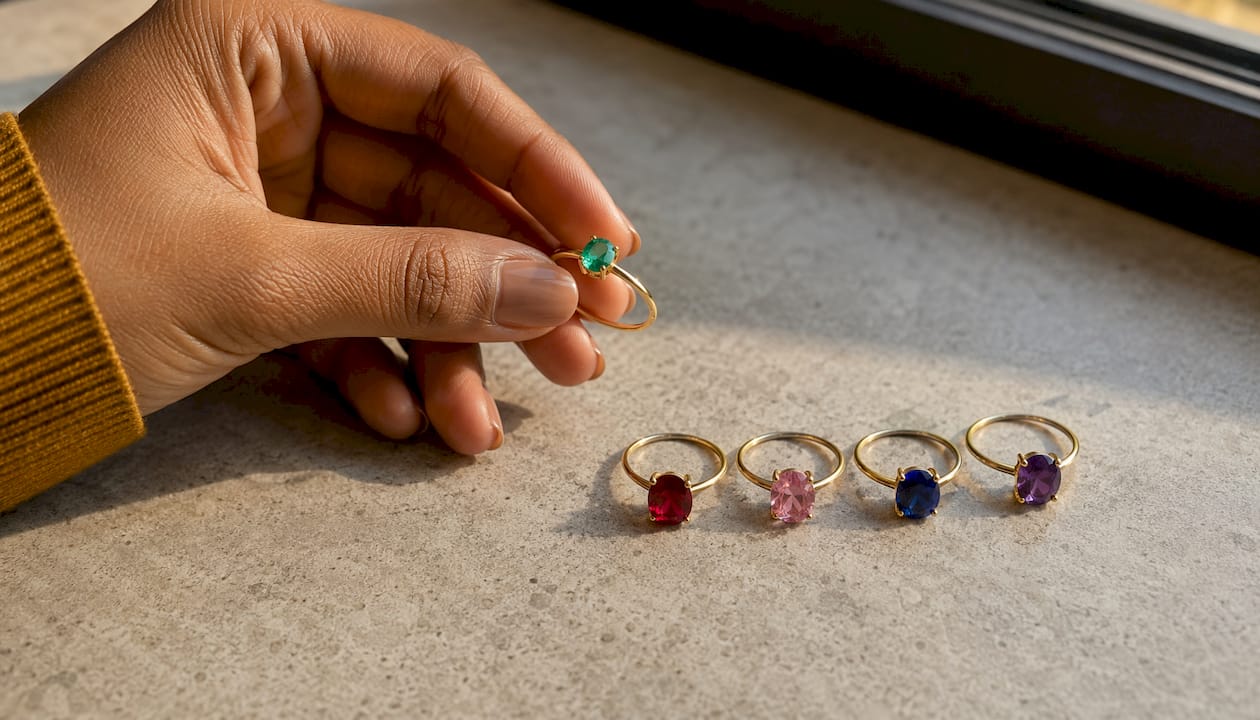
Color is the single most important factor for most people when buying a colored gem, according to GemSelect. The guide below maps the major color families to their core meanings, example stones, and practical styling notes.
| Color | Core meaning | Example gems | Best use |
|---|---|---|---|
| Red | Passion, courage, vitality | Ruby, red garnet | Statement rings, anniversary gifts |
| Pink | Love, compassion, romance | Pink tourmaline, pink topaz | Everyday wear, Valentine’s gifts |
| Orange/Yellow | Optimism, creativity, warmth | Citrine topaz, orange garnet | Casual and layered looks |
| Green | Growth, healing, renewal | Emerald, peridot | Everyday pendants, nature-inspired designs |
| Blue | Calm, loyalty, wisdom | Sapphire, blue topaz | Engagement rings, professional settings |
| Purple | Spirituality, clarity, calm | Amethyst | Everyday and gift pieces |
| Black | Strength, protection, mystery | Black diamond, black tourmaline | Bold statement and men’s jewelry |
| White/Clear | Purity, new beginnings, elegance | Diamond, white topaz | Bridal, classic, and everyday fine jewelry |
| Brown/Earth | Stability, reliability, grounding | Smoky quartz, brown topaz | Casual and nature-inspired styling |
Red gems like ruby and deep red garnet carry the strongest emotional charge of any color family. Ruby has represented courage and life force across South Asian, European, and East Asian traditions for centuries. Red garnet is a more accessible alternative with nearly the same warmth.
Pink gems sit at the softer end of the passion spectrum. Pink tourmaline and pink topaz both carry associations with compassion and emotional healing. They pair beautifully with rose gold, which amplifies the warmth of the hue.
Green gems span a wide range. Emerald’s deep, saturated green has been tied to truth and renewal since ancient Egypt. Peridot’s lighter, yellow-green tone feels fresher and more casual, making it a natural fit for everyday pendants. Both sit in the heart chakra tradition.
Blue gems are the most consistently requested color in fine jewelry. Sapphire’s deep blue signals loyalty and wisdom, which is why it has been a royal engagement stone for centuries. Blue topaz offers a lighter, more accessible alternative with a similar calming quality.
Purple gems led by amethyst carry a long tradition of calm and clarity. Historically worn to promote sobriety and clear thinking, amethyst remains one of the most versatile purple stones for both everyday and gift pieces.
Pro Tip: For a color-led gift, pair the gem’s symbolic meaning with the recipient’s wardrobe. A person who wears a lot of navy and gray will love a deep blue sapphire pendant far more than a bright orange citrine, regardless of what the color chart says about their personality.
For a look at how these colors translate into finished pieces, Usajewels’s gemstone jewelry collection shows ruby, emerald, and more set in a range of styles and metals.
What are color-shifting gems and how do they affect meaning?
Some gems do not commit to a single color, and that is part of their appeal. Color-change and pleochroic stones add a layer of meaning that static gems cannot: they express transformation, versatility, and complexity.
Color-change gems shift between two distinct colors depending on the light source. Alexandrite is the most famous example: it appears green to blue-green in daylight and shifts to red to purplish-red under incandescent light. Color-change stones like alexandrite appear to shift between green/blue and red/purple under different light sources, which makes them one of the most dramatic optical phenomena in the gem world. Certain garnets and sapphires also display color-change, though less dramatically.
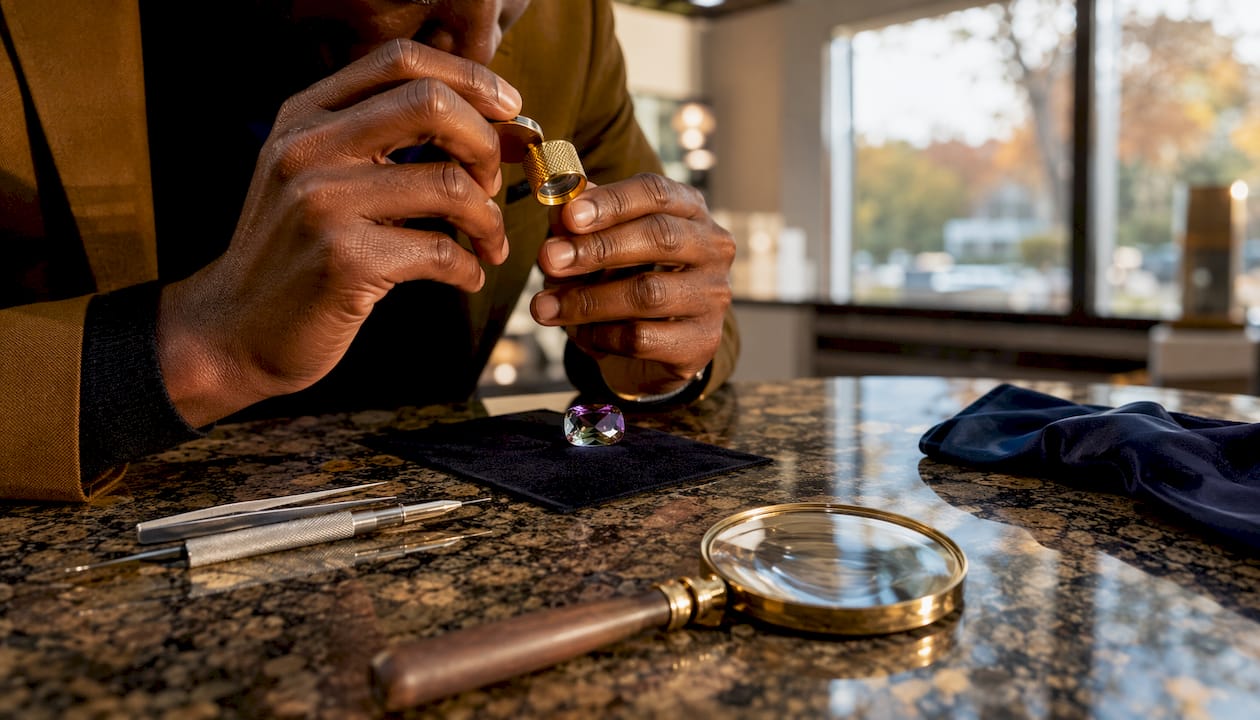
Pleochroic gems show different colors when viewed from different angles, not just under different lights. Tanzanite can appear blue, violet, or burgundy depending on the viewing direction. Some tourmalines shift between green and brown. This effect is subtler than full color-change but adds visual depth.
Opal occupies its own category with “play-of-color”: flashes of spectral color that move across the surface as the stone shifts. No two opals display the same pattern, which makes each stone genuinely unique.
What these gems mean symbolically:
- Alexandrite: Transformation, duality, adaptability
- Opal: Creativity, spontaneity, individuality
- Color-change garnet: Versatility, hidden depth
- Pleochroic tourmaline: Complexity, multifaceted personality
Pro Tip: When evaluating a color-change gem online, ask the seller for photos taken under both daylight and incandescent light. A strong color-change is clearly visible in both; a weak one may look nearly identical in both shots.
How do treatments and durability affect your gem’s color?
Color in a gemstone is not always permanent. Many gems on the market have been treated to enhance or stabilize their color, and knowing this before you buy protects both your investment and your expectations.
Common treatments that affect color:
- Heat treatment: Used on sapphire, ruby, and tanzanite to improve color and clarity. Industry-standard and widely accepted, but should be disclosed.
- Irradiation: Used on blue topaz and some diamonds to produce or deepen color. Stable under normal conditions.
- Oiling and resin filling: Used on emerald to fill surface fractures and improve apparent color. Requires gentle cleaning; avoid ultrasonic cleaners.
- Fracture filling: Used on ruby to improve transparency and color appearance.
Always ask your jeweler whether a stone has been treated and how that affects care. Usajewels’s gemstone treatments guide explains each treatment type and its impact on value and longevity.
Durability by color group:
| Gem | Mohs hardness | Key care note |
|---|---|---|
| Diamond | — | Virtually scratch-proof; minimal care needed |
| Ruby / Sapphire | ~9 | Excellent for everyday wear; safe for ultrasonic cleaning (if untreated) |
| Emerald | 7–— | Usually oiled; avoid ultrasonic and steam cleaners |
| Topaz | — | Hard but brittle; protect from sharp blows |
| Amethyst / Citrine | 7 | Good everyday durability; avoid prolonged sun exposure |
| Tourmaline | 7 | Durable; clean with mild soap and water |
| Peridot | 6.5–7 | Sensitive to acids; clean gently |
| Opal | 6–6.5 | Fragile; avoid heat, dry conditions, and harsh chemicals |
| Alexandrite | —.5 | Very durable; excellent for daily wear |
| Garnet | 6.5–7 | Good durability; avoid sharp impacts |
Tanzanite rates around 6.5 on the Mohs scale, and certain opals sit in a similar range, which means both benefit from protective bezel or halo settings rather than exposed prong settings.
Pro Tip: For softer colored gems like opal or peridot, choose a bezel setting that wraps the stone’s edge in metal. It dramatically reduces the risk of chipping during everyday wear without hiding the gem’s color.
Why personal connection often matters more than color lists
Color meaning is a “private vocabulary of intention,” as many jewelers put it. Cultural patterns exist and they are useful starting points, but a customer’s personal associations are often the decisive factor when choosing a gem that will be worn and loved for years.
Jewelers consistently advise prioritizing personal resonance over rigid color-meaning lists when designing custom pieces. A stone that the wearer loves and will wear often is more meaningful than a “perfect” symbolic match. If you love the look of a black tourmaline but the traditional symbolism does not resonate with you, the style should win.
Two practical steps to test your personal resonance with a color:
- Wear the color for a day. Put on a scarf, shirt, or accessory in the gem’s color before you buy. Notice how you feel in it by midday, not just in the morning mirror.
- Photograph it in different light. Take a photo of the stone or a color swatch in natural daylight, fluorescent office light, and warm evening light. Colors shift dramatically between environments, and you want to love it in all three.
Color meaning in jewelry is not a fixed code. It is a starting point for a conversation between the stone, the wearer, and the moment the piece was chosen. The most meaningful gems are the ones that feel right, not just the ones that match a list.
Individual life experience shapes color preference in ways that no reference chart can fully account for. A person who associates deep blue with a beloved grandmother’s brooch will feel that color differently than someone who associates it with a difficult period. Treat color symbolism as a guide, not a rule.
Key Takeaways
Gemstone color meaning works best as a personal tool: start with intention, test colors against your wardrobe and light, confirm durability, and trust what genuinely resonates with you.
| Point | Details |
|---|---|
| Start with intention | Decide what you want the piece to express before choosing a color or stone. |
| Tone and saturation matter | Vivid saturation often commands the highest prices; a slightly less saturated stone can look beautiful for less. |
| Check Mohs hardness | Everyday pieces need a gem rated 7 or higher; softer stones like opal (6–6.5) need protective settings. |
| Ask about treatments | Heat, irradiation, and oiling all affect color stability and care requirements; always ask before buying. |
| Trust personal resonance | Jewelers advise that a stone you love and will wear often is more meaningful than a perfect symbolic match. |
Explore Usajewels’s fine jewelry collection to see how color-led design choices come to life in finished pieces.

A jeweler’s perspective on color and meaning
When we sit down with a customer at Usajewels, the first question is never “What’s your birthstone?” It’s “What do you want this piece to say?” Color is the fastest way a gem communicates, and that communication happens before anyone reads a tag or asks about the stone’s name. We balance three things: what the color means to the wearer, how the stone will hold up in daily life, and whether the hue works with the metals and wardrobe the person already loves.
A deep blue sapphire on a white gold band says something very different from the same sapphire set in yellow gold. Neither is wrong. But one will feel right to a specific person, and that feeling is what makes a piece last a lifetime. If you want to explore how color, metal, and stone come together in a design built around you, our custom jewelry design options are a good place to start.
Useful sources for further reading
These sources support the claims in this article and offer deeper reading on gemology, color psychology, and gem care:
- GIA (Gemological Institute of America): The primary authority on gemstone grading, color standards, and gemological science.
- GemSelect: Gemstones by Color: A practical reference for shopping by color family, with notes on durability and availability.
- Scott Jewelry Design: Gemstone Color Meanings: Jeweler perspective on personal resonance and the limits of prescriptive color lists.
- AJLuxe: Gemstone Meanings: Cultural and chakra associations for major gemstones with historical context.
- Social Animal: Gemstone Color Guide: Technical explanation of trace elements, tone, saturation, and color-change phenomena.
- The Knot: Colored Gemstones 101: Accessible overview of Mohs hardness and durability considerations for colored gems.
- Usajewels: Gemstone Buyers Guide: Buying guidance covering treatments, grading, and colored-diamond options from Usajewels’s own education team.
For styling inspiration, the Sabra gemstone dangle earrings from JV London show how color-led design choices translate into finished gold-detail pieces.
FAQ
What do different colors of gemstones represent?
Each color family carries consistent symbolic associations: red signals passion and courage (ruby, garnet), blue represents calm and loyalty (sapphire), green suggests growth and healing (emerald, peridot), purple conveys spirituality and clarity (amethyst), and white or clear stones symbolize purity and new beginnings (diamond). Personal and cultural context can shift these meanings, so treat them as starting points rather than fixed rules.
What is the rarest gem color?
Red is widely considered the rarest color in fine gemstones. Gem-quality red diamonds are extraordinarily scarce, and top-grade rubies with a pure “pigeon’s blood” red command some of the highest per-carat prices of any colored stone at auction.
What is the role of gemstones in jewelry and culture?
Gemstones have served as symbols of status, protection, healing, and personal identity across virtually every culture for thousands of years. In jewelry, they communicate intention and emotion, from an emerald chosen for its association with truth to a sapphire selected for loyalty in an engagement ring.
What gemstones shift color?
Alexandrite is the most dramatic color-change gem, shifting from green to blue-green in daylight and red to purplish-red under incandescent light. Certain garnets and sapphires also display color-change. Opal displays “play-of-color,” a spectral flash across the surface, while pleochroic gems like tanzanite and some tourmalines show different colors from different viewing angles.
Recommended
- USA Jewels: Gemstones – Modern Elegance & Timeless Style
- Gemstone Jewelry: Ruby, Emerald & More | USA Jewels
- USA Jewels: Gemstone Buyers Guide – Engagement, Wedding Rings &
- Colored Diamond Jewelry, Fine Jewelry Artistry | USA Jewels

Deep Mehta is the Co-Owner of USA Jewels, a family-owned jewelry business she has led since 2013 in Deerfield Beach, Florida. With over 13 years of hands-on experience in fine jewelry retail, manufacturing, and diamond importing, Deep specializes in engagement rings, wedding bands, and custom jewelry design. She also co-manages Kaash Group Talent Acquisition. Deep is a University of Florida graduate and oversees every aspect of USA Jewels’ operations, from product development to marketing.
Fine Jewelry Collection


You May Also Like
How Lab-Grown Diamonds Are Ethically Produced
$3,000–$7,000 Engagement Rings for U.S. Buyers: Skip Retail Markup, Buy Smarter