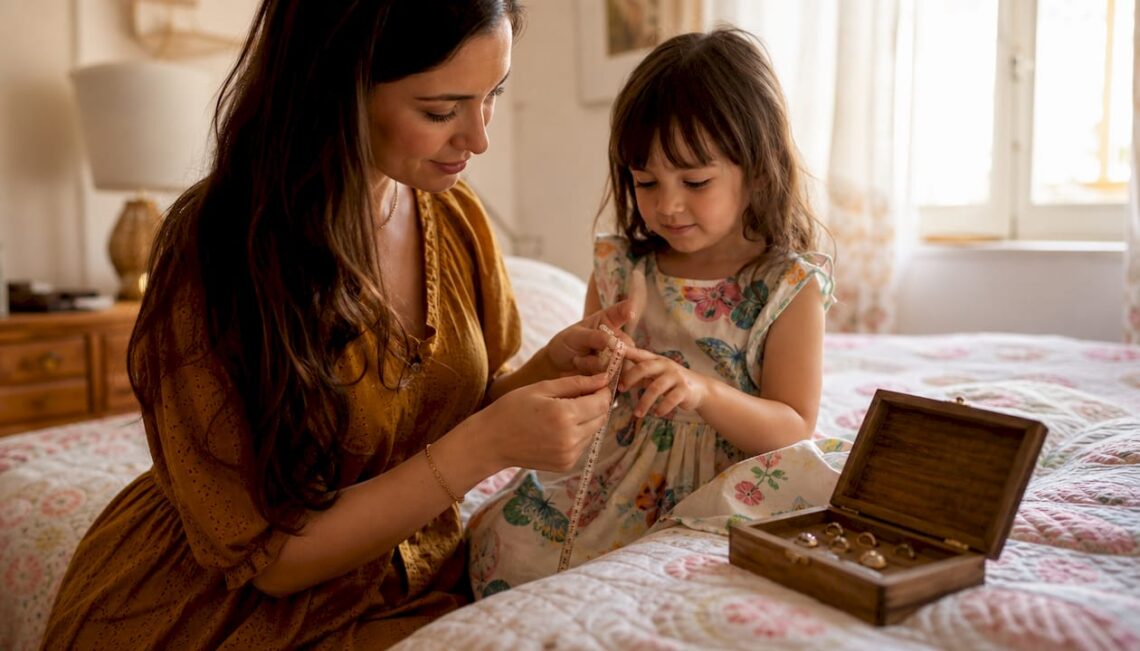
Adjustable Ring Children Jewelry: A Parent’s Safety Guide
An adjustable ring for children is defined as a ring with a flexible or open band that can be resized to fit a child’s finger without tools or professional help. These rings solve one of the most frustrating problems in kids’ jewelry: children’s fingers grow fast, and a fixed-size ring becomes too tight or too loose within months. Adjustable rings for kids offer a practical, cost-effective solution by fitting comfortably across several years of growth. They are recognized as safe and practical when made with smooth, secure mechanisms from hypoallergenic materials. For parents focused on safety, quality, and affordability, understanding how these rings work is the first step to choosing the right one.
What is adjustable ring children jewelry, and how does it work?
Adjustable rings for children are designed with a band that can be opened or tightened to change the ring’s diameter. Unlike adult rings, which are sized precisely in millimeters, children’s adjustable jewelry uses mechanical flexibility to accommodate growth. The ring sits comfortably on the finger at one size, then gets gently widened or narrowed as the child grows.
Four key adjustable mechanisms exist in children’s rings: open-back designs, screw-back bands, hinged bands, and removable size guides. Each works differently, and each carries its own safety profile. Parents who understand these differences make better buying decisions.
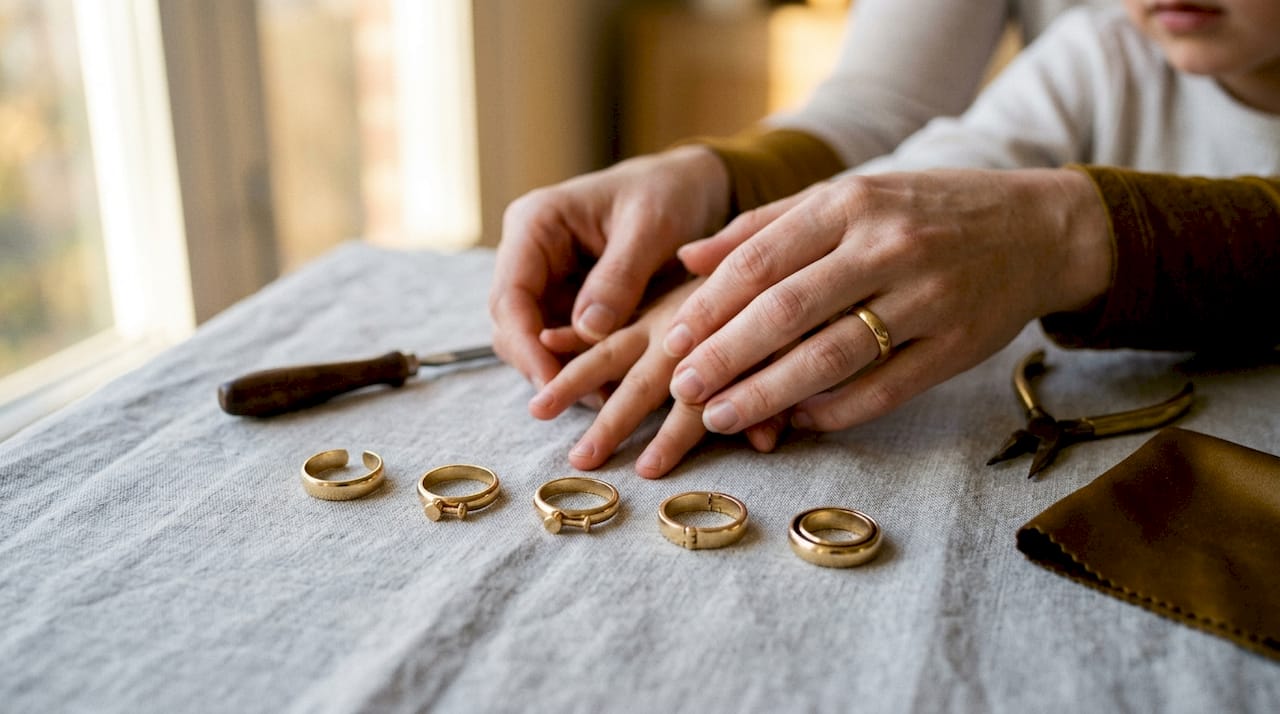
| Mechanism | How it works | Best for | Safety note |
|---|---|---|---|
| Open-back design | Band has a gap at the back; squeeze or spread to resize | Ages 5 and up | Check for sharp edges at the gap |
| Screw-back band | A small screw tightens or loosens the band | Older children | Inspect screw regularly for looseness |
| Hinged band | A hinge allows the band to open and close | Toddlers and young kids | Confirm hinge locks securely |
| Removable size guide | A plastic or metal insert fills extra space inside the band | All ages | Replace insert when no longer needed |
Open-back designs are the most common style in children’s adjustable jewelry. They are simple and inexpensive, but the gap at the back can pinch skin if the edges are not fully rounded. Hinged bands tend to be safer for younger children because they close completely around the finger with no exposed gap.
Pro Tip: Before buying any adjustable ring for a child, run your fingernail along the inner surface. If you feel any roughness or a sharp edge at the adjustment point, skip that ring. A smooth inner surface is non-negotiable for comfort and safety.
How do adjustable rings promote safety and comfort for children?
Safety is the top priority in children’s adjustable jewelry, and the adjustment mechanism is where most risks hide. Comfort and safety take priority over aesthetics, so parents should look for rings with smooth mechanisms that prevent pinching and stay securely in place during active play.
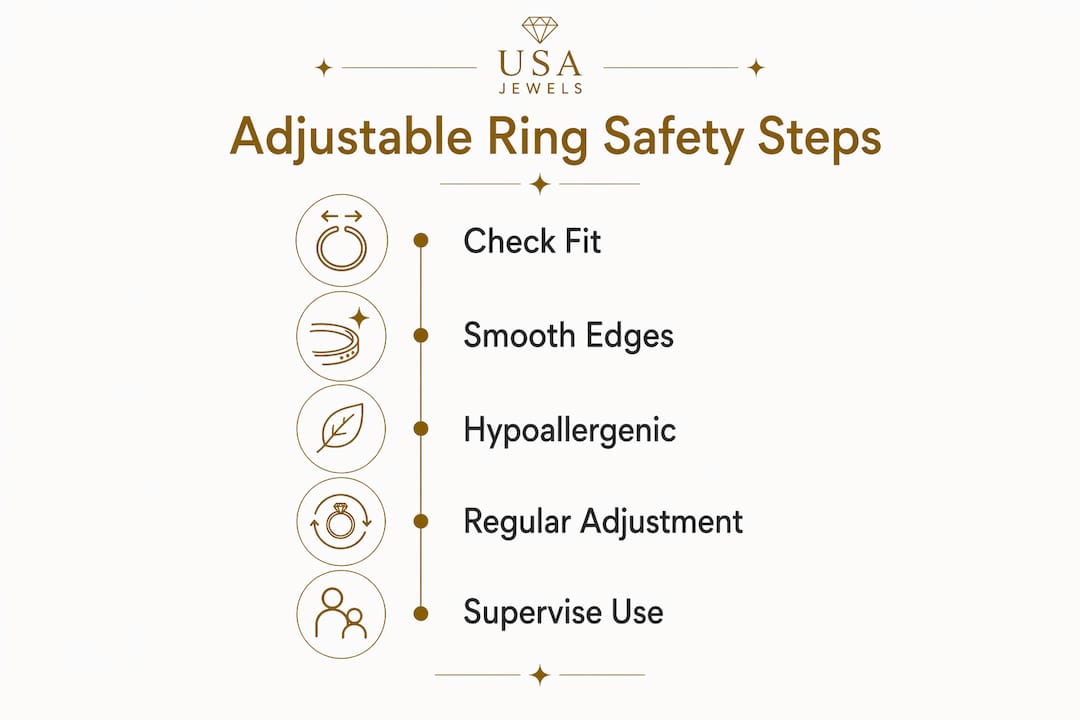
The material matters just as much as the design. Many quality children’s adjustable jewelry sets use safe, nickel-free materials and are marketed for ages 3 and up to reduce choking risks. Nickel is the most common cause of contact dermatitis in children, so a nickel-free or hypoallergenic certification is a meaningful standard to look for, not just a marketing label.
Sizing errors create two distinct hazards:
- Too tight: A ring that cuts off circulation causes swelling, numbness, and in serious cases, tissue damage. Rings too small can restrict blood flow, especially during sleep or warm weather when fingers swell.
- Too loose: A ring that slides off easily becomes a choking hazard, particularly for children under age 5 who still put objects in their mouths.
- Sharp edges: Some adjustable ring designs can pinch skin if gaps or edges are sharp. Inspect bands carefully before children wear them.
- Dangling parts: Jewelry for toddlers should be lightweight, simple, and free of dangling elements that snag on clothing or skin.
- Loose stones or parts: Any decorative element that can detach is a swallowing risk. Check settings and embellishments before each wear.
Pro Tip: Check the ring’s fit every few weeks for children under age 7. Fingers can swell in heat and shrink in cold, so a ring that fits perfectly in winter may feel tight by summer.
How to properly size and fit adjustable rings for growing children?
Sizing children’s rings is more complex than most parents expect. Age-based ring size charts are guidelines only. Hand growth varies widely between children of the same age, so direct measurement of the child’s finger is always more reliable than a chart.
Children’s ring sizes grow from approximately sizes A-B at ages 3–4 up to sizes J-L by the late teen years. That range spans many years and many growth spurts. A child who is large for their age may wear a size E at age 6, while a smaller child the same age may still wear a size B. The Usajewels ring size guide provides detailed at-home measurement instructions that work well for children’s fingers.
Follow these steps to measure a child’s finger at home:
- Choose the right time of day. Fingers are slightly larger in the afternoon and after physical activity. Measure then for the most accurate fit.
- Use a strip of paper. Wrap a narrow strip around the base of the finger the ring will be worn on. Mark where the paper overlaps.
- Measure the strip. Lay the paper flat and measure the length in millimeters. This is the finger’s circumference.
- Convert to ring size. Use a standard ring size conversion chart to find the matching size. For children, sizes typically run from A through L.
- Add a small buffer. For adjustable rings, aim for a fit that slides on easily but does not fall off when the hand is relaxed.
- Recheck every 6–12 months. Adjustable rings require regular monitoring and fit checks to maintain safety as the child grows.
The 6–12 month recheck schedule is not optional. Children’s hands grow in spurts, and a ring that fit perfectly in september may be dangerously tight by march of the following year.
What materials and qualities should parents look for in children’s adjustable rings?
The material of a children’s ring determines its safety, durability, and long-term value. Parents shopping for the best rings for kids face a clear choice between play jewelry and heirloom-quality pieces. Both have a place, but they serve different purposes.
Common materials in children’s adjustable rings fall into two broad categories:
| Material | Benefits | Best suited for | Notes |
|---|---|---|---|
| 14K gold | Durable, hypoallergenic, holds value | Special occasions, heirloom gifts | Higher cost; worth it for sensitive skin |
| Sterling silver | Affordable, hypoallergenic, classic look | Everyday wear, gifts | Can tarnish; needs regular cleaning |
| Nickel-free metals | Budget-friendly, low allergy risk | Play jewelry, everyday use | Verify certification before buying |
| Iron or zinc alloy | Very affordable, widely available | Short-term play jewelry | Not suitable for sensitive skin |
| Glass or resin accents | Colorful, fun designs | Play jewelry | Check for loose settings |
14K gold is popular for kids’ jewelry because it combines durability with a low allergy risk. Pure gold (24K) is too soft for rings that take daily wear, but 14K gold holds its shape well through active use.
For parents choosing between materials, these priorities help:
- Sensitive skin: Choose 14K gold or certified sterling silver. Both are recognized as hypoallergenic for most children.
- Active play: Choose nickel-free alloy rings. They withstand rough handling and are inexpensive to replace.
- Special gifts: Choose 14K gold or sterling silver for pieces the child will keep and wear into adulthood.
- Budget: Nickel-free alloy and sterling silver offer the best balance of safety and affordability for everyday kids jewelry styles.
Age-appropriate warnings on packaging matter too. Reputable manufacturers mark rings with choking hazard warnings for children under age 3 and list the materials used. If a ring’s packaging does not list its materials, that is a reason to look elsewhere.
What are best practices for maintaining and caring for adjustable rings for kids?
A well-maintained adjustable ring lasts longer and stays safer. Children are hard on jewelry, so regular care is not optional. These practices keep rings in good condition:
- Inspect weekly. Check the adjustment mechanism for looseness, cracks, or sharp edges that may have developed from wear. A hinge that no longer locks or a screw that has worked itself loose needs immediate attention.
- Clean gently. Use warm water and a soft cloth for most metals. Avoid harsh chemicals, ultrasonic cleaners, or abrasive materials on children’s rings. Sterling silver benefits from a polishing cloth to remove tarnish.
- Store carefully. Keep rings in a soft pouch or lined box to prevent scratches. The Usajewels jewelry storage guide covers the best storage practices for different metals, including tips that apply directly to children’s pieces.
- Limit over-adjustment. Repeatedly bending an open-back ring weakens the metal at the flex point. Adjust only when necessary, and replace the ring if the band shows signs of cracking or fatigue.
- Remove before water and activity. Take rings off before swimming, bathing, or rough outdoor play. Chlorine damages metals, and physical activity increases the risk of the ring catching on something.
Supervision matters most for children under age 6. A parent or caregiver should check the ring’s fit and condition before the child puts it on each day. That 30-second check prevents most of the common problems with children’s adjustable jewelry.
Key Takeaways
Adjustable rings for children are the safest, most practical choice for growing fingers when made from hypoallergenic materials with smooth, secure mechanisms and checked for fit every 6–12 months.
| Point | Details |
|---|---|
| Definition and purpose | Adjustable rings resize to fit growing fingers, combining comfort, safety, and long-term value. |
| Four mechanism types | Open-back, screw-back, hinged, and removable guide designs each carry different safety profiles. |
| Material selection | Choose 14K gold or sterling silver for sensitive skin; nickel-free alloys for everyday play. |
| Sizing accuracy | Measure the child’s finger directly; age charts alone are unreliable due to growth variation. |
| Regular maintenance | Inspect fit and condition every 6–12 months and clean gently to extend ring life and safety. |
What I’ve learned from years of watching parents choose kids’ rings
Most parents walk into a children’s jewelry purchase focused on how the ring looks. That is understandable. A sparkly ring with a butterfly or a heart is genuinely delightful, and the child’s excitement is real. But the parents who come back frustrated are almost always the ones who prioritized design over fit and material.
The detail I see overlooked most often is the adjustment mechanism. Parents squeeze an open-back ring once in the store, decide it feels fine, and move on. They do not check the inner surface for sharp edges or test whether the gap stays closed during normal hand movement. Six weeks later, the child has a small pinch mark on their finger and the ring goes in a drawer.
The other common mistake is treating adjustable rings as a permanent solution. They are not. A ring that fits a 5-year-old’s finger perfectly will be dangerously tight by age 7 in many cases. The 6–12 month recheck schedule exists for a real reason. I have seen parents skip it for two years and then wonder why their child’s finger looks red and irritated.
What I genuinely appreciate about adjustable rings, when chosen well, is their sentimental staying power. A quality sterling silver or 14K gold adjustable ring can be resized and worn from childhood into the teen years. That kind of longevity makes it a meaningful gift, not just a trinket. Pair that with a formal occasion outfit and you have a complete look that grows with the child.
Prioritize comfort and durability first. The ring that fits well and stays safe is the one the child will actually wear and remember.
— Joseph
Usajewels children’s rings: quality you can trust
Choosing the right adjustable ring for your child does not have to mean settling for cheap materials or uncertain quality. Usajewels has been crafting trusted, family-quality jewelry since 1999, and that care extends to pieces suited for younger wearers.

Usajewels offers a curated jewelry collection that includes pieces made from hypoallergenic metals and ethically sourced materials, with the same in-house manufacturing quality that has earned over 222 five-star Google reviews. Every piece is built to last, not just to look good in the box. Parents who want a ring that is safe, beautiful, and worth keeping can browse Usajewels’ full selection and find something their child will treasure for years.
FAQ
What is an adjustable ring for children?
An adjustable ring for children is a ring with a flexible or open band that can be resized to fit a growing finger without professional tools. These rings are designed to accommodate children’s hand growth over several years.
Are adjustable rings safe for kids?
Adjustable rings are safe for kids when made from hypoallergenic, nickel-free materials with smooth, rounded inner surfaces and no sharp edges. Parents should inspect the fit and mechanism regularly, especially every 6–12 months.
What materials are best for children’s adjustable rings?
14K gold and sterling silver are the best materials for children’s adjustable rings because both are durable and hypoallergenic. Nickel-free alloy rings are a good budget option for everyday play jewelry.
How often should I check my child’s ring size?
Check your child’s ring size every 6–12 months, since children’s hands grow in spurts and a well-fitting ring can become dangerously tight within a year. Direct finger measurement is more reliable than age-based size charts.
At what age can children start wearing adjustable rings?
Most children’s adjustable rings are designed for ages 3 and up, with choking hazard warnings for younger children. Toddlers should only wear simple, lightweight rings with no dangling parts, and always under adult supervision.
Recommended
- Ring Stacking Guide: How to Stack Rings for a Polished Look | USA Jewels
- Why 14K Gold Is Popular for Kids’ Jewelry
- Jewelry Care Guide: Cleaning, Storage & Maintenance | USA Jewels
- Men’s Jewelry Guide: Chains, Rings, Bracelets & More | USA Jewels

Deep Mehta is the Co-Owner of USA Jewels, a family-owned jewelry business she has led since 2013 in Deerfield Beach, Florida. With over 13 years of hands-on experience in fine jewelry retail, manufacturing, and diamond importing, Deep specializes in engagement rings, wedding bands, and custom jewelry design. She also co-manages Kaash Group Talent Acquisition. Deep is a University of Florida graduate and oversees every aspect of USA Jewels’ operations, from product development to marketing.
Frequently Asked Questions
What materials should I look for in adjustable children's rings to avoid allergic reactions?
How often should I check or adjust my child's adjustable ring as they grow?
Are open-back adjustable rings safe for very active children, or should I choose a different mechanism?
Can adjustable children's rings accommodate significant growth, or will my child outgrow them quickly?
What's the price difference between adjustable children's rings and traditional fixed-size rings, and is it worth it?
Fine Jewelry Collection


You May Also Like
Best 7879.co Alternatives for Investment-Grade Jewelry in 2026
Necklace Length Guide: Find Your Perfect Fit