Why Lab-Grown Diamonds Cost Less: 2026 Price Guide
Lab-grown diamonds cost less than natural diamonds because their production and supply chain economics are fundamentally different, not because they are lower in quality. A lab-grown diamond is chemically, physically, and optically identical to a mined stone. The price gap comes down to how each stone is made, how it travels to market, and how much supply exists. Today, lab-grown diamonds retail for 50% to 80% less than comparable natural stones. That kind of savings means you can choose a larger carat weight, a higher clarity grade, or a more elaborate setting without stretching your budget.
Why lab-grown diamonds cost less: production economics explained
The single biggest driver of the lab diamond price difference is how these stones are created. Two primary methods are used: Chemical Vapor Deposition (CVD) and High Pressure High Temperature (HPHT). Both replicate the conditions that form natural diamonds, but inside a controlled laboratory environment rather than deep underground over millions of years.
CVD grows diamonds by introducing a carbon-rich gas into a chamber and using energy to break it down, layer by layer, onto a seed crystal. HPHT mimics the extreme pressure and heat of the earth’s mantle using industrial presses. Neither process requires excavating land, relocating communities, or managing the environmental remediation that comes with large-scale mining operations.
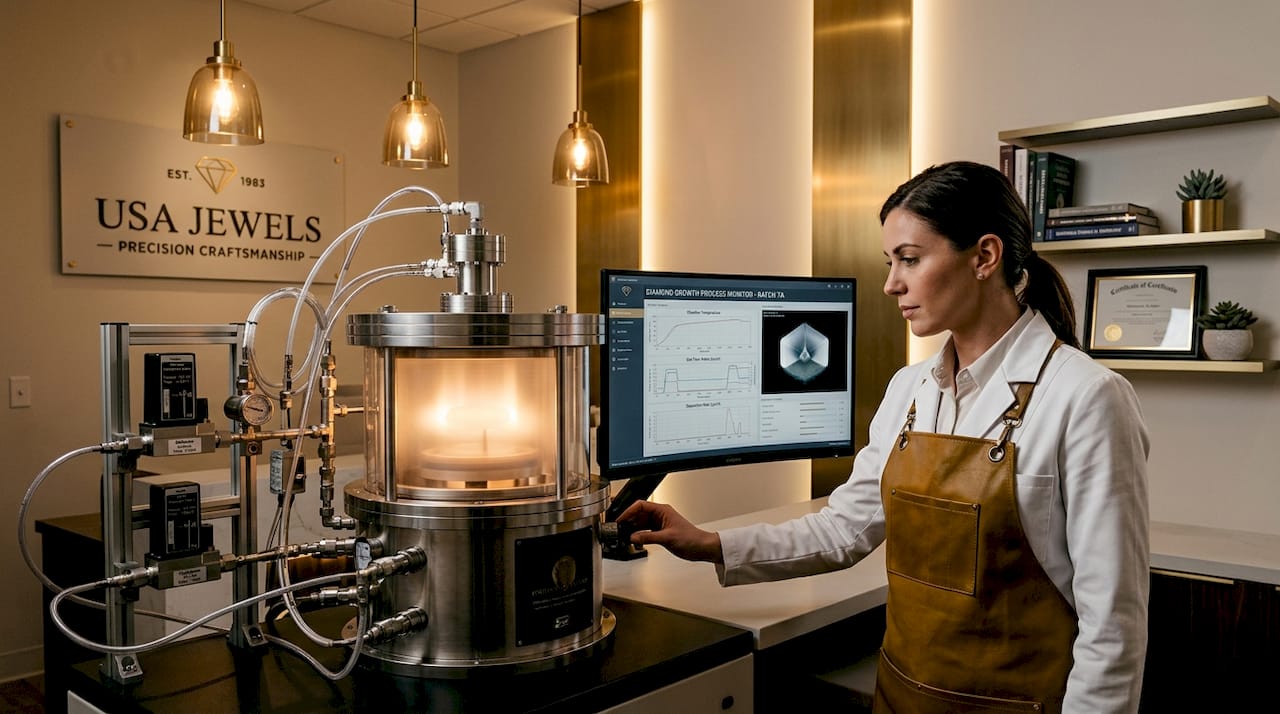
Faster CVD reactors now produce gem-quality diamonds in days rather than weeks, and manufacturing efficiency has improved steadily since the technology scaled commercially. That speed translates directly into lower cost per carat. A mine, by contrast, requires years of capital investment before a single diamond reaches the surface.
Here is what the production cost structure looks like for lab-grown diamonds compared to mining:
- No land acquisition or excavation costs. Mining operations require permits, heavy equipment, and years of site preparation.
- No large labor force for underground or open-pit work. Lab facilities run with smaller, more specialized teams.
- No geopolitical risk premium. Mined diamonds often come from regions with complex regulatory and logistics environments.
- Scalable output. Labs can increase production by adding reactors, not by finding new deposits.
- Predictable quality control. Controlled environments reduce the proportion of stones that fail to meet gem standards.
Pro Tip: When comparing lab-grown diamond prices, ask whether the stone was produced by CVD or HPHT. HPHT tends to cost slightly more for smaller stones due to rising production costs in that size range, so CVD may offer better value at lower carat weights.
How the supply chain drives down lab-created diamond pricing
Even after a diamond is produced, its price is shaped by how many hands it passes through before reaching you. The traditional mined diamond supply chain runs from mining company to rough diamond broker, to cutting and polishing facility, to wholesale distributor, to retail jeweler. Each step adds a markup. By the time a natural diamond sits in a display case, it may have passed through five or six intermediaries.
Lab-grown diamonds have shorter supply chains that reduce compounded markups. Many lab-grown producers sell directly to retailers or operate their own direct-to-consumer channels. Technology-enabled brands list prices with minimal markup above wholesale, which is a model that traditional jewelers cannot easily replicate given their overhead and inventory costs.
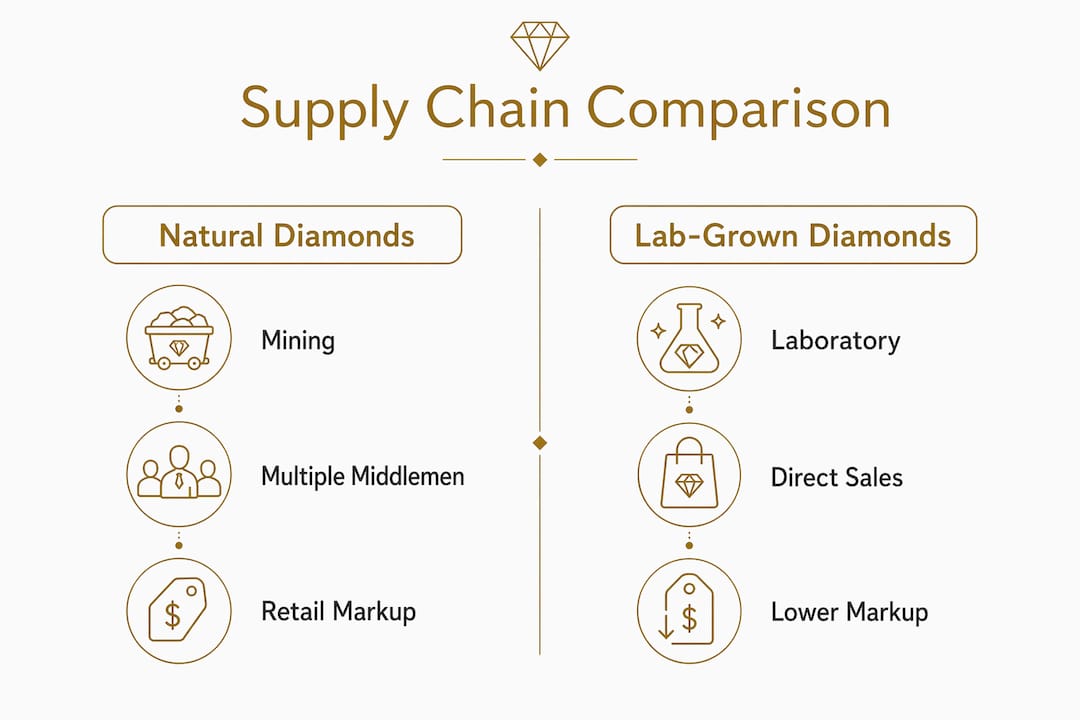
Here is a direct comparison of the two supply chain structures:
| Stage | Natural diamond | Lab-grown diamond |
|---|---|---|
| Origin | Mining operation (global) | Laboratory facility |
| Processing | Rough broker, cutter, polisher | Often integrated or fewer steps |
| Distribution | Multiple wholesale tiers | Direct or single-tier wholesale |
| Retail markup | High (covers overhead, inventory) | Lower with direct-to-consumer models |
| Typical retail premium over cost | 100% to 200%+ | 20% to 50% in many direct channels |
Direct-to-consumer brands reduce markup layers and often list near-wholesale prices, giving buyers transparency that traditional retail rarely offers. This structural advantage is permanent, not a temporary promotion.
Pro Tip: Before buying, check whether the retailer manufactures in-house or sources through a distributor. In-house manufacturing, like the model used by Usajewels, eliminates an entire layer of middleman cost and passes those savings directly to you.
What recent market data shows about lab diamond prices in 2025 and 2026
The market data from 2025 and early 2026 tells a clear story. Wholesale prices dropped 26% year-on-year in 2025, according to Edahn Golan’s Lab Diamond Wholesale Price List published in January 2026. That is a significant decline, but the pace is slowing. Quarterly declines eased to 4.7%, which signals the market is maturing rather than continuing to freefall.
“The lab-grown diamond market is transitioning from rapid price declines to a more stable pricing phase as scale and technology mature.” — Edahn Golan Research, January 2026
Production capacity has expanded by over 300% since 2020, driven by growth in manufacturing hubs in China and India. More supply at lower production cost pushes prices down, and that pressure has also affected the natural diamond market. Major miners have reduced output and repositioned their marketing strategies in response to lab-grown competition.
The price picture is not uniform across all stone sizes and shapes. Smaller stones show stabilized or slightly rising prices in some HPHT categories, because production costs for that method have increased. Larger stones, particularly in the 1 to 3 carat range produced by CVD, have seen the steepest price reductions. This means the cost advantage of lab-grown diamonds is most pronounced for buyers shopping in the mid-to-large carat range.
For buyers, the practical takeaway is straightforward. The 50% to 80% retail price advantage over natural stones is real and documented. That gap is unlikely to close significantly in the near term given current production economics.
Are lab-grown diamonds the same quality as natural ones?
The most common misconception about affordable synthetic diamonds is that lower price means lower quality. It does not. Lab-grown diamonds meet the legal diamond definition and are graded under the same 4Cs framework used for natural stones: cut, color, clarity, and carat weight. A GIA gemologist grades a lab-grown diamond using the exact same criteria applied to a mined stone.
Here is what the 4Cs mean in practice for lab-grown stones:
- Cut: Determined by the polisher, not the origin. A well-cut lab-grown diamond reflects light identically to a well-cut natural diamond.
- Color: Graded on the same D-to-Z scale. Lab-grown diamonds can achieve colorless grades (D, E, F) at lower cost than equivalent natural stones.
- Clarity: Controlled growth conditions often produce fewer inclusions than natural stones formed under chaotic geological processes.
- Carat: Weight is weight. A 1.5-carat lab-grown diamond is physically the same size as a 1.5-carat natural diamond.
Lab-grown diamonds retain equal sparkle and physical properties to natural stones. No gemologist can distinguish them with the naked eye. The one area where a real difference exists is resale value. Lab-grown diamonds have a weaker resale market compared to natural stones, which matters if you plan to sell the stone later. For buyers focused on wearing and enjoying their jewelry rather than treating it as a financial asset, this distinction rarely affects the purchase decision.
You can explore the full 4Cs grading guide at Usajewels to understand exactly how these standards apply when you are comparing stones.
How to get the best price on lab-grown diamonds
Knowing why lab-grown diamonds are cheaper is useful. Knowing how to shop them well is what actually saves you money. Price variation across vendors, carat weights, and shapes is significant, and the difference between a savvy purchase and an overpriced one can be hundreds of dollars.
Follow these steps to get the best value:
- Compare by exact specification. Wholesale price changes are uneven by carat weight and shape. A 1.0-carat round CVD stone and a 1.0-carat oval CVD stone carry different price points. Always compare like-for-like specifications.
- Prioritize certified stones. Ask for GIA or IGI certification. Certified stones have verified grades, which protects you from inflated quality claims.
- Choose direct-to-consumer or in-house manufacturers. Retailers who manufacture their own jewelry, like Usajewels, cut out distributor markups entirely. That saving shows up in the final price.
- Consider fancy shapes over round. Round brilliant cuts command a premium because of higher demand and cutting waste. Oval, cushion, and pear shapes often deliver more visual size per dollar.
- Check the return and upgrade policy. Some jewelers offer lifetime diamond upgrades. This matters more for lab-grown stones given their softer resale market.
- Avoid department store and mall chain pricing. These retailers carry high overhead costs that inflate prices well above what direct or family-owned jewelers charge.
Pro Tip: A 1.5-carat lab-grown oval or cushion cut will often look larger face-up than a 1.0-carat round brilliant, at a lower total price. Shape choice is one of the most underused tools for maximizing visual impact per dollar.
For a detailed breakdown of how pricing factors interact, the diamond pricing guide at Usajewels walks through supply, demand, and quality variables in plain language.
Key takeaways
Lab-grown diamonds cost less because their production technology, supply chain structure, and expanding output capacity reduce costs at every stage compared to mined stones, with no compromise on gem quality.
| Point | Details |
|---|---|
| Production cost advantage | CVD and HPHT methods eliminate mining infrastructure, cutting cost per carat significantly. |
| Supply chain savings | Fewer intermediaries mean lower compounded markups before the stone reaches you. |
| Market price trends | Wholesale prices dropped 26% in 2025; retail savings of 50% to 80% versus natural stones are documented. |
| Quality parity | Lab-grown diamonds are graded under the same 4Cs framework and are physically identical to natural stones. |
| Smart shopping | Compare exact specifications, choose certified stones, and buy from direct or in-house manufacturers for best value. |
My honest read on where lab-grown diamond pricing is headed
I have watched the lab-grown diamond market move through two distinct phases. The first was the rapid price collapse between 2020 and 2024, when production scaled faster than demand could absorb it. The second, which we are in now, is stabilization. Prices are still falling, but the pace has slowed. That is actually good news for buyers who were worried about purchasing a stone that would lose half its value in six months.
What I find more interesting is the shift in how buyers are thinking about value. The old framework treated a diamond as a store of value, something you could sell later at a profit or at least break even. Lab-grown diamonds do not fit that model well, and I think that is fine. Most people who buy an engagement ring or anniversary piece do not sell it. They wear it, pass it down, or keep it as a memory. For that purpose, a lab-grown diamond at 60% less than a comparable natural stone is not a compromise. It is a smarter allocation of your money.
The ethical dimension matters too. Conflict-free sourcing and a significantly lower environmental footprint are not marketing language. They are real differences in how the stone came to exist. As more buyers prioritize these factors, the value proposition of lab-grown diamonds strengthens beyond price alone.
My expectation is that prices will continue to ease modestly over the next two years as production in India and China matures further. But the dramatic drops are behind us. If you are waiting for prices to fall another 50%, you are likely waiting for something that will not happen. The better move is to buy now, buy certified, and buy from a jeweler who manufactures directly.
— Joseph
Find your perfect lab-grown diamond at Usajewels
At Usajewels, we have been helping families find beautiful, certified jewelry since 1999. Our family-owned, in-house manufacturing model means we skip the distributor entirely and pass those savings directly to you. Every lab-grown diamond we carry is conflict-free, certified, and selected for quality.

Whether you are shopping for an engagement ring, anniversary gift, or something personal, our team will guide you through every option. You choose the diamond quality, the metal type, and the design. We handle the craftsmanship. Browse our fine diamond jewelry collection to see current pricing on lab-grown and natural diamond pieces, or explore our full lab vs. natural diamonds guide to compare your options side by side before you decide.
FAQ
Why are lab-grown diamonds so much cheaper than natural ones?
Lab-grown diamonds cost less because they are produced in controlled laboratory environments using CVD or HPHT technology, eliminating the massive costs of mining, land acquisition, and multi-tier distribution. The result is a stone with identical physical properties at 50% to 80% less than the retail price of a comparable natural diamond.
Do lab-grown diamonds look different from natural diamonds?
Lab-grown diamonds are visually and physically identical to natural diamonds. No gemologist can distinguish them with the naked eye, and they carry the same sparkle, hardness, and optical properties as mined stones.
Are lab-grown diamonds certified the same way as natural diamonds?
Yes. Lab-grown diamonds are graded under the same 4Cs framework (cut, color, clarity, carat) used for natural stones, and leading labs including GIA and IGI issue certificates for both types.
Will lab-grown diamond prices keep falling?
Wholesale prices dropped 26% in 2025, but the quarterly rate of decline slowed to 4.7%, signaling market stabilization. Significant further price drops are unlikely in the near term as production and demand reach a more balanced state.
Is the resale value of a lab-grown diamond lower?
Lab-grown diamonds do have a weaker resale market compared to natural diamonds. For buyers focused on wearing and enjoying their jewelry rather than reselling it, this difference rarely affects the overall value of the purchase.
Recommended
- Lab-Grown vs Natural Diamonds Guide | USA Jewels
- Diamond Pricing Guide: What Diamonds Cost | USA Jewels
- Lab-Created Diamonds: Process & Value | USA Jewels
- Engagement Ring Budget Guide | USA Jewels

Frequently Asked Questions
If lab-grown diamonds are chemically identical to mined diamonds, why do jewelers still prefer natural stones?
Should I choose CVD or HPHT lab-grown diamonds when shopping for an engagement ring?
Can I really save 50-80% buying lab-grown instead of mined, or is that marketing hype?
Will a lab-grown diamond hold its value if I want to resell or trade it in later?
Does a lab-grown diamond require different care or maintenance compared to a mined diamond?
Fine Jewelry Collection


You May Also Like

Adjustable Ring Children Jewelry: A Parent’s Safety Guide
60–70% Lead Metal Rule: Wear Mixed Metal Jewelry with Intent