Hypoallergenic Jewelry Metals: Why Nickel Release Beats Labels
The least-reactive metals are implant-grade titanium or niobium, and for fine jewelry, platinum and 18-karat-or-higher gold come closest to that same low risk. If you have a fresh piercing or a history of severe reactions, the simplest rule is this: stick with implant-grade titanium or niobium until your skin tells you otherwise.
TL;DR:
- The U.S. does not regulate the term hypoallergenic, so ask for the exact alloy and nickel release documentation rather than trusting nickel free labels.
- For a fresh piercing or severe sensitivity, use implant grade titanium or niobium; for fine jewelry, choose platinum or gold at 18 karats or higher.
- For earrings, stainless steel meeting ASTM F 138 offers a second choice, but generic surgical steel labels do not confirm its grade.
- A DMG swab detects nickel release above 0.5 micrograms per square centimeter weekly, but may miss lower levels that still trigger sensitive skin.
- If redness, swelling, or itching persists despite changing metals, see a dermatologist; patch testing can identify the specific allergy more reliably than product labels.
Table of Contents
- What “Hypoallergenic” Really Means on a Jewelry Label
- Best Hypoallergenic Jewelry Metals: A Practical Guide
- How to Tell If a Piece Is Actually Hypoallergenic
- Choosing Metals for Piercings, Earrings, Rings, and Daily Wear
- How We Help Sensitive-Skin Shoppers Choose Safely
- Comparing Durability and Care Across Hypoallergenic Metals
- What Hypoallergenic Metals Cost, Upfront and Over Time
- Where Hypoallergenic Metals Come From, and Why Sourcing Matters
- Myths About Hypoallergenic Jewelry Worth Retiring
- A Straight Answer on Metal Allergies
- Find Your Safe Metal Match With USA Jewels
- FAQ
- Sources
What “Hypoallergenic” Really Means on a Jewelry Label
“Hypoallergenic” sounds like a promise, but in the United States jewelry industry, no government agency defines or regulates the term. A brand can print it on a tag whether or not the piece has been tested for nickel release, which means the word alone tells you very little.
What matters more is nickel release, not just nickel content. A piece can contain small amounts of nickel in its alloy and still be safe to wear, while another piece marketed as “nickel-free” can shed enough nickel through surface wear to trigger a reaction. Release, measured over time against the skin, predicts allergic potential far better than the ingredient list.
The scale of the issue is worth understanding before you shop:
- Nickel allergy affects an estimated 14% to 17% of women and about 3% of men, making it the most common metal-related skin sensitivity on record, according to epidemiological research on nickel allergy.
- Piercings are a major driver of that risk, with pooled data showing a strong association between having pierced ears and developing a nickel allergy later in life, according to a systematic review of piercings and nickel allergy.
- Earrings sold in North America show a notably higher rate of excessive nickel release compared with European samples, largely because EU limits are stricter and more consistently enforced.
That last point matters for anyone buying earrings online: a listing that looks identical to a European one may not meet the same standard.
Best Hypoallergenic Jewelry Metals: A Practical Guide
Some metals are inert by nature. Others are low-risk only when made and finished correctly. Here is what separates them.
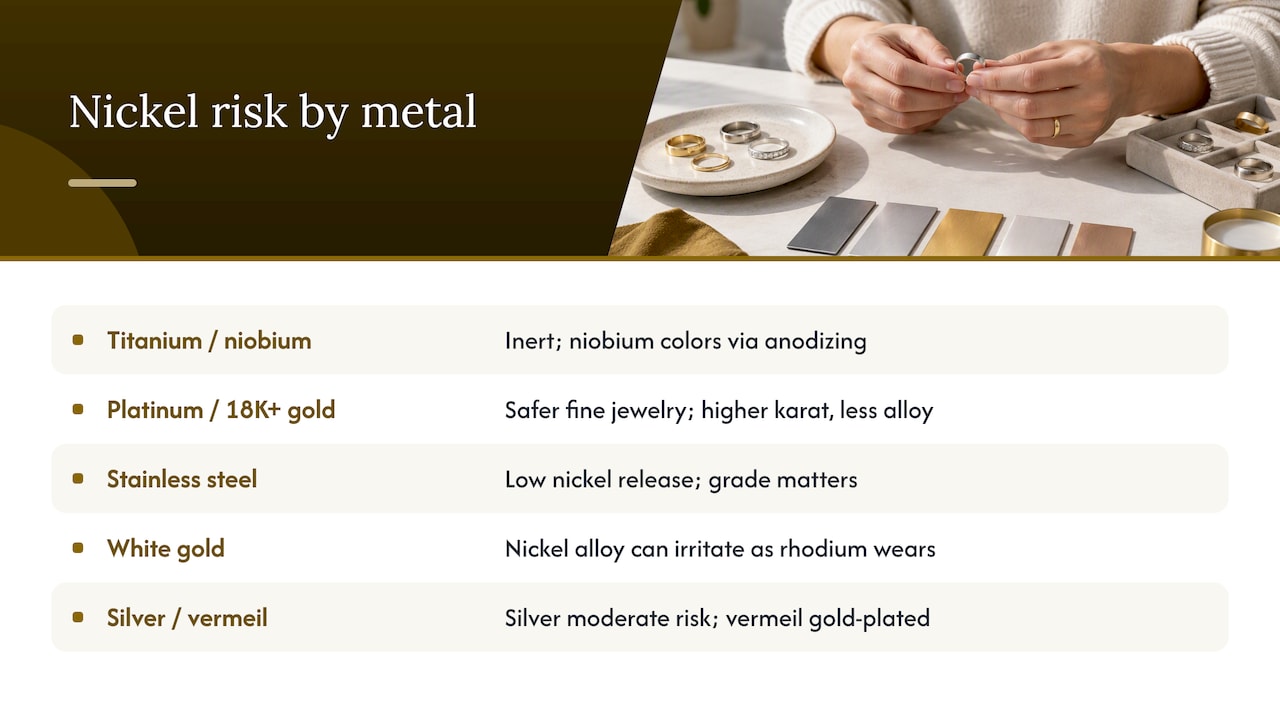
Implant-grade titanium is about as close to allergy-proof as jewelry metal gets. It does not contain nickel, resists corrosion, and is the metal surgeons use for joint replacements and bone plates, which is why body piercers favor it for fresh piercings. It is lightweight, holds up to daily wear, and rarely needs special care. The tradeoff is aesthetic: titanium does not have the warmth or shine of gold, and most pieces come in a limited range of finishes.
Niobium behaves almost identically to titanium in terms of inertness and is a favorite among piercers for new or irritated piercings. It can be anodized into a range of colors without introducing allergens, which makes it a good option for people who want some visual variety without sacrificing safety.
Platinum is the purity leader in fine jewelry. That purity is why dermatology guidance consistently lists platinum among the safer choices for people with metal allergies, according to Mayo Clinic’s nickel allergy overview. Our platinum jewelry collection reflects that same purity standard in every piece we craft in-house.
High-karat yellow gold (18K and above) dilutes the alloy content that can carry nickel, since gold itself does not cause reactions. The higher the karat, the less room there is for a problematic alloy mix, though 18K and 22K gold are softer and more prone to scratching than 14K. Readers who want the full breakdown of gold alloys can check our precious metals guide for a closer look at purity and karat tradeoffs.
White gold deserves its own caution. It is typically yellow gold alloyed with nickel or palladium, then coated in rhodium plating to achieve its bright white finish. Nickel-alloyed white gold can irritate sensitive skin once the rhodium wears thin, so anyone prone to reactions should ask specifically whether a piece uses a palladium alloy instead. Our guide to nickel-free white gold walks through exactly what to look for.
Surgical stainless steel, often labeled 316L or ASTM F-138, is generally low in nickel release, but “surgical” and “stainless” are not protected terms either. Grade matters: F-138 is the implant-grade specification used in medical devices, while a generic “stainless steel” listing could mean something far less consistent.
Sterling silver sits in the moderate-risk category. It is 92.5% silver alloyed with other metals, usually copper, and is generally well tolerated, though some people react to the alloy mix or to tarnish buildup on the surface. Our sterling silver care guide covers how regular cleaning reduces that risk.
Vermeil (gold-plated sterling silver) can work for people with mild sensitivity, but only if the gold layer is thick enough to prevent the base metal from reaching skin. Thin plating wears through faster than most buyers expect.
Tantalum is another inert, biocompatible option similar to titanium, though it shows up less often outside specialty and piercing jewelry.
Pro Tip: If you are unsure where a metal falls on the risk scale, ask the seller for the exact alloy composition before you buy, not just a marketing label.
How to Tell If a Piece Is Actually Hypoallergenic
Labels are a starting point, not proof. Here is how to verify what you are actually buying:
- Ask for the metal composition in writing. A reputable seller can tell you the exact karat, alloy, or grade, not just “hypoallergenic” or “nickel-free.”
- Request nickel-release documentation when it exists. The laboratory reference method is EN1811, the European standard used to measure how much nickel actually leaches from a surface over time.
- Understand the DMG spot test and its limits. The dimethylglyoxime test is a simple chemical swab that turns pink in the presence of nickel release above roughly 0.5 micrograms per square centimeter per week, a threshold tied to EU regulatory limits, according to the piercings and nickel allergy review. It is useful for a quick home check, but it can miss lower levels of release that still bother sensitive skin.
- Watch for plating wear. Rhodium-plated white gold and gold vermeil both rely on a thin surface layer. Once that layer thins from daily wear, the base metal underneath becomes the thing touching your skin.
- Look for implant-grade or ASTM-graded language. Terms like “ASTM F-136” (titanium) or “ASTM F-138” (stainless steel) reference actual manufacturing specifications, which carry more weight than an unregulated marketing term.
A substantial share of North American earrings tested in some market studies exceeded safe nickel-release thresholds, according to the systematic review on piercings and nickel allergy, which is a strong argument for asking questions before you buy rather than after you react.
Choosing Metals for Piercings, Earrings, Rings, and Daily Wear
Different pieces sit against your skin differently, so the right metal depends on how and where you wear it.
- For fresh piercings or a documented severe sensitivity, choose implant-grade titanium or niobium and nothing else until the site has fully healed.
- For everyday earrings and studs, titanium posts are the safest default, with verified nickel-free surgical stainless steel as a reasonable second option.
- For rings and bracelets that sit against sweat and friction all day, platinum or high-karat gold hold up better than thinly plated white gold, which wears faster in exactly the spots that touch skin.
- For budget or fashion pieces worn occasionally, thick vermeil or verified stainless steel can be acceptable, as long as you keep them dry and clean to slow plating wear.
How We Help Sensitive-Skin Shoppers Choose Safely
We manufacture our jewelry in-house, which means we control the metal selection from the start rather than relying on a third-party supplier’s description. When you design a piece with us, you choose the metal directly: platinum, sterling silver, or gold at 14K, 18K, or 22K, depending on what your skin tolerates.
We built educational resources specifically for this kind of decision, including our precious metals guide and our breakdown of nickel-free white gold, so you can understand exactly what you are buying before you commit.
A few practical habits we recommend before any purchase:
- Ask us directly for the alloy composition of any piece you are considering.
- Request material documentation if you have a known or suspected metal allergy.
- Read through our metals education pages if you want the fuller technical picture before you design a custom piece.
Since 1999, our family-run team has built a reputation on direct answers and transparent sourcing, reflected in the trust customers have placed in us through 222+ Google reviews.
Comparing Durability and Care Across Hypoallergenic Metals
Safety and longevity are not the same question, and the best metal for your skin is not automatically the lowest-maintenance one.
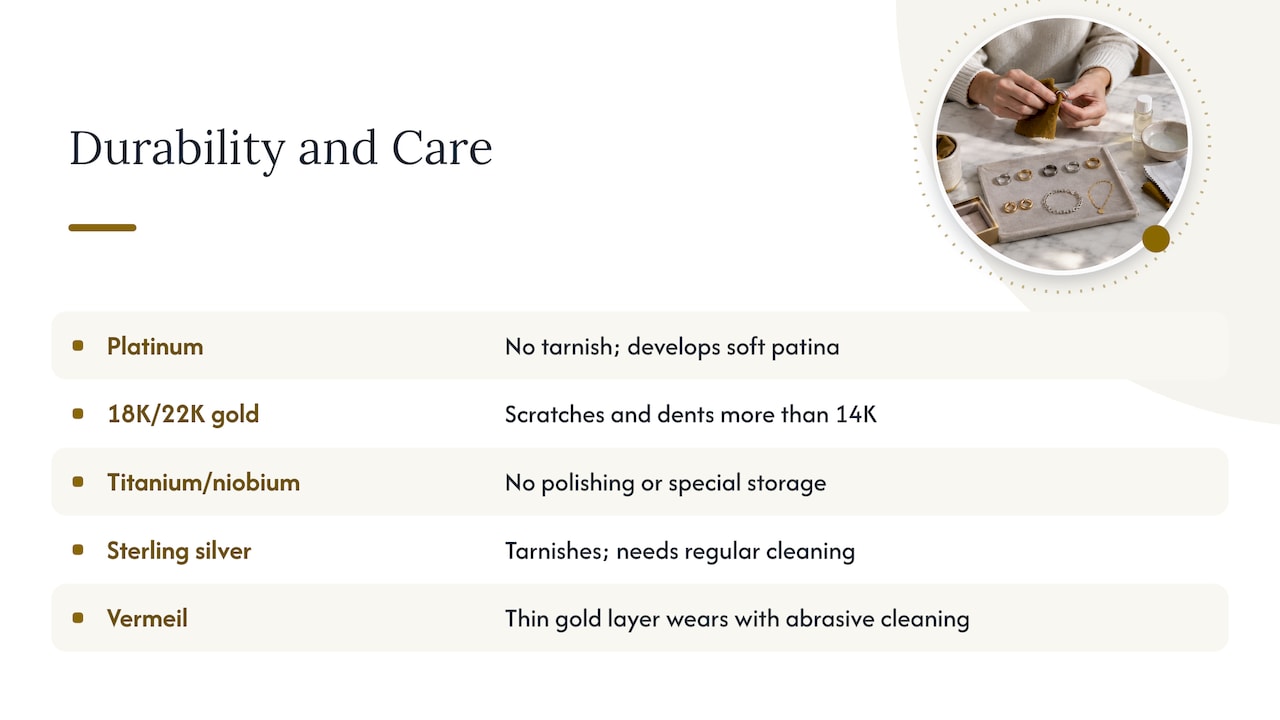
Platinum is the most durable of the group. It resists tarnish entirely and develops a soft patina over years of wear rather than scratching away, though it is a dense, heavier metal that some people notice more on the hand. High-karat gold, by contrast, trades some durability for purity. The higher the karat, the softer the metal, so 18K and 22K gold scratch and dent more easily than 14K, even though they carry less alloy and therefore less allergy risk.
Titanium and niobium are both remarkably tough and corrosion-resistant, which is part of why they work for permanent and healing piercings. Neither needs polishing or special storage. Sterling silver needs the most routine attention of the group: it tarnishes with air exposure and oils from skin, so it benefits from regular cleaning and dry storage between wears, as outlined in our sterling silver care guide. Vermeil needs the gentlest handling of all, since its gold layer is thin enough that abrasive cleaning or frequent contact with lotion and perfume can wear it down faster than solid gold ever would. Our jewelry care guide covers cleaning and storage habits that extend the life of any of these metals, and for higher-value pieces, a dedicated jewelry safe adds another layer of protection at home.
What Hypoallergenic Metals Cost, Upfront and Over Time
Price tends to track purity, and purity tends to track safety, which means the safest metals are often, though not always, the pricier ones.
Platinum carries the highest upfront cost of the group because of its density and purity, but it rarely needs replating or re-finishing, so the long-term cost of ownership is lower than it first appears. High-karat gold sits in the middle: 18K costs more than 14K at purchase, but both hold value well and need only occasional polishing. Titanium and niobium are comparatively affordable for what they offer, since the metals themselves are less costly to source than gold or platinum, making implant-grade pieces an accessible entry point for anyone prioritizing safety on a budget.
Sterling silver and vermeil sit at the lower end of the price range, which makes them appealing for everyday or fashion pieces, but vermeil carries a hidden long-term cost: thin gold plating wears through and may need replating within a few years of regular wear, an expense worth factoring in before you buy. Our sterling silver jewelry starts at $46, while platinum jewelry starts at $327, giving you a real sense of where each tier lands before you commit to one.
Where Hypoallergenic Metals Come From, and Why Sourcing Matters
Choosing a safer metal is only part of the picture. Where and how that metal was mined and refined carries its own set of considerations.
Platinum and gold mining both carry environmental weight, from land disturbance to the energy required for refining, which is why ethical sourcing commitments matter when you are comparing sellers. Titanium and niobium, by contrast, are often byproducts of other mineral extraction, which can mean a smaller dedicated environmental footprint, though sourcing transparency still varies by supplier. Recycled gold and platinum are increasingly available and reduce the need for new mining entirely, giving sensitive-skin shoppers a way to combine safety with a lighter environmental impact. When you are evaluating a seller, conflict-free and ethically sourced claims are worth asking about directly, the same way you would ask about nickel content.
Myths About Hypoallergenic Jewelry Worth Retiring
A few persistent myths lead people straight into the metals most likely to bother them.
The biggest one: “hypoallergenic” means tested and certified. It does not, since no U.S. standard governs the word, and a label alone is not evidence of low nickel release. A second myth is that “nickel-free” and “hypoallergenic” mean the same thing. Nickel-free describes content; hypoallergenic implies a broader safety claim that includes release rates, plating durability, and alloy composition, none of which a nickel-free label guarantees on its own.
Many people also assume gold is always safe because it does not itself cause allergies, overlooking that lower-karat gold and white gold both rely on alloy metals that can include nickel. And some assume that once a reaction clears up, the metal that caused it is now safe to wear again. Metal sensitivities tend to persist or worsen with repeated exposure rather than resolve, which is part of why switching metal substitutes without addressing the underlying allergy can lead to new sensitizations to metals like cobalt or palladium, according to research on the immunological mechanisms of metal allergies.
A Straight Answer on Metal Allergies
If there is one thing worth repeating here, it is that the safest approach is also the simplest: prioritize implant-grade titanium or niobium when sensitivity is severe or a piercing is fresh, and lean on platinum or 18K+ gold for everyday fine jewelry. Labels are not proof, documentation is.
If reactions persist no matter what you wear, that is a signal to go beyond jewelry shopping altogether. Patch testing remains the clinical standard for confirming a specific metal allergy, and a dermatologist can tell you with more certainty than any product label ever will, a point dermatology specialists reinforce when discussing metal sensitivity and implants. Persistent redness, swelling, or itching under jewelry you have worn before is worth that conversation, not another guess at a different metal.
— Joseph
Find Your Safe Metal Match With USA Jewels
We know how frustrating it is to fall in love with a piece only to wonder if it will leave your skin red and irritated a week later. Because we manufacture in-house, we can tell you exactly what is in every piece we make, and build it in the metal your skin actually tolerates.
Our relevant collections include:
- Platinum jewelry for the lowest-risk fine metal we offer.
- Gold jewelry collections in 14K and 18K, for readers who want warmth with less alloy.
- Sterling silver jewelry for everyday pieces at a gentler price point.
- A design your own option where you choose the exact metal, diamond, and setting yourself.
Every order ships free and insured, comes with a 30-day money-back guarantee, and qualifies for our lifetime diamond upgrade program. Reach out through our fine jewelry collections page to request material documentation or start a custom design built around the metal your skin needs.
FAQ
What is the most hypoallergenic metal for jewelry?
Implant-grade titanium and niobium are considered the least likely metals to trigger a reaction, since both are biologically inert and contain no nickel. For fine jewelry, platinum and high-karat gold (18K and above) are the closest equivalents, according to Mayo Clinic’s guidance on nickel allergy.
What metals don’t cause skin irritation?
Titanium, niobium, platinum, and high-karat gold are the metals least likely to cause irritation, largely because they contain little to no nickel and release very little of it even with daily wear. Surgical-grade stainless steel (316L or ASTM F-138) is also typically low-risk, though grade and sourcing can vary between sellers.
Can I wear 14K gold if I’m allergic to nickel?
It depends on the alloy. Yellow 14K gold usually contains less nickel than white 14K gold, which often relies on a nickel alloy under its rhodium plating, so asking a seller for the specific alloy composition before buying is the safest step, as explained in our nickel-free white gold guide.
What metal is 100% nickel free?
Pure titanium, niobium, tantalum, and platinum contain no nickel at all, making them reliable choices if you need to avoid the metal entirely. High-karat gold (18K and above) also contains very little alloy content, though “nickel-free” is not the same guarantee as “hypoallergenic,” since other alloy metals can still cause reactions in rare cases.
Sources
- Contact allergy to nickel and related epidemiology (PMC3047925)
- Nickel allergy – Symptoms & causes – Mayo Clinic
- Could a metal implant affect your skin? — American Academy of Dermatology
Recommended
- Nickel Free White Gold: Your Guide for Sensitive Skin
- Safe Jewelry Metals for Children: A Parent’s Guide
- Precious Metals Guide: Gold & Platinum

Deep Mehta is the Co-Owner of USA Jewels, a family-owned jewelry business she has led since 2013 in Deerfield Beach, Florida. With over 13 years of hands-on experience in fine jewelry retail, manufacturing, and diamond importing, Deep specializes in engagement rings, wedding bands, and custom jewelry design. She also co-manages Kaash Group Talent Acquisition. Deep is a University of Florida graduate and oversees every aspect of USA Jewels’ operations, from product development to marketing.
Fine Jewelry Collection

You May Also Like

Save 30–50% with Clarity Enhanced Diamonds: GIA Facts and What to Ask

How Jewelry Personalization Options Work for Gifts