Save 30–50% with Clarity Enhanced Diamonds: GIA Facts and What to Ask
A clarity enhanced diamond is a real, natural diamond that’s been treated with laser drilling or fracture filling to make inclusions less visible, typically selling for 30 to 50% less than a comparable untreated stone. That savings comes with real trade-offs: lower resale value, special care requirements, and limits on how future jewelers can work with the stone. Enhanced diamonds suit budget-focused buyers who want maximum visual sparkle for the price and don’t plan to resell.
TL;DR:
- Clarity enhanced diamonds are typically 30 to 50% less expensive than untreated stones but have a resale value that can be 20 to 50% lower.
- Laser drilling is considered stable and publicly disclosed on reports, while fracture filling is less permanent and often undisclosed, affecting market acceptance and grading.
- Proper documentation, including treatment disclosure and lab reports, is essential before purchasing, as untreated status and treatment method impact value and resale potential.
- Treated stones require gentle cleaning and careful handling to prevent filler degradation, with regular inspections recommended to preserve appearance and value.
- Clarity enhanced diamonds are suitable for buyers prioritizing size and sparkle on a budget, but less ideal for long-term durability and resale or estate planning.
Table of Contents
- Clarity Enhancement Explained: Laser Drilling and Fracture Filling
- Price Savings, Resale Value, and What the Market Actually Pays
- Weighing the Pros and Cons Before You Buy
- Your Buying Checklist: Questions to Ask Before You Sign Anything
- Caring for a Clarity Enhanced Diamond Long Term
- How Usajewels Documents and Supports Every Diamond Purchase
- When Clarity Enhanced Diamonds Make Sense (and When They Don’t)
- Design a Ring Around a Diamond You Actually Understand
- Sources
- FAQ
Clarity Enhancement Explained: Laser Drilling and Fracture Filling
Clarity enhancement doesn’t change what a diamond fundamentally is. It’s still a natural stone pulled from the ground, formed over billions of years. Treatment just addresses cosmetic flaws that would otherwise pull down the clarity grade and, more importantly, the price.
There are two methods you’ll run into when shopping for enhanced clarity diamonds:
- Laser drilling uses a focused beam to create a microscopic tunnel to a dark inclusion, then bleaches or lightens it. The GIA considers this generally stable once complete, though the drill hole itself becomes a permanent clarity characteristic the lab will note on any report.
- Fracture filling injects a glass-like substance into a surface-reaching crack to make it harder to see. This one is far less permanent. Heat, ultrasonic cleaning, and even some jewelry repairs can degrade or dislodge the filler.
That difference in permanence matters enormously for disclosure. The GIA’s 4Cs education confirms the lab will annotate laser-drilled diamonds on its reports but won’t grade fracture-filled stones at all. If a seller can’t produce a grading report, ask why, and ask specifically which treatment was used.
Price Savings, Resale Value, and What the Market Actually Pays
The math on clarity enhanced diamonds looks appealing on paper. You get a stone with the visual clarity of a much higher grade, at a fraction of the price. But the same market forces that make the discount attractive also cap what you’ll get back later.
By the numbers: Clarity enhanced diamonds typically cost 30 to 50% less than comparable untreated stones, but resale potential runs an estimated 20 to 50% lower than an equivalent untreated diamond.
Three factors drive that resale gap:
- Disclosure requirements. Reputable sellers must disclose treatment status, and that disclosure follows the stone into any future sale.
- Limited grading acceptance. Fracture-filled diamonds often can’t get a full grading report from major labs, which makes buyers on the secondary market nervous and appraisers cautious.
- Buyer preference shifts at resale. Someone buying new jewelry for themselves may love the look-for-price ratio. Someone buying a used stone tends to want long-term durability and full certification, which pushes demand (and price) toward untreated or lab-created diamonds instead.
None of this makes clarity enhanced diamonds a bad purchase. It makes them a purchase you should make with your eyes open, especially if resale or estate value factors into your decision at all. If you’re buying jewelry to wear and enjoy rather than treating it as an investment vehicle, the discount can be the smarter play.
Weighing the Pros and Cons Before You Buy

Here’s the honest trade-off, laid out plainly rather than buried in marketing copy.
The advantages of clarity enhanced stones:
- You get an eye-clean appearance (no visible inclusions to the naked eye) at a clarity grade you likely couldn’t afford untreated.
- Your budget stretches further, often letting you buy a larger center stone or add better side stones and matching accents.
- The treatment doesn’t change the diamond’s identity. It’s still a natural, mined stone, not a simulant.
The trade-offs you’re accepting:
- Heat sensitivity means resizing, soldering, and prong repairs carry real risk to fracture-filled stones.
- Filler can degrade over years, sometimes turning cloudy or slightly discolored.
- Certification is inconsistent. GIA won’t grade fracture-filled diamonds, which limits your documentation options and, later, your resale pool.
Pro Tip: Ask specifically whether GIA graded the stone before or after treatment, and request the treatment company’s own certificate if one exists. A seller who hesitates on either question is telling you something.
Full disclosure isn’t optional in this industry; it’s the standard every reputable dealer should meet without you having to push for it.
Your Buying Checklist: Questions to Ask Before You Sign Anything
Walking into a jewelry purchase with a checklist protects you far better than trusting a sales pitch. Use this sequence before you commit to any clarity enhanced stone.
- Ask for written treatment disclosure. It should state exactly what was done: laser drilling, fracture filling, or both.
- Request the lab report and confirm its timing. Find out whether the GIA or AGS graded the stone after treatment, since that changes what the grade actually reflects.
- Identify the exact treatment method. Laser drilling and fracture filling carry different risks, so don’t accept a vague “enhanced” label.
- Ask for the treatment company’s certificate, if the seller worked with a third-party treatment facility rather than doing it in-house.
- Confirm the return policy in writing, including the window and whether it covers a change of mind or only defects.
- Ask about repair and warranty procedures specifically as they apply to treated stones, since standard warranties sometimes exclude filler-related damage.
- Get an independent appraisal from a jeweler who wasn’t involved in the sale, especially for anything above a modest price point.
Skipping any one of these steps is how buyers end up surprised later, either at a jeweler’s counter when a repair goes wrong or at resale when a buyer balks at incomplete documentation.
Caring for a Clarity Enhanced Diamond Long Term
Treated stones need a gentler routine than untreated diamonds, and getting this wrong can undo the treatment entirely.
- Skip the ultrasonic and steam cleaners. Both can dislodge or damage filler in fracture-filled stones. Stick to mild soap, warm water, and a soft cloth.
- Warn every jeweler before any heat work. Resizing, soldering, and prong retipping all involve heat that can bubble or discolor filler material.
- Schedule regular inspections. Once a year is reasonable for most wearers, more often if you wear the piece daily.
- Watch for warning signs. If filler starts to look cloudy, darkens, or a channel becomes newly visible, get it checked before the problem spreads.
A little more than 1 in 5 resale valuations on enhanced stones come in lower specifically because of undisclosed or unnoticed filler damage from improper cleaning. Careful maintenance protects both the look of your stone and its value down the line.
How Usajewels Documents and Supports Every Diamond Purchase
Every diamond conversation at Usajewels starts with documentation, not upselling. Since 1999, our family-owned, in-house manufacturing model has let us control sourcing and disclosure directly rather than relying on outside vendors to tell us the truth. Whether you’re comparing natural, enhanced, or lab-created options, you get clear treatment status, ethical sourcing, and access to our lifetime diamond upgrade program. With over 222 Google reviews behind that reputation, we’d rather you ask hard questions before you buy than have regrets after.
When Clarity Enhanced Diamonds Make Sense (and When They Don’t)
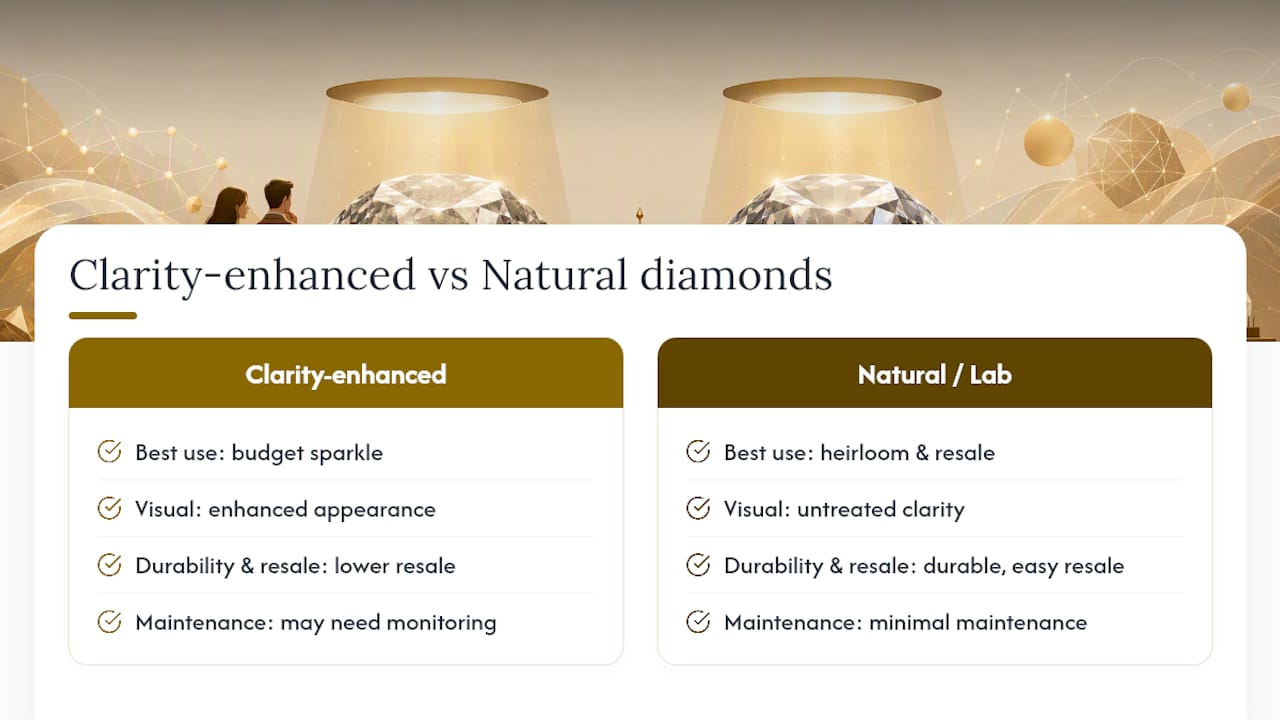
If you want maximum visual size and sparkle on a fixed budget, and you’re not treating the ring as a future resale asset, clarity enhanced diamonds are a reasonable, well-disclosed option. If your priority is heirloom durability, easy resale, or minimal maintenance, an untreated natural diamond or a lab-grown stone will serve you better over the long run.
Whichever direction you lean, insist on a lab report and get an independent appraisal before you finalize anything. Skipping that step is the one mistake that turns a good deal into a bad surprise.
— Joseph
Design a Ring Around a Diamond You Actually Understand
Usajewels gives you something most jewelers won’t: the choice to see exactly what you’re buying, whether that’s a documented clarity enhanced stone at a lower price point or a fully untreated natural diamond built for the long haul. Our design-your-own process lets you pick the diamond quality, shape, and metal yourself, backed by ethical sourcing and a lifetime upgrade program that most competitors simply don’t offer.
Every stone we sell comes with clear treatment disclosure, a real return policy, and access to independent appraisal, so you’re never guessing what you paid for. If you’re ready to start comparing options with full documentation in hand, browse our engagement ring collection or explore our fine diamond jewelry to see documented stones side by side before you decide.
Sources
FAQ
What does it mean if a diamond is clarity enhanced?
It means a natural diamond underwent laser drilling, fracture filling, or both, to reduce the visibility of internal or surface inclusions and improve its apparent clarity grade.
What does “diamond enhanced” mean?
“Diamond enhanced” and “clarity enhanced” describe the same thing: a treatment process applied to a natural stone to mask flaws, not a synthetic or lab-created diamond.
Which clarity grade is the best?
Flawless (FL) and Internally Flawless (IF) sit at the top of the GIA clarity scale, but most buyers get better value from eye-clean grades like VS1 or VS2, whether treated or untreated.
Are clarity enhanced diamonds real?
Yes. A clarity enhanced diamond is a genuine, natural diamond that’s been treated to improve its appearance; it is not a synthetic, simulant, or fake stone.
Recommended
- Diamond Clarity Chart — FL to I3 Grades Explained
- Natural Diamonds: Quality, Value & Origin
- GIA Certification Diamonds: What Buyers Need to Know
- Diamond Cut Guide — How Cut Grades Affect Brilliance

Deep Mehta is the Co-Owner of USA Jewels, a family-owned jewelry business she has led since 2013 in Deerfield Beach, Florida. With over 13 years of hands-on experience in fine jewelry retail, manufacturing, and diamond importing, Deep specializes in engagement rings, wedding bands, and custom jewelry design. She also co-manages Kaash Group Talent Acquisition. Deep is a University of Florida graduate and oversees every aspect of USA Jewels’ operations, from product development to marketing.
Fine Jewelry Collection


You May Also Like

Affordable Luxury Jewelry Types: Your 2026 Style Guide

Why Jeweler Reputation Matters When Buying Fine Jewelry