Safe Jewelry Metals for Children: A Parent’s Guide
The safest metals for children’s jewelry are implant-grade titanium (ASTM F-136), commercially pure niobium, and verified solid gold in 14K or 18K. These three options are nickel free, biocompatible, and recommended by professional piercers for initial piercings. Solid 22K gold is also safe in cultural contexts when the alloy is confirmed nickel-free. For everyday necklaces and bracelets on older children with healed skin, certified 925 sterling silver and platinum are also solid choices.
Do: Ask sellers for ASTM F-136 certification or a mill test certificate confirming nickel-free composition before you buy.
Don’t: Purchase plated, costume, or any piece labeled only “hypoallergenic” without a specific alloy designation to back it up.
Age-appropriate quick guide:
- Under 3: No small-parts jewelry, no removable earrings, no loose charms.
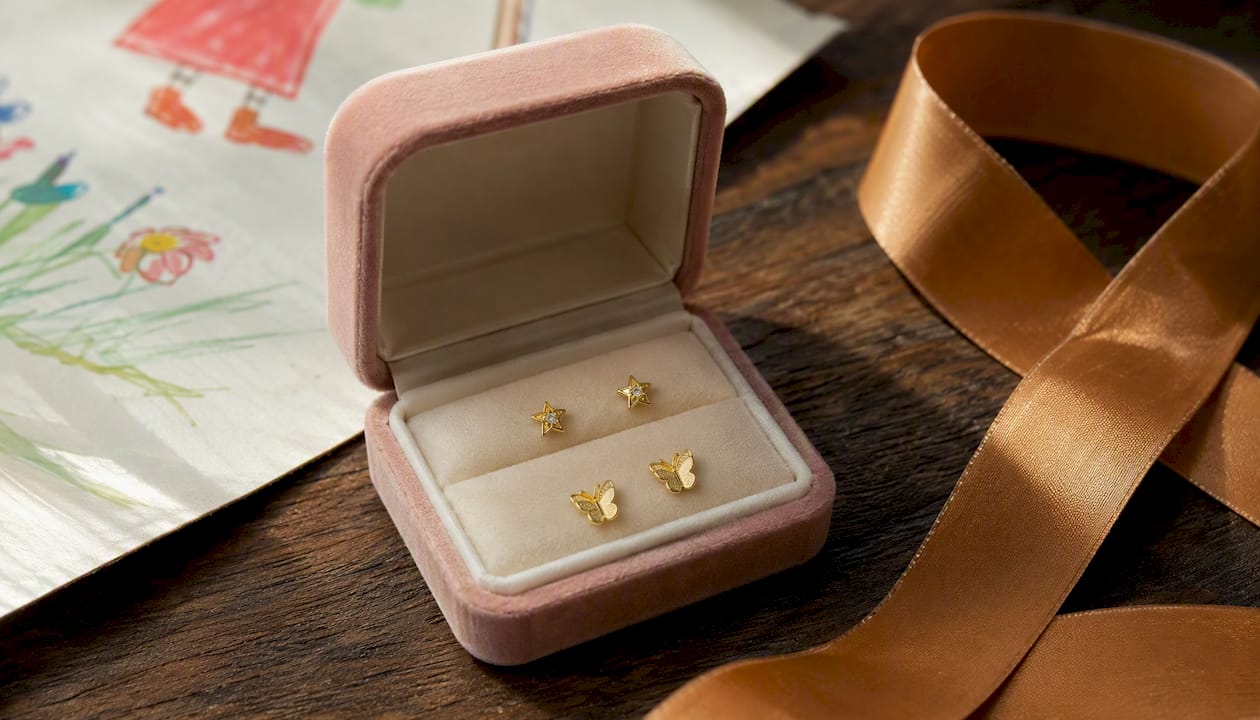
- Ages 3–8: Titanium or nickel-free solid gold studs with secure screw-backs.
- Ages 9 and up: More options are available once piercings are healed and sensitivity is known, including sterling silver and surgical steel for non-sensitive children.
Usajewels offers solid-gold options with verifiable metal documentation, making it straightforward for parents to shop with confidence.
Table of Contents
- Why do children react to some metals?
- Metal-by-metal guide for children’s jewelry
- What should you check before buying children’s jewelry?
- What should you do if your child has a reaction?
- Key Takeaways
- What parents often get wrong about children’s jewelry safety
- Usajewels makes it easier to shop safely for your child
- Useful sources
- FAQ
Why do children react to some metals?
Nickel and ingested heavy metals are the two main hazards in children’s jewelry. Understanding both helps you cut through the marketing noise.
Nickel contact dermatitis is the most common metal allergy in children. When nickel ions leach from a metal alloy into skin, the immune system can mount a reaction: redness, itching, and small fluid-filled blisters around the contact point. Once sensitized, a child often stays sensitive for life. The risk is highest during the healing phase of a new piercing, when the skin barrier is broken and ion absorption is greatest.
Lead and cadmium are a different category of risk. These metals are toxic primarily when ingested, which makes them especially dangerous for young children who put jewelry in their mouths. Health Canada sets regulatory limits on lead and cadmium content in children’s jewelry to minimize ingestion risk. Lead accumulates in the body and causes developmental harm; cadmium is associated with kidney damage and systemic effects. The U.S. Consumer Product Safety Commission (CPSC) enforces similar limits under federal law, and both agencies focus testing on small parts and items likely to be mouthed.
Statistic to know: Health Canada caps total lead in children’s jewelry at 90 mg/kg and cadmium in small parts at 130 mg/kg, reflecting the ingestion risk for young children.
The term “hypoallergenic” has no legal definition in the United States. A seller can print it on any package without testing. “Surgical grade” is equally unreliable without a specific ASTM or ISO designation. The Association of Professional Piercers recommends relying on documented alloy designations (ASTM F-136, ISO 5832-3) and mill test certificates rather than marketing labels. A handcrafted vs. mass-produced comparison can also clarify when composition claims are trustworthy.
Key hazard sources to watch for:
- Nickel in alloys (white gold, surgical steel, brass, cheap silver)
- Lead and cadmium in painted or plated costume jewelry
- Plating wear that exposes reactive base metals over time
- Small removable parts that create ingestion and choking risk
Metal-by-metal guide for children’s jewelry
| Metal | Nickel/Lead/Cadmium Risk | Durability | Price Range | Best Age Group | Notes |
|---|---|---|---|---|---|
| Implant-grade titanium (ASTM F-136) | None | Excellent | Moderate | All ages, including infants | Gold anodized colors available; first choice for new piercings |
| Niobium | None | Very good | Moderate | All ages | Hypoallergenic, anodizable; slightly heavier than titanium |
| 14K/18K solid gold (nickel-free alloy) | None when verified | Very good | Higher | Ages 3+ | Confirm alloy is nickel-free; white gold may contain nickel unless palladium-based |
| 22K solid gold | None when verified | Softer | Higher | Cultural/ceremonial use | Traditional choice; verify alloy; not ideal for active daily wear |
| Platinum | None | Excellent | Highest | Ages 5+ | Naturally nickel-free; very durable; premium price |
| Sterling silver (925) | Trace risk in low-quality pieces | Good | Lower | Healed piercings, ages 6+ | Tarnishes; not ideal for fresh piercings; verify nickel-free stamp |
| Surgical stainless steel (316L/316LVM) | Contains ~8% nickel | Excellent | Low | Healed ears, ages 6+ | Safe for most healed piercings; avoid for new piercings or known sensitivity |
| Gold-plated / vermeil / filled | Base metal exposed when plating wears | Poor long-term | Lowest | Not recommended for piercings | Plating wears through; base metal contact risk |
| Costume / base metals (brass, copper) | High (nickel, lead, cadmium possible) | Poor | Very low | Not recommended | Avoid for all children’s pierced jewelry |
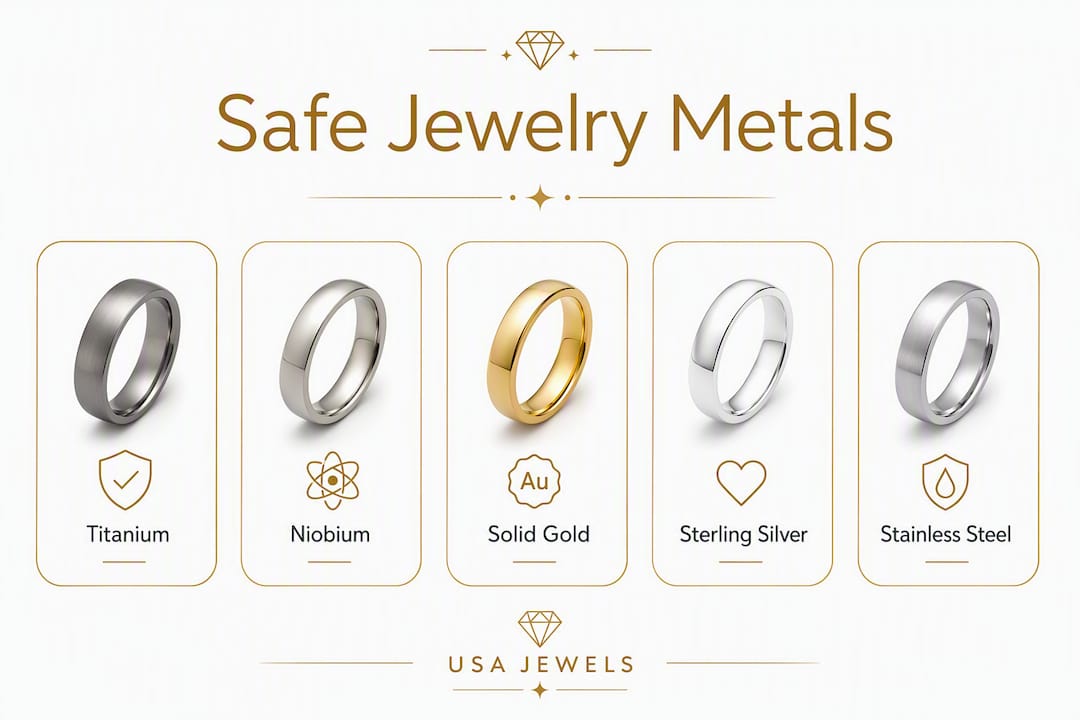
Titanium (ASTM F-136): This is the gold standard for children’s initial piercings. It releases no nickel ions, is lightweight, and professional piercers consistently recommend it. Anodized finishes add color without coatings that can chip or flake.
Niobium: Equally biocompatible, slightly denser, and a strong alternative when titanium is unavailable. Like titanium, it can be anodized for color.
Solid gold (14K/18K): The 14K alloy balances durability and biocompatibility well. The critical caveat: white gold is frequently nickel-alloyed unless the seller specifies a palladium-based formula. Rose gold contains copper, which is generally tolerated but can irritate very sensitive skin. Always ask for written nickel-free confirmation. Solid 18K and 22K gold are long-standing cultural choices and are reliably safe when the alloy is verified.
Sterling silver (925): Acceptable for healed piercings in older children, but it tarnishes and some lower-quality pieces carry trace alloy elements. Not a first choice for fresh piercings. Clean regularly and inspect for tarnish or discoloration near the post.
Surgical stainless steel (316L/316LVM): Contains roughly 8% nickel by alloy composition. For most children with healed ears and no known sensitivity, it is generally safe. For a new piercing or a child with suspected sensitivity, choose titanium or niobium instead.
Plated jewelry: Gold plating wears through with normal wear, exposing the base metal underneath. Never use plated pieces for a healing piercing, and inspect plated necklaces and bracelets regularly for wear.
What should you check before buying children’s jewelry?
Always verify metal composition and request a mill certificate or ASTM/ISO code before purchasing any piece for a pierced child. Marketing language alone is not enough.
Buying checklist:
- Ask for a mill test certificate or written alloy specification (e.g., “ASTM F-136 titanium” or “14K nickel-free gold”).
- Look for stamps: 14K, 18K, 925, or ASTM F-136 on the piece itself.
- Reject any piece described only as “hypoallergenic” or “surgical grade” without a named alloy standard. The limits of hypoallergenic labeling are well documented in the jewelry industry.
- Confirm nickel-free status in writing, especially for white gold.
- Avoid plated, filled, or vermeil pieces for pierced ears.
Closure and small-part safety:
- Choose screw-back or flat-back studs for children under 8; they are harder to remove accidentally.
- No small removable charms or pendants for children under 3.
- Check chain thickness: thin chains can break and become a choking hazard.
- Inspect clasps for sharp edges and secure closure.
Care tips:
- Clean titanium and niobium with mild soap and warm water; no harsh chemicals needed.
- Sterling silver tarnishes; use a soft polishing cloth and avoid chlorine and lotions.
- Inspect plated pieces monthly for wear; retire them when the base metal shows.
Pro Tip: When buying solid-gold or titanium earrings for a child’s fresh piercing, request the batch traceability number or mill certificate by name. A reputable seller will have it. If they hesitate, that hesitation is your answer.
What should you do if your child has a reaction?
Mild contact dermatitis looks like redness, itching, or small blisters at the jewelry contact point. An infected piercing shows swelling, warmth, discharge, and sometimes fever. The response differs.
- Remove the jewelry immediately. Do not wait to see if it improves while the piece is still in contact with skin.
- Clean the area with gentle soap and warm water. Pat dry with a clean cloth.
- Apply a cool compress for 10–15 minutes to reduce redness and itching.
- For mild dermatitis, a low-strength topical hydrocortisone cream can calm the reaction. Follow your pediatrician’s guidance on strength and duration.
- Monitor for 24–48 hours. If redness spreads, swelling increases, or your child develops a fever, contact your pediatrician.
- Go to the ER if swelling restricts breathing, if your child swallowed a piece of jewelry, or if you suspect ingestion of an item that may contain lead or cadmium.
- Keep the jewelry. Do not discard it. A dermatologist or allergist can test it, and you may need the piece to request composition documentation from the seller.
- Follow up with a professional. If reactions recur, ask your pediatrician for a referral to a pediatric dermatologist for patch testing to identify the specific allergen.
Key Takeaways
Implant-grade titanium (ASTM F-136), niobium, and verified nickel-free solid gold (14K–18K) are the safest metals for children’s jewelry, and no piece should be purchased without documented alloy composition.
| Point | Details |
|---|---|
| Top safe metals | ASTM F-136 titanium, niobium, and verified 14K/18K nickel-free solid gold are the first choices for all ages. |
| Avoid plated and costume pieces | Plating wears through and exposes reactive base metals; costume jewelry may contain lead or cadmium. |
| Demand documentation | Ask for a mill test certificate or ASTM/ISO code; “hypoallergenic” alone is not a verified safety claim. |
| Age and part safety | Children under 3 should not wear small-parts jewelry; screw-back or flat-back studs are safest for ages 3–8. |
| Usajewels for verified options | Usajewels offers solid-gold jewelry with metal documentation and in-house manufacturing you can trust for children’s pieces. |
What parents often get wrong about children’s jewelry safety
The conventional wisdom says “just buy hypoallergenic.” That advice is well-meaning and almost useless. “Hypoallergenic” is a marketing word with no regulatory definition in the United States. A piece stamped with it can still contain nickel, still leach metal ions, and still trigger a reaction in a sensitive child.
What actually matters is documented alloy composition. A mill certificate is a piece of paper that says exactly what a metal is made of, by percentage, traceable to the batch. It costs a reputable manufacturer nothing to provide. If a seller cannot produce one for a piece going into a child’s fresh piercing, that is a meaningful signal about how the piece was made.
There is also a tendency to treat gold as automatically safe. It is not, categorically. White gold is frequently alloyed with nickel to achieve its color. Rose gold contains copper. Neither is dangerous for most children, but for a child with a developing immune system and a healing piercing, the alloy composition matters as much as the karat stamp. Solid 14K or 18K gold from a verified, nickel-free alloy is safe. “Gold-colored” or “gold-plated” is a different product entirely.
The families who avoid problems are the ones who ask one simple question before buying: “Can you show me the alloy specification?” The answer tells you everything.
Usajewels makes it easier to shop safely for your child
Finding verified, child-safe metal jewelry should not require a chemistry degree. At Usajewels, we’ve been manufacturing fine jewelry in-house since 1999, which means we control the metal sourcing, the alloy choices, and the documentation from the start. Parents shopping for solid-gold earrings, simple gold chains, or secure-clasp bracelets can request metal specifications directly, because we make the pieces ourselves.
Our fine jewelry collection includes solid 14K and 18K gold options, the same verified alloys professional piercers recommend for children. We can provide metal documentation on request, and our lifetime diamond upgrade program means the pieces you choose today grow with your family. No middlemen, no guesswork about what the metal actually is.
Browse our jewelry collections or reach out directly to ask about metal specifications for a specific piece. We’re here to help you choose something beautiful and genuinely safe.
Useful sources
- Association of Professional Piercers: Jewelry for Initial Piercings — The industry standard for safe piercing metals, ASTM designations, and mill certificate requirements.
- Usajewels: Precious Metals Guide — Detailed information on gold karats, platinum, and metal choices available through Usajewels.
- Usajewels: Sterling Silver Guide — Care, composition, and everyday-wear guidance for 925 sterling silver.
- Usajewels: Age-Appropriate Jewelry Examples — Practical gift and safety guidance organized by age group.
FAQ
What is the safest metal for a child’s first ear piercing?
Implant-grade titanium stamped to ASTM F-136 is the safest choice for a child’s first piercing. It is nickel-free, biocompatible, and recommended by the Association of Professional Piercers for initial healing.
Is surgical stainless steel safe for children’s jewelry?
Surgical stainless steel (316L/316LVM) is generally safe for healed piercings in children without known nickel sensitivity, but it contains roughly 8% nickel and is not recommended for fresh piercings or children with suspected metal allergies.
What does “hypoallergenic” mean on children’s jewelry?
“Hypoallergenic” has no legal definition in the United States and is not a verified safety claim. Always ask for a specific alloy designation (such as ASTM F-136) or a mill test certificate instead of relying on this label.
Can children wear gold jewelry safely?
Yes, solid 14K or 18K gold from a verified, nickel-free alloy is safe for most children. White gold is often nickel-alloyed, so confirm it is palladium-based and nickel-free before purchasing. Usajewels offers solid-gold options with documented metal composition.
What should I do if my child’s skin reacts to jewelry?
Remove the jewelry immediately, clean the area with mild soap and water, and apply a cool compress. If redness spreads, swelling increases, or fever develops, contact your pediatrician. Keep the piece for possible allergy testing.
Recommended
- Affordable Gold Jewelry for Kids: A Parent’s Guide
- Adjustable Ring Children Jewelry: A Parent’s Safety Guide
- Age-Appropriate Jewelry Examples: A Complete Gift Guide
- Handcrafted vs. Mass-Produced Children’s Jewelry Guide

Deep Mehta is the Co-Owner of USA Jewels, a family-owned jewelry business she has led since 2013 in Deerfield Beach, Florida. With over 13 years of hands-on experience in fine jewelry retail, manufacturing, and diamond importing, Deep specializes in engagement rings, wedding bands, and custom jewelry design. She also co-manages Kaash Group Talent Acquisition. Deep is a University of Florida graduate and oversees every aspect of USA Jewels’ operations, from product development to marketing.
Fine Jewelry Collection


You May Also Like
Why Diamond Stud Earrings Are the Best Starter Jewelry

10 Engagement Ring Design Mistakes to Avoid