Conflict-Free Diamond vs Lab Grown: Buyer’s Guide
Conflict-free diamonds and lab-grown diamonds are two ethically conscious choices that differ significantly in origin, certification, and environmental impact. Understanding those differences is the key to making a purchase you feel good about for years. A conflict-free natural diamond is a mined stone certified to be free from funding armed conflict, primarily through the Kimberley Process Certification Scheme. A lab-grown diamond is physically identical to a natural diamond but created in a controlled facility, making it inherently conflict-free by design. Certifications from GIA, IGI, and the Responsible Jewellery Council (RJC) play a central role in verifying both types.
Conflict-free diamond vs lab grown: how each is sourced
The sourcing story behind each diamond type shapes its ethical profile from the start.
Conflict-free natural diamonds are mined stones that carry documentation proving they did not finance rebel movements or wars against recognized governments. The Kimberley Process is the global certification framework behind that claim. Nearly 99% of diamonds worldwide carry Kimberley Process certification. That number sounds reassuring, but it reflects only one narrow definition of “ethical.”

The Kimberley Process has real limitations. It covers conflict funding only, leaving out labor rights, worker safety, environmental damage, and community impact. A diamond can pass Kimberley Process review and still come from a mine with unsafe conditions or poor environmental practices. That gap is why beyond-Kimberley standards matter.
The Responsible Jewellery Council (RJC) fills some of that gap. RJC certification requires third-party audits covering human rights, labor standards, environmental performance, and business ethics. Retailers who hold RJC membership commit to supply chain traceability, not just conflict-free paperwork. When you ask a jeweler how their conflict-free diamonds are sourced, RJC membership is one of the strongest answers they can give you.
Lab-grown diamonds sidestep the mining supply chain entirely. They are produced in facilities using either High Pressure High Temperature (HPHT) or Chemical Vapor Deposition (CVD) methods. Because no mining occurs, there is no risk of funding armed conflict and no land disruption. The sourcing question shifts from geography to energy source and labor conditions inside the manufacturing facility.
- Kimberley Process certifies conflict-free status for natural diamonds
- RJC certification adds labor, environmental, and human rights standards
- Lab-grown diamonds carry no mining-related conflict risk
- Energy source and facility labor practices determine the ethical profile of lab-grown stones
- Supply chain traceability documents are the strongest verification tool for natural diamonds
Pro Tip: Ask any jeweler for the specific country of origin and the name of the mine or facility. Vague answers like “ethically sourced” without documentation are a red flag.
What are the real benefits of lab-grown diamonds?
Lab-grown diamonds offer a genuinely different ethical and environmental profile compared to mined stones, but the picture is more nuanced than most marketing suggests.
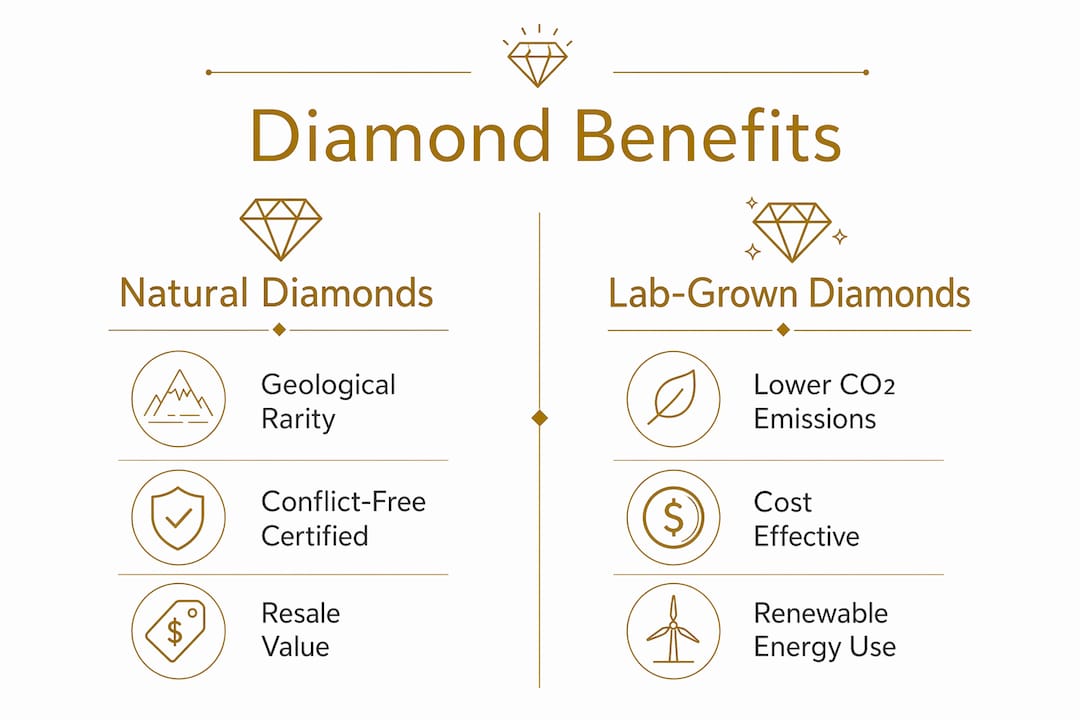
The environmental case for lab-grown diamonds is strong on several fronts. Lab-grown diamonds produce 80–97% less CO2 than mined diamonds and require no land disruption or significant water use. That reduction in carbon output is meaningful, especially for buyers who prioritize climate impact.
Energy consumption is the counterpoint. Lab-grown diamond production requires significant electricity, and the environmental footprint depends entirely on the energy source powering the facility. A diamond grown using coal-powered electricity may carry a higher environmental impact than a responsibly mined natural stone. Facilities running on renewable energy tell a very different story.
Labor conditions inside lab-grown facilities are generally more transparent than deep-mine operations, but they are not automatically ethical. Facilities in regions with weak labor protections can still expose workers to poor conditions. The key is asking whether the manufacturer publishes labor audits and energy sourcing data.
Here is a direct comparison of the two ethical profiles:
- Lab-grown diamonds: No mining conflict risk, lower CO2 output, no land disruption, but energy-intensive production and variable labor transparency
- Conflict-free natural diamonds: Kimberley Process certified, but limited to conflict funding only; broader ethics depend on additional RJC or third-party certification
Pro Tip: When evaluating a lab-grown diamond, ask the retailer whether the production facility uses renewable energy. That single question separates genuinely low-impact stones from ones that just avoid mining.
The ethical choice between lab grown and natural is not determined by production method alone. Governance, supply chain transparency, and verified energy sourcing matter just as much as where the diamond came from.
How does pricing compare between the two?
Price is one of the most practical differences between conflict-free natural diamonds and lab-grown alternatives, and the gap is significant.
Lab-grown diamonds typically cost 50–80% less than a comparable natural diamond. That price advantage comes from unlimited supply and lower production costs. For buyers who want maximum size and quality within a set budget, lab-grown diamonds deliver far more stone per dollar.
| Factor | Conflict-Free Natural Diamond | Lab-Grown Diamond |
|---|---|---|
| Average price vs. comparable stone | Baseline | 50–80% less |
| Resale value | 25–50% of retail | Lower than natural |
| Supply | Finite, geologically limited | Unlimited, factory-produced |
| Price trend | Relatively stable | Declining as supply grows |
| Certification impact on value | Significant | Moderate |
Resale value is where both types disappoint buyers who treat diamonds as investments. Mined diamonds typically resell at 25–50% of retail, while lab-grown diamonds retain even less due to growing supply. Neither type is a reliable financial asset. Buy a diamond because it carries meaning, not because you expect to profit from it later.
How conflict-free status affects diamond pricing is subtle but real. Certified conflict-free natural diamonds with RJC documentation and verified origin command a premium over uncertified stones. That premium reflects the cost of auditing, traceability, and documentation. Lab-grown diamonds carry their own certification costs through GIA or IGI, but those costs are smaller relative to the overall price reduction.
For budget-conscious buyers, the math is straightforward. A lab-grown diamond lets you choose a larger carat weight or higher clarity grade for the same spend. For buyers who place high value on natural origin and geological rarity, the premium for a certified natural stone reflects something beyond price.
What certifications should you look for?
Certification is the single most reliable way to verify what you are actually buying, whether you choose a conflict-free natural diamond or a lab-grown stone.
- GIA (Gemological Institute of America): The most widely recognized grading authority for both natural and lab-grown diamonds. A GIA report confirms cut, color, clarity, and carat weight, and for natural diamonds, it includes origin information where traceable.
- IGI (International Gemological Institute): Widely used for lab-grown diamonds. IGI reports confirm that a stone is lab-grown and provide full 4 Cs grading, making them a trusted standard for lab-created diamond certification.
- RJC (Responsible Jewellery Council): A retailer-level certification, not a stone-level report. RJC membership means the seller has passed third-party audits on ethics, labor, and environmental standards.
- Supply chain documentation: For natural diamonds, ask for country of origin, mine name, and any traceability reports beyond the Kimberley Process certificate.
- Manufacturer audit reports: For lab-grown diamonds, ask for documentation on energy sourcing and labor standards at the production facility.
Certification from GIA or IGI provides details on cut, color, clarity, and carat, which are the four factors that determine a diamond’s quality and value. Never purchase a diamond without a grading report from one of these recognized labs. Sellers who cannot provide third-party certification are asking you to take their word for it.
Pro Tip: A certificate number on a GIA or IGI report can be verified directly on those organizations’ websites. Always cross-check before you buy.
Key takeaways
The ethical quality of any diamond, natural or lab-grown, depends on verified supply chain transparency and recognized certification, not origin alone.
| Point | Details |
|---|---|
| Conflict-free certification limits | Kimberley Process covers conflict funding only; RJC adds labor and environmental standards. |
| Lab-grown environmental edge | Lab-grown diamonds produce 80–97% less CO2, but only when powered by clean energy sources. |
| Price advantage of lab-grown | Lab-grown diamonds cost 50–80% less than natural stones, offering more quality per dollar. |
| Resale reality | Neither natural nor lab-grown diamonds are reliable investments; buy for sentiment, not return. |
| Certification is non-negotiable | Always request a GIA or IGI grading report and ask for supply chain documentation. |
Why the natural vs. lab debate misses the point
I have spent years helping customers work through this exact question, and the most common mistake I see is treating it as a simple binary. People assume lab-grown automatically means ethical, or that a Kimberley Process certificate settles the matter for natural diamonds. Neither assumption holds up under scrutiny.
The ethical evaluation hinges on governance and verified supply chains, not just production method. A natural diamond from a Canadian mine with full RJC certification, documented traceability, and renewable energy-powered operations can be more ethical than a lab-grown diamond produced in a coal-powered facility with no published labor audits. That is not a theoretical edge case. It happens regularly.
What I tell every customer is this: ask harder questions. “Conflict-free” is a starting point, not a finish line. The ethical choice increasingly depends on transparency, governance, and verified supply chains across both categories. A jeweler who cannot answer specific questions about origin, energy sourcing, or labor standards is not giving you the full picture.
Your personal values and budget should guide the final decision. If you want maximum size and quality for your money with a lower carbon footprint, a lab-grown diamond from a verified, renewable-energy facility is a strong choice. If you value geological rarity and are willing to invest in a fully documented natural stone, a certified conflict-free diamond with RJC backing is equally defensible. Neither path is wrong. The wrong path is buying without asking.
— Joseph
Find certified diamond jewelry at Usajewels
At Usajewels, we carry both conflict-free natural diamonds and lab-grown diamonds, each backed by recognized certification and our family’s commitment to ethical sourcing since 1999. Every piece in our collection comes with full documentation so you know exactly what you are buying and where it came from.
Whether you are drawn to the geological rarity of a certified natural stone or the value and lower environmental footprint of a lab-grown diamond, our team is here to help you find the right fit. Browse our fine diamond jewelry collection to explore certified options across every style and budget. With in-house manufacturing and direct pricing, you get quality without the markup.
FAQ
What does conflict-free diamond mean?
A conflict-free diamond is a natural mined stone certified to have not funded armed conflict against a recognized government. The Kimberley Process Certification Scheme is the primary standard used to verify this status globally.
Are lab-grown diamonds always more ethical than natural diamonds?
Not automatically. Lab-grown diamonds produced using coal-powered electricity may carry a higher environmental impact than a responsibly mined natural diamond with full RJC certification and supply chain documentation.
How do i verify a diamond is conflict-free?
Request a GIA or IGI grading report and ask for the country of origin and mine name. For stronger assurance, look for retailers with Responsible Jewellery Council membership and third-party supply chain audit documentation.
Why are lab-grown diamonds so much cheaper?
Lab-grown diamonds cost 50–80% less than comparable natural stones because they can be produced in unlimited quantities at lower cost. That price gap reflects supply and production economics, not a difference in physical quality or appearance.
Do lab-grown diamonds hold their value?
Lab-grown diamonds generally retain less resale value than natural diamonds due to growing supply. Both types typically resell below retail price, so diamonds are best purchased for their personal meaning rather than financial return.
Recommended
- Lab-Grown vs Natural Diamonds Guide | USA Jewels
- Lab-Created Diamonds: Process & Value | USA Jewels
- Why Lab-Grown Diamonds Cost Less: 2026 Price Guide
- How Lab-Grown Diamonds Are Ethically Produced

Deep Mehta is the Co-Owner of USA Jewels, a family-owned jewelry business she has led since 2013 in Deerfield Beach, Florida. With over 13 years of hands-on experience in fine jewelry retail, manufacturing, and diamond importing, Deep specializes in engagement rings, wedding bands, and custom jewelry design. She also co-manages Kaash Group Talent Acquisition. Deep is a University of Florida graduate and oversees every aspect of USA Jewels’ operations, from product development to marketing.
Frequently Asked Questions
How can I verify that a conflict-free diamond is actually conflict-free before buying?
Are lab-grown diamonds really more ethical than conflict-free natural diamonds?
What's the difference between HPHT and CVD lab-grown diamonds, and does it matter for ethics?
If I choose a conflict-free natural diamond, what should I ask my jeweler about RJC certification?
Can I mix conflict-free natural diamonds with lab-grown diamonds in a custom engagement ring?
Fine Jewelry Collection


You May Also Like

Pick Ring Setting Style Guide for Every Buyer
Hearts and Arrows vs GIA Excellent: When the Premium Is Worth It