What Does E Color Diamond Mean: Buyer’s Guide
An E color diamond is defined as the second-highest grade on the GIA diamond color scale, sitting just below D in the colorless range (D, E, F). According to the GIA color grading system, E color diamonds appear virtually colorless to the naked eye, with only minute color traces detectable under controlled lab conditions by trained gemologists. This places them among the rarest and most visually pure diamonds available, making them a top choice for engagement rings and fine jewelry where brilliance and whiteness matter most. Understanding what E color means helps you spend your budget where it counts.
What does E color diamond mean on the grading scale?
An E color diamond occupies the second position on the diamond color scale, which runs from D (absolutely colorless) through Z (visibly yellow or brown). The colorless range covers only D, E, and F grades. Everything from G onward falls into the near-colorless category, where faint warmth begins to appear under magnification.
The GIA grades diamonds by comparing them face-down against master stones under controlled lighting. Only trained gemologists using master sets and controlled conditions can distinguish an E color diamond from a D color stone. To the naked eye, they appear identical. This is a fact worth holding onto when you start comparing prices.
Approximately 16% of diamonds sold by major jewelers are E color, which reflects both its desirability and its relative scarcity compared to near-colorless grades. That 16% figure tells you this grade is genuinely sought after, not a niche specialty. Buyers who want exceptional whiteness without paying the absolute top of the market consistently land on E color as their sweet spot.
How does E color compare to D and F color diamonds?
The visual difference between D and E is imperceptible to anyone outside a gemological laboratory. Both appear bright white and crisp when mounted in a ring or set in earrings. The distinction exists on paper and in pricing, not in what you see on your finger.
E color diamonds typically cost about 10% less than equivalent D color diamonds, with the gap widening as carat size increases. At one carat, the price difference between D and E can range from $600 to $1,800. That savings can fund a better cut grade, a larger stone, or a more detailed setting without any visible trade-off in color appearance.
F color diamonds sit just below E and still fall within the colorless range. The difference between E and F is similarly invisible without magnification. However, once you move into G and H territory, a very slight warmth can begin to appear in certain lighting conditions, particularly in larger stones or solitaire settings with minimal metal coverage.
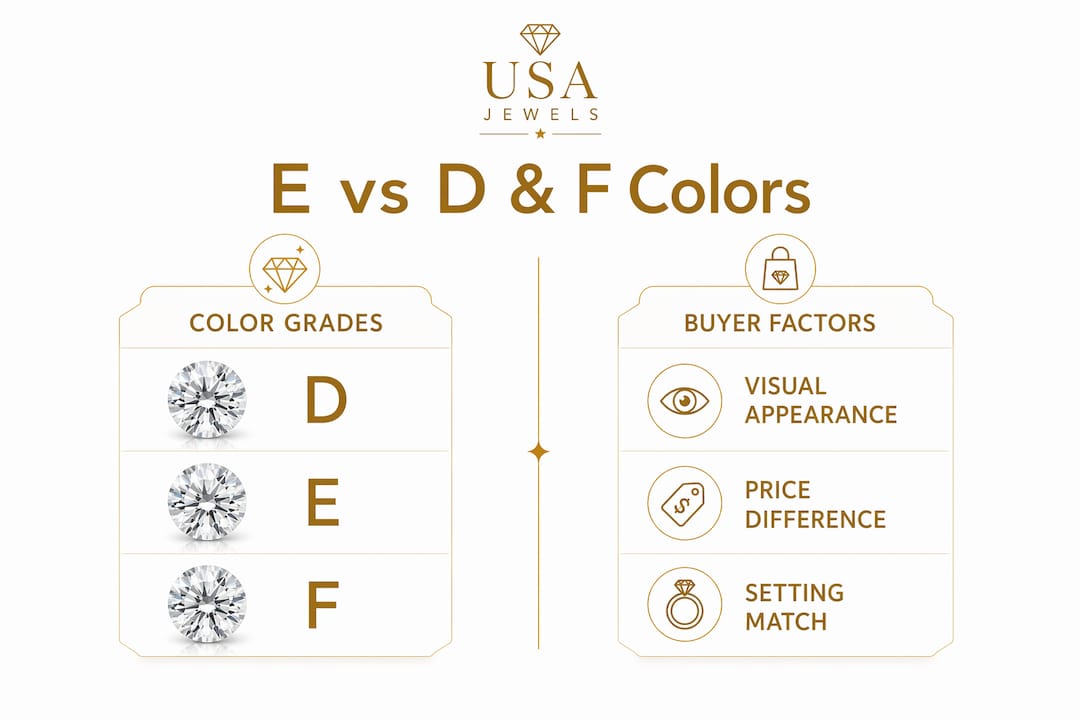
The table below summarizes how these grades compare across the factors that matter most to buyers.
| Color grade | Visual appearance | Price relative to D | Best setting match |
|---|---|---|---|
| D | Absolutely colorless | Baseline (highest) | Platinum, white gold |
| E | Virtually colorless | ~10% less than D | Platinum, white gold |
| F | Colorless, trace detectable in lab | ~15-20% less than D | Platinum, white gold |
| G | Near-colorless, faint warmth | ~25-35% less than D | White gold, yellow gold |
Pro Tip: If your budget is fixed, choose E over D and redirect the savings toward a better cut grade. Cut determines how much light a diamond returns to your eye. A well-cut E color diamond will outshine a poorly cut D color stone every time.
What are the key characteristics and clarity considerations of E color diamonds?
E color diamonds are defined by their position in the colorless range, but color grade alone does not determine how a diamond looks in real life. Clarity plays an equally significant role. VS2 clarity combined with E color is one of the most common pairings for buyers who want optimal visual impact without overpaying for microscopic perfection.
VS2 (Very Slightly Included 2) diamonds are typically eye-clean, meaning inclusions are not visible without magnification. Pairing VS2 clarity with E color gives you a stone that looks flawless to anyone admiring it in person, while keeping your budget more flexible than if you pursued FL (Flawless) or IF (Internally Flawless) grades.
Gemologists consistently recommend focusing budget on cut and clarity over marginal color improvements at the E grade level, because the aesthetic return is greater. A VS1 or VS2 stone with an Excellent or Ideal cut will look more brilliant than a Flawless stone with a mediocre cut. Color is one variable in a system of four.
Here are the clarity grades most commonly recommended alongside E color diamonds:
- VS2 (Very Slightly Included 2): Eye-clean in most shapes and sizes, best value pairing with E color
- VS1 (Very Slightly Included 1): Slightly cleaner than VS2, minimal price jump, good for larger stones
- VVS2 (Very Very Slightly Included 2): Near-flawless appearance, worth considering for stones above 1.5 carats
- VVS1 (Very Very Slightly Included 1): Exceptional clarity, typically reserved for investment-grade or heirloom pieces
- FL/IF (Flawless/Internally Flawless): Laboratory-perfect, significant price premium with no visible benefit in most settings
Pro Tip: For round brilliant cuts under 1.5 carats, VS2 is almost always sufficient. Step cuts like emerald or Asscher show inclusions more readily, so consider VS1 or higher when choosing those shapes with E color.
What is the significance of E color diamonds in jewelry and symbolism?
The meaning of E color diamonds extends beyond a laboratory grade. Within the colorless spectrum, E color carries a strong symbolic weight. It represents purity, precision, and rarity. Buyers who choose E color are selecting a stone that sits at the very top of what most people will ever wear, without the collector-grade premium attached to D.
E color diamonds are a preferred choice for engagement rings precisely because they deliver exceptional whiteness in the settings where diamonds are most scrutinized. Solitaire rings, three-stone designs, and halo settings all benefit from the crisp, bright appearance that E color provides. The stone reads as pure white under all lighting conditions, from candlelit dinners to bright office fluorescents.
In fine jewelry collections, E color diamonds appear in pieces designed to make a statement. Eternity bands, tennis bracelets, and drop earrings featuring E color stones carry a visual consistency that lower color grades cannot always maintain across multiple stones. When a jeweler sets several diamonds side by side, color matching becomes critical, and E color simplifies that process.
The significance of E color diamonds in the market also reflects buyer values. Choosing a stone this close to the top of the scale signals care and intentionality. For many buyers, that meaning matters as much as the technical grade.
- Engagement rings: E color delivers the bright white appearance most associated with classic diamond solitaires
- Eternity bands: Consistent color across multiple matched stones is easier to achieve at E grade
- Stud earrings: High visibility from the front makes color grade more noticeable, making E an excellent choice
- Heirloom pieces: E color holds long-term value and visual appeal across decades of wear
- Luxury collections: Fine jewelry designers favor E color for pieces where whiteness and brilliance define the aesthetic
How to assess and choose an E color diamond
Choosing an E color diamond well means looking beyond the color grade itself. Certification, cut, setting, and price all interact to determine whether you get genuine value.
Start with certification. Only diamonds certified by recognized laboratories like GIA or AGS provide reliable color grades. A diamond described as “E color” without a GIA or AGS certificate is an unverified claim. The certificate is the only document that confirms the grade was assigned under standardized conditions.
Setting choice directly affects how color is perceived. Platinum and white gold settings enhance the whiteness of E color diamonds by reflecting neutral light into the stone. Yellow gold settings can introduce a warm cast that slightly diminishes the colorless appearance, though this matters less with E color than with near-colorless grades. If you want the full visual benefit of an E color diamond, white metal settings are the right match.
Buyers often overestimate the visibility of slight color differences between D and E grades, which leads to paying unnecessary premiums. The incremental price premium from D to E is driven largely by retail demand and perceived rarity rather than any visually appreciable difference. Knowing this gives you real negotiating clarity.
Here is a practical checklist for evaluating an E color diamond before purchase:
- Confirm certification: Verify the diamond carries a GIA or AGS grading report, not a house certificate
- Check the cut grade: Prioritize Excellent or Ideal cut; this has the greatest impact on brilliance
- Evaluate clarity: Target VS2 or VS1 for most shapes; step cuts warrant VS1 or higher
- Review the setting: Choose platinum or white gold to maximize the colorless appearance
- Compare pricing: Use the diamond pricing guide to benchmark E color prices against current market rates
- Inspect the certificate: Confirm the color grade, clarity grade, cut grade, and carat weight all match the listing
| Factor | Recommended standard | Why it matters |
|---|---|---|
| Certification | GIA or AGS | Guarantees accurate, standardized color grading |
| Cut grade | Excellent or Ideal | Maximizes light return and visual brilliance |
| Clarity | VS2 or VS1 | Eye-clean appearance at strong value |
| Metal setting | Platinum or white gold | Preserves and enhances colorless appearance |
| Carat weight | Based on budget after cut/clarity | Size is visible; marginal color gains are not |
Key takeaways
An E color diamond delivers the visual quality of the colorless range at a meaningful price advantage over D, making it the most practical choice for buyers who want exceptional whiteness without paying a collector-grade premium.
| Point | Details |
|---|---|
| E color defined | Second-highest on the GIA scale, virtually colorless and indistinguishable from D to the naked eye. |
| Price advantage | E color diamonds cost approximately 10% less than D, with savings growing at larger carat weights. |
| Clarity pairing | VS2 is the most practical clarity match for E color, delivering an eye-clean appearance at strong value. |
| Setting matters | Platinum and white gold settings maximize the colorless appearance of E color diamonds. |
| Certification required | Only GIA or AGS certified diamonds guarantee the E color grade was assigned under standardized conditions. |
Why E color is where I tell most buyers to start
I have worked with diamond buyers at every budget level, and the conversation almost always reaches the same point: someone wants to know whether they should spend more to get a D. My honest answer is almost always no.
The visual returns beyond E color are minimal once a diamond is mounted in a setting. Industry professionals often choose G or H color for their own purchases because differences above G are negligible to the naked eye. E color sits well above that threshold. You are already in territory where the stone looks perfectly white to every person who will ever see it.
What I see most often is buyers fixating on color grade as a proxy for quality, then under-investing in cut. A diamond with an Excellent cut grade returns light in a way that makes the stone look alive. A diamond with a Good or Very Good cut can look flat regardless of its color grade. If you have $8,000 to spend and you are choosing between a D color with a Very Good cut and an E color with an Excellent cut, take the E every time.
The other misconception worth addressing is that D color is somehow more meaningful as a gift. The person receiving the ring will not see a difference. They will see a beautiful, brilliant stone. E color gives you that result while leaving room to invest in the details that actually change how the diamond looks and feels to wear.
— Joseph
Find your perfect E color diamond at Usajewels
At Usajewels, we hand-select certified E color diamonds for our fine diamond jewelry collections, including engagement rings, stud earrings, and custom designs. Every stone comes with GIA or AGS certification, and our family-owned, in-house manufacturing model means you get direct pricing without the markups that traditional jewelers build in. We have been helping customers find the right diamond since 1999, and we back every purchase with a lifetime diamond upgrade policy. Browse our diamond jewelry collections to explore E color options across a range of settings, metals, and styles. If you have questions, our team is here to help you find the stone that fits your vision and your budget.
FAQ
What is an E color diamond?
An E color diamond is the second-highest grade on the GIA diamond color scale, falling within the colorless range (D, E, F). It appears virtually colorless to the naked eye and is indistinguishable from a D color diamond without laboratory equipment.
How does E color compare to D color in price?
E color diamonds typically cost about 10% less than equivalent D color diamonds, with the price gap increasing at larger carat sizes. The visual difference between D and E is imperceptible outside a gemological laboratory.
What clarity grade pairs best with E color?
VS2 clarity is the most practical pairing for E color diamonds, as it delivers an eye-clean appearance at a strong value. For step-cut shapes like emerald or Asscher, VS1 or higher is recommended due to greater transparency.
Does the ring setting affect how an E color diamond looks?
Yes. Platinum and white gold settings enhance the colorless appearance of E color diamonds by reflecting neutral light. Yellow gold settings can introduce a warm tone that slightly reduces the perception of whiteness.
Is E color worth it compared to F or G color?
E color is worth the modest premium over F if you want a certified colorless grade with strong resale value and visual consistency across multiple stones. Compared to G, the difference in appearance is minimal once set, but E color provides a higher certified grade for buyers where documentation and grade matter.
Recommended
- Diamond Color Chart — D-to-Z Color Scale Explained | USA Jewels
- Natural Diamonds: Quality, Value & Origin | USA Jewels
- Lab-Created Diamonds: Process & Value | USA Jewels
- Colored Diamond Jewelry, Fine Jewelry Artistry | USA Jewels

Frequently Asked Questions
Is E color diamond worth the price difference compared to F color?
Should I prioritize E color or a better cut grade when budgeting for a diamond?
Will an E color diamond look different in white gold versus platinum?
At what carat weight does the E versus D color difference start to matter visually?
Is 16% market share for E color diamonds a sign I should choose a different grade?
Fine Jewelry Collection


You May Also Like
Eye Clean Diamonds: How to Get a Flawless Look
5 Bench Steps Every Buyer Should Check for a Flush Setting Ring