Save 30–40%: Wedding Band Cost and Buyer’s Checklist
Most couples spend between $1,200 and $2,300 total on their two wedding bands, though a single ring can run anywhere from a few hundred dollars to several thousand. Metal choice and diamond content explain nearly all of that spread. A plain 14k gold band and a platinum eternity band can differ by thousands, even at the same width.
TL;DR:
- Choosing a wedding band’s style has the greatest impact on cost, with simple metal bands starting around $150 and diamond-accidented styles exceeding $1,000.
- Metal choice significantly influences price, with platinum costing two to three times more than gold, while alternative metals like titanium can be under $100 for basic designs.
- Lab-grown diamonds in wedding bands can reduce costs by 50 to 70 percent compared to natural diamonds, especially for pavé and eternity styles.
- Couples should consider full-eternity bands carefully, as they are difficult to resize and may require choosing half-eternity or channel-set designs for future adjustments.
- Online shopping can save up to 40 percent, but buyers must verify policies on resizing, warranties, and diamond certification before purchase.
Table of Contents
- How Much Does a Wedding Band Cost by Style?
- What Drives Wedding Band Prices Up or Down?
- Lab-Grown vs. Natural Diamonds: Which Costs Less?
- What Do Wedding Bands Cost at Each Budget Tier?
- How Can You Save Money on Wedding Bands?
- What Buyers Get Wrong About Wedding Band Cost
- Ready to Price Out Your Wedding Bands?
- Sources
- FAQ
How Much Does a Wedding Band Cost by Style?
The style you pick determines your price bracket more than any other single decision. A plain gold band and a diamond-covered eternity band aren’t just different looks. They’re different budget categories entirely.
Here’s how the common styles break down in price:
- Simple metal bands (no stones): typically $150 to $700, depending on metal and width
- Diamond-accented bands (a few small stones or a modest channel setting): usually $700 to $2,500
- Vintage-inspired or milgrain designs: often $600 to $1,800, since detailed handwork adds labor cost even without diamonds
- Alternative metal bands (tungsten, titanium, stainless steel): commonly $25 to $400
- Matching sets: priced as a pair, generally 10 to 15 percent less than buying two rings separately from different lines
Women’s bands average slightly higher than men’s because they’re more likely to carry diamonds, while men’s bands tend to be wider and heavier, which raises the raw metal cost even on a plain design. A realistic couple total for two modestly styled bands, one plain and one diamond-accented, lands close to the $1,500 midpoint most sources report. If both partners want diamonds, expect the total to climb toward the higher end of that range or beyond.
What Drives Wedding Band Prices Up or Down?
Metal choice moves the price more than anything else. Platinum typically costs 2 to 3 times more than comparable 14k gold, usually adding $800 to $1,500 to a comparable design, because platinum is denser, purer, and more labor intensive to work with. Alternative metals sit at the opposite end, running 70 to 90 percent cheaper than gold for a similarly styled band.
By the Numbers: A standard 4mm women’s plain band might run $300 in 14k gold, $450 in 18k gold, $900 in platinum, or under $100 in titanium for the same basic design. That’s the single widest price swing you’ll encounter shopping for a plain band.
Beyond the base metal, a few other factors compound the cost:
- Width and weight: a 6mm men’s band uses noticeably more metal than a 4mm women’s band, adding to the base price regardless of style
- Finish: hammered, brushed, or two-tone finishes require extra hand-finishing time and typically add $50 to $150
- Diamond total carat weight: more stones or larger stones raise both the material and setting cost
- Setting type: pavé and channel settings require more precise labor than a bezel or flush setting, which shows up in the final price
- Custom labor: a fully custom design built from scratch generally costs more than a modified ready-to-ship setting, and it also takes longer to produce
Engraving is usually a small flat fee, often $20 to $50, but rush orders on custom pieces can add a meaningful premium if you need the ring in under two or three weeks.
Lab-Grown vs. Natural Diamonds: Which Costs Less?
For the small stones used in most wedding bands, lab-grown diamonds cost 50 to 70 percent less than natural diamonds of comparable size and quality. Since a pavé or channel-set band relies on many small stones rather than one large center stone, that savings compounds fast. A detailed comparison of lab-grown and natural diamonds shows the two are visually identical to the naked eye at these smaller sizes, which is exactly why more couples are choosing lab-grown for bands even when they kept a natural stone for the engagement ring.
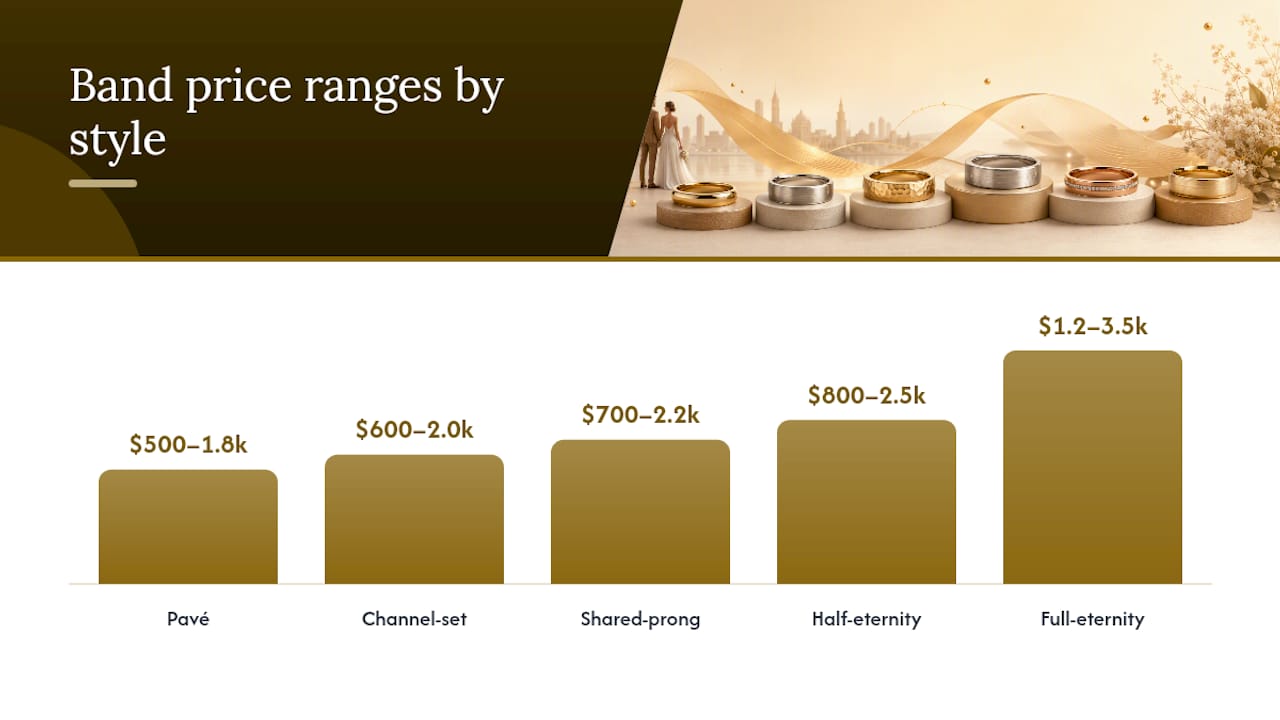
Diamond coverage style matters just as much as origin. Typical ranges look like this:
- Pavé bands (small stones set close together across the surface): $500 to $1,800
- Channel-set bands (stones set flush between two metal walls): $600 to $2,000
- Shared-prong bands (stones held by shared prongs for maximum sparkle): $700 to $2,200
- Half-eternity bands (stones across the front half only): $800 to $2,500
- Full-eternity bands (stones circling the entire ring): $1,200 to $3,500 or more, depending on total carat weight
One practical catch: full-eternity bands are difficult or impossible to resize because stones run all the way around the shank. If your ring size might change, a half-eternity or channel-set style keeps resizing options open without giving up much sparkle.
What Do Wedding Bands Cost at Each Budget Tier?
Seeing real combinations at each price point makes budgeting far less abstract than staring at a range. Here’s how three common tiers typically shake out for a couple buying both rings together:
- Budget tier ($400 to $900 total): a titanium or tungsten men’s band paired with a thin 14k gold band for her, sometimes with a few small accent stones. Priority here is durability and staying under $1,000 without sacrificing a finished look.
- Midrange tier ($1,200 to $2,500 total): a 14k or 18k gold band for him with a brushed finish, paired with a pavé or channel-set band in lab-grown diamonds for her. This is where most couples land, balancing sparkle against cost.
- Premium tier ($3,000 to $6,000-plus total): platinum for him, a half- or full-eternity natural diamond band for her, often with custom engraving or a fully custom-designed set. Priority shifts toward metal longevity, maximum diamond coverage, and personalization.
Most couples move between tiers based on one variable: how much diamond coverage they want on the woman’s band. Metal choice for the man’s band tends to matter less to total budget than most couples expect going in.
How Can You Save Money on Wedding Bands?
Buying online instead of at a traditional retail counter often saves 30 to 40 percent on comparable rings, mainly because online sellers skip the overhead of a physical showroom staffed with commissioned salespeople. The tradeoff is that you need to verify return policies, resizing terms, and diamond grading documentation before you buy, since you can’t try the ring on in person first. In-store shopping costs more but lets you see and feel the actual piece, which matters more to some buyers than the savings do.
Before you commit to any jeweler, online or in-store, ask these questions directly:
- What karat of gold or purity of platinum is stamped and hallmarked on this ring?
- Is the diamond total carat weight measured for the whole ring or per stone?
- What grading report or certification comes with the diamonds?
- What’s your resizing policy, and is it free within the first year?
- What warranty or maintenance plan is included, and does it cover re-plating or prong tightening?
- Do you offer a diamond upgrade program if we want to trade up later?
Pro Tip: Ask about a lifetime diamond upgrade program before you buy, not after. It’s the one feature that protects your choice today even if your taste or budget changes years down the road.
If you want to trim cost without trimming quality, choose lab-grown stones, reduce total carat weight slightly, pick a simpler prong or channel setting over full pavé, and check ready-to-ship options online before committing to a custom build.
What Buyers Get Wrong About Wedding Band Cost
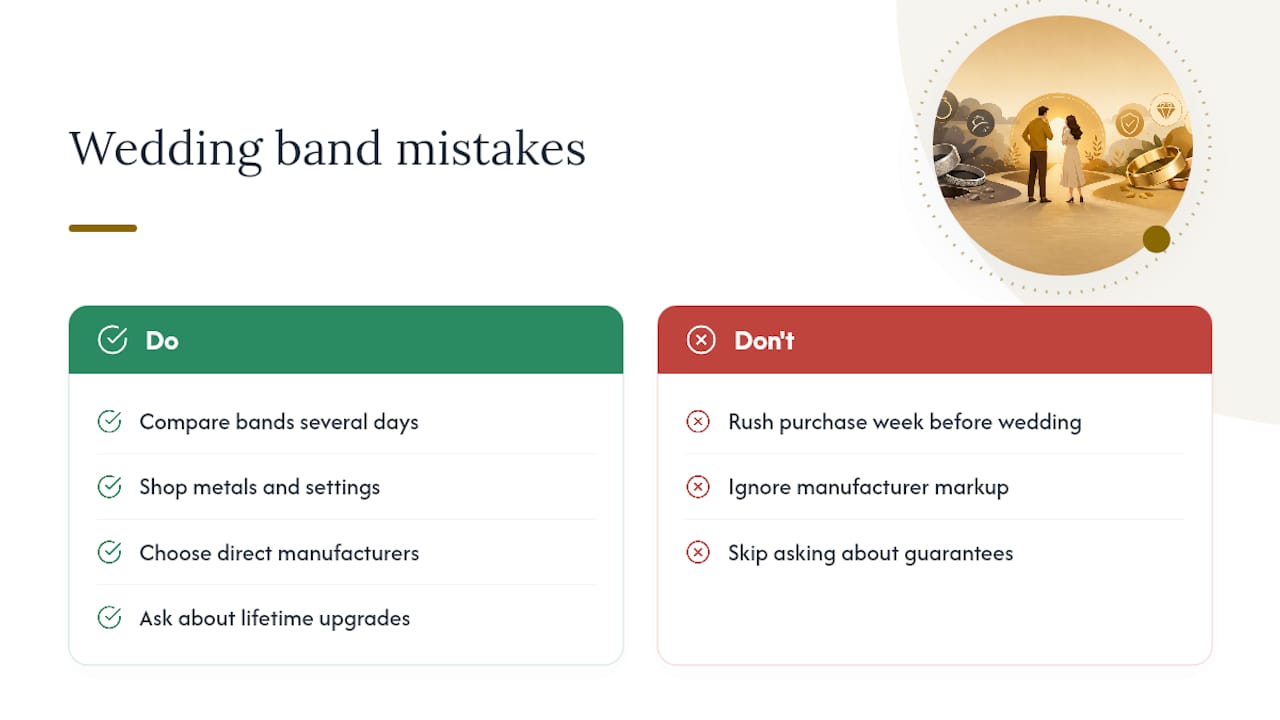
The mistake I see most often is couples pricing the engagement ring obsessively while treating wedding bands as an afterthought bought in a rush the week before the wedding. That backwards priority costs them real money, because band pricing rewards patience: a few extra days of comparison shopping on metal and setting easily saves several hundred dollars.
Direct manufacturing removes a layer of markup that traditional retail can’t avoid, which is part of why some jewelers operate as family-owned, in-house manufacturers… Many jewelers offer lifetime diamond upgrade programs, and such guarantees are often highly valued by customers.
— Joseph
Ready to Price Out Your Wedding Bands?
Some jewelers offer direct-to-consumer options as alternatives to traditional retail markups, including ready-to-ship products and design-your-own tools that allow shoppers to customize metal, diamond origin, and setting.
If you already know the look you want, browse our fine diamond rings and wedding bands to see current pricing across metals and styles. Prefer to talk through options first, including lab-grown versus natural diamonds or a fully custom build? Start a design consultation and get a real quote before you commit to anything.
Sources
- How Much Do Wedding Rings Cost? Average Price Breakdown – Zola Expert Wedding Advice
- How Much Does a Wedding Ring Cost? Complete Price Guide (2026)
FAQ
How much should a wedding band cost?
Most individual wedding bands cost between a few hundred dollars and several thousand, with couples spending $1,200 to $2,300 total on both rings combined.
Is platinum worth the extra cost for a wedding band?
Platinum typically costs 2 to 3 times more than 14k gold, but it resists tarnishing and wear better over decades, which makes it worth considering for a band you’ll wear daily for life.
Are lab-grown diamonds a good choice for wedding bands?
Yes. Lab-grown diamonds cost 50 to 70 percent less than natural diamonds at the small sizes used in pavé and eternity bands, with no visible difference to the naked eye.
Should I buy my wedding band online or in-store?
Buying online can save 30 to 40 percent compared to traditional retail, but confirm resizing policy, warranty terms, and diamond grading documentation before you check out. Usajewels offers both ready-to-ship pieces and custom design consultations so you can choose the buying path that fits your comfort level.
How long does it take to get a wedding band made?
Ready-to-ship bands can arrive within days, while fully custom designs typically take two to four weeks depending on the complexity of the setting and any resizing needed after the initial fitting.
Recommended
- Design a Custom Wedding Ring Set That’s Truly Yours
- Wedding Ring Guide: How to Choose the Perfect Wedding Band
- Save 30–50% with Clarity Enhanced Diamonds: GIA Facts and What to Ask
- Gold Wedding Bands, Radiant Brilliance

Deep Mehta is the Co-Owner of USA Jewels, a family-owned jewelry business she has led since 2013 in Deerfield Beach, Florida. With over 13 years of hands-on experience in fine jewelry retail, manufacturing, and diamond importing, Deep specializes in engagement rings, wedding bands, and custom jewelry design. She also co-manages Kaash Group Talent Acquisition. Deep is a University of Florida graduate and oversees every aspect of USA Jewels’ operations, from product development to marketing.
Fine Jewelry Collection


You May Also Like
Anniversary Jewelry Milestone Gifts That Last a Lifetime

Fact Checked Tennis Bracelet Meaning: Chris Evert Origin and Care