Best Carat Size for Small Hands: A Practical Guide
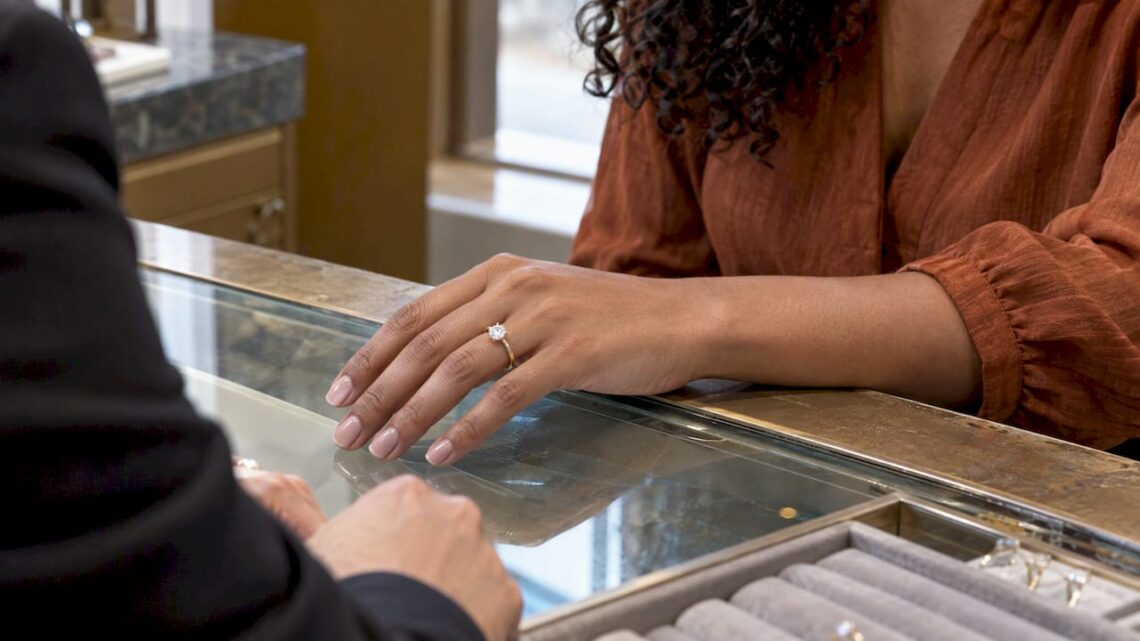
For small hands, the best carat size for most people is 0.75 to 1.25 carats. A size 4 to 6 finger often looks balanced with a diamond in that range, and 1.5 carats or more reads as a bold statement. Carat is only part of the picture. Shape, cut, setting and band width decide how large a diamond looks on your finger, so a smaller stone can look generous when those choices are right.
We are a family-owned jeweler, and we have helped couples choose rings since 1999. Below we walk through the sizes, shapes and settings we recommend for petite fingers, and how to stretch your budget without giving up beauty.
TL;DR
- Most petite hands look best with 0.75 to 1.25 carats. Go to 1.5 carats or more only if you want a bold, statement look.
- Carat measures weight, not size. GIA defines it as 200 milligrams, so the same weight can look different depending on shape and cut.
- Oval, pear and marquise shapes spread across the finger and look larger per carat than a round.
- A 0.90 to 0.95 carat stone can look nearly identical to a 1.00 carat one, and often costs less.
- Put cut quality first. A well-cut smaller diamond outshines a larger, poorly cut one.
Table of Contents
- Why a Diamond Looks Bigger on Small Hands
- Carat Is Weight, Not Size
- Carat Size Guide for Small Hands
- The Shape Decides the Look
- Setting and Band: Quiet Ways to Make a Diamond Look Larger
- Skip the Magic Numbers and Spend on Quality
- A Worked Example
- Natural or Lab-Grown for a Petite Ring
- Our Perspective: Fit the Ring to the Hand and the Life
- Design a Ring for Small Hands With Us
- Checklist Before You Buy
- FAQ
- Sources
Why a Diamond Looks Bigger on Small Hands
Your eye judges a diamond by comparison. A stone sits against the width of your finger, the length of your knuckle and the scale of your hand. On a slender finger, the same diamond covers more of the visible space, so it looks larger than it would on a broader hand.
That is why a one-carat diamond that feels modest on one person can feel substantial on someone wearing a size 4 or 5. It is also why the popular advice you will see online, such as 1.0 carat for hands under about a size 6.5, is a starting point and not a rule. Taste matters as much as measurement.
Two questions help more than any chart:
- Do you want the ring to be noticed from across a room, or to be a quiet detail you see every time you glance down?
- Do you work with your hands, type all day or wear gloves? Practical life shapes what feels comfortable.
Carat Is Weight, Not Size
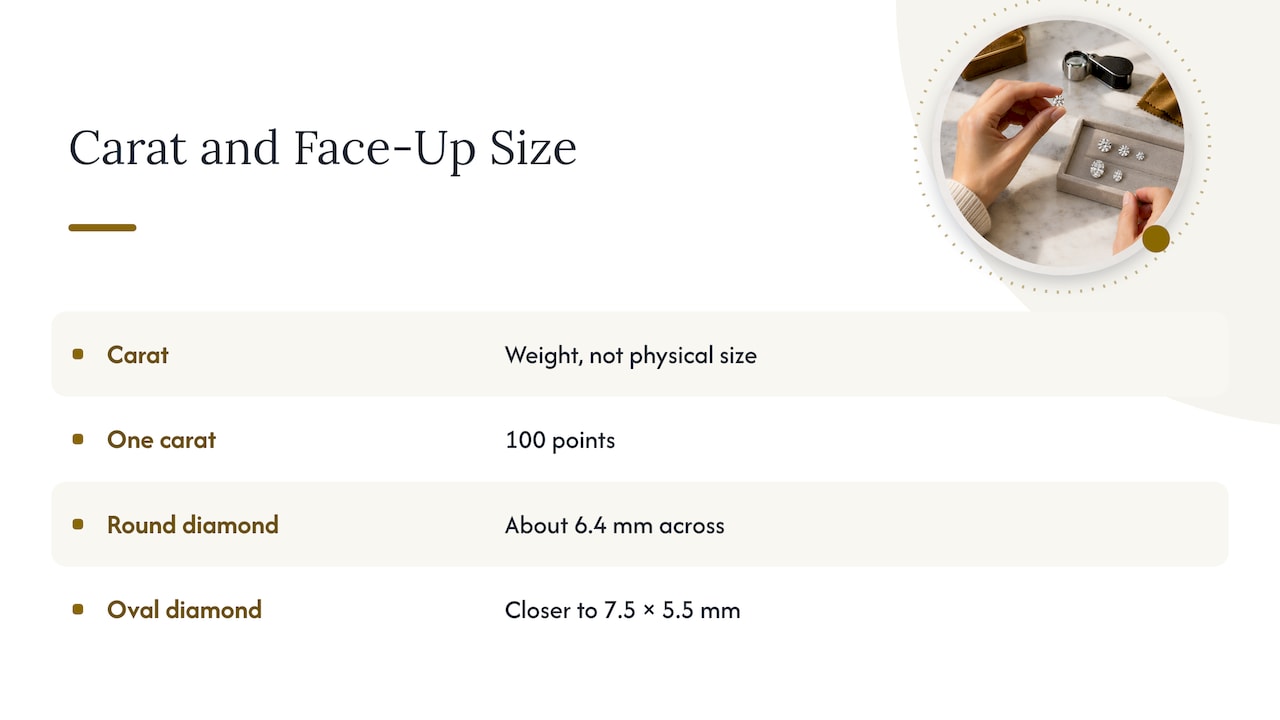
The word carat confuses many first-time buyers. GIA explains that carat measures weight, not size, and that one carat is divided into 100 points. GIA also notes that equating a gem’s carat weight with its physical dimensions is a common mistake.
What you actually see on your hand is the top surface, called the face-up size, usually quoted in millimeters. A well-proportioned one-carat round diamond measures roughly 6.4 mm across. A one-carat oval is closer to 7.5 by 5.5 mm, and the exact numbers vary with proportions. Always ask for the millimeter measurements of the exact stone, not only the carat weight.
A stone cut too deep hides weight in its bottom half, so it looks smaller than its carat weight suggests. A stone cut very shallow can spread wide, but it often loses sparkle. This is why we steer customers to look at the whole diamond, not just one number.
Carat Size Guide for Small Hands
Use this table as a friendly starting point. Finger sizes are US ring sizes, and the looks describe round or similar shapes in a simple solitaire.
| Carat weight | How it tends to look on a size 4 to 6 finger | Best for |
|---|---|---|
| 0.50 to 0.75 | Delicate and refined, lots of bare finger around it | Minimalists, active hands, tighter budgets |
| 0.75 to 1.00 | Classic and balanced, clearly visible without overwhelming | Most petite hands |
| 1.00 to 1.25 | Prominent and elegant, a very noticeable center stone | Those who want presence |
| 1.50 | Bold, often covers much of the finger width | Statement lovers |
| 2.00 and up | Very dramatic, can look top-heavy on the smallest fingers | Those who want maximum impact |
The sweet spot for most of the couples we meet is a stone close to one carat. If your finger is a size 3 to 4.5, many people prefer to stay at or under about 1.25 carats. If you wear a size 6 or above, going up toward 1.5 carats is a natural step. These are guidelines drawn from experience, not guarantees. Try before you commit whenever you can.
The Shape Decides the Look
Shape often does more for apparent size than an extra quarter carat. Here is how common shapes behave on petite hands.
Oval and pear
Elongated shapes run along the finger and make it look longer and slimmer. Per carat, they present more surface area than a round. An oval of 0.90 carats can look as large as a one-carat round. Pear shapes do the same, with a soft point that flatters short fingers.
Marquise
Marquise is the longest of the group and can look dramatic on a small hand. It has more points that can catch on fabric, so ask about a protective setting if you use your hands a lot.
Round brilliant
Round is the classic and the most sparkly shape. It sits symmetrically and keeps its look in any setting. It has less spread than elongated shapes, so on petite hands you may want to nudge toward 0.90 to 1.00 carats.
Emerald and radiant
Emerald cuts show clean, long lines and a hall-of-mirrors flash instead of sparkle. They look elegant on slender fingers, and the long face gives good coverage for the weight. Radiant gives the same rectangular outline with more brilliance.
Cushion and princess
These square-ish shapes read compact. They can look smaller than ovals of the same weight, so size up slightly if you want a larger look.
Setting and Band: Quiet Ways to Make a Diamond Look Larger
You can add visual size without adding weight.
- Choose a slim band. A thin band, around 1.5 to 2 mm, makes the center stone look larger by contrast. A thick band does the opposite.
- Try a halo. A ring of small diamonds around the center extends the face-up size. It can make a 0.75 carat center look closer to a full carat.
- Consider a three-stone design. Side stones increase finger coverage. A one-carat center with small side diamonds gives a wider look without a bigger center stone.
- Use a low or medium profile. A very tall setting can catch on things and look top-heavy on a small hand. Lower settings feel secure and natural.
- Pick the metal with intent. White metals such as platinum and white gold blend with the diamond and let it take the spotlight. We offer a wide range of platinum jewelry and gold jewelry in solid, not hollow or plated, construction.
A wedding band matters too. Many petite brides prefer a slim channel-set band that sits flush beside the engagement ring. If you are planning ahead, a style like this channel set diamond wedding band in platinum adds sparkle without crowding the finger.
Skip the Magic Numbers and Spend on Quality
Sizes such as 1.00, 1.50 and 2.00 carats are popular, and that popularity adds to the price. GIA’s buyer’s guide notes that prices for diamonds of 1.00 carat and larger are comparatively higher because those sizes are rarer, and that choosing just below a round number can lead to significant savings.
In practice, a 0.95 carat diamond looks essentially the same as a 1.00 carat on a hand, since the difference is a fraction of a millimeter. The money you save can go toward a better cut, color or clarity grade.
On small hands this strategy works especially well. A modest difference in carat is hard to see on a petite finger, while a difference in sparkle is easy to see.
Cut comes first
GIA advises buyers to focus on cut, color and clarity when judging quality, because size does not determine quality or beauty. A well-cut smaller diamond has more brilliance and fire than a larger stone that leaks light. If you have to compromise somewhere, do it on carat, never on cut.
Our guide on why cut should come before color and clarity explains the trade-offs, and our overview of diamond color and clarity shows what to buy at each budget. If clarity is your question, read the best clarity for an engagement ring.
A Worked Example
Imagine a couple shopping for a size 5 finger with a clear preference for a bright, noticeable ring.
- They start by looking at one-carat rounds, and find the price jumps just at 1.00.
- They compare a 0.93 carat round with excellent cut to a 1.00 carat with a good cut. The smaller stone looks livelier and the face-up size is nearly identical.
- They then look at ovals. A 0.90 carat oval spreads further across the finger than either round.
- They pair the oval with a slim band and a hidden halo, and the ring looks like a statement piece on a small hand.
- The savings go toward a higher color grade or a more elaborate setting.
This is the kind of path we walk customers through. The final choice always depends on the exact stone, which is why we recommend viewing the measurements and certificate before you decide.
Natural or Lab-Grown for a Petite Ring
Both options can suit small hands. Lab-grown diamonds usually cost less per carat, which can let you choose a larger or better-cut stone. Natural diamonds appeal to those who want a stone formed in the earth. For ethical peace of mind, GIA says about 99% of diamonds in the marketplace are now considered conflict-free thanks to the Kimberley Process set up in 2002. We hand-select certified conflict-free stones, and you can read how lab-grown diamonds are ethically produced.
Whichever you choose, insist on a grading report. GIA’s guidance for buyers is to insist on a diamond grading report, and our article on GIA certification for diamonds covers what to look for.
Our Perspective: Fit the Ring to the Hand and the Life
We have been a family business since 1999, and we make our jewelry in-house, so we see how rings are worn long after the proposal. Our advice for small hands is simple.
First, do not chase a number. Customers often arrive with a carat goal because a friend or a celebrity has one. Then they see a well-cut 0.90 carat oval on a slim band and prefer it. A ring should feel like you, not like a spec sheet.
Second, comfort counts. A ring you worry about catching on a sweater is a ring you take off. On small hands we often suggest a lower setting and a secure design.
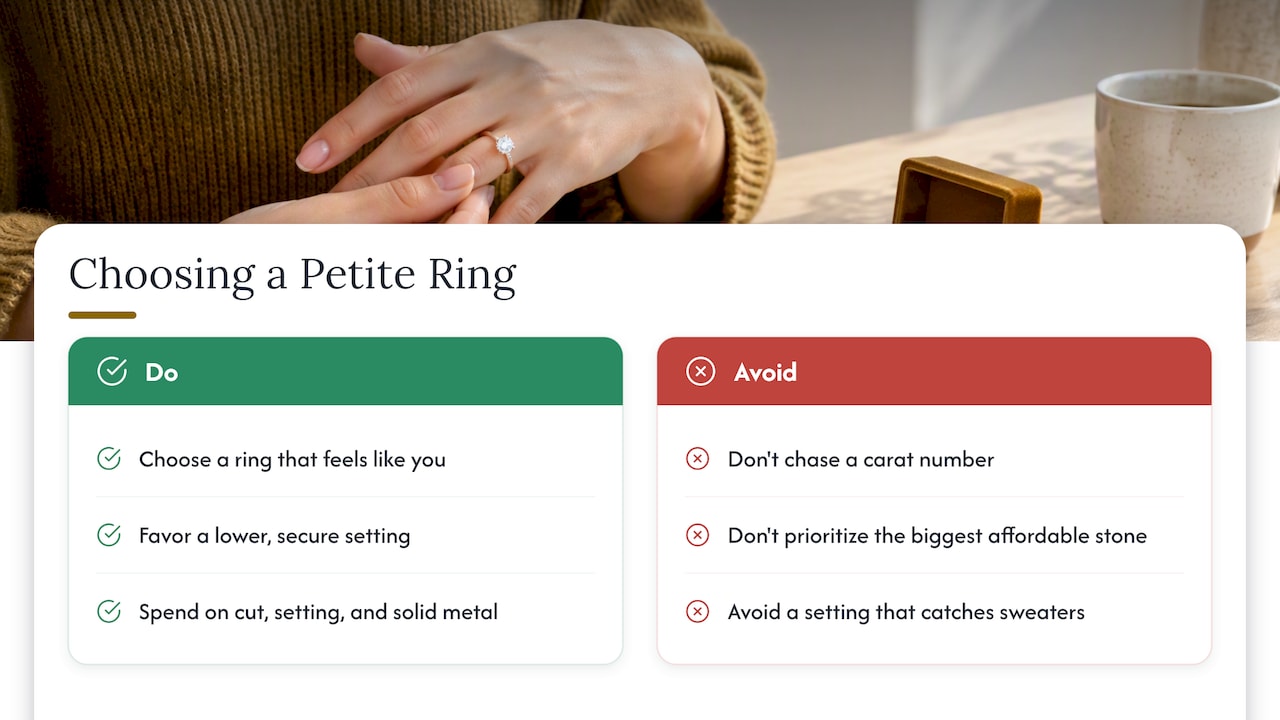
Third, spend where the eye goes. A beautiful cut, a good setting and solid metal give more daily joy than the last tenth of a carat. Because we manufacture in-house and sell direct, we can put more of your budget into the diamond and the craftsmanship instead of middlemen. And if your taste or budget changes, our lifetime diamond upgrade program means a first ring can grow with you.
We would rather you leave with the ring you will love in twenty years than the biggest one you can afford this month.
— Joseph
Design a Ring for Small Hands With Us
If you want to see these ideas in practice, you can design your own diamond ring from 399 USD. You choose the diamond shape, the quality and the metal, and can test oval, pear or round at different weights. Prefer to start with the stone? Browse our certified loose diamonds, from 142 USD, or explore engagement rings from 346 USD. Our step-by-step design guide walks you through the process, and our diamond carat weight guide covers size, price and value in more depth.
Every order comes with free insured shipping and a 30-day money-back guarantee, so you can see the ring on your own hand with confidence.
Checklist Before You Buy
- Know your ring size, ideally measured by a jeweler.
- Ask for the diamond’s millimeter measurements, not just carat weight.
- Compare two or three shapes at similar weights.
- Ask for stones just under the magic numbers, like 0.90 to 0.95 carats.
- Choose a slim band and a low to medium setting.
- Check the grading report for cut, color and clarity.
- Confirm return and upgrade policies.
After the ring is chosen and the answer is yes, many couples turn to celebrating. If you are planning a party, some ideas for engagement party decorations can help set the scene for showing off the ring.
FAQ
What is the best carat size for a size 4 or 5 finger?
Most people with a size 4 or 5 finger look best with 0.75 to 1.25 carats. A one-carat stone already looks prominent on a petite finger. Choose an oval or pear if you want it to look larger without adding weight.
Will a bigger diamond look too large on small hands?
It can. A stone of 2 carats or more can look top-heavy on a very slim finger, especially in a tall setting. Some people love that bold look, so it depends on your taste. A slim band and low profile help keep a larger stone comfortable.
How big is a 1.5 carat diamond in millimeters?
A well-cut 1.5 carat round measures roughly 7.4 mm across. Fancy shapes differ: an oval of that weight is about 8.5 by 6.5 mm. Exact sizes depend on the cut, so ask for the measurements of the specific diamond.
Does shape really change how big a diamond looks?
Yes. Oval, pear, marquise and emerald cuts have a longer face, so they look bigger per carat than a round or cushion. GIA notes that carat is a measure of weight, so the outline you see depends on the shape and proportions.
Should I buy a 0.95 carat instead of a 1 carat?
For most buyers, yes. The visual difference is tiny, while the price difference can be meaningful, as GIA’s buyer’s guide explains. Use the savings for a better cut.
Sources
- GIA: Natural diamond buyer’s guide
- GIA 4Cs: Diamond carat weight
- GIA 4Cs: Buying a quality diamond
- GIA 4Cs: Understanding carat weight in grading reports
Recommended
- Diamond Carat Weight Guide — Size, Price & Value Explained
- Diamond Carat Weight: What It Means and Why It Matters

Deep Mehta is the Co-Owner of USA Jewels, a family-owned jewelry business she has led since 2013 in Deerfield Beach, Florida. With over 13 years of hands-on experience in fine jewelry retail, manufacturing, and diamond importing, Deep specializes in engagement rings, wedding bands, and custom jewelry design. She also co-manages Kaash Group Talent Acquisition. Deep is a University of Florida graduate and oversees every aspect of USA Jewels’ operations, from product development to marketing.
Fine Jewelry Collection

You May Also Like
Fact Checked Tennis Bracelet Meaning: Chris Evert Origin and Care
What Is Name Necklace Jewelry? Styles, Meaning & More