Diamond Cut Comparison Guide for Engagement Rings
Diamond cut comparison is the process of evaluating different cut styles to understand how each one affects brilliance, fire, and overall beauty. Cut is the single most important of the 4Cs of diamonds because it controls how light travels through the stone. A poorly cut diamond with excellent clarity will look dull next to a well-cut stone with modest clarity. This guide walks you through every major cut type, explains GIA grading standards, and gives you the tools to choose with confidence.
1. What are the main diamond cut types?
Cut style and diamond shape are two different things. Cut style refers to the facet arrangement that controls light reflection. Shape is the geometric outline you see from above.
The three primary cut styles are brilliant, step, and mixed.
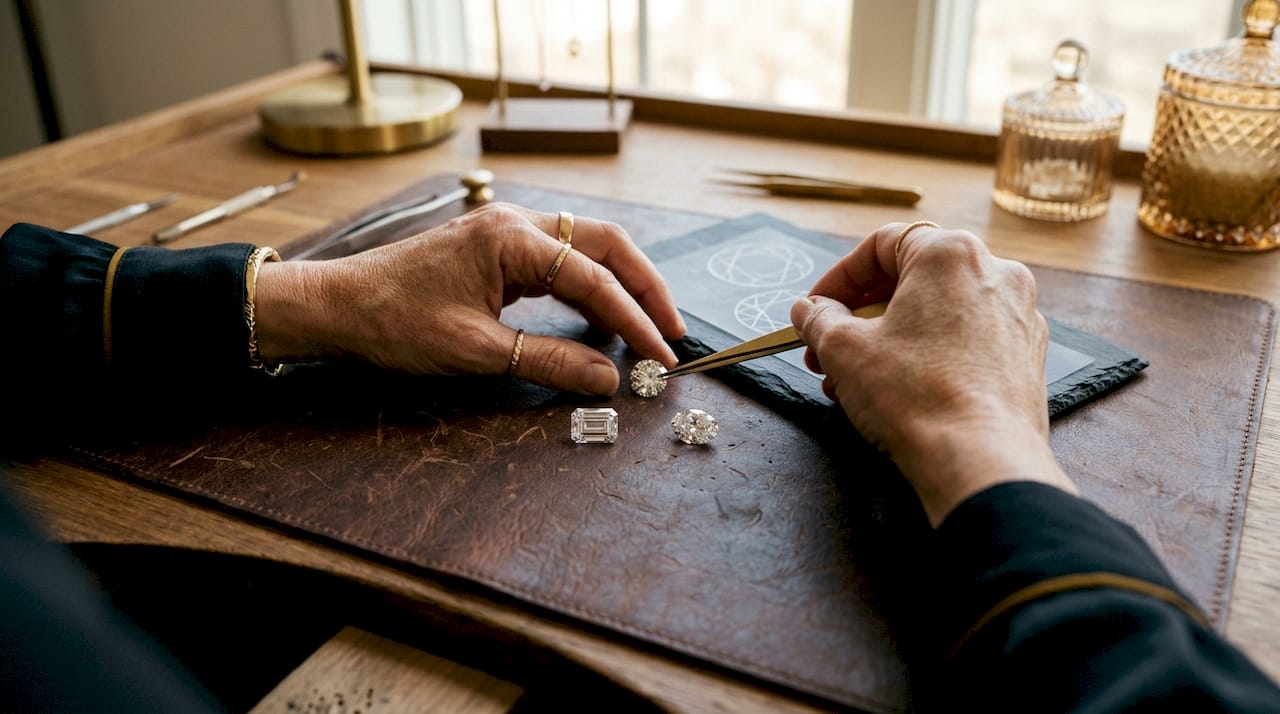
Brilliant cuts use triangular and kite-shaped facets arranged to maximize light return. Round, oval, pear, marquise, and princess diamonds all fall into this category. Their complex facet patterns scatter light in multiple directions, creating the sparkle most people associate with diamonds.
Step cuts use long, parallel facets arranged in a staircase pattern. Emerald and Asscher diamonds are the clearest examples. Step cuts produce a “hall of mirrors” effect: deep, glassy reflections rather than scattered sparkle. They prioritize elegance and transparency over raw brilliance.
Mixed cuts combine elements of both styles. The cushion cut, for example, often uses brilliant-style facets within a rounded square outline. Mixed cuts give buyers a middle ground between fire and clarity of reflection.
- Brilliant cuts: maximum sparkle, best at hiding inclusions
- Step cuts: elegant, open, require higher clarity and color grades
- Mixed cuts: balanced light performance, versatile style
2. How do popular diamond shapes compare?
Shape is what most couples notice first. Each shape carries its own cut characteristics, sparkle pattern, and style personality.
| Shape | Cut style | Sparkle level | Best for |
|---|---|---|---|
| Round brilliant | Brilliant | Highest | Maximum fire, classic look |
| Oval | Brilliant | High | Elongated fingers, modern style |
| Pear | Brilliant | High | Unique, vintage-inspired |
| Marquise | Brilliant | High | Dramatic, finger-elongating |
| Princess | Brilliant | High | Contemporary, geometric |
| Cushion | Mixed | Medium-high | Romantic, vintage feel |
| Emerald | Step | Low-medium | Sophisticated, minimalist |
| Asscher | Step | Low-medium | Art Deco, architectural |
The round brilliant is the most popular diamond shape for engagement rings. It receives the most thorough GIA cut grading and consistently delivers the highest light return of any shape.
Oval, pear, and marquise shapes offer elongated brilliance that makes a stone look larger per carat than a round of the same weight. The tradeoff is the bow-tie effect, a dark shadow that runs across the center of elongated shapes. A mild bow-tie is normal. A severe one detracts from beauty and is visible only through careful inspection or high-quality video.
Emerald and Asscher cuts require you to choose higher clarity grades because their open facets act like windows into the stone. Inclusions and color warmth show more readily in step cuts than in brilliant cuts.
Pro Tip: When comparing oval or pear shapes, always ask to see a video of the stone rotating under different lighting. A bow-tie that looks mild in one photo can appear severe under direct light.
3. What do diamond cut quality grades mean?
The GIA grades round brilliant diamonds on a five-point scale: Excellent, Very Good, Good, Fair, and Poor. Each grade reflects proportions, symmetry, and polish and their combined effect on light performance. An Excellent grade means the stone handles light at the highest measurable level.
The AGS Ideal grade is a parallel standard used by the American Gem Society. An AGS Ideal cut corresponds roughly to GIA Excellent and signals the same top-tier light performance.
Fancy shapes, meaning every shape other than round, receive no standardized GIA cut grade. That gap matters. You cannot rely on a lab report alone to assess cut quality in an oval, cushion, or pear diamond. Visual inspection and video review become your primary tools.
Visual cut quality indicators to look for:
- Bright, even light return across the entire face of the stone
- No dark or dead zones when viewed from above
- Symmetrical outline with no visible distortion
- Minimal or no bow-tie shadow in elongated shapes
- Crisp, well-defined facet edges under magnification
For round brilliants, advanced tools like Idealscope and ASET scope provide a visual map of how the stone handles light. Red areas in an ASET image indicate light return. Blue indicates contrast. White areas signal light leakage. A well-cut round shows mostly red with defined blue contrast and minimal white.
The Hearts and Arrows pattern is another quality indicator for round brilliants. A true Hearts and Arrows stone shows eight symmetrical hearts when viewed from below and eight arrows from above. This level of optical symmetry requires exceptional cutting precision.
Pro Tip: For fancy shapes, request a high-definition video from multiple angles before purchasing. A photo can hide a severe bow-tie or uneven light distribution that becomes obvious in motion.
4. Which cuts offer the best value for different budgets?
Cut quality delivers more visible improvement than any other factor in the 4Cs. Prioritizing cut over clarity beyond eye-clean levels is the single most effective way to maximize sparkle per dollar spent. A VS2 clarity stone with an Excellent cut will outshine a VVS1 stone with a Good cut in almost every lighting condition.
Brilliant cuts also work in your favor when budgeting for color. Brilliant-cut facets mask color and inclusions better than step-cut facets. A round or oval in the G-H color range looks near-colorless to the naked eye. The same color grade in an emerald cut shows more warmth.
Budget-conscious buying tips:
- Choose an Excellent or Ideal cut grade first, then work down on clarity and color.
- Consider oval or cushion shapes. They often look larger per carat than round diamonds of the same weight.
- For step cuts, budget for VS1 clarity or better and F-G color to avoid visible flaws.
- Avoid paying a premium for VVS clarity in a brilliant cut. SI1 eye-clean stones offer the same visual result at a lower price.
- Use the diamond color scale to find the lowest color grade that still looks white in your chosen metal. Yellow gold masks warmth better than white gold or platinum.
Oval and pear shapes frequently offer a larger face-up appearance than rounds at the same carat weight. That size advantage can let you step down half a carat without any visible difference in presence on the finger.
5. How step cuts differ from brilliant cuts in practice
Step cuts reward patience and a higher budget. Emerald and Asscher cuts expose flaws and color tone more readily than brilliant cuts because their large, open facets act as mirrors rather than light-scattering prisms.
An emerald cut in VS2 clarity may show an inclusion visible to the naked eye that would be completely hidden in a round brilliant of the same grade. That is not a flaw in the grading system. It is a direct result of the facet structure. Step-cut buyers need to budget for VS1 or higher clarity and F-H color to achieve a clean, bright appearance.
The payoff is a look that no brilliant cut can replicate. Step cuts have a cool, architectural elegance. The long, parallel facets create deep flashes of light rather than the scattered sparkle of a brilliant. For couples who want a ring that reads as sophisticated rather than flashy, the emerald or Asscher cut is the right choice. The emerald cut diamond has seen a strong resurgence among buyers who prioritize style and restraint over maximum fire.
6. Understanding the bow-tie effect in elongated shapes
The bow-tie effect is a dark shadow that appears across the center of oval, pear, and marquise diamonds. Every elongated brilliant has some degree of bow-tie. The question is severity.
A mild bow-tie adds depth and dimension to the stone. A severe bow-tie creates a distracting dark band that reduces the stone’s beauty significantly. Severe bow-tie shadows are visible only through careful inspection in various lighting conditions, not from a single photograph.
No GIA report flags bow-tie severity. You must assess it yourself through video or in-person viewing. Ask your jeweler to show the stone under both direct light and diffused light. A stone that looks clean under a spotlight may show a pronounced bow-tie under natural indoor light.
The bow-tie is caused by the angles of the facets near the tips of the stone. Cutters who optimize for carat weight rather than light performance tend to produce more severe bow-ties. This is why two oval diamonds of identical carat weight and GIA grades can look dramatically different.
Key Takeaways
Cut quality is the most important factor in a diamond’s visual beauty because it controls how light enters, reflects, and exits the stone.
| Point | Details |
|---|---|
| Cut beats clarity for sparkle | An Excellent cut with SI1 clarity outshines a Good cut with VVS1 clarity in most lighting. |
| Fancy shapes need visual inspection | GIA does not grade cut for oval, pear, or marquise diamonds; always review video before buying. |
| Step cuts require higher grades | Emerald and Asscher cuts need VS1 or better clarity and F-H color to look clean. |
| Bow-tie effect is real and variable | Severity varies by cutting quality; inspect elongated shapes under multiple lighting conditions. |
| Brilliant cuts hide color and inclusions | Complex facets in round and oval diamonds mask warmth and minor flaws better than step cuts. |
My take on choosing a diamond cut
People often ask me which cut is “the best,” and my honest answer is that the question itself is slightly off. The best cut is the one that performs well under the lighting conditions where you will actually wear the ring.
Most engagement ring photos are taken under studio lighting or direct sunlight. Both conditions make almost any well-cut diamond look spectacular. The real test is how the stone looks under office fluorescent lights or candlelight at dinner. I always recommend viewing a diamond in at least three different lighting environments before committing.
The second thing I have learned is that buyers consistently underestimate how much cut affects color and clarity perception. A G color round brilliant in an Excellent cut looks whiter than an F color round in a Good cut. The facet arrangement changes everything. Spending your budget on cut first, then adjusting clarity and color downward, is the most reliable path to a beautiful stone.
My third observation is about step cuts specifically. Couples who choose emerald or Asscher cuts are making a deliberate style statement. They want elegance over flash. That is a completely valid choice, but it requires a higher clarity and color budget. Going into that decision informed makes all the difference. Review the diamond shapes guide before you finalize your shape, and cross-reference it with the diamond color and clarity guide to set realistic expectations for each cut style.
— Joseph
Usajewels makes your diamond cut decision easier
Choosing the right cut is personal, and Usajewels has supported couples through that decision since 1999. As a family-owned, in-house manufacturer, Usajewels offers direct pricing with no middlemen, which means your budget goes further on cut quality where it counts most.
Usajewels carries an extensive selection of diamond rings for engagement and beyond, along with curated fine diamond jewelry spanning rings, earrings, and more. Every piece is crafted with conflict-free, ethically sourced diamonds. The team is ready to guide you through designing a custom ring that reflects your style, your stone preference, and your budget. With over 222 verified Google reviews and a lifetime diamond upgrade policy, Usajewels gives you both the expertise and the confidence to choose well.
FAQ
What is the most important factor when choosing a diamond cut?
Cut quality is the most important factor because it directly controls a diamond’s sparkle and light performance. Prioritizing an Excellent or Ideal cut grade delivers more visible brilliance than spending the same money on higher clarity or color.
Do fancy shape diamonds get GIA cut grades?
GIA only provides cut grades for round brilliant diamonds. Oval, pear, cushion, and marquise shapes have no standardized cut grade, so buyers must assess cut quality through video review and in-person inspection.
What is the bow-tie effect and should I avoid it?
The bow-tie effect is a dark shadow across the center of elongated shapes like oval, pear, and marquise diamonds. A mild bow-tie is normal and acceptable; a severe one reduces beauty and should be avoided by inspecting the stone under multiple lighting conditions.
Which diamond cut looks largest for the price?
Oval and pear cuts typically appear larger per carat than round brilliants because of their elongated face-up shape. Cushion cuts also offer a generous face-up size relative to their carat weight.
Why do emerald cut diamonds require higher clarity grades?
Emerald cut diamonds have large, open facets that act like mirrors, making inclusions and color warmth more visible than in brilliant cuts. Buyers should select VS1 clarity or better and F-H color to achieve a clean, bright appearance in a step-cut stone.
Recommended
- Diamond Shapes Guide: Every Shape Compared | USA Jewels
- Diamond Alternatives Compared | USA Jewels
- Diamond Cut Guide — How Cut Grades Affect Brilliance | USA Jewels
- Diamond Buying Guide: The 4 C’s Explained | USA Jewels

Deep Mehta is the Co-Owner of USA Jewels, a family-owned jewelry business she has led since 2013 in Deerfield Beach, Florida. With over 13 years of hands-on experience in fine jewelry retail, manufacturing, and diamond importing, Deep specializes in engagement rings, wedding bands, and custom jewelry design. She also co-manages Kaash Group Talent Acquisition. Deep is a University of Florida graduate and oversees every aspect of USA Jewels’ operations, from product development to marketing.
Frequently Asked Questions
What's the difference between diamond cut and diamond shape, and why does it matter?
I love the look of oval and marquise diamonds, but I've heard about the bow-tie effect. Should I be concerned?
Why do step-cut diamonds like emerald and Asscher require higher clarity and color grades than brilliant cuts?
Which diamond cut is best for hiding inclusions and imperfections?
If I want maximum sparkle and fire in my engagement ring, which cut style should I choose?
Fine Jewelry Collection


You May Also Like
Top 4 Affordable Custom Jewelry gld.com Alternatives 2026
Check Earring Backs Every Six Months: Types for Sleep, Sport, Heirloom